Weeds at embarcation

As he waits to board the car on the right, the young man’s derby seems to be anchored to his head by a cord running to a clip behind his ear. The effect seems disproportionately serious, like the obsessed drawings in one of those books about funny patents. Furthermore, in the years since this photograph from 1905 was taken, the derby itself has acquired comical connotations, and men’s hats in general have gone ironic. But if we treat the image with the common intellectual decency of trying to see it as of 1905, it will go tender on us. The young man and the pretty little woman next to him then might be, oh, Gabriel and Gretta Conroy from “The Dead,” and the little girl in her sailor suit might be one of their children. Backs turned on us who look at them, they are off now to wherever it is that Gabriel and Gretta will voyage through their long snowy night.

Simultaneously, from the door of the car on the left, a young woman is watching two more women say goodbye. One of them, middle-aged, has a foot already on the trainman’s portable step. She is the one who will be leaving on this train, and the car she is about to board has been given a 1905 purpose that, like the derby, is no longer in use: ladies’ dressing room. She seems emotionally undressed herself as she exchanges a kiss with an older woman, but once she boards the dressing room she will become fully clad in the wear of 1905. As to the older woman, she is already dressed because she won’t be boarding the dressing room, and her clothes are another specialization for the seen universe of 1905.

The clothes are called weeds, and weeds were the mourning wear dictated for widows in 1905 America. The word “weed,” singular, had meant “clothing” for about a thousand years before then, from the ninth century through the nineteenth, but it soon acquired specialized meanings which by 1905 had diminished only to one. Some time before 1905, “weed” came to refer only to a widow’s veil, and then (says the Oxford English Dictionary) the rest of the wardrobe followed and became an outfit strictly in the plural.

But the fashions of signifying death didn’t stop changing with that, and as the term “weeds” became incomprehensible in time, the related terms “dressing room” and “lady” also had to be read in new lights. Flash photography, too, is no longer executed with a frying pan full of powdered magnesium, and so we see in new lights as well. On the evidence of this photograph, the fourth wall stood closer to the backdrop in 1905 than it stands now, and the farewell speech in between was more aglare with high contrast.

But we don’t seem able now to read the expression on the face of the third actress, the one standing at the door of her dressing room. In the glare of 1905 it ought to be immediately understandable, but the immediate seems to have vanished from this image. Requiring a mediation that the image can’t supply, the expression on the woman’s face is one more term dated strictly 1905. Time-stamped, it is to be understood as a word extracted from a body language that is no longer comprehensible now.

It has changed, and in the disembodied language you’re now reading we can’t know how. But at least we can say why. Moments after George T. Nicholson took this picture, the ladies’ dressing room rolled away into what’s called forever after, and in the shed whose flashlit form remained in memory over the darkened track, nothing remained.


Source: George T. Nicholson, “CC Ladies’ dressing room on the Limited.” Library of Congress, http://www.loc.gov/pictures/item/2012649442/. Photoshopped. I don’t know what “CC” stands for — “chair car,” maybe? The Chicago & Alton Railroad used the term, and in 1900 its Alton Limited was the subject of a famous panoramic photograph by George T. Nicholson’s employer, George R. Lawrence.

http://www.midcontinent.org/rollingstock/dictionary/hortonseats.htm

Toward the end, a new way of reading the word “light”

In New York, one cold morning as the long nineteenth century drew to its close, the front page of the New York Sun bustled with news of the continuing revolution in transportation. Off the coast of Massachusetts, said the Sun, the passenger liner Roma, carrying 500 souls, had been driven by a gale onto the rocks of an island called No Man’s Land, where it was stranded for four hours before being safely refloated. In Florida, Lieutenant J. M. Murray of the Naval Aviation Corps had been killed when his airplane nose-dived into Pensacola Bay. This was the naval station’s first fatal air accident. On the other hand, in California Silas Christofferson had flown from Bakersfield to Los Angeles, reaching an altitude of 7000 feet and effecting history’s first crossing of the Sierras by air. And at the bottom of the page, a one-sentence story datelined London declared: “It is announced that the new Cunard liner Aquitania will sail from this side on her maiden voyage to New York on May 30.”

The page was dated February 17, 1914. Just one more decade afterward, with the long nineteenth century definitively in the past, Le Corbusier would claim the Aquitania as a paradigm for his pedagogy of twentieth-century space.

No people are on view in these images. For Le Corbusier, the people always were secondary to the geometry. But as of 1914 the Sun was still following journalism’s chatty nineteenth-century convention of humanizing events by giving them
names —

(Who, exactly, was Silas Christofferson? No, reader, you don’t know either. But as soon as it crossed your mind that you don’t know, you realized that you live now by means of a sensibility from which the nineteenth century’s ways of perceiving and reacting have departed. Only in the artificial nineteenth century imagined by the twentieth-century ironist P. G. Wodehouse could Jeeves praise Bertie’s new shirts by observing in the spirit of Le Corbusier that the monograms would come in handy if Bertie should forget his name.)

— and this front page had one more chatty story to tell.

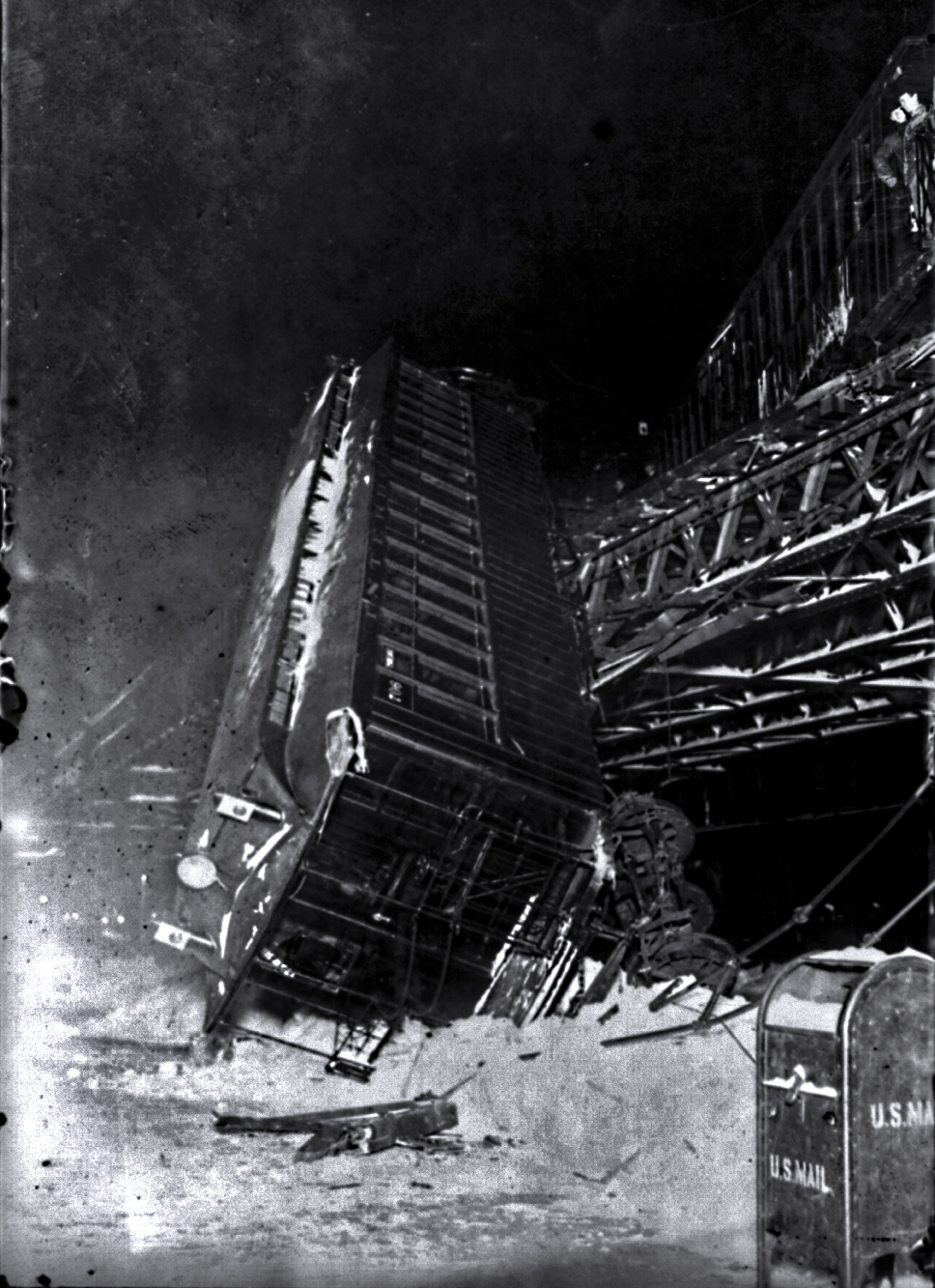
At about 7:15 on the night of February 16, said the story, a train on Manhattan’s Ninth Avenue elevated line derailed at 138th Street and sideswiped a car on the adjacent track, sending it over the side of the trestle with one end hanging from the rails and the other down on the street in a pile of snow. The car was empty except for its motorman, John Becker, and he wasn’t hurt. But the nineteenth-century conventions of journalism insisted on completing the anecdote by furnishing the named and extricated Motorman Becker with a quip to say, and so to the immortal record Motorman Becker was then said to have said:

“Well, here I am. Guess I’ll go get my dinner.”

To enlarge the quip and try to imagine it as an oration, click it. The click won’t get you far, though, because this nineteenth-century front page is all text, no pictures.

But the long nineteenth century also brought perception the gifts of a camera and a tripod and a frying pan filled with powdered magnesium. In the right hands, these turned out to make it possible to understand in the dark. And so, at the end of this particular century of development, readers began seeing their reading matter in a new way: without words.

Here, for instance, is the wordless version of the anecdote of Motorman Becker. Right at the start, its language is distanced from reading by the effect of translation — in this case, translation from text to chiaroscuro, with the surprise effect of a suddenly vertical railroad car finding its balancing irony in the surprise effect of a suddenly illuminated night. Imagining Motorman Becker locked in his dark cabin in the image’s interior, we on the image’s exterior are locked in a frame full of brilliant reflections. If we do any reflecting of our own there, it won’t be in words. We may think of words later, sitting at (for instance) a typewriter in a newspaper’s city room, but here and now we can have nothing in mind except light and dark, in silence. The Sun story is full of excited conversations in the crowd and the noise of the Eighth Avenue streetcar that eventually hauled the El car back down to horizontal, and because we’re now reading the sound-words in sound-words of our own, the sounds continue. But as you begin seeing your way into this oblong of black, the story is light and dark (seen), and silence (not heard), and nothing else.

In scenes like these, filled with nothing else in a way that isn’t available to text, frying pans loaded with new light began helping readers at the end of the long nineteenth century to draw a dark line around a moment of time and say, “Forever after, anything outside this frame will be named The End.”

Sources:

Le Corbusier, Toward an Architecture, second edition, trans. John Goodman (1924; Los Angeles: Getty Research Institute, 2007), [154].

“Elevated car falls to street 2/16/14.” George Grantham Bain Collection, Library of Congress, http://www.loc.gov/pictures/item/2002699891/. Photoshopped.

The New York Sun from 1914 is online at the Library of Congress’s Historic American Newspapers collection, http://chroniclingamerica.loc.gov/.

The express from Byzantium

In the Library of Congress at http://www.loc.gov/pictures/item/det1994016929/PP/, this photograph has gone white with lost detail. We pretty much have to take the librarians’ word that it depicts a famous American train from the turn of the twentieth century, the New York Central Railroad’s Empire State Express, on its way though Syracuse. For their own part, the librarians can only approximate the date of the passage. The faded image and its owners’ records tell them only that this photograph of the Express’s transit was taken some time between 1900 and 1915.

But parts of the transit can be retraced by post-processing, and I suppose that may aid in fine-focusing its history. Clicking away from this image to the next one, for instance, a railroad historian might be able to do something with the more legible number on the Express’s locomotive, and a fashion historian might be able to make something chronological of the dress worn by the one woman I can now see again. For historians of Syracuse, too, Photoshop has put the century-old signs back up on Syracuse’s businesses. See how that has put the big building on the left back into communication with time. Carved deep into its rock there on an upper-story frieze, the two monosyllables The Yates look once more the way they did on the date of the transit: as if they’d traveled to The Yates by express from Mount Sinai. The history of The Yates, says reread stone, hasn’t had to die after all. The lost, says Photoshop, may be restorable.

But to read the history of the image as a whole we’d need to know the history of the light that filled a camera in Syracuse for a sunny moment some time between 1900 and 1915, and the lighting script for that moment has been rewritten. Syracuse’s light isn’t now what it was during the century and a half of the steam era. Seen through smoky light as it was seen then, the Express under its moving cloud has passed through Syracuse forever, and it won’t be back. Light no longer works the way it did when locomotive no. 3897 offered up its smoke to the air. On the building to the left, the frieze that the sun lighted in those years was lighted for those years only. Then its inscription, “The Yates,” was to be read only by day, under layers of soot; now it’s to be read by day or night, carbonless by day and with its night colors changed by sodium vapor.

Because the way we read is always changing in this way and others, a poet once dreamed of a writing as resistant to change as metal. He was old, he cried, and about the light and shadow of the changing earth on which his body lay he cried, “That is no country for old men.” Funnily, he had a name homophonic with “Yates,” and in his hard Yates poem he sang,

Once out of nature I shall never take
My bodily form from any natural thing,
But such a form as Grecian goldsmiths make
Of hammered gold.

And yes: framed here on your monitor, The Yates does look lapidary, hammered into a permanent place in a permanent image. But compare the original image with my photoshopped version and you’ll understand that the lapidary look is only an effect of artifice and temporal confusion. Next to an image of a vanishing cloud of smoke, an image of a stone building looks immortal by comparison. The symbolism of this particular building’s Renaissance architecture, too, is an evocation in stone of ideas like traditional. But a tradition expressed within an image must have originated outside the image, before the image existed, while on the other hand the image’s work of evocation can begin only within the image. First an artist envisions an empty frame, and only then does it begin to fill itself with picture. Look up, for instance, to the dappling light near the top of The Yates where smoke seems to touch and fill and then withdraw from shadowed stone. It’s the pictured dapple, only, that hurts your heart. And as to you with the hurting heart who take your picture from an upper-story window, you have set up your camera on the Express’s side of the street, where nothing is still.

Leave the camera there and descend. Cross from the single hard-edged shadow of your building into the unclear polyshadow of the smoke. Approach the still glass front of The Yates along the roadway where Syracuse’s slow light is moving a horse and a tall-helmeted policeman into position. Step between the horse and the policeman. The light reflected from their bodies will help you when you begin looking into the window. For now, the window in the image lets you see only two glittering words, The Yates, and a tall-helmeted reflection. While the shadow of the smoke lasts, there will be nothing else. But when the shadow moves off and the Express is gone and the dark glass is restored to full reflectivity, the Syracuse light may unseal its record. And then, under glass in the smoky light that once illuminated the dead, you may see that you too have been changed by passages over you of cloud and light.

Estampe XIII: Mineral Water, Pears and Peaches

The text:

The event, that which the text can’t speak of:
arrival at a source

3a19099uM 8 bit

Click to enlarge. Photograph by L. M. Bosworth, 1908, in the Library of Congress, http://www.loc.gov/pictures/item/2012646336/. Photoshopped. The first two words of the caption are “Interurban Car.”

3a19099uB3 8 bitAs from a voyage, rich with merchandise

Estampe XII: activity at the edge of an emptiness


On November 16, 1919, someone named George B. Parks notified what was then called The New York Times Review of Books that a book purporting to be a war memoir was so factually inaccurate that it couldn’t be non-fiction.

George B. Parks was undoubtedly correct. The book he was examining is only 84 pages long, and in that tiny intimate volume the facts stand out only because they are so few and so vaguely described. On the other hand, an extratextual fact, this one startling, is that as of November 1919 this book had already been in print for a full year. Just days after the end of the war, the Times had announced its publication this way.

97046371

The book was so well received that its author eventually came forward and identified herself as the journalist and writer of children’s books Grace Duffie Boylan. The facsimile published by Forgotten Books bears a title page date of 1919, and the digitized copy at Archive.org bears a title page date of 1920.

But why? The book itself is not just vapid but almost totally empty. In heaven, wirelesses the dead soldier to his mother, the souls in khaki do, you know, stuff. They have dogs and cats and horses to keep them company, and the dogs travel busily back and forth between the astral plane and the terrestrial but the cats are looked on with suspicion. No reason for this is given. However, we do specifically learn that everybody spends time discussing the text “They shall be one flesh.” What the doughboys in the clouds wonder is: if a woman has been married more than once, with which one of her husbands will she be reunited in Paradise?

(Grace Duffie Boylan herself was married four times.)

Well, the answer to the question “Why?” is in the history books. It isn’t surprising: in the horrible stillness after the guns of the Great War went silent, millions of readers went gleaning for grains of comfort in bookstores, where businesspeople were waiting to accommodate them.

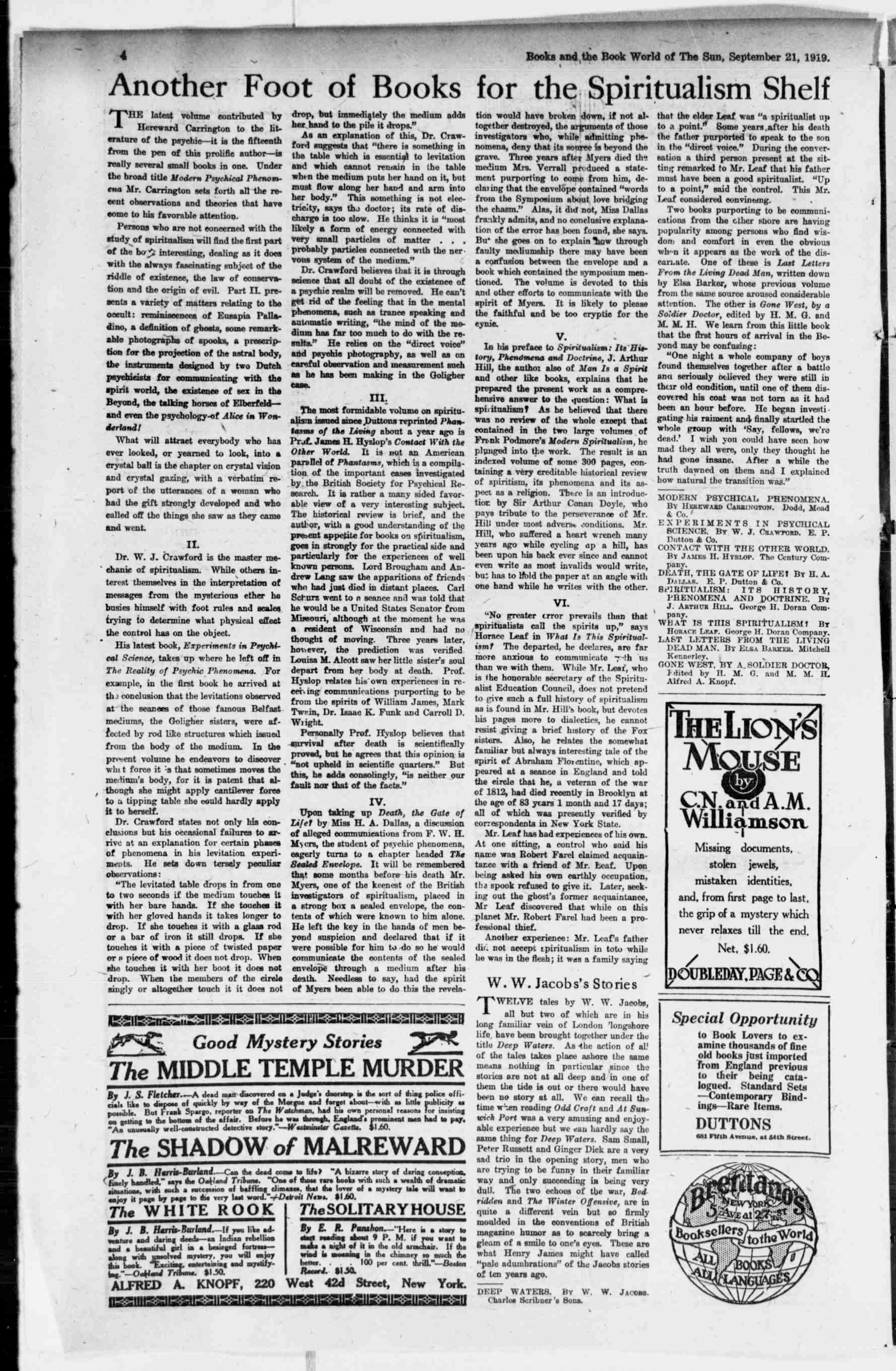
New York Sun 9.21.1919Click to enlarge.

The same thing had happened after the Civil War, when Elizabeth Stuart Phelps’s consoling theological fiction The Gates Ajar provoked Mark Twain into a full-length parody, Captain Stormfield’s Visit to Heaven.

But you wouldn’t read The Gates Ajar or Thy Son Liveth the way you’ve read my paragraph of literary history about them. The consolations of Thy Son Liveth were made available in 1918 and 1919 and 1920 by the respectable Boston firm of Little, Brown, and Company for the reasonable price of 75¢, and of course it was a large predicted multiple of 75¢ that motivated the literary labor of Mrs. Boylan, Mr. Little, and Mr. Brown. The old-fashionedness of that symbol ¢ is the kind of topic that literary history is loquacious about, but emptiness in the heart of a grieving mother is mute. Around the wordless emptiness there bustle George B. Parks and the journalists of the New York Times and Sun and assorted Little, Brown businesspeople, but by contrast with their cheerful realism (“Another foot of books for the spiritualism shelf” [laughs]) the emptiness is only darker, more unimaginable, and more mute, if there could be degrees of muteness.

Ten years earlier, a vast excavation was being hollowed out under New York for the new Grand Central Station. As fast as it was created, it was filled again. In this hole, life was ongoing. As of 1908, someone looking at it through a fence might have felt exhilarated on behalf of the excavation’s embodiment of life growing up toward the light from deep in the earth. But ten years afterward, Grand Central was complete and its newsstands were selling fictions purporting to speak in a language from beyond the grave. The excavation had been completed by then, and light no longer shone into it.

Detroit Publishing Company Collection, Library of Congress, http://www.loc.gov/pictures/item/det1994001893/PP/
Photoshopped. Click to enlarge.

Estampe VI: a correction for the passage of time

The original: “Buffet library car on a deluxe overland limited train,” between 1910 and 1920. Detroit Publishing Company Collection, Library of Congress, http://www.loc.gov/pictures/item/det1994002352/PP/. Click to enlarge.

A century ago, it wasn’t as easy to see as it is now. The lighting wasn’t as good, and the air coming through the open clerestory of the buffet library car would have been smoky. A century afterward, too, it no longer seems possible to determine the exact date on which this 6.5-by-8.5-inch glass negative was exposed. But the negative’s unchanging physical property of large exposed area has preserved into the future a large latency of light and form. A 35-millimeter negative, a standard way of archiving the records of light until the day before yesterday, has the exposed dimensions of 24 by 36 millimeters, or 864 mm². A 6.5-by-8.5-inch negative comprises 35,645 mm², or 41 times as much potential terrain for light and lens to fill with detail.

Now, claiming that detail on behalf of my own time in the future, I digitally effect entry into the image. Entering, I move closer to one of its pictorial elements than I ever could have in what’s called real life, when the pictorial element was a still living man with a word printed on his cap and, perhaps, a sensitivity to having it and his face looked at together, close up in the same frame of reference.

No, I can’t quite read the word yet. But with Photoshop’s help, I can now see that the failure to be readable is only a minor error of institutional history. As it turns out, the word is hard to read because the negative has been printed backward. Correcting the error, I re-reverse the image. Up comes the word then, and it turns out to say “Porter.” Now that I can see the word correctly on the porter’s cap, I can also see the porter correctly. At least partially, I have learned to read the man’s face and body and their printed label as they were read when men rode the deluxe overland limited in a library. The word “Porter” has become part of the lexicon of body language.

In body language, then, let’s reread the text of the men in their library, this time oriented correctly on their page.

Seen reading as they pass through time, the men with their spittoons and the servant who cleans them are once again outlined as sharply as they were when books enclosed within their covers illustrative engravings in black and white.