

railroad
Estampe VI: a correction for the passage of time
The original: “Buffet library car on a deluxe overland limited train,” between 1910 and 1920. Detroit Publishing Company Collection, Library of Congress, http://www.loc.gov/pictures/item/det1994002352/PP/. Click to enlarge.

A century ago, it wasn’t as easy to see as it is now. The lighting wasn’t as good, and the air coming through the open clerestory of the buffet library car would have been smoky. A century afterward, too, it no longer seems possible to determine the exact date on which this 6.5-by-8.5-inch glass negative was exposed. But the negative’s unchanging physical property of large exposed area has preserved into the future a large latency of light and form. A 35-millimeter negative, a standard way of archiving the records of light until the day before yesterday, has the exposed dimensions of 24 by 36 millimeters, or 864 mm². A 6.5-by-8.5-inch negative comprises 35,645 mm², or 41 times as much potential terrain for light and lens to fill with detail.
Now, claiming that detail on behalf of my own time in the future, I digitally effect entry into the image. Entering, I move closer to one of its pictorial elements than I ever could have in what’s called real life, when the pictorial element was a still living man with a word printed on his cap and, perhaps, a sensitivity to having it and his face looked at together, close up in the same frame of reference.

No, I can’t quite read the word yet. But with Photoshop’s help, I can now see that the failure to be readable is only a minor error of institutional history. As it turns out, the word is hard to read because the negative has been printed backward. Correcting the error, I re-reverse the image. Up comes the word then, and it turns out to say “Porter.” Now that I can see the word correctly on the porter’s cap, I can also see the porter correctly. At least partially, I have learned to read the man’s face and body and their printed label as they were read when men rode the deluxe overland limited in a library. The word “Porter” has become part of the lexicon of body language.

In body language, then, let’s reread the text of the men in their library, this time oriented correctly on their page.

Seen reading as they pass through time, the men with their spittoons and the servant who cleans them are once again outlined as sharply as they were when books enclosed within their covers illustrative engravings in black and white.
Commute


Source: “Transfer Steamer Detroit,” Detroit River, Detroit, Michigan, about 1905. Detroit Publishing Company Collection, Library of Congress, http://www.loc.gov/pictures/item/det1994019506/PP/. Photoshopped.
Rolling stock
1
This poster dates from 1915. In it, beside the artillery insigne on the boxcar belonging to Russia’s Northwest Railroad, a printed word says “Supplies,” and below that a chalk scrawl says “Due,” in the sense of a bill that has to be paid. In that picture and those words, the image illustrates the idea of a weapon being trundled through a snowy landscape toward the completion of its purpose. Like the picture on a banknote, it realizes one of the transactions which it is the business of a government to execute. Below the picture, a caption educationally adds: “War loan, 5½%. The more funds, the more munitions and supplies, the sooner the victory.”
 Source: http://blog.vintascope.com/post/100172424646/russian-poster-wwi-051. Photoshopped.
Not long after this edition rolled in its thousands out of a press, a different train delivered Lenin to the Finland Station, and then all those who had trusted that the Czar’s word was his 5½-percent bond lost their investment. Ironic interpretations followed. To the designers whose political labor brought this poster into existence, history was something toward which to roll. It was a future at the end of a line. A century later, we might read the poster differently — for instance, as an allegory of the term “wreck.” According to such an interpretation, wreckage may not be visible on the surface of the poster, but catastrophe always has been implicit in the design.
2
In Peconic, Long Island, New York, on March 3, 1942, a train collided with a car. At the site where I found this image of the aftermath, someone has taken care to note that the woman driving the car wasn’t injured.
However, matters of life and death aren’t the primary concerns of this page, because it is a picture history of the Long Island Rail Road. Asking us to read images as if we were not living men and women but creatures in a picture, this history deploys its picture archive only to direct our attention away from our lives and toward to a text. In turn, the text enters a strictly numeric register as it chronicles the beginning and end of the little station bearing the name “Peconic”: built, August 1876; torn down, April 1942, just a month after it was pictured with boarded-up windows across the tracks from the damaged automobile. For a moment during that interval, a train with a caboose passed down one of those tracks between the abandoned station and the wrecked car. For the duration of that time, someone in Peconic could have seen in the distance the smoke from the train’s steam engine. Both the caboose (an obsolete piece of rolling stock) and the steam engine (another obsolete piece of rolling stock) are gone now, of course. We’ll never see their like again. But the only thing in this image that can now matter to the text called history is the building’s unpicturable abstract hic jacet: 1876-1942.
 Source: http://www.trainsarefun.com/lirr/peconic/peconic.htm. Photoshopped.
3
“Nothing beside remains,” as the traveler from an antique land reported to Shelley. But the antique land itself pleads:
Credit this photo: State Archives of Florida, Florida Memory, http://floridamemory.com/items/show/157308
(please include photographer’s name when noted).
The photographer’s name isn’t noted, so I can’t grant to his memory what is due. But as if my word were my bond, I can at least point at the anonymous text appended to a dateless image found in the archive and say:
“Look. The words printed above it say, ‘Woman and girl stand near the train wreck — Lloyd, Florida.’”
The words — either my words or the words I’m now writing about — mean almost nothing. Outside Lloyd, Florida, at some unspecified time during perhaps (to judge from the clothing) the 1940s, they are probably all but lost to the text of history. In the phrase “the train wreck,” the definite article the can’t be read now as anything but a symptom of delusion. The train wreck? What train wreck?

But in the interstices between what the text of history designates as events, it’s still possible for light to fall, and for sight and memory to account for that other, wordless event. So long as we remain near the wreck ourselves, we wordlessly know it.
Dainty personality: a history of the nineteenth century in verse and prose

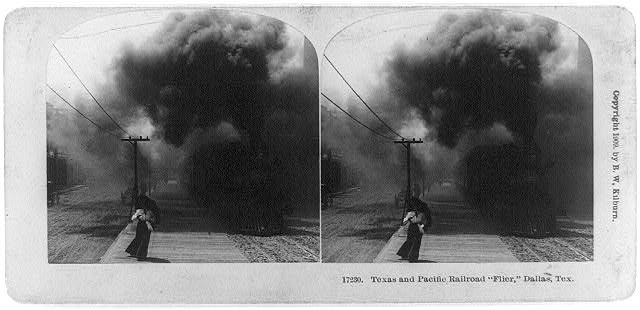


Click images to enlarge. Source of the Texas & Pacific stereograph: Library of Congress, http://www.loc.gov/pictures/item/2002716430/. Requires an anaglyphic (red and blue) stereo viewer.
The effect of shadow: iron, man

Source: George Grantham Bain Collection, Library of Congress, http://www.loc.gov/pictures/item/ggb2005022621/. Photoshopped.
Semaphore

For Jack Delano, born August 1, 1914
Iron age

“Melrose Park (near Chicago), Ill, C&NWRR. William London has been a railroad worker 25 years – now working at the roundhouse at the Proviso yards.” Photograph by Jack Delano, December 1942. Library of Congress, Farm Security Administration / Office of War Information Color Photographs, http://www.loc.gov/pictures/collection/fsac/item/fsa1992000720/PP/. Photoshopped for color balance.
As things fade to white
Between 1903 and 1917, a woman named Phoebe Snow traveled like a celestial body along the tracks of one of America’s regional railroads, the Delaware, Lackawanna and Western.
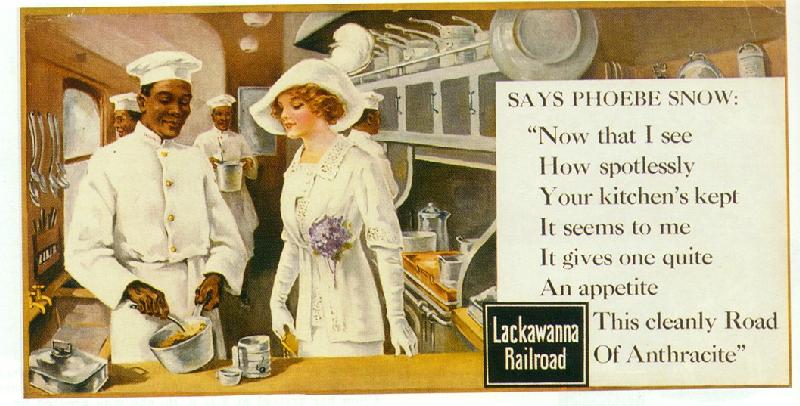
Click to enlarge.
The creature of one of the most successful advertising campaigns in American history, Miss Snow existed only to be unceasing: unceasingly in motion along a pounding iambic dimeter, unceasingly white, unceasingly bountiful of her whiteness. In her unceasingness, she was loved.

This illustrated history may help show you why. A comet always arriving, destined never to drop back into the dark and go still, Phoebe lived as light and motion, bestowing herself on everyone beside the track who existed to make her sidereal. Along the path of her orbit, brilliance illuminated the labor of engine crews, yard crews, porters and dining car waiters and the brilliantly white-clad cooks in the dining car’s galley. In her presence, light entered into the interior of what it seemed to mean to be human, dissolving secrecy and shame and shadow into a single all-encompassing whiteness.
http://scout901.hubpages.com/hub/Phoebe-Snow-Railroad-Advertising-Icon
The whiteness released her victims from darkness into love. It even extended underground, to the veins of coal and the men who worked them and the mules who worked alongside the men like brothers of Phoebe’s. There underground, Phoebe became her picture’s source of light. Descending into the dark and then ascending again, she traced letters from light across the darkness, and interpreted them to mean that all will be happy now, even in the face of death.

 —
—
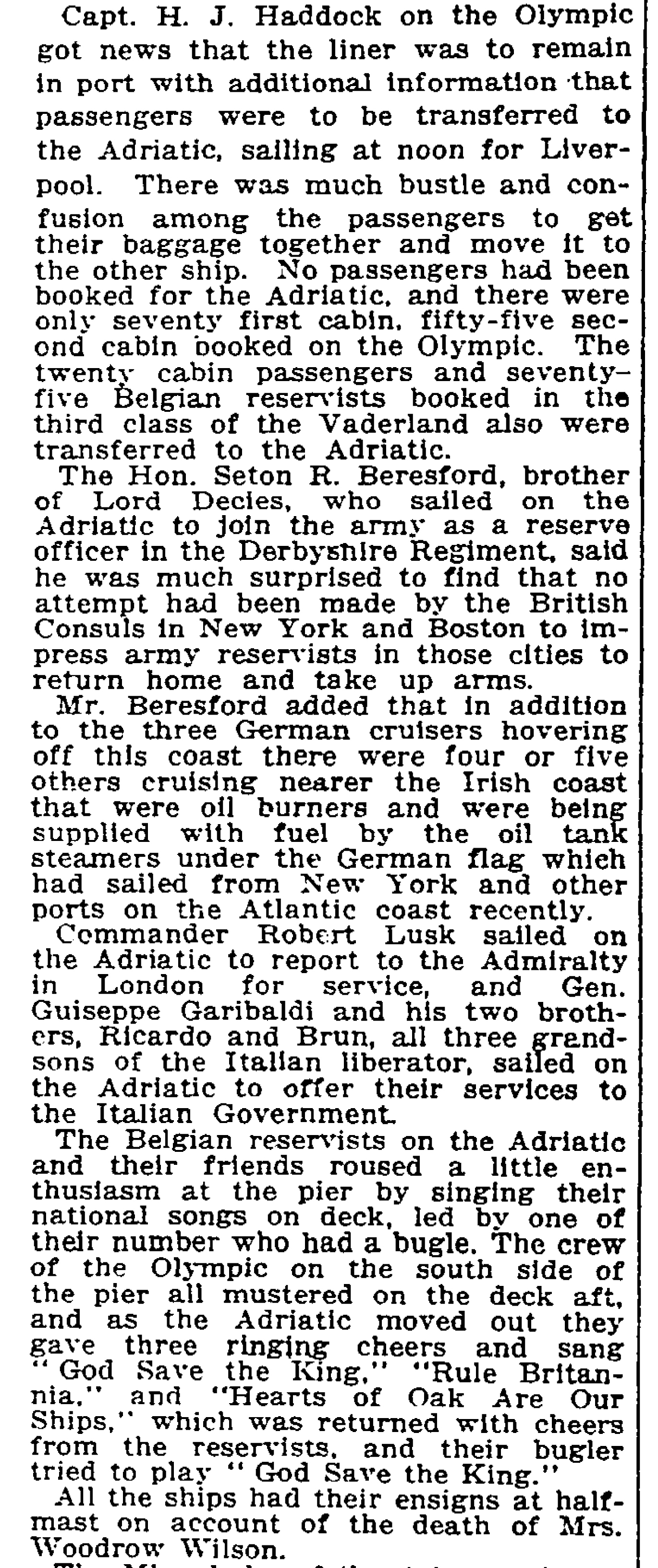
On August 8, 1914, that consciousness was still alive and still animating a gentleman in love with nature. By then, however, it had abruptly become remarkable. On August 9, a reporter for The New York Times observed it in its descent toward incomprehensibility. Far down now in the third paragraph of an article, it was barely readable by then; too deep in the shade cast by the headline. The language of that headline was a dark new dialect whose words could not have endured in the sunshine vocabulary of Snow.

Not far from the pier, the transatlantic cables surfacing in New York were drowning Phoebe’s meters in irregular sobbings, and Belgian reservists were boarding a ship bound eastward, where the dark was rising.

To understand, then, we have to look away from Phoebe and the gentleman entomologist.. A camera creature has surfaced from the dark flood, extending a black-and-white photograph of the Olympic’s cheering stewards to us.
 Source of this image and the next two:
http://www.loc.gov/pictures/item/ggb2005017010/
The next two have been Photoshopped for contrast.
From this angle in the photograph’s space, the time is the present. The stewards are and will always have been seen to be in mid-cheer. Panning toward the Olympic’s sister ship, the cameraman records the visual testimony of the Belgian reservists singing and cheering back. As they sing, marking time, they are moving outward. The stern of the Adriatic is being eased away from the pier.
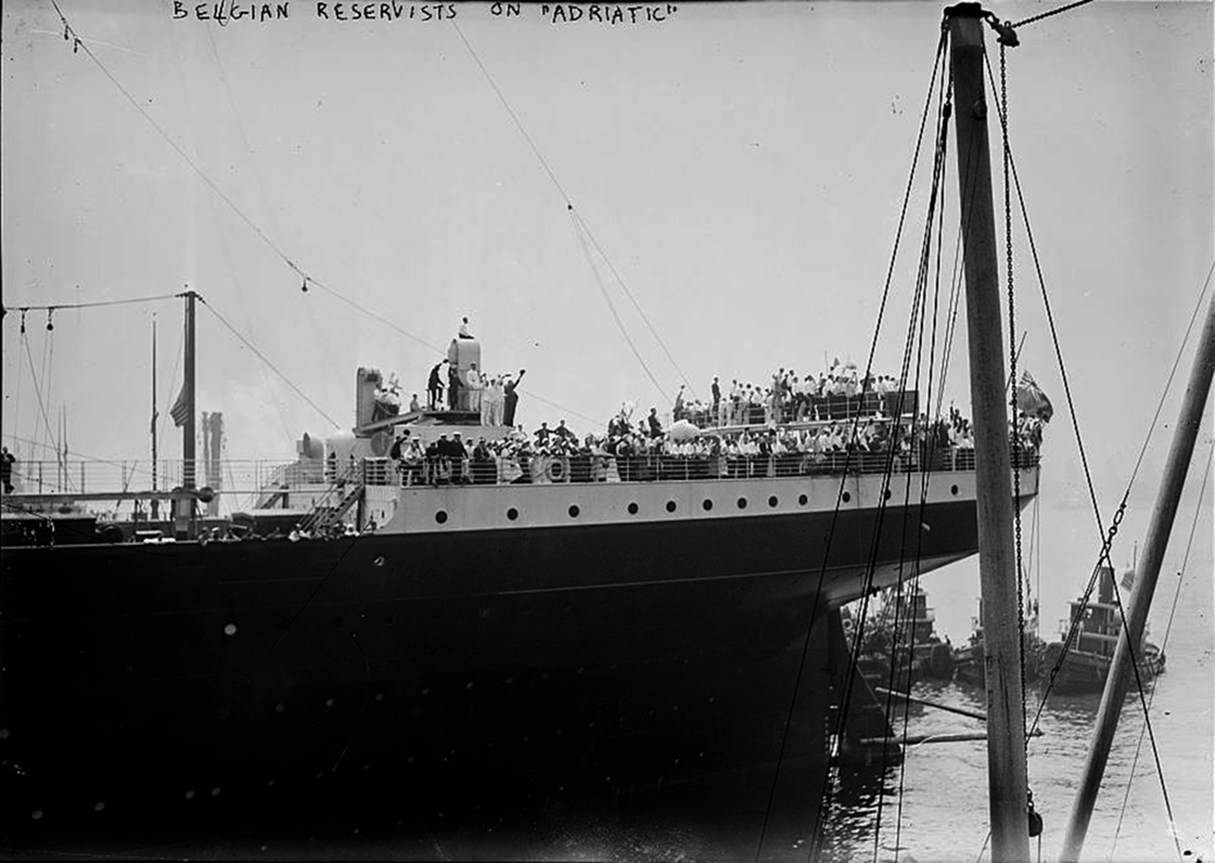
That motion has prepared us to receive an image that history, in due time, will call definitive. Now and forever, this image holds us back on August 8, 1914, at the watery verge of a pier in New York. At the far boundary of the space, receding as we watch, the White Star liner Adriatic is now becoming visible as a whole. On board the ship, certain men who will soon die can no longer be seen, though unillustrated abstract history provisionally asserts that they are still, for the moment of August 8, 1914, alive.

In comparison with the blankness into which the ship is now disappearing, Phoebe Snow’s immortally conceived whiteness was only a whim. Anthracite burns cleaner (a little cleaner) than soft coal, but to have believed in Phoebe’s absolute whiteness was never more than a suspension of disbelief. “Of course,” says Phoebe’s image to you, “I am only one of art’s happy ways of helping you imagine possibility. You always knew that.” To have looked at Phoebe’s picture, read her poem, and then bought a ticket on the Road of Anthracite was never a more significant act than, say, buying a ticket to a movie with the cheerful intent of surrendering for a couple of hours to an optical illusion. If Miss Marion Murray had been in this scene, she would have been stationed among us dark-clad neutrals left behind on terra firma, imagining like us rather than being imagined like Phoebe. The optics of this photograph don’t work only on the mind’s eye the way an image of Phoebe does.
Because as the Adriatic begins fading into the dazzle of a hazed atmosphere just at the moment when we take it in, it becomes less visible to the eye even as it becomes more conceivable to the imagination. On August 8, 1914, men and women on a pier and in boats and barges saw a ship loom up through space under clouds of coal smoke and then fade in accordance with the laws of physics. If we could only see it now, we would see it as they did: as a mortal body fading to white, as graceful as it traverses its bright vanishing instant as Miss Marion Murray ever was.
Perfect
From where we stand on our hillside, the train at a station in Michigan can’t be seen. It’s there, however, or perhaps it was there a moment ago. We know, because a cloud of smoke is drifting away from the station. In a zone just outside the visible portion of this image, a steam engine is, or is about to be, somewhere else in space and time.
 “Michigan Central railroad station”
http://www.shorpy.com/node/10829
Click to enlarge.
The image comes to us now trailing a Shorpy comment stream, and from there we can learn that this building in Michigan is located at 401 Depot Street, Ann Arbor. Still standing and in good repair, it looks much as it did when this image of horses and derby hats was captured. Two more images in the stream, captured at approximately the present time, demonstrate. One of the two is a download from Google Street, and with its help we can take a virtual walk around the building, just as if we were alive on the spot.
Simultaneously, from a dig where the stream cuts through the past, a researcher reports that The Awakening of Helena Richie, one of the plays advertised on the billboards to the left of the street, ran on Broadway from September 1909 to January 1910, then went on tour in the spring. That locates a terminus in time for the mixed group of buggies and cars in front of the station. The year when somebody put his head under a photographer’s dark hood to see the group this way was 1910, two years after Henry Ford’s Model T, forty miles down the rail line in Detroit, had begun changing the mix. The camera could record the mix but not the change. Photography is the art of stillness in the momentary.
But then, blurred a little by his passage into and then out through the stillness, a man carrying a winter overcoat but wearing a summer suit began climbing the hill from the station. Because he wasn’t in the stillness then, he will never stop now. Trudging toward us along a borderline between the seasons of his year, he is headed past the camera toward a destination somewhere over the camera’s shoulder. His course is set toward a space created by the educational conventions of perspective between ourselves and the composition’s foreground. If the lesson is successful and we bring ourselves to think of him coming to rest there, he will have left the picture’s depicted fraction of a second and arrived in a future.
However, that future isn’t depicted in the picture itself, and it can’t be depicted anywhere else because both the man and the fraction of a second when he was have vanished from time. It’s true that while the camera’s shutter was open, the man’s left foot in its buttoned shoe seemed still, as if it could claim a place, no matter how tiny, in a finally fixed and stable history. But of course it couldn’t. Freeze-framed on the pavement by the camera’s virtual way of seeing, visible there only as an illusion of motion stopped and about to start again, that not really unmoving shoe is something like a visual equivalent of grammar’s future perfect tense: the representation of an action completed (Latin perfectus) with respect to a moment in the future.
In that grammatical sense, perhaps every instant when a shutter opens and closes and time seems to stop is a perfect instant. It may be that an image is only an a perfect instant confined within a frame. Of this moment in 1910, at any rate, nothing remains except what is interior to its frame. As unconfined creating light passed westward through the exterior and away along its track, the end came for everything: the horses on their dirt road, the railroad station which is now a restaurant with a railroad theme, the men in their derby hats. But when we put the frame around our tiny image of the man walking up a little hill toward us, we locked in the illusion it had created of a moment held still for us to see, forever. It was a moment in the interior, with the end locked out.
Then, at the end, we let the man escape into the end. Hold his image up to the light, let the light penetrate, and look. From its foreground in the past, this picture seems to extend toward the invisible place over our shoulder where the man with his suitcase will finally have gone.