Eighty-two words and an untranslated song

From a portrait painted by her father in 1872, Jeanne-Rachel Pissarro (1865-1874) looks out at us sidelong, lips pursed and mouth off center. The mouth is in the light, but the big staring eyes have been cast into shadow. Only they have been painted with a fine brush to show detail. They are the center of the image’s illuminating force. They show us a glimpse of a life on the verge. In this image, everything else — the layered clothes, the shadow-casting hat, the bouquet of colored shadows — is subordinate to the eyes. The layers of thick cloth in which the child is wrapped serve as an integument. It will ward off, but (its muted, fading colors warn and promise) only for now. Only for the time being, while the body is still warm-clad and the flowers are still alive.

*

The two figures in my subject line sum up the entire corpus of an extinct language, Crimean Gothic. It has been on record ever since it was compiled in the mid-sixteenth century by Ogier Ghiselin de Busbecq (1522-1592), a Flemish diplomat stationed in Constantinople. His Turkish Letters remain a valuable historical resource, and from the Levant he introduced the lilac and the tulip to Europe. They bloom now outside the library, but of the history of Crimean Gothic the words are no longer spoken and the song is no longer sung.

*

When the invention of the glass negative in 1854 made it easy to create photographs in multiple copies, a new kind of history book entered the corpus: the photo album, rapidly filling with mass-produced carte de visite images like this one.

It can be read as a document in the history of nineteenth-century sentimentality — a silent little counterpart of, say, a Schubert lied or a Dickens novella. The little girl’s poignant expression mimes the poignancy of her plea, which is poignant in its turn because it is in words that can’t be heard. On her behalf, because she is mute, it asks you to give her an image to keep her company in the dark when her book closes.

Language note: in a time of austerity, the conscience undergoes change

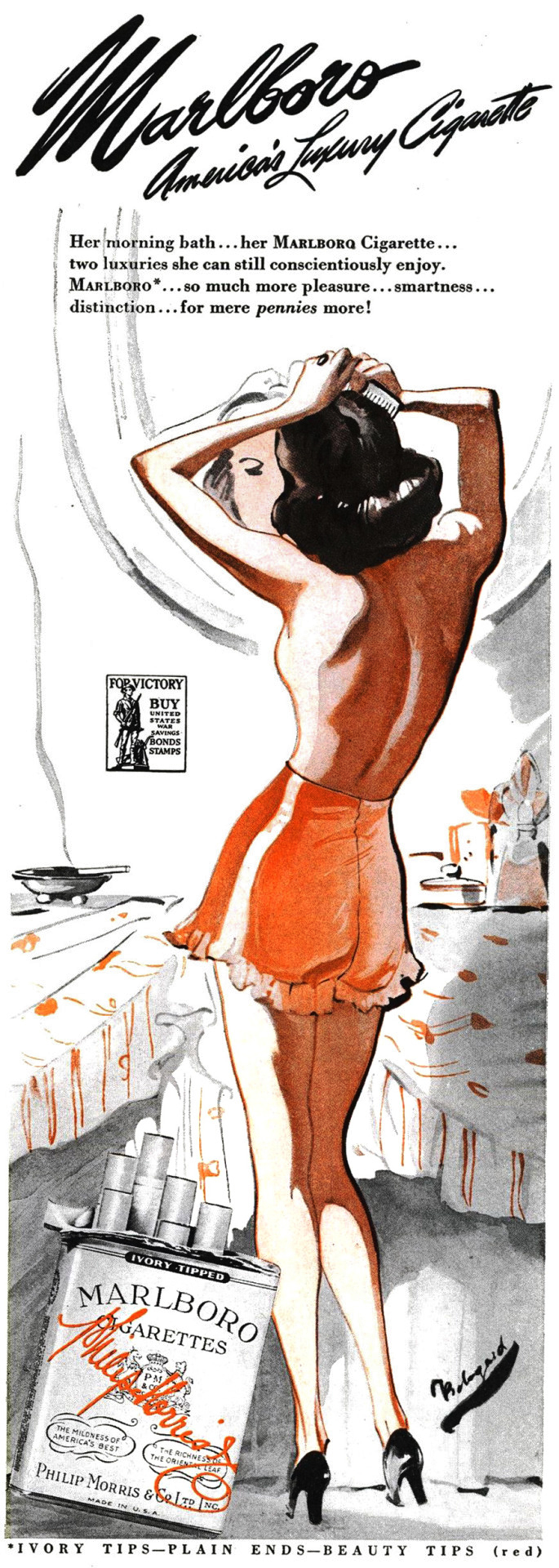
During the early 1970s, Marlboro cigarettes, formerly a niche brand, rocketed to the top of the market and became the best selling cigarettes in the world. The reason is well covered in histories of advertising: Marlboro’s manufacturer switched niches. If the cigarettes haven’t killed you yet, you associate Marlboros with masculinity, thanks to the extraordinary success of an advertising campaign whose icons came coughing onto the page beginning in 1954 — first as men with tattoos, then as cowboys. Look to your left, however, and you’ll see that as of 1944 Marlboros were a woman’s cigarette, tipped with red to hide lipstick stains. At http://tobacco.stanford.edu/tobacco_main/images.php you’ll find a richly illustrated history of the gender reassignment. This note is about a language change that seems to have occurred concomitantly, and perhaps a moral change too.

Yes, in this advertisement even the illustration has a moral. Between the woman and her ashtray stands Daniel Chester French’s image of the Minuteman of Concord, steadfastly posted eyes-front at breast height. Almost as an afterthought, the advertisement’s text is duty-bound likewise. “Two luxuries she can conscientiously enjoy,” it explains about the illustration, and it half-conceals its heroine’s lineaments of conscientiously gratified desire behind a turned back and a mirror image guarded by a raised arm.

Nineteen-forty-four, after all, was a year when openly acknowledged desire must have seemed shameful. In the sixth year of the Second World War, all of the unashamed rest of America was austere. In window after window hung a little flag bearing at least one star, each star the symbol of a son in the Armed Forces or (if the star were gold) of a son dead on the field. In magazine after magazine, too, the advertisers who articulated the language of America’s economy somberly explained the necessities of shortage and pleaded for willing submission to the unending sacrifice. Turning her back and refusing to look at anyone but herself, Miss Marlboro counterpleaded, with feminine emphasis and a feminine diminutive, for “mere pennies,” but the 1943 penny itself was a memento mori. Not made of copper that year because copper was desperately needed for shell casings, it was minted instead in galvanized steel: no longer the red of a Marlboro beauty tip but gray, gray. “In this refulgent summer, it has been a luxury to draw the breath of life,” Ralph Waldo Emerson had cried with defiant joy as he stood before Harvard’s divinity school in 1838, but 106 years later the threat to joy was no longer a three-quarters-dead regional Puritanism but death itself, fully dressed against the summer in menacing black.

But no, pretty miss in heels and peach-colored panties: even under that dread circumstance, you need not feel ashamed of your bath. It makes you not just clean but clean-feeling, and that harmless benefit comes to you free of any charge, either in money or in currencies of the soul. The world outside has descended fully into 1944, but in this room with the ashtray on the vanity you are about to sink into a bath conscientiously. The original sense of that adverb happens to have been in good conscience.

Postwar, I get the impression that that sense has all but disappeared from American English. The word conscientiously now seems to connote little more than rational but uninspired acceptance of a duty. Yes, yes; I do, conscientiously, try to practice good dental hygiene. But except perhaps as a vestigial technicality in the legal term conscientious objector, any sense of conscience as a motivating joy seems almost to have vanished from English. In 1914, in the first poem of the sonnet sequence he called 1914, Rupert Brooke compared men about to volunteer for the war with “swimmers into cleanness leaping,” but as early as 1918 some of the Englishmen to whom that simile had once seemed to mean something were saying, “Went to war with Rupert Brooke, came home with Siegfried Sassoon.”

So conscience understands that it will be different this time when you take off your panties and leap. But do leap. It seems possible that the calendar will never again advance from 1944, and the leap will at least make you feel clean until you resurface in the smoky air. As a poet who thought himself postwar once sang:

Never such innocence,
Never before or since.


Sources:

http://rbrower45.tumblr.com/post/147185242401/gameraboy-marlboro-ad-1944. Photoshopped.

Ralph Waldo Emerson, “The Divinity School Address”

Philip Larkin, “MCMXIV”

Testament

Reflected from horsehide, light glows in a specific horsehide way. Wanting to believe that having seen the glow has conveyed it to me, I may try to prove my possession by making a bequest. I may try to write a poem about the light, for instance, as Rilke did in his horse poem dedicated to Tolstoy, Sonette an Orpheus I.20.

As if I could declare my desire to live on in the language of horselight. Of course I can’t. In this document the mortal words and their desperate good-luck symbol constitute one vocabulary and the horses in undying light constitute another. For the language of testament no translation is available.


Source: The Official State Atlas of Kansas Compiled from Government Surveys, County Records and Personal Investigations. Philadelphia: L.H. Everts & Co., 1887. http://www.davidrumsey.com/luna/servlet/detail/RUMSEY~8~1~23597~830077:A-group-of-stallions-and-mares,-Lin. Photoshopped.

“Nor have they then a makeshift body”

In front of television cameras in 1998, Representative Henry Hyde regressed for a moment to a pre-television English. As he prepared to consider the impeachment of President Clinton before the House Judiciary Committee, he asked the clerk, “How much time have I?” I still remember being startled by that idiom, the inversion of subject and main verb in a question. For decades before 1998 I had heard it only in old movies, yet suddenly Representative Hyde, on color TV, was speaking the language of a black-and-white newsreel.

Well, the anachronism isn’t mysterious. In 1998 Representative Hyde was 74 years old, and he was simply continuing to speak English as it had been spoken when he was young — for instance, in the year 1938, when a physician in William Carlos Williams’s short story “The Girl with a Pimply Face” asked about a sick baby, “Has it diarrhoea?” (119). I haven’t conducted a systematic search, but from books and movies I get the impression that during the first half of the twentieth century that inverted construction (“Has it diarrhoea?”) gave way rapidly and almost completely to the construction with an auxiliary verb, along with a related change in pronoun reference (“Does she have diarrhea?”). As infant mortality became unusual in the Anglophone world, speakers of English no longer had a practical use for the self-protective reflex of referring to babies as only provisionally human it-objects. But Representative Hyde, by that time in his own history, was no longer noticing.

Outside sickrooms, however, the old idiom’s final years coincided with the aftermath of the war and plague of 1914-1918. Even in health during that time, speakers of American English must have felt the fear of mortality in new ways. At any rate, advertisers seemed to have intuited such an insecurity, for the idiom of their advertisements began straining after the perdurable. Fonts went lapidary, vocabulary went Latinate, and syntax began pacing itself slower to accommodate the dignified walking rhythms of the healthily portly. For the portly in one such advertisement, the penalty of Adam was to be mitigated by something called the Enclosure, and the vocabulary that prepared souls to enter the Enclosure sang of eternal life. Its syntax, too, modulated itself into a gently rocking iambic tetrameter with a feminine ending as it intoned, “Nor have they then a makeshift body.”

But the rite of the Enclosure drew its deepest power from its simplest trait: mobility, the assurance it extended to the enclosed that it wasn’t just an Enclosure but an Enclosure on wheels. After 1918, especially, that assurance drew strength from a new, post-1918 knowledge: the knowledge that at a not unimaginably great distance from the hard stable surface under the Enclosure’s wheels, a body lay barely moving in a bed. The sense of that difference took form as a solemn didactic happiness, and it taught itself to riders in the Enclosure with a single noun scratched deep into its own photosensitized surface. Cripple, said the noun to the world of 1918, in a photographic caption carefully worked into a Socratic lesson plan. And the world of just after 1918 happily responded in the counter-language it had newly learned, “The Enclosure cannot rattle or squeak.”

But to the world no longer inhabited by Henry Hyde the old noun still cries Cripple. A blogger with a taste for the comedy of the antique may have posted the pompous disyllable cannot because “cannot rattle or squeak” makes a more nineteenth-century sound than “can’t rattle or squeak,” but cripple seems unaffected by the passage of time. Affixed to its glass backing, the depicted body of the cripple has a permanent context. The glass is cracked but not altered in its transparency to meaning.

But the cripple’s glass has been paired with another hard permanent document, and that one is reassuringly opaque. Within the image itself, erected directly over the cripple’s bed, a wooden slab promises in knotty pine, “I can’t speak, but if I could I would say, ‘I say unto thee, Arise, and take up thy bed.’ My name, which none of us need to speak because all of us know it, is Makeshift.”

Even more reassuring, Makeshift has another name, in actual speakable language: the word design. Design is a word from the universe of meaning that Keats, making use of a mobile metaphor (“Much have I travell’d”), called the realms of gold. Singing from a libretto scratched deep into the cripple’s image, design assures us who are not yet crippled that in coming times it will enchant us as well. It will dance, too, as it comes. It will dance right through the glass that will begin enclosing us when we sink into our bed. After all, the sinking will still be a motion of the body.

So rejoice, sings the word design. So long as you remain only partially crippled, I will be with you. While you still are able, raise your paintbrush and let it touch me and transmit my strength to you. For the time being, now am I your makeshift body.


Sources: William Carlos Williams, “The Girl with a Pimply Face.” The Collected Stories of William Carlos Williams (New York: New Directions, 1996) 117-30. The story was first published in book form in Life Along the Passaic River (1938).

The automobile advertisement originally appeared in Literary Digest 24 November 1923. I copied it and Photoshopped it for sharpness from http://blog.vintascope.com/post/145306079472/oakland-motor-car-company-19231124-literary

The undated photograph of the man in bed is one of a group of World War I hospital images apparently taken in France. George Grantham Bain Collection, Library of Congress, http://www.loc.gov/pictures/item/ggb2006002284/. Photoshopped.

From 1922, some contemporary satire of the pretentious diction of American advertisements can be found in Sinclair Lewis’s Babbitt.

Spiraling into control

The military postcard from World War I is completely covered with preprinted words. In nine of the languages of the Austro-Hungarian Empire – German, Hungarian, Czech, Polish, Ukrainian, Italian, Slovenian, Croatian and Romanian – the words warn a sender not to blemish the mosaic of themselves by adding even one word more.

The mosaic’s surface is perfect in the grammatical sense of the perfect tenses, which get their name from the Latin word perfectus, meaning “completed.” If we could see through the surface into a space not yet perfected, we might be tempted to top it up with words expressing completion in a future – for instance, “By the time you read these words, I may still be alive.” But a sentence like that would be nonsense. In the aftermath of the card’s preprinted now-and-forever Ich bin gesund, it would be like Chomsky’s “Colorless green ideas sleep furiously”: grammatical but meaningless. It would depend for its significance on the logically incoherent idea of a history with a future.

Therefore a military censor put a stop to the nonsense. In advance of whatever future is rationally conceivable, he ordered the postcard’s printer to fill in every unfilled space more than one character wide. His chosen blackout medium, too, was not mere amorphous ink, the raw material of writing, but a pair of already finished dingbats. The dingbats are spirals: one turning to the left in its line of text, the other to the right. They belong to all of the card’s nine alphabets but to none of its nine languages. All they do is execute self-canceling semicircles, clockwise and then counterclockwise. Pure wordless form, they communicate their one-letter Archimedean meaning only to themselves. But as they execute their pivot left and right, tessera by tessera, they assemble themselves into a sequence, deploy across the card’s surface, and join into a mosaic entanglement. To write past or around or through that, a soldier would have to cut through as if it were barbed wire and his only cutting tool were a scraper for clearing space on a palimpsest.

Mobilized line by line and made into a text which says nothing and enforces the saying of nothing, the meaningless little letters have spiraled into control of the card.

Source: http://historicaltimes.tumblr.com/post/140789125122/slovenska-zgodovina-during-the-first-world-war. Translation of the central and peripheral blocks: “I am in good health and doing fine” and “No other communication may be made on this card.”

The way of the monitor and the way of the stylus

According to Christopher Busta-Peck’s blog about the history of Cleveland, this dark image depicts the moment on March 25, 1913, when flood currents drove the ship William Henry Mack into the swing bridge spanning the Cuyahoga River at West Third Street, demolishing it.

Like the prose you’re now reading, Mr. Busta-Peck’s blog is set in the font called Georgia. According to the Wikipedia article “Georgia (typeface),” this font belongs very much to the history of the computer. Its date of origin is 1993, and it was originated specifically to fill a need for legibility on low-resolution monitors. There it is read by default in monitor mode, the mode of prose: transparently, offering access to language’s content (what freshmen call “the message”) while making only the necessary minimum of contact with language’s form.

Mr. Busta-Peck’s Georgia-inflected words about the flood are readable at http://www.clevelandareahistory.com/2009/12/floods-of-1913-in-flats.html, in a post dated December 26, 2009. They manifest themselves onscreen in a monitor alphabet that was deliberately intended only to be looked through, not seen in itself. But to Ernest Fenollosa, a contemporary of the flood, it seemed desirable to write a story like flood’s not transparently but in flood’s own mud-opaque alphabet, as “a vivid shorthand picture of the operations of nature.”

To Fenollosa, vivid shorthand meant specifically the ideographs of Chinese, where in principle a word is a thing. To Ezra Pound, who completed Fenollosa’s unfinished essay “The Chinese Written Character as a Medium for Poetry” after Fenollosa’s death, this meant writing poetry with a specifically poetic language technology. Pound’s preferred medium for that was the typewriter, and he famously subdued the apparatus to his poet’s will by means of James Whitcomb Riley dialect spellin’, the alienation effect of text incorporated from other languages, and the other alienation effect of isolating his verse’s signifying units from contact with one another by means of two hard hits on the spacebar after every word. But at almost exactly the moment Pound was making those small modifications in the machinery, some nameless scribes employed by the Bain News Service were composing their own “vivid shorthand picture of the operations of nature” directly upon records transcribed by nature itself.

They had the records, thanks to the operation of certain photochemical processes. They needed to write their shorthand picture. They could have done that the way Pound did, with a typewriter slightly modified to emit the look of bardic chant. But they did something more radical. Laying hands directly upon the negative that just a moment earlier had been flooded by reality, they inscribed. If the inscription didn’t look quite like any other human alphabet, that was because its mediation into language was incomplete. Some of its form remained untranslated, still in the language of nature. The scribes weren’t fully in command of that language because some of it remained in the state of nature: the state of things — that is, scratches in gelatin — which still resisted their reduction to mere words. No matter how they were written, the photographers’ words about the flood remained partly flood, partly inarticulate.

Still, look at the verb above: swept away. Trying to articulate a language of deluge, it has inscribed itself in a font that could have been named Debris. The instrument that carved it there was a stylus scratching letters onto a 5-by-7 inch glass plate named Negative. Because the letters have to be scratched onto the sensitive side of the negative, they have to be scratched in reverse. That’s why they look that way. They are morphemes of a language newly emerging onto a flood plain and teaching itself to write itself.

Think of a Chinese connoisseur writing a poem on a picture. If he does it right, the words he has sown with his inkbrush will take root in the picture and make its nature blossom into verbal meaning. That’s how the process works on dry land. But think of somebody stepping for the first time onto the mud deposited by the subsidence of the Black Sea, picking up a handful, molding it into a tablet, picking up a twig, and beginning to write on the wet new surface in his hand the story of Gilgamesh.

Sources:

Christopher Busta-Peck, “The floods of 1913 in the Flats,” 26 December 2009. http://www.clevelandareahistory.com/2009/12/floods-of-1913-in-flats.html

“Bridge being swept away by flood — Cleveland.” George Grantham Bain Collection, Library of Congress, http://www.loc.gov/pictures/item/ggb2005011625/. Adjusted for contrast and detail in Photoshop.

Ernest Fenollosa, ed. Ezra Pound, “The Chinese Written Character as a Medium for Poetry.” 1918. Excerpted in The Poetics of the New American Poetry, ed. Donald M. Allen and Warren Tallman. New York: Grove Press, 1973. 13-35.

Weeds at embarcation

As he waits to board the car on the right, the young man’s derby seems to be anchored to his head by a cord running to a clip behind his ear. The effect seems disproportionately serious, like the obsessed drawings in one of those books about funny patents. Furthermore, in the years since this photograph from 1905 was taken, the derby itself has acquired comical connotations, and men’s hats in general have gone ironic. But if we treat the image with the common intellectual decency of trying to see it as of 1905, it will go tender on us. The young man and the pretty little woman next to him then might be, oh, Gabriel and Gretta Conroy from “The Dead,” and the little girl in her sailor suit might be one of their children. Backs turned on us who look at them, they are off now to wherever it is that Gabriel and Gretta will voyage through their long snowy night.

Simultaneously, from the door of the car on the left, a young woman is watching two more women say goodbye. One of them, middle-aged, has a foot already on the trainman’s portable step. She is the one who will be leaving on this train, and the car she is about to board has been given a 1905 purpose that, like the derby, is no longer in use: ladies’ dressing room. She seems emotionally undressed herself as she exchanges a kiss with an older woman, but once she boards the dressing room she will become fully clad in the wear of 1905. As to the older woman, she is already dressed because she won’t be boarding the dressing room, and her clothes are another specialization for the seen universe of 1905.

The clothes are called weeds, and weeds were the mourning wear dictated for widows in 1905 America. The word “weed,” singular, had meant “clothing” for about a thousand years before then, from the ninth century through the nineteenth, but it soon acquired specialized meanings which by 1905 had diminished only to one. Some time before 1905, “weed” came to refer only to a widow’s veil, and then (says the Oxford English Dictionary) the rest of the wardrobe followed and became an outfit strictly in the plural.

But the fashions of signifying death didn’t stop changing with that, and as the term “weeds” became incomprehensible in time, the related terms “dressing room” and “lady” also had to be read in new lights. Flash photography, too, is no longer executed with a frying pan full of powdered magnesium, and so we see in new lights as well. On the evidence of this photograph, the fourth wall stood closer to the backdrop in 1905 than it stands now, and the farewell speech in between was more aglare with high contrast.

But we don’t seem able now to read the expression on the face of the third actress, the one standing at the door of her dressing room. In the glare of 1905 it ought to be immediately understandable, but the immediate seems to have vanished from this image. Requiring a mediation that the image can’t supply, the expression on the woman’s face is one more term dated strictly 1905. Time-stamped, it is to be understood as a word extracted from a body language that is no longer comprehensible now.

It has changed, and in the disembodied language you’re now reading we can’t know how. But at least we can say why. Moments after George T. Nicholson took this picture, the ladies’ dressing room rolled away into what’s called forever after, and in the shed whose flashlit form remained in memory over the darkened track, nothing remained.


Source: George T. Nicholson, “CC Ladies’ dressing room on the Limited.” Library of Congress, http://www.loc.gov/pictures/item/2012649442/. Photoshopped. I don’t know what “CC” stands for — “chair car,” maybe? The Chicago & Alton Railroad used the term, and in 1900 its Alton Limited was the subject of a famous panoramic photograph by George T. Nicholson’s employer, George R. Lawrence.

http://www.midcontinent.org/rollingstock/dictionary/hortonseats.htm