Unknown word in a too knowable language

At

and

you’ll find a pair of documents from 1857 Charleston. They advertise slaves for sale. https://en.wikipedia.org/wiki/Old_Slave_Mart

In each, a woman named Eve is referred to with the term prolap. In 1857, readers of those advertisements must have known what that word meant, but I don’t know now. It isn’t in the Oxford English Dictionary, the Dictionary of American Regional English, or any of the nineteenth-century dictionaries that I’ve consulted, and a Newspapers.com search through the 1850s yields only an unrelated medical term, prolapse. I didn’t find it, either, in any of the several 1850s gynecology texts that I found at Archive.org. So today I submitted prolap to the OED.

I was being sentimental. I intended to make myself believe that I was completing Eve’s forgotten name and nobly getting it admitted to a dictionary’s kind of memory. But both the dictionary’s language and what memory does with it will tell me I’m no nobleman. All that my memory and my words actually did was to dress me up as a headwaiter, station me with a volume of the OED behind a reservation desk, and let me admit the gentlemen and ladies already in the corpus to the privilege of being known there once again. The grammar of my notion about Eve was possessive, as if she were an Eve of my own to decide about in a future of my own. But long before I was born, the orders concerning Eve had already been written into the book I wielded, and the whiteness of the shirt that I wore when I read them out had always been a part of their language.

Alexandria Gazette (Alexandria, Virginia), October 10, 1853, page 3. In the nineteenth century the word “mechanic” referred to any blue-collar worker, as in Whitman’s “the mechanic’s wife with her babe at her nipple interceding for every person born” (Song of Myself, sec. 41).

Eighty-two words and an untranslated song

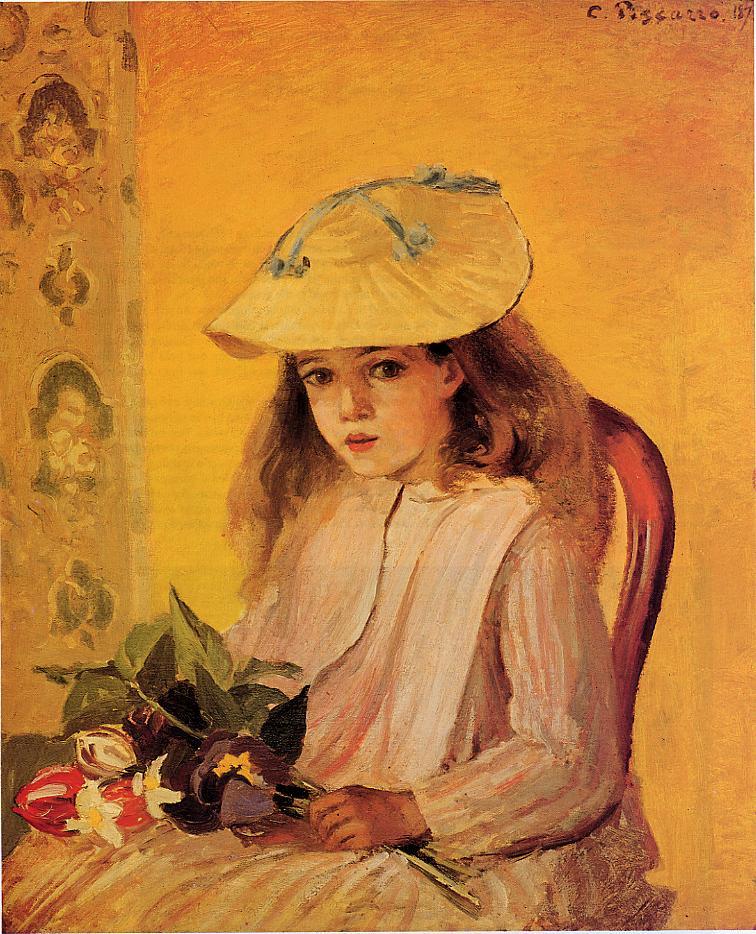
From a portrait painted by her father in 1872, Jeanne-Rachel Pissarro (1865-1874) looks out at us sidelong, lips pursed and mouth off center. The mouth is in the light, but the big staring eyes have been cast into shadow. Only they have been painted with a fine brush to show detail. They are the center of the image’s illuminating force. They show us a glimpse of a life on the verge. In this image, everything else — the layered clothes, the shadow-casting hat, the bouquet of colored shadows — is subordinate to the eyes. The layers of thick cloth in which the child is wrapped serve as an integument. It will ward off, but (its muted, fading colors warn and promise) only for now. Only for the time being, while the body is still warm-clad and the flowers are still alive.

*

The two figures in my subject line sum up the entire corpus of an extinct language, Crimean Gothic. It has been on record ever since it was compiled in the mid-sixteenth century by Ogier Ghiselin de Busbecq (1522-1592), a Flemish diplomat stationed in Constantinople. His Turkish Letters remain a valuable historical resource, and from the Levant he introduced the lilac and the tulip to Europe. They bloom now outside the library, but of the history of Crimean Gothic the words are no longer spoken and the song is no longer sung.

*

When the invention of the glass negative in 1854 made it easy to create photographs in multiple copies, a new kind of history book entered the corpus: the photo album, rapidly filling with mass-produced carte de visite images like this one.

It can be read as a document in the history of nineteenth-century sentimentality — a silent little counterpart of, say, a Schubert lied or a Dickens novella. The little girl’s poignant expression mimes the poignancy of her plea, which is poignant in its turn because it is in words that can’t be heard. On her behalf, because she is mute, it asks you to give her an image to keep her company in the dark when her book closes.