I am still not I, but now I’m updated to 1595

Last December, for at least the second time, I received a handwritten letter bearing a Spanish stamp but signed by somebody using a Romanian woman’s name. Enclosing three low-resolution photographs, the writer asked if these depicted me and requested in vaguely menacing language that I get in touch with her or him. 

The address was correct, but I’m not Tony Morris and the man in the pictures is not me. My earlier blogpost about that is at http://theartpart.jonathanmorse.net/i-am-not-i/. I took the post’s title from the last line of one of Sidney’s sonnets:

I am not I, pity the tale of me.

That’s still a great last line, but after more than 400 years it’s no longer the last word. Just now, for instance, I’ve done something I couldn’t have done in the days of Sir Philip: scanned one of the pictures to my desktop and then dragged it into Google for a search by image. Up it popped there, instantly: the identical face and pose, and attached this time to a LinkedIn name. The name was Tony Morris, too, and furthermore, wondrously! the text attached to the name was a poem. It wasn’t just any poem either; it came to me demanding to be read in the lofty spirit of Horace’s odi profanum vulgus.

Those are the words of George Chapman, him who spoke out loud and bold to John Keats. As a principle either of writing or of reading, they’re right. Hear for yourself as you give ear to the tale of Tony.

Tony Morris Linkedin

Singing its way down the page as from a score, the reading will complicate beautifully into counterpoint when it reaches the words “Hawaiian Islands,” because nobody in Hawaii refers to his home that way — not even if he also lives simultaneously in Florida and Hong Kong. And Hawaii, ordinarily referred to as such, happens to be part of the United States, where the British-spelled word “defence” isn’t in the name of any of the armed forces. Likewise, the academic abbreviation “BSc” is British, not American, and the University of Hawaii at Manoa doesn’t offer a degree in chemical engineering.

And Tony: you harmonize the registers of mathematics and capitalized General Problem Solving? And you sing not just of Asia but of Asia Good morals? Plus chemicals? Romanian lady of Spain, no wonder this Tony is the man you want to link! He is not I; he is far more. He is language itself, a self-singing lyric with an illustrated libretto: “High and hearty invention expressed in most significant and unaffected phrase.”

And best of all, he is, as Chapman says of his own poems, strange.

Source: George Chapman, Ovid’s Banquet of Sense. London, 1595; facsimile, Menston, Yorks., Scolar Press, 1979.

Toward the end, a new way of reading the word “light”

In New York, one cold morning as the long nineteenth century drew to its close, the front page of the New York Sun bustled with news of the continuing revolution in transportation. Off the coast of Massachusetts, said the Sun, the passenger liner Roma, carrying 500 souls, had been driven by a gale onto the rocks of an island called No Man’s Land, where it was stranded for four hours before being safely refloated. In Florida, Lieutenant J. M. Murray of the Naval Aviation Corps had been killed when his airplane nose-dived into Pensacola Bay. This was the naval station’s first fatal air accident. On the other hand, in California Silas Christofferson had flown from Bakersfield to Los Angeles, reaching an altitude of 7000 feet and effecting history’s first crossing of the Sierras by air. And at the bottom of the page, a one-sentence story datelined London declared: “It is announced that the new Cunard liner Aquitania will sail from this side on her maiden voyage to New York on May 30.”

The page was dated February 17, 1914. Just one more decade afterward, with the long nineteenth century definitively in the past, Le Corbusier would claim the Aquitania as a paradigm for his pedagogy of twentieth-century space.

No people are on view in these images. For Le Corbusier, the people always were secondary to the geometry. But as of 1914 the Sun was still following journalism’s chatty nineteenth-century convention of humanizing events by giving them
names —

(Who, exactly, was Silas Christofferson? No, reader, you don’t know either. But as soon as it crossed your mind that you don’t know, you realized that you live now by means of a sensibility from which the nineteenth century’s ways of perceiving and reacting have departed. Only in the artificial nineteenth century imagined by the twentieth-century ironist P. G. Wodehouse could Jeeves praise Bertie’s new shirts by observing in the spirit of Le Corbusier that the monograms would come in handy if Bertie should forget his name.)

— and this front page had one more chatty story to tell.

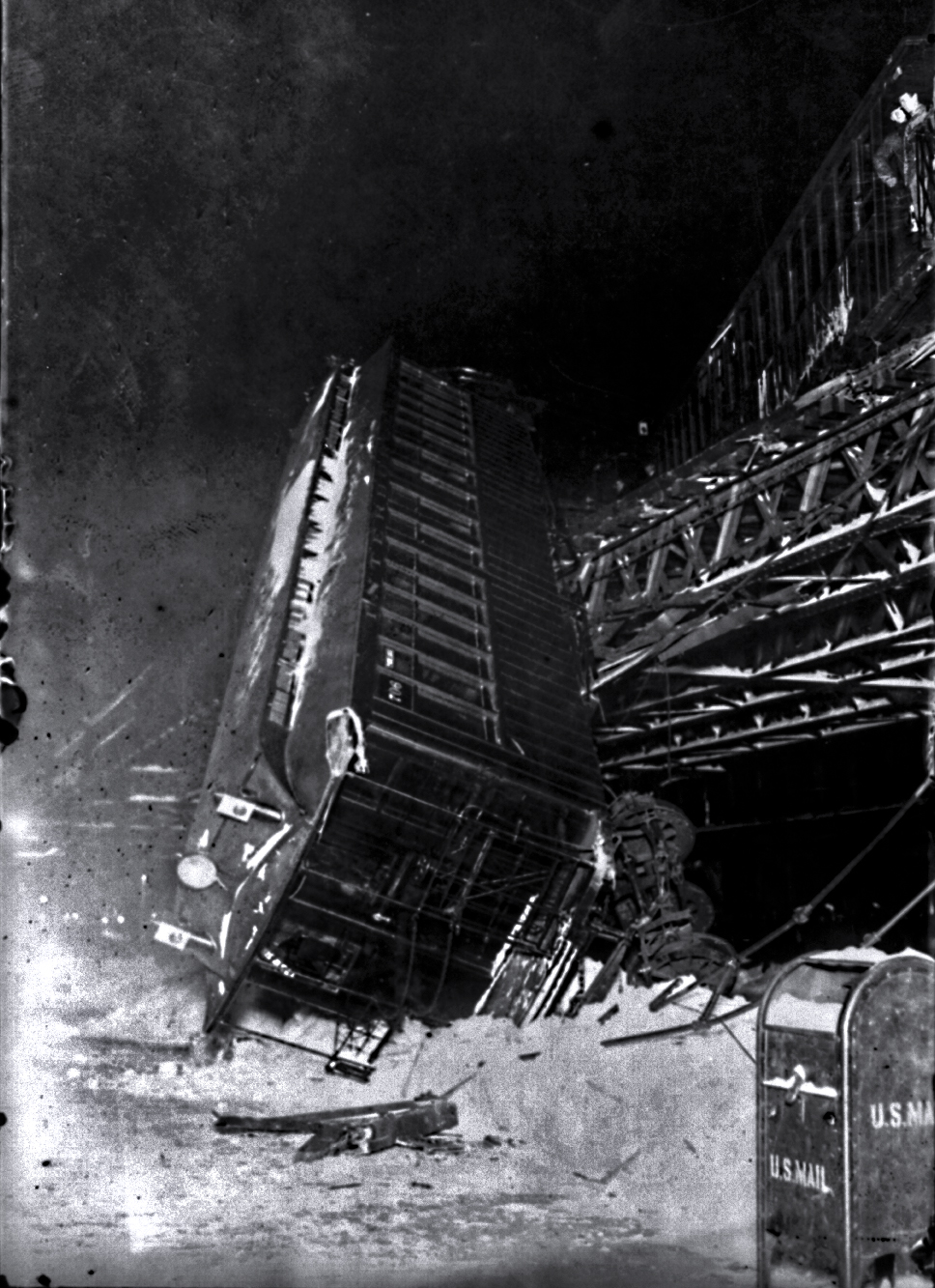
At about 7:15 on the night of February 16, said the story, a train on Manhattan’s Ninth Avenue elevated line derailed at 138th Street and sideswiped a car on the adjacent track, sending it over the side of the trestle with one end hanging from the rails and the other down on the street in a pile of snow. The car was empty except for its motorman, John Becker, and he wasn’t hurt. But the nineteenth-century conventions of journalism insisted on completing the anecdote by furnishing the named and extricated Motorman Becker with a quip to say, and so to the immortal record Motorman Becker was then said to have said:

“Well, here I am. Guess I’ll go get my dinner.”

To enlarge the quip and try to imagine it as an oration, click it. The click won’t get you far, though, because this nineteenth-century front page is all text, no pictures.

But the long nineteenth century also brought perception the gifts of a camera and a tripod and a frying pan filled with powdered magnesium. In the right hands, these turned out to make it possible to understand in the dark. And so, at the end of this particular century of development, readers began seeing their reading matter in a new way: without words.

Here, for instance, is the wordless version of the anecdote of Motorman Becker. Right at the start, its language is distanced from reading by the effect of translation — in this case, translation from text to chiaroscuro, with the surprise effect of a suddenly vertical railroad car finding its balancing irony in the surprise effect of a suddenly illuminated night. Imagining Motorman Becker locked in his dark cabin in the image’s interior, we on the image’s exterior are locked in a frame full of brilliant reflections. If we do any reflecting of our own there, it won’t be in words. We may think of words later, sitting at (for instance) a typewriter in a newspaper’s city room, but here and now we can have nothing in mind except light and dark, in silence. The Sun story is full of excited conversations in the crowd and the noise of the Eighth Avenue streetcar that eventually hauled the El car back down to horizontal, and because we’re now reading the sound-words in sound-words of our own, the sounds continue. But as you begin seeing your way into this oblong of black, the story is light and dark (seen), and silence (not heard), and nothing else.

In scenes like these, filled with nothing else in a way that isn’t available to text, frying pans loaded with new light began helping readers at the end of the long nineteenth century to draw a dark line around a moment of time and say, “Forever after, anything outside this frame will be named The End.”

Sources:

Le Corbusier, Toward an Architecture, second edition, trans. John Goodman (1924; Los Angeles: Getty Research Institute, 2007), [154].

“Elevated car falls to street 2/16/14.” George Grantham Bain Collection, Library of Congress, http://www.loc.gov/pictures/item/2002699891/. Photoshopped.

The New York Sun from 1914 is online at the Library of Congress’s Historic American Newspapers collection, http://chroniclingamerica.loc.gov/.

Estampe XI: the verb “establish”

In the foreground of the image is a boat carrying the first class. On its sturdy and cleanly varnished port rail rest the neatly folded arms of a woman decorated with a hat decorated with concentric circles. Under its brim, whatever can be seen of the woman’s identifying face keeps itself to itself. The image records only lowered eyes, directed downward toward whatever once lay below the image frame.

Simultaneously, on the opposite side of the boat, there can be seen a top hat. The facial features beneath the hat have been obscured, but the image records a hat glossily in place forever. In this lower part of the image, the formal in place is all that matters.

But what fills the upper half of the image is an object whose property of in place is different. Pale in the background haze, this massive thing differs from the hats and the faces that define the lower half because it has a name. Up there in its half it is only steel and bronze and coal, but so long as it also subsists as a name that can fill a page of history, it can never, unlike the flesh and blood of the first class, die.

Specialized for a double image like this one which divides along the locus where language makes contact with photography, a definition of history in human terms might be: that which has successfully replaced the sense of a body with the idea of an image. History is what came into being when a shutter opened and then closed again. An image was thereby cut off from the human life cycle, and the transitive verb establish thereby lost contact with its grammatical object. Thenceforth the image became a monument to the act of its having being established. In the achieved photograph, establish became a noun.

In this image, for instance, a lavish handful of first class people (I count 31 of them: thirty men and the woman in the geometrically decorated hat) have been metamorphosed into costume jewels. In their little jewelbox of a boat, they exist now only to accessorize the mass floating above them at the image’s vanishing point. Collectively, they are no longer a noun (“the name of a person, place, or thing”), because we can no longer conceive of them as having names independent of the name-bearing mass at anchor there in the upper half. Once upon a time the thirty men and the woman were in motion themselves, not looking at the hazed form as they passed by. The stretch of water that established their presence in relation to it was only a temporary strait mapped by the opening and closing of a shutter. But the instant when that map was drawn by a flash of light entering a camera has turned out to be forever.

Source: the ocean liner Mauretania, New York, 1908. Detroit Publishing Company collection, Library of Congress, http://www.loc.gov/pictures/item/det1994012352/PP/. Photoshopped.

To judge from the seasonal clothing, this photograph may have been taken on or shortly after September 23, when the outbound Mauretania was forced by fog to anchor off Brooklyn. “Acrid Fog Grips City,” New-York Daily Tribune 25 September 1908: 4. http://chroniclingamerica.loc.gov/lccn/sn83030214/1908-09-25/ed-1/seq-4/

A tree for Walter Benjamin, author

At the bargain price of $16.78 from Amazon.com, the shirt comes with an almost superfluous bonus: hanging from a button, a tiny four-page book that attests to the shirt’s pedigree. This shirt, the pedigree book certifies, isn’t just a shirt; it’s a Chestnut Hill. And then it humbly asks us (us! us, the undocumented!) to accept it.

In the United States there are at least two Chestnut Hills: a neighborhood of Philadelphia and a suburb of Boston. Both of those Chestnut Hills are upscale, accessorized with architecture that communicates the patrician values of old houses and old money. The chestnut tree (pictured) also has a sturdy American symbolism, as in Thanksgiving stuffing and the first two stanzas of Longfellow’s once beloved poem “The Village Blacksmith”:

Under a spreading chestnut-tree
The village smithy stands;
The smith, a mighty man is he,
With large and sinewy hands;
And the muscles of his brawny arms
Are strong as iron bands.

His hair is crisp, and black, and long,
His face is like the tan;
His brow is wet with honest sweat,
He earns whate’er he can,
And looks the whole world in the face,
For he owes not any man.

the-village-blacksmith-granger

However, the chestnut tree itself is now almost extinct in the United States, wiped out early in the twentieth century by a parasitic fungus. In the financialized American economy of the twenty-first century, too, the line “He owes not any man” retains little of its primitive truth-value. In the days of Longfellow it connoted virtue, but now it is only a nonsense, with the additional connotation of irresponsible naïveté. And as to combining the best of American style with a sophisticated European sensibility, the shirt itself is made in China.

So the Chestnut Hill where this pedigree has originated can’t meaningfully be thought of as a visitable place in the physical world, with a latitude and a longitude. All it is, as it looks up at us from the page of its little book, is a concept. Here in the pedigree, its name isn’t to be read as the word “Chestnut” followed by the word “Hill,” with each term referable to the atlas. Instead, it’s to be read as a portmanteau form consisting of two inseparable parts, each deriving all of its meaning from the other. On its own, the first part, “Chestnut Hill,” is actually meaningless. It is a term from an atlas without a geography. On its own, the second part, “®,” is meaningless likewise. It is a term signifying the legal status of a word outside any of the laws of meaning. But when the two parts are brought into meaningful juxtaposition by an economic motive, each becomes a lexeme. The combined word-like object that results, “Chestnut Hill®,” has no textual meaning that might be referable to any document except its own pedigree, but there in the pedigree it becomes something that means. It means in an especially luxurious way, too: silently, drawing all of its wordless significance from the body which it has colored by being put on and buttoned up.

—

But the pedigree also has a verso: this.

The recto, a series of roman constatives demanding to be read as facts, is actually fiction. The verso, an italic simile asking to be read only as a poem, is actually non-fiction. We can’t read the simile as anything but a simile: a closed semantic system with a tenor referring only to its vehicle, which in turn refers back only to its tenor. Into that closed system the lying world cannot enter. Nothing exists there but the system’s own words. Because the words cannot be falsified there, they are either true or meaningless. And Walter Benjamin, Author, comes naming himself onto the page to assure us that he’s still speaking to us, and therefore he’s still alive, and therefore the words on his page are true.

But are the trees in his picture chestnut trees?

I don’t think so, but I’m willing to believe the document that delivers their image to me. In words, they are something warm, to be worn silently on the body.


Flightverb

The image in the Library of Congress’s George Grantham Bain Collection at http://www.loc.gov/pictures/item/ggb2004008125/ (click to enlarge) is gray.

Explaining to us what we’re supposed to be seeing, an appended afterthought of a noun phrase is crabbed and black.


But to add a verb is to add color.

And then light shines through a cloth-clad wing, a wave takes the light in and mates it with black, and a clause comes into being and teaches us to soar with M. Van den Born. Soaring, we enter a seabird’s bodily understanding of the word “above.”


To read, read monocularly

Sometimes reading is possible only through a monocle. Here’s your evidence, below and above.

Below is one of the comment spams that are once again, after a long absence, trying to parasitize this blog. They arrive at exactly the right historical moment: the impending centenary of the Great War, whose concomitant rhetoric caused Hemingway’s Lieutenant Henry to deliver himself of a set speech famously beginning, “I was always embarrassed by the words sacred, glorious, and sacrifice and the expression in vain” and continuing, “I had seen nothing sacred, and the things that were glorious had no glory and the sacrifices were like the stockyards at Chicago if nothing was done with the meat except to bury it.” Keep those lines in mind now as you continue reading and encounter the phrase “For instance.”

Yes, Tenente: “Certain numbers . . . certain dates and these with the names of the places were all you could say and have them mean anything.” If it’s read only for the duration, within the sub-grammar of spam, the phrase “For instance” above does mean something. It is an anti-Bayesian element. Its function is to defeat the software that tries to detect a human purpose (such as “Buy my wares”) in the non-verbal vicinity of a verbal communication. But within the larger grammar of the English language, “For instance” also has an inhuman purpose. Out of the disembodied inhuman elements of logic it assembles trains of thought, coupling sex cars to sex cars and photography cars to photography cars. To spam that act of construction by decoupling its contexts is to commit an act of sabotage against language itself.  Yes, Tenente: even the simple adverbial “For instance” can be made to mean nothing.

But once he had thought himself that far into the predicaments of language, Hemingway’s talkative hero retreated a short way by opening his paragraph about the meaninglessness of language with the self-negating formula, “I did not say anything.” As if saying that one is not saying anything could absolve one from saying something.

The monocled man in the picture above was braver when it came to saying something and then dealing with the damage.  This was Tristan Tzara, and when he and his collaborators created Dada they created a language which not only articulated the possibility of meaninglessness but spoke meaninglessness into a counter-meaning. Put on the monocle now and see: a century after Dada, the spam’s money shot following the line about the anatomy of the penis is a link to a Facebook page advertising child care.

If we’re even to hope of thinking grammatically about that, we’ll probably have to break the communication down to single words like “penis” and “care” and read them slowly and squintingly, each one by itself, in isolation from its spamgrammar. For that, a recommended implement might be the monocle.

Source: Ernest Hemingway, A Farewell to Arms (New York: Scribners, 1929; Hemingway Library Edition, 2012) 161.

Thesaurus of verbs and nouns

Web page of the Bill and Melinda Gates Foundation, 2014

accelerate approach catalyze support develop generate trigger highlyinnovate addressseveralkeyfactors engageinboldsystematicreformefforts effectivelyintegratetoolsandapproaches experimentwithgroundbreakingnewparadigms

*

Collier’s, November 12, 1949

Source: Jon Williamson, https://www.flickr.com/photos/jon_williamson/13417497454/