The old noun is enameled iron. The fabric bears the impression of another old noun, mangle. The glasses’ thin delicate lenses are actually made of glass. The wide eyes and smiling face are turned full on toward an about-to-be-blinding light.
As things lose their immediacy of reference and become mere historical artifacts, the names they once had (“mangle”; “bedstead”) become hard, ironic, and unforgiving. The trusting smile that the picture shines toward us isn’t like the smile we return, because the man in the picture isn’t thinking, “Little do I know.” He is innocent. If he should say “bedstead,” the sound in his smiling mouth would lack the overtones demanded by our third-person knowingness. The reproduction would be low-fidelity, as if it had been played by a Victrola invisible within the image frame. Only we outside the image frame have been equipped by the passage of time post-flash to hear ourselves wanting to believe, “Little does he know.”
In the flash, “Little does he know” underwent a change of tense to “Little did he know” and the image acquired a caption. In the language of the past it can now say, for instance, “Bedstead.” Post-flash, we translate such words into bedtime stories that we force-read to ourselves, making believe that seeing what no longer exists (for an illuminated moment, a bedstead) can somehow come to mean understanding what no longer exists (forever, a bedstead). But the translation is a language we don’t understand ourselves. Now that the bedstead’s touchable knowable actual iron has passed out of reach in a flash, little can we know.
Source: Jack Delano, “Freight train operations on the Chicago and Northwestern Railroad between Chicago and Clinton, Iowa. Engineer John Johnson.” January 1943. U. S. Farm Security Administration / Office of War Information Black & White Photographs, Library of Congress, http://www.loc.gov/pictures/item/owi2001016175/PP/. Photoshopped.
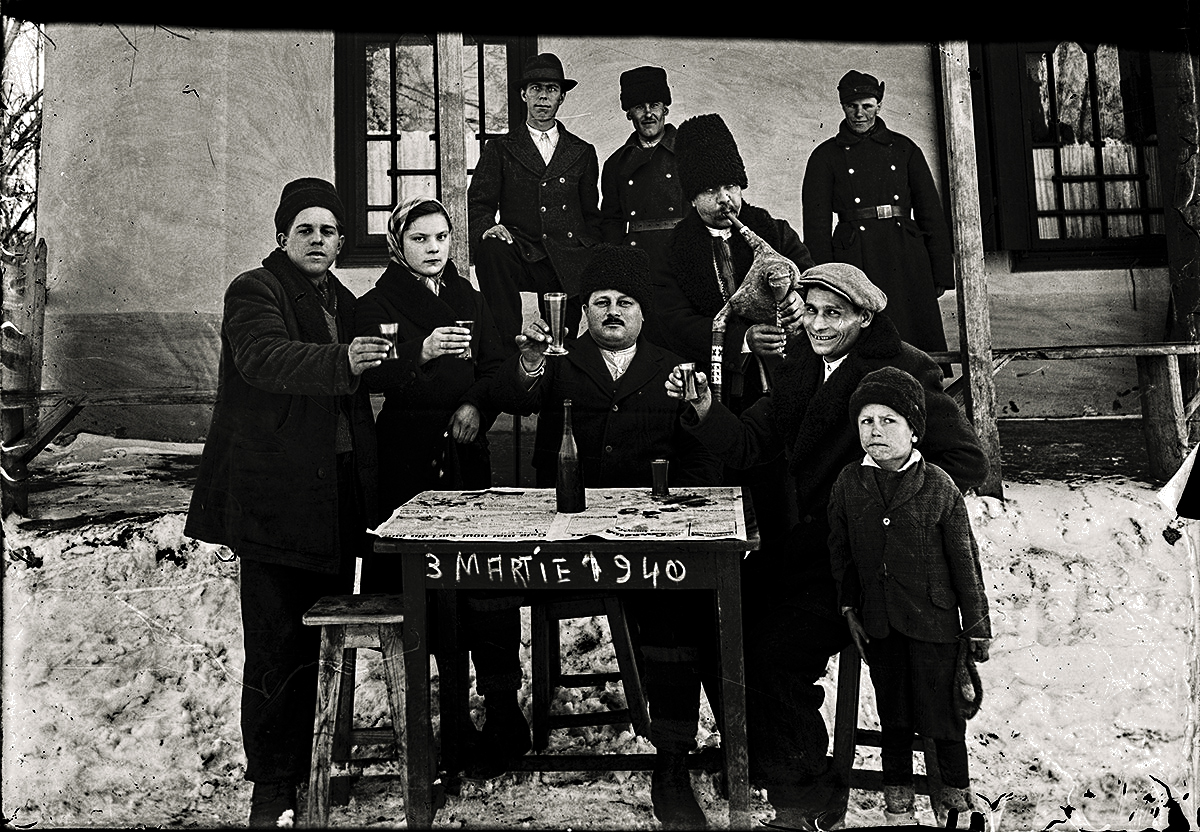
What is the woman thinking as she grasps a glass in her huge hand? Her clothes are firmly secured and no communication can be opened with her eyes or her mouth.
What is the man in the cap thinking? His body is relaxed only to the extent necessary for taking a seat at the table. His mouth is smiling but his eyes aren’t.
Both hands extended along the legs in the military posture called Attention, the little boy in front of the man is rigid. But his body deviates by several degrees from the perpendicular, and one of the two fastenings that close his tattered coat against the cold is a safety pin.
The expression on his face . . .
But it doesn’t matter, because at the center of the scene, eyes alert behind pads of fat, sits the big man with the big glass. He is his image’s low center of gravity. His legs take up all of the space under the table. It is his table, his. He stabilizes all the lives that have been brought close to its cold wood, freezing them into a dark tableau. Upstage, positioned apart from the snow, a greatcoated soldier looks watchfully sidelong toward the wings, while at the big man’s furrily warmed ear a bagpiper in a folk hat worn comically low over the brow makes a crosseyed face while he plays a song.
It can’t be heard on our side of time, but we who can’t hear have been admitted by the photographer Costică Acsinte to a place where the moment of its having become music is remembered. Seen there in snow, frozen note by note into a composition, the song appears to be part of a pageant of praise for the big man. But the auditorium for Acsinte’s pageant is so ample that it can accommodate men even bigger than this one. In fact, you are among some of them now, and they have begun striding forward from your vantage point to approach the image.
Not at all long after March 3, 1940, they will break through the fourth wall, enter a snowy little town in Romania, and make themselves welcome: Brueghel’s hunters, bringing to the big man’s newspaper-covered table their glad news of fresh kill.
In January 2015, the cyclical history of Martin Heidegger’s post-World War II rehabs and relapses entered a new phase when the chairman of the Martin Heidegger Society resigned his position, stating, “As chairman of a society, which is named after a person, one is in certain way a representative of that person. After reading the Schwarze Hefte, especially the antisemitic passages, I do not wish to be such a representative any longer. These statements have not only shocked me, but have turned me around to such an extent that it has become difficult to be a co-representative of this.” (http://dailynous.com/2015/01/19/germanys-heidegger-society-chair-resigns/)
The phrase Schwarze Hefte (“black notebooks”) refers to a group of previously unpublished manuscripts which are only now appearing in print, on a schedule dictated by Heidegger. The notebooks are bound in black oilcloth, and in the first instance “black” is all the word schwarze means. But of course it also has moral connotations. These dark texts seem to make clear, if anything in Heidegger’s ambit is clear, that racism was one of the fundamental, constitutive parts of his thought.
Well, the history of the Fascist years is filled with stories in the style of Henry James about eminent people shadowed by their past. The reputations of E. M. Cioran and Mircea Eliade, for instance, were at least a little tarnished by their association with the Iron Guard, Romania’s peculiarly nasty Fascist party. On the other hand, the Nazi section of Herbert von Karajan’s curriculum vitae did him no harm in after years. If anything, it only added more excitement to his bad-boy reputation. Until recently, at least, Heidegger’s reputation seemed to luxuriate in an ambiguity strong on both sides, as when he deplored the Holocaust as just another instance of the inauthenticity of plowing with tractors instead of horses like God intended. Unfortunately, history doesn’t seem just now as if it will continue indulging Heidegger’s reluctance to resolve his dilemma. The dilemma itself seems to be little more than silliness on one horn and careerism on the other. But when the moral ambiguities of the Hitlerzeit were forced up against the moral ambiguities of the Cold War era, the human consequence was sometimes larger and more interesting.
In 1950, for instance, the German field marshal Erich von Manstein was convicted of war crimes and sentenced to eighteen years in prison. This was soon reduced to twelve years, and in the event he served only three. Almost immediately after his release, he was recruited to build a new army for West Germany, to be deployed against the enemy in which he had always specialized, the Soviet Union. Thereafter and therefore, official history decreed the former Manstein and his Wehrmacht to have been strictly apolitical, wholeheartedly humane, and motivated only by the ancient military virtues of uprightness and chivalry.
Look, therefore, at this image of the former Manstein leading his Romanian armies against the Bolsheviks.
Postwar, you’re intended to see an apologetic in every element of the composition. Fluently dictating from a prescribed lexicon, it tells you: Marshal Manstein, like his moral compeer Martin Heidegger, was (the phrase enters the mind prefabricated, a brick of cliché) an old-fashioned nationalist. You experience the whole history of the word “old” in his upright posture and stern, unflinching attentiveness to the world, in all of its evil and all of its tragic good. Within this image frame, nothing except the old-fashioned has been allowed to survive. If you try to read through or past or around the image to anything in its background (anything called history, for instance) you’ll probably fail. Standing firm and still within his car, Marshal Manstein is on his way to taking dominion everywhere.
That’s easy to prove. See for yourself: having experienced the image of Marshal Manstein, didn’t you flinch when you began experiencing this other image?
—
It was captured by the photographer Costică Acsinte (1897-1984), who between 1930 and 1960 operated a studio in a Romanian farm town named Slobozia. After the studio closed, his glass negatives were stored for decades under neglectful conditions until they were rediscovered by another photographer, Cezar Popescu, who is now preserving and cataloging them. His online archive is at http://colectiacosticaacsinte.eu/.
The paragraph you’ve just read is one way of accounting for the image’s history. Another way might be to open a book and start reading about Romania during the 1930s and ’40s, when the photograph was probably taken. A guide to Romanian officers’ uniforms could provide further detail, and in Slobozia there may, even now, survive someone who can attach a name and a war diary to the image of the young law enforcer, club at the ready, who is pointing his pistol at someone not visible in this image at this time — someone who happens to be standing to the right of the photographer.
What expression is on the face of the person facing the muzzle of the officer’s automatic? The officer is backed by a set from The Seagull or The Cherry Orchard, with flowers bordering a window and a door, but we’ll never learn who is about to walk forward from the camera’s vantage, speak the password that will make the officer reholster his gun, and enter the scene. Such an entrance would be an event. If the word could be spoken, the young man could relax his vigilance and begin speaking in his own turn. Until then, however, he can be nothing but a Manstein: a shape on photosensitive paper, serving a purpose off-camera.
His time on camera is short, too. Even as he waits for his event to begin, time is peeling his form away from its transparent backing. A break in the image’s continuity has already opened itself right across his eyes. He won’t be able to keep watch within the image frame much longer, and behind the image’s transparent support there seems to be nothing but dark. Still, the dark has a grammatical force of its own. Radiating forward to the image, it keeps it from communicating off camera. On camera, the officer’s uniform, a symbol written in a specialized code, may say “nationalism,” but it doesn’t seem able to translate the sentimental off-camera adjective “old-fashioned.” That which is old-fashioned is either thought to be dead or thought to be dying, and the historical record between Heidegger’s time and ours seems to show that the man with the pistol will live forever, just as he is imaged on camera here and now. The old-fashioned nationalist will never live to become old-fashioned because he isn’t going to die.
Sooner or later, too, we who still live in history may be able to imagine the pistol swinging in our direction. If that act of the imagination becomes possible, we will know that in this image Costică Acsinte achieved a work of art worthy of art’s terrible task of outliving.
What am I reading here? Some history. I can place the document in that genre because it explains and is explained by its date of composition: April 1942. Off the page, history has already taught me that April 1942 has something to do with the United States’ entry into World War II in December 1941, and I accordingly think I understand what the words on the page mean when they say: “Los Angeles, California. The evacuation of the Japanese-Americans from West Coast areas under U.S. Army war emergency order. Japanese-American children waiting for a train to take them and their parents to Owens Valley.”
That timestamped and circumstantial text isn’t only a history, of course. It’s also a literature. Shaped by narrative convention, it belongs to the literary genre of the caption — specifically, the caption to this photograph by Russell Lee in the Library of Congress’s Farm Security Administration / Office of War Information archive at http://www.loc.gov/pictures/item/fsa1998003537/PP/.
Because a caption has an explanatory power over its attached image, its words make the image in some sort verbal. They make it tell a story. From this historical era, for example, there exist similar photographs taken in other theaters of World War II, and our reaction to any of them will be, so to speak, captional. If the caption tells us of a Japanese baby being evacuated from Los Angeles, we’ll react one way; if the caption tells us of a Chinese baby being evacuated from Nanking, we’ll react another. Likewise, as of August 2014 I think most of my academic colleagues would react with sympathy if a caption told them that the image were of a Palestinian baby, but with exasperation if an editor then corrected the caption’s adjective “Palestinian” to read “Israeli.”
It’s been a long time since a news photo could be thought of as intelligible on its own terms, of course. A century ago, not long after Freud taught us how hard it is in principle to know what we’re seeing, Lev Kuleshov demonstrated that in practice we can’t even see the difference between a dead baby and a bowl of soup. In Kuleshov’s experiment, a movie clip — one clip, only — showed an actor going through the physical correlates of emotion. A montage of that clip with some ostensible stimuli of emotion then made clear that any imputed sense of emotion, of emotion about an ostensible stimulus, was demonstrably nothing but an artifact of the montage effect. Juxtaposed with the image of the baby, the actor’s mobile features and heaving chest seemed to mean one thing; juxtaposed with the image of the soup, they seemed to mean something else. We might have thought they expressed feeling, but In themselves they were nothing but mobility and heaving. Whatever emotion we derived from them was an illusion. We were misled by our expectation of a caption to read. But from the belated realization that Kuleshov’s tiny silent movie is captionless there follows a happy ending. To learn that one is free from captions is to learn to be free from other things as well.
Therefore, face to face with an image that has been captioned, I find myself wondering whether I can do something in the captional space above the border where the caption’s words begin. Wondering, I open Photoshop and set about trying to change the non-verbal part of this historical record. Timidly, at the start, I may tell myself and you that I’m only restoring the captioned image, only using modern narrative technique to put an illustrated story — a children’s book, a picture book! — back together. But of course what Photoshop and I are doing to this ensemble of words and non-verbal forms isn’t merely a historiographic revision. Photoshop and I aren’t doing history now; we have subordinated ourselves to a corpus of aesthetic principles that have nothing to do with Los Angeles or trains or 1942. Our project has been taken over by art. So:
And you see: I have not merely restored the record or corrected it. I have (as editors used to say in the days of Thomas Bowdler, he of the verb bowdlerize) improved it. See how much more tragic than Russell Lee’s original my little girl is, hear how much more clearly we can say “Little does she know” about her! How satisfyingly pretty I have made this children’s story!
Because it’s open to the possibility of an aesthetic judgment like that one, my version of Russell Lee’s photograph is no longer quite a historical document. It can now be read without its caption, as if it were in the process of growing distant from the history of events. It’s no longer merely captional. If it isn’t yet art, it may at least be art history. Because the space around the little girl has now been filled with art, her mother has now been barred forever from entering the image frame to reroll her daughter’s cuff. Because art always has a completion function, the caption below this image has now been translated into a dead language and made emotionally unreadable on any terms but art’s. The little girl’s picture can now say only the one thing art ever can say about itself: The End. Waiting for a train which can now never arrive to transport her out of the image, holding the doll which she now will never outgrow, the little girl has become an unravished bride of quietness.
The image of women on the battlefield can be found in many locations online. It was taken by Dmitri Baltermants in Kerch, 1942.
The painting of the girl writing to the soldier wearing Norwegian mittens in Germany’s SS Wiking division, like the two other propaganda images in color, is by the Norwegian Nazi artist Harald Damsleth. All three of the Damsleth images are at http://gasskammer.blogspot.com/2013/02/en-nasjonal-samling-bilder-av-harald.html
Enten eller translates as “Either / or.” The red-and-yellow sun disk was the emblem of the Nasjonal Samling (National Gathering), Vidkun Quisling’s Norwegian Nazi party. In the image titled Kultur-Terror, the dialogue at the bottom translates as, “The U.S.A. will save Europe’s culture from destruction. . . . with what right?” I thank Domhnall Mitchell for correcting the translations.
Ernst Hanfstaengl had been a popular member of Harvard’s class of 1909. Wealthy, talented, gregarious and cosmopolitan, with an aristocratic German father and an American mother, he composed songs for the football team while he was in school and enjoyed productively networked friendships in New York afterward. Acquainted with both Theodore Roosevelt and Franklin D. Roosevelt, he was also briefly engaged to Djuna Barnes. In 1934, when the time came for his twenty-fifth Harvard reunion, he was named a vice-marshal of the class. By then, however, his country of residence was Germany, where he had become one of Hitler’s early intimates.
Hanfstaengl with Hitler and Goering in 1932, from Wikimedia Commons
By then, too, the nature of the Nazi regime was apparent. After students and alumni protested, Hanfstaengl resigned his honorary position at the head of his class, and on Harvard’s behalf President James Bryant Conant refused his thousand-dollar gift to his alma mater. Students also demonstrated against a visit of the German cruiser Karlsruhe to Boston, and arrests were made. In Cambridge, the spring of 1934 was a halcyon time for the emotions.
The emotions weren’t all on one side, either. At least two prominent members of Harvard’s humanities faculty, Francis Peabody Magoun, Jr., and George Kingsley Zipf, were openly pro-Nazi, and it was as Harvard’s Charles Eliot Norton Professor for the academic year 1932-33 that T. S. Eliot formulated his notion that there can be no place in a healthy society for Jews. Here, from the Crimson’s archive for May 17, 1934, is a little pragmatic souvenir of what the word “society” was capable of meaning during that time.To find our way through that, perhaps we should listen in the text for guiding imperatives. There is one: Royall Victor’s tune, crying to Harvard and to the after time, “Don’t spare my heart.” Reading in a way that doesn’t spare the heart, then, we’ll begin to comprehend that Ernst Hanfstaengl’s family business was art publishing and the boat was pretty. It was to sail prettily on until April 9, 1940, when it was sunk during the invasion of Norway.
Three hundred miles from Harvard, on the quiet Quaker campus of Swarthmore College, another young man felt that his heart had not been spared. When he tried to tell the editors of The Nation about his heart’s wound, however, they reacted only with bafflement. Baffled by others in the same way, they asked their readers on December 27, 1933, for help.
Eighty years later, the bafflement seems to have changed into a problem in the definition of terms. Because history’s lexicon in 2013 probably would define the Third Reich as indeed a regime of “men without conscience — in short, cruel, inhumane, selfish, and even immoral, lacking one redeeming characteristic,” speakers of a 2013 dialect of English will have difficulty communicating a sense of what David Lukens Price was trying to communicate in the vocabulary of 1933, before words like “cruel” had become encrusted with their post-1933 senses. And what makes our attempt to read the simple dead language of the past more difficult, not less, is that we actually have a single hint as to who David Lukens Price, speaker of a language once living but now dead, once seemed to be.
In Delaware County, Pennsylvania, we might be able to visit the courthouse and learn more. Anywhere outside Delaware County, however, the little that seems to be known of the history of David Lukens Price is that he was born into a Quaker family on October 27, 1908, graduated from Swarthmore High School, and continued living at home while he attended Swarthmore College, from which he graduated in 1932. The date at the foot of his letter to The Nation says he was still in the borough three semesters later. Literarily, that seems to be it, at least outside Delaware County. If he ever again wrote a word for the record of history, I haven’t found it. His obituary in the Delaware County Times for September 28, 1974, p. 4, says only that his last job was in Puerto Rico, as an area representative for a textbook publisher. No wife or children are mentioned. At the time of his death, the sole hint of what he might have been as a living man was a testimony more than forty years old. It had come whispering through a pair of verbal events separated by a year in the early 1930s, and it was named Halcyon.
Halcyon was the yearbook of Swarthmore College. The 1932 edition displays a small picture of the older than average senior David Lukens Price, with his local address and a list of the student organizations to which he belonged, notably German Club I, II, III, IV. But the yearbook during those years was a project of the junior class, and on the Price page in the 1931 edition somebody has tried hard to say something nice about junior Dave.
In Pennsylvania newspaper archives from the 1960s, a Charles E. Pugh shows up here and there, typically delivering a speech in his capacity as head of the Pennsylvania chapter of the American Automobile Association. I don’t know whether that man is the continuation through time of the cheerful frat boy in the right column above, but the fit would be seamless. In comparison . . .
In comparison, oh poor Dave. No wonder he wrote the word “destiny!” with an exclamation mark. In his head he had a picture of a girl (or boy) named Germany, and he liked to think that if he could just sing beautifully enough she (or he) would notice him. After all, the only substantive difference between Dave the musician and Ernst the musician lay in their venues of performance. In Cambridge and Berlin, members of the audience would rise inspired from their seats, go forth, and christen cruisers. From the air over Swarthmore, on the other hand, the sounds of the ocean were absent. Unable to send men forth, unable to make them join and love the songs he heard in his head, Dave could only go silent. On their yearbook page, Halcyon’s words about him bring forth no echo.
—
I also discuss the page from The Nation at http://jonathan-morse.blogspot.com/2010/04/how-not-to-write-while-incredulous.html. A critical history of policies toward Nazi Germany on American campuses in the 1930s is Stephen H. Norwood’s The Third Reich in the Ivory Tower: Complicity and Conflict on American Campuses (Cambridge University Press, 2009). David Lukens Price’s birth in Palymra, NJ, the son of Charles Evans Price and Gertrude Lukens Price, is recorded in the Friends’ Intelligencer, vol. 65, p. 686 (Philadelphia: Friends’ Intelligencer Association, 1908). His father’s obituary in the Delaware County Times, 30 January 1956, p. 54, is headed “Charles Price, Football Official” and says, “He played a year of football at Swarthmore College at the turn of the century.”
But the Japanese Tumblogger who reposted it had another name in mind. “HIGE,” she wrote in capital letters — a word that means “WHISKER.” Rewhiskered, my cat’s image was then instantly reblogged by dozens of other Japanese sites. Every one of them was kawaii: a Japanese word that translates as “cute,” but with a richer connotation than the English word. Kawaii is the uniformly thick coloring-book line that metes and bounds Hello Kitty, and the big hair and big eyes of manga and anime, and the infantine nightmare figures of Takashi Murakami, and the dress-up ritual (Yukio Mishima converses with Philip Larkin about spanking the maid) that is known by a pseudo-English name, “cosplay.” Reblogged, my cat now (as of April 6, 2013) cosplays with playmates in Tumblrspace, here.
Elsewhere on the same site, more costumes are worn and more smiles are smiled.
Unlike the girl in white with white confection and white teeth, these images are obviously old. Their reblogger certifies them as such with a pair of antique dates: December 17 and 19, 1937. But they too are kawaii. In a cute world, they are cute. How cute they are, after all, these smiling soldiers hugging smiling little kids. A newspaper, Mainichi Shimbun, immortalized the smiles, and now their dentition will last forever, reblogged aere perennius.
On December 18, 1937, a different newspaper, The New York Times, mentioned those same smiles in words equally black and white but perhaps less immortalizing because merely words. An image of the headline under which the words spoke looks merely like this
Except for the neutral shapes of the letters themselves, there is nothing to see here. However, a few more inches down the column a game of cosplay begins. Playfully swinging from newspaper to newspaper, the New York Times grabs Mainichi Shimbun’s imperial photographs out of their Tumblframe, spins them around, and boots them all the way back to 1937. There, mugging and juggling, it mimes an explanatory 1937 caption to the 2013 pictures of cute soldiers cavorting with my cute cat.
Still aglow from their proximity to the sweatless volleyball girl with her perfect teeth, the words “greatly enjoyed the spectacle” bask briefly in the disciplined beauty of art. Just as the girl underwent orthodontia, the New York Times journalist served an apprenticeship to journalistic convention. But in the nature of poor brief mortality, his kind of communication from whatever form history might once have had before it was reblogged can’t last much longer. Now, in the final years of their pre-Tumblr existence, some unpictured pages from the history of China come before us in antique fonts and antique verbal conventions to plead:
Find a Chinese, Filipino, or Korean who is old enough to remember the Japanese occupation. Say to that person, “We Americans feel guilty about Hiroshima and Nagasaki.” Listen conscientiously then to what you will be told in reply.
But no, of course you won’t believe it. A line like “You should have your head examined” isn’t cute enough to enter into the Tumbldeathlessness of art. It doesn’t have pictures.
Flaps down, wheels down, its blurred outline communicating airspeed as it hurtles from right to left across the image frame, a Mitsubishi Ki-57 in wartime camouflage is about to reestablish contact with the earth. The photograph predicts that its flight, from ground to air to ground again, will have been successful. The airplane’s shadow is already on the ground, darkening as its source of darkness descends.
Outside the frame, in textual space, there will be words to fill in the parts of the image that we can’t see. After we have visualized the landfall, we can read its story. The landing strip, these words will say, was in Zhijiang, Hunan, China. The shadow of the airplane was cast there on August 21, 1945, and a short time after it stopped moving, the airplane’s door opened and Major General Takeo Imai stepped out to receive the Allied Forces’ instructions for the surrender of Japan’s million-man army in China.
We read that history in languageand as language, but the image prior to the words you’ve just read shows us history in the form it takes when the sky passes over a sundial. It can’t be a propositional history, a history in words, because the words a sundial offers us to read can be only those that were there before the sun struck. They are words off to the side of what actually happened, in the margin of the light. Jacques Derrida, who thought about that prior language, passed his childhood under the sun of Algeria, and there, after some Ki-57s had landed in China and some Ju-52s had landed in France, nobody would speak to him. He was alone in the darkfall.
2
Of course there are ways of requesting a shadow image to step into the light and explain itself. After is has vanished, we can reimagine it with the help of history’s functions of generalization and exemplification. If it is inserted into a curriculum, we can even translate its into the language of computer-assisted design and read it on a glowing screen like the one where you’re now reading these words. Look, the screen can say. Look at:
But to read an image under those educational circumstances is to abstract it from the history which engendered the desire to read. After all, why should we care to see this schematic? There’s only one reason, and it isn’t pictured. It’s off to the side, written down in an unillustrated, unillustrable language that has the power to evoke nightmare after we have stopped reading and closed our eyes for the night. The dream of reason, wrote a Spanish artist into one of his pictures, brings forth monsters. The true monstrosities are the ones we dare only to imagine, not to see.
3
But El Greco’s Burial of the Count of Orgaz depicts monstrosity. Unlike the photograph of the airplane which for a moment concealed within itself, pregnant before the eye of history, the defeated body of General Imai, this sky picture had a purpose which existed before history delivered it to view. Its creator followed a curriculum as he worked, and the educational labor of inserting the curriculum’s words into the image can only help us to see the image more clearly. Pedagogy will demonstrate what was there in the picture’s conception before the picture itself came into existence, and it will also send us to the dictionary to read up on what pedagogy is putting us through. There in the dictionary, we’ll discover that the words “demonstrate” and “monster” both come from a Latin root signifying portent and warning. That etymological exercise will teach us that we knew all along what was going to be on this canvas before El Greco picked up his brush to make the first stroke. It was all horror, too: the horror of historiography, the horror of birth into the terrible instant in which transfiguration begins its henceforth endless cycle of reproduction. Reproducing, moving within time, the moment of change always becomes without ever passing into the stillness of being.
As long as an image comes before us in the glow of the moment of unchange, the shadow of General Imai’s airplane will not yet have come to rest. Elsewhere under the sky of China, the dying will continue. China is all. El Greco picks up his laser pointer to make the demonstration.
Robert Doisneau’s two photographs of Paris during World War II show us the world capital of chic keeping up appearances beautifully. Look at the calligraphy and composition of a bakery’s explanation to its customers that there is no more bread because there is neither fuel nor flour. Its corners carefully trimmed, its margins as impeccable as snowy cuffs, the hunger text is volubly tasteful. Look, too, at the bicycle rickshaw, double-headed as it pounds through the snow in front of the Opéra. Click any image to enlarge it.
In Gertrude Stein’s twentieth-century America there was a whole pictorial genre of travel scenes like that second one, but on that side of the Atlantic the motive unit was a superhuman machine and the direction of movement was usually an advance to the front of the picture plane, not a retreat.
Grif Teller, “Giant Conquerors of Space and Time,” 1931
On either side of the ocean, however, Gertrude Stein experienced transport from a greater distance than this, and de haut en bas. “When I was in America [1934-35],” she wrote, “I for the first time travelled pretty much all the time in an airplane and when I looked at the earth I saw all the lines of cubism made at a time when not any painter had ever gone up in an airplane.” Remaining behind in France during the war, continuing to create chic out of her carefully rationed words, she was able both to supersede train and airplane and to rise above vitrine and pedicab. Herr Brecht once wrote her a song containing the line “Erst kommt das Fressen, dann kommt die Moral,” but Mr. Gray offered her a beautiful portrait of himself for her permanent collection.
My May 16 post about the cliché language of Charles Bernstein’s claim that he is “setting the record straight” about Gertrude Stein’s survival in Vichy France made the deconstructive point that if a record is a record, it can’t be set straight. It’s a point that Bernstein’s own poetry has always made, of course. The crookedness of the record is basis of the great ironic joke that is Language poetry. So when he picks up his crooked pen to write clichés like “setting the record straight” or “by hook or by crook” or “when push comes to shove” (in a text that bears unspoken reference to the Vélodrome d’Hiver, the bicycle racetrack where Parisian Jews destined for the death camps were confined without food or water) Bernstein is writing out the joke once again, and this time with a punchline so funny that it achieves self-deconstruction.
That was all I said on May 16. My post was about Bernstein, not Stein. But on the University of Buffalo’s e-mail list about poetics it drew a couple of responses about Stein and the record, so here’s the part of my reply where I do talk about Stein.
“As to my own biographical take on Stein, I hardly have one. She was hardly the only American author of German Jewish descent to feel embarrassed or distressed or even pained by her genealogy. The ironist Nathanael West had that problem and dealt with it interestingly, by donning a mask and proceeding to wear it until it killed him. (Nobody expects a man named Nathan Weinstein to be a reckless driver, so when Nathan Weinstein changed his name he also started driving so recklessly that his friends refused to get into his car. Not long afterward, as these things go, he drove through a stop sign, and that was that for Nathanael West. He was 37.) By contrast, Walter Lippmann, the highly serious father of modern media punditry, was merely uninteresting. He attempted to pass like Anatole Broyard, and to even hint to him that you knew he was Jewish was to break off all communication with him, forever. Considered as a Jew with a biography, Stein may have been personally either interesting or uninteresting, but of course her language is always interesting. That is (among other things), it helps us understand the difficulty of attaching the word “problem” to any human being.
“Which is to say that Gertrude Stein was a great poet. But surely (this is a modest enough idea, isn’t it?) none of us is going to claim that being a good (i.e., competent) artist is the same as being a good (i.e., virtuous) person.
“And surely the example of Bernstein’s language means that we aren’t warranted in reading Bernstein or Barbara Will or Stein or anybody else as if they were journalists, uttering clichés but asking us (because — what’s the cliché? — their hearts are in the right place) not to pay attention to them. If only the sign that Nathanael West drove through had said not ‘Stop’ but ‘Aporia.'”