
Source: George Grantham Bain Collection, Library of Congress, http://www.loc.gov/pictures/item/ggb2005024750/. Photoshopped.
World War I
Transport II

Source: Provincial Archives of Alberta, https://www.flickr.com/photos/alberta_archives/17428524715/in/photostream/. Photoshopped.
Poetry against propaganda: somebody’s mother considers popping the question
Source of the photoshopped image at the foot of the page: “Helen Rook,” George Grantham Bain Collection, Library of Congress, http://www.loc.gov/pictures/item/ggb2005024344/. Helen Rook, on the right, was a Broadway actress of the 19-teens. In the New York Evening World, May 2, 1918, p. 7, the Bloomingdale’s advertisement promised that she (“Lieut. Helen Rook of the Camp Recreation Corps”) would sing at a white sale. Lieutenant Helen was also on hand the next month when (New-York Tribune, June 3, 1918, p. 6; Historic American Newspaper Collection, Library of Congress) a shipload of Australian officers landed in New York:

At the foot of the page, a band of patriotic milk dealers added:

—
But in spite of the imperative “End!,” Miss Rook still remains available after hours. Touch your keyboard for her and she will come back to unfailing life. See:

Estampe XII: activity at the edge of an emptiness

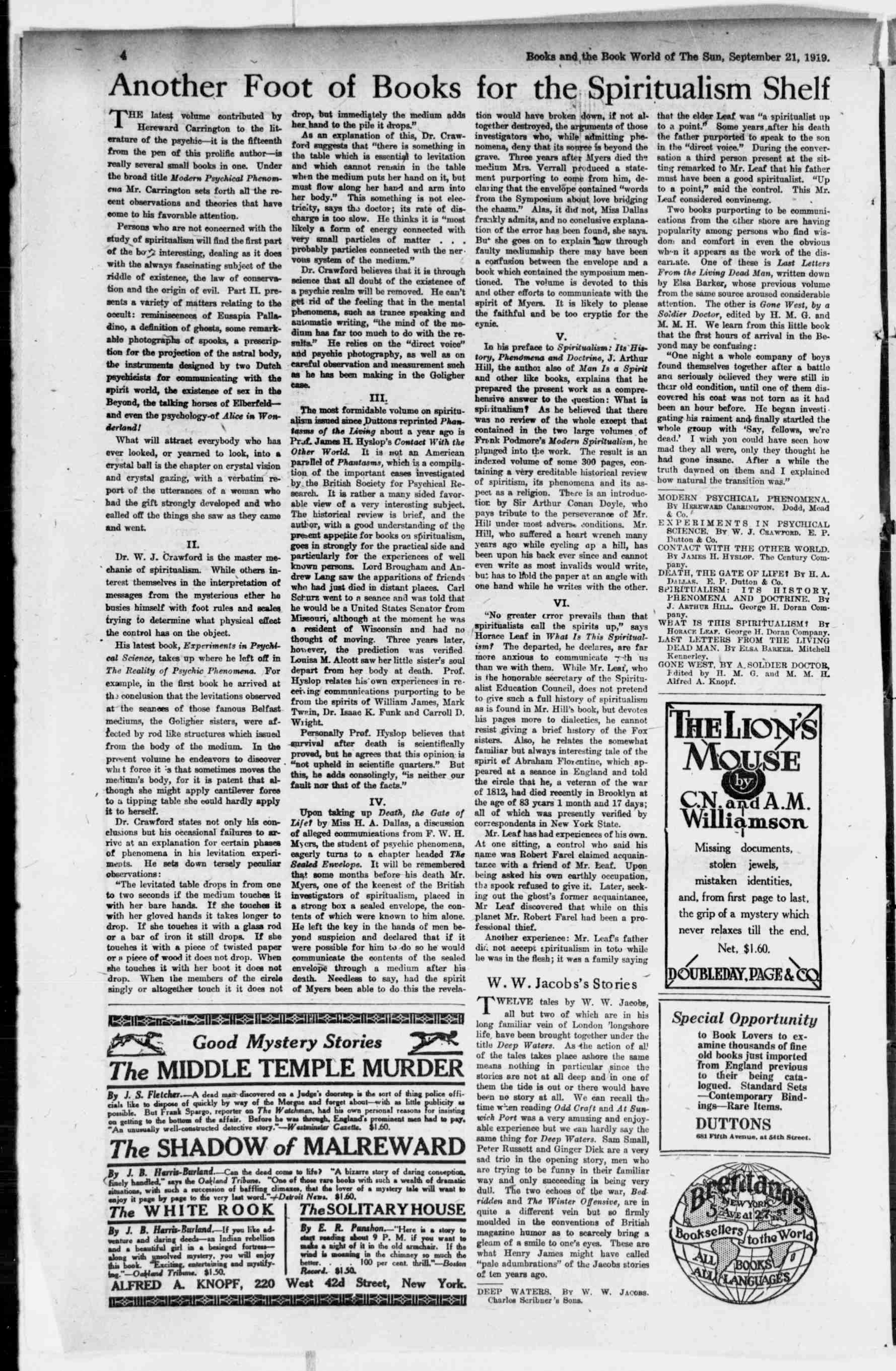
On November 16, 1919, someone named George B. Parks notified what was then called The New York Times Review of Books that a book purporting to be a war memoir was so factually inaccurate that it couldn’t be non-fiction.
George B. Parks was undoubtedly correct. The book he was examining is only 84 pages long, and in that tiny intimate volume the facts stand out only because they are so few and so vaguely described. On the other hand, an extratextual fact, this one startling, is that as of November 1919 this book had already been in print for a full year. Just days after the end of the war, the Times had announced its publication this way.

The book was so well received that its author eventually came forward and identified herself as the journalist and writer of children’s books Grace Duffie Boylan. The facsimile published by Forgotten Books bears a title page date of 1919, and the digitized copy at Archive.org bears a title page date of 1920.
But why? The book itself is not just vapid but almost totally empty. In heaven, wirelesses the dead soldier to his mother, the souls in khaki do, you know, stuff. They have dogs and cats and horses to keep them company, and the dogs travel busily back and forth between the astral plane and the terrestrial but the cats are looked on with suspicion. No reason for this is given. However, we do specifically learn that everybody spends time discussing the text “They shall be one flesh.” What the doughboys in the clouds wonder is: if a woman has been married more than once, with which one of her husbands will she be reunited in Paradise?
(Grace Duffie Boylan herself was married four times.)
—
Well, the answer to the question “Why?” is in the history books. It isn’t surprising: in the horrible stillness after the guns of the Great War went silent, millions of readers went gleaning for grains of comfort in bookstores, where businesspeople were waiting to accommodate them.
 Click to enlarge.
The same thing had happened after the Civil War, when Elizabeth Stuart Phelps’s consoling theological fiction The Gates Ajar provoked Mark Twain into a full-length parody, Captain Stormfield’s Visit to Heaven.
But you wouldn’t read The Gates Ajar or Thy Son Liveth the way you’ve read my paragraph of literary history about them. The consolations of Thy Son Liveth were made available in 1918 and 1919 and 1920 by the respectable Boston firm of Little, Brown, and Company for the reasonable price of 75¢, and of course it was a large predicted multiple of 75¢ that motivated the literary labor of Mrs. Boylan, Mr. Little, and Mr. Brown. The old-fashionedness of that symbol ¢ is the kind of topic that literary history is loquacious about, but emptiness in the heart of a grieving mother is mute. Around the wordless emptiness there bustle George B. Parks and the journalists of the New York Times and Sun and assorted Little, Brown businesspeople, but by contrast with their cheerful realism (“Another foot of books for the spiritualism shelf” [laughs]) the emptiness is only darker, more unimaginable, and more mute, if there could be degrees of muteness.
—
Ten years earlier, a vast excavation was being hollowed out under New York for the new Grand Central Station. As fast as it was created, it was filled again. In this hole, life was ongoing. As of 1908, someone looking at it through a fence might have felt exhilarated on behalf of the excavation’s embodiment of life growing up toward the light from deep in the earth. But ten years afterward, Grand Central was complete and its newsstands were selling fictions purporting to speak in a language from beyond the grave. The excavation had been completed by then, and light no longer shone into it.
 Detroit Publishing Company Collection, Library of Congress, http://www.loc.gov/pictures/item/det1994001893/PP/
Photoshopped. Click to enlarge.
New York, November 20, 1908: manifestation of a term that has not yet become historiographic


Source: “Lusitania docking at new Hudson River piers.” George Grantham Bain Collection, Library of Congress, http://www.loc.gov/pictures/item/ggb2004002950/, http://www.loc.gov/pictures/item/ggb2004002951/, and http://www.loc.gov/pictures/item/ggb2004002952/. Photoshopped.
Heraldic
The photograph’s composition is unbalanced. The building on the left isn’t matched by anything comparably massive on the right, and the line of people extending all the way from margin to margin has no margins of its own. The people aren’t arranged in any obvious order, either. Some of them are looking at the harbor scene in the distance but others aren’t.
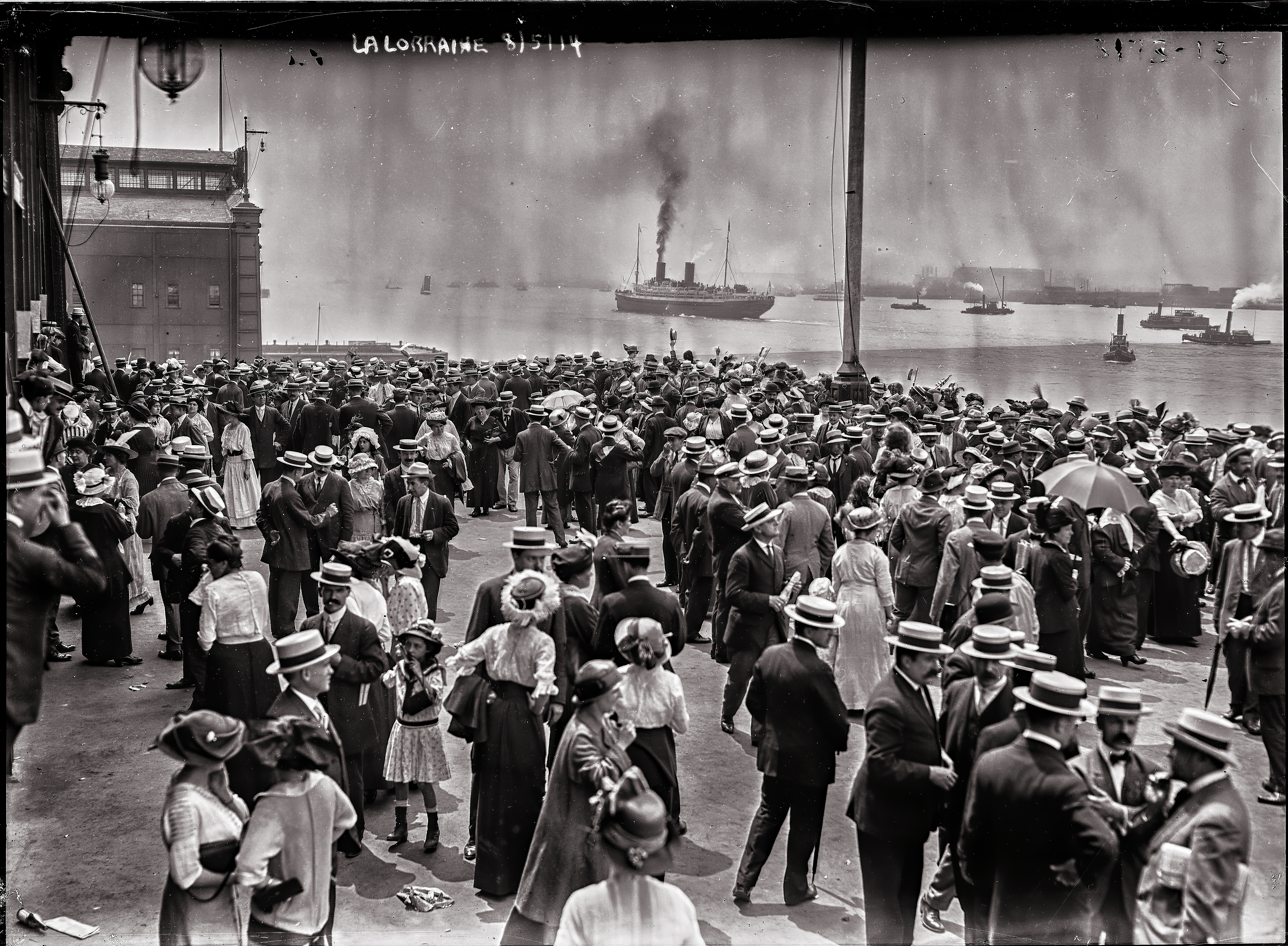
Within the image, we can see only detail by detail, each sub-image in isolation from the rest. It will take some help from literary cliché before we can even decide what’s represented by the details. In the crowd, for instance, there does exist an image of a skipping little girl in antique clothing, her feet poised forever above an item about to be swept away and a matched pair of shadows that will vanish likewise when the little girl skips away.
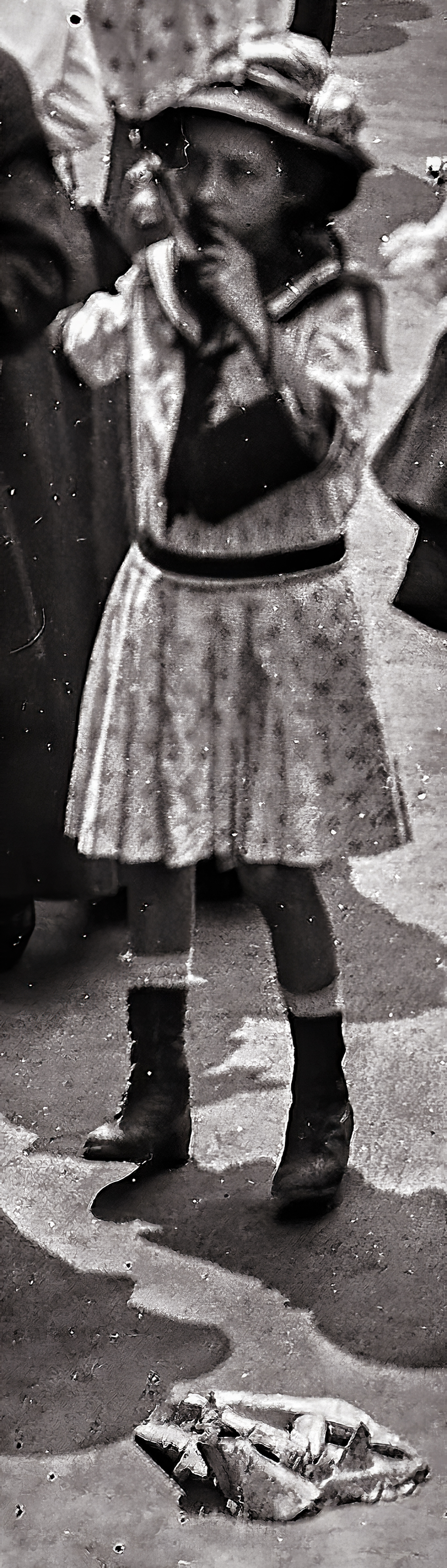
Counterbalancing that eheu fugaces platitude is another. No doubt, says this one: All the world’s a stage / And all the men and women merely players. In the play, a cynical emphasis falls on the “merely,” and here in the imaged crowd stands a predictable allusion. This one’s task is to illustrate man’s stage 6, the one named Pantaloon: his youthful hose, well saved, a world too wide / For his shrunk shank.

And all of this is too easy. Platitudinous moralizing is one of the clichés routinely evoked by street photography and its photographers. Look, cry Diane Arbus and Bruce Gilden: people suffer, and I laugh at them!
But here’s a third detail: one that barely shows us any people to laugh at, one before which moralizing and sadism slip away and evade our desire to be made to laugh or cry. Yes indeed: why are some members of this crowd still waving to the distant ship? They must know their signal can no longer communicate itself to anyone on board. What they’re doing isn’t even laughable. It’s only indefinable.
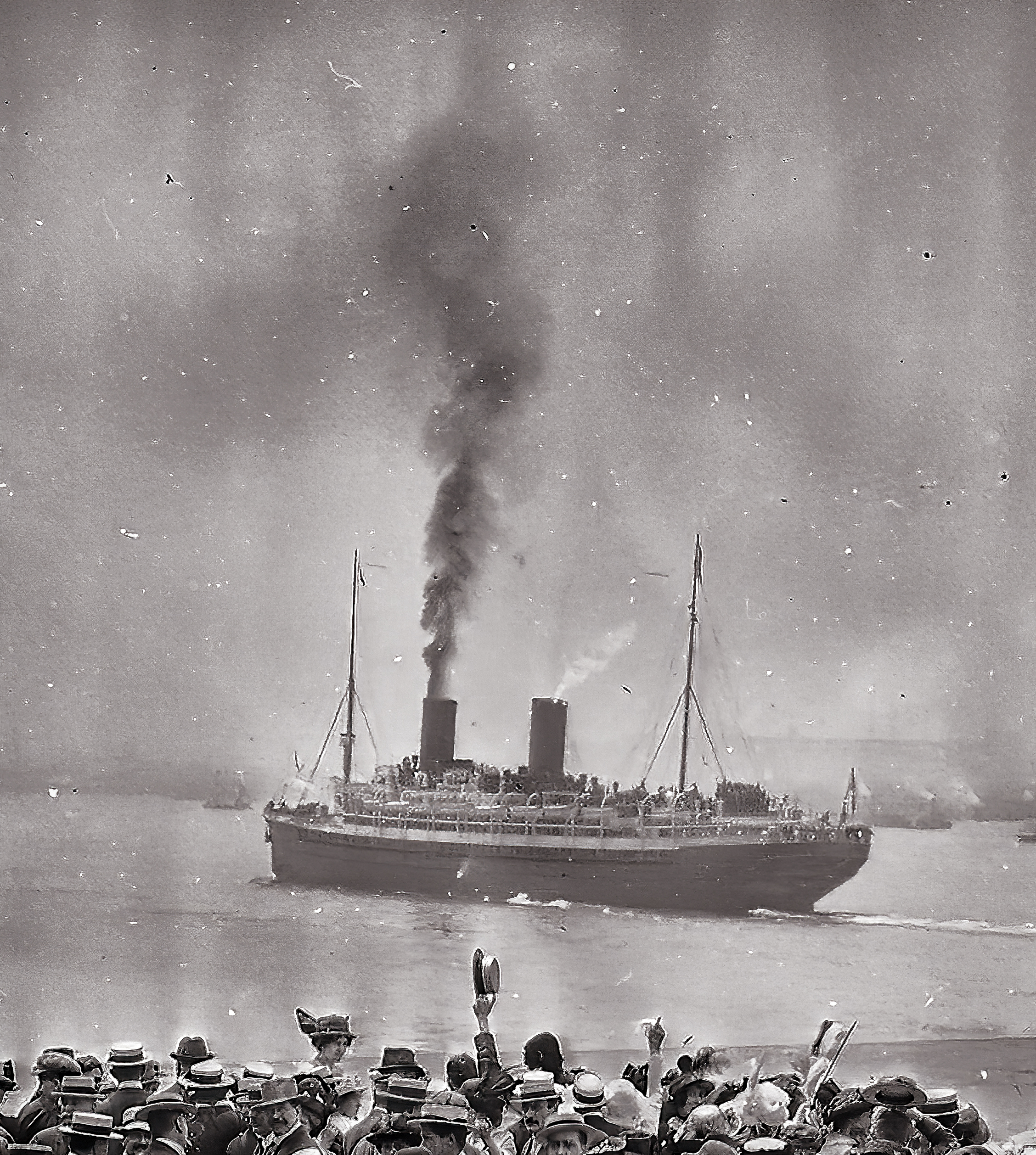
Well, language can help with at least that. Language asks us to take note of the barely legible words at the top of the image — “La Lorraine 8/5/14” — and then entrust ourselves to what lies outside the image frame, in the world. There in the world, some words preserved in a library can begin breaking the news that the cryptic inscription refers to the French Line ship La Lorraine on a date in the twentieth century. Furthermore, the date refers to far more than a mere maritime timetable, and the maritime business being transacted isn’t what is transacted on other days. The harbor is New York, the French ship is carrying French reservists home from the United States, and as of August 5, 1914, World War I is about to begin. Something henceforth central to history has begun occurring.
Heraldry, a visual genre of literature, has a technique for creating analogues for centrality. On either side of a genealogy chronicled across generations by a coat of arms, heraldry often places allegorical human or animal figures which face the symbols of history and encompass them with images of the living. Standing between the changing symbols at the document’s center and their not yet changed interpreters at the edge, these figures are called supporters. Signifying in their own representational way, they stand beside and second whatever it is that abstract symbolism seems to have to say.

And look: just before the photographer of August 5, 1914, set down for history his wide-angle memorandum of crowd and departing ship, he was able to move in for a different view: a tight shot sustained by supporters. That image, too, is still readable in the library. We could look it up, for instance, in a textbook of photographic composition. Unfortunately, however, the chemistry of decay has reduced the image’s central element to indecipherable glare.
 But it is recoverable. There, flanked by supporters, two lovers are now seen to part. Wordlessly, the unsupported central part of the image tells us that much.

And the supporters tell us the wordy rest. The supporter on the left may see the camera, may even understand thereby that his allegorical function is to represent the idea of a communication that has begun and will end in a single instant. But the supporter on the right has no need for either the lovers or the image into which they are about to enter. Holding his American flag and his Royal Navy ensign, he is looking straight ahead toward posterity. He is the custodian of the part of this image that is about to vanish. He is in charge of that which tells its story outside the image frame, in the library. On his side of the frame, the intent is to reassure. Don’t worry, say the supporter’s flags, waving to us spectators at the image’s front margin. Don’t worry; wave your summer hat at the ship. Don’t worry; we two wave and these two live, forever.
Only the decaying center where the lovers are would suggest otherwise.
Sources: George Grantham Bain Collection, Library of Congress, http://www.loc.gov/pictures/item/ggb2005016973/ and http://www.loc.gov/pictures/collection/ggbain/item/ggb2005016965/. Post-processed for contrast and detail.
Estampe IV

Source: “Eitel Friedrich, United States Navy. German ship taken over by U.S. crowded with crews of captured ships.” Harris & Ewing Collection, Library of Congress, 1915. http://www.loc.gov/pictures/item/hec2008004472/. Photoshopped.
Estampe III

August 9, 1914: at the beginning of World War I, the American Line ship New York arrives in New York from Southampton, having departed from an England not yet at war.
—
In Southampton, the New York had become an interesting footnote to the history of tragedy two years earlier, on April 10, 1912, when suction generated by the propellers of the departing Titanic tore the smaller ship from its mooring and drew it toward the Titanic’s stern. Only skillful ship-handling by the Titanic’s Captain Edward J. Smith averted a collision and allowed the Titanic to resume its journey toward the iceberg. That enriches the New York’s log for April 10, 1912, with irony. By comparison, the log for any other day in the ship’s long history (1888-1923) might as well be blank.
So this second image of the New York on August 9, 1914, is all but meaningless to the kind of history that consists in a log of things seen. The second image was taken closer to the ship in space and time, but proximity has left little ironic context within the image frame for a log’s words to work on. If anything, the camera’s privileged proximity has erased the rest of the contextual universe from consideration. Unlike the first image, this one fills the visual field solely with itself. There, it is nothing but a view of morally neutral steel, and of some human flesh seen in incidental connection with the steel.
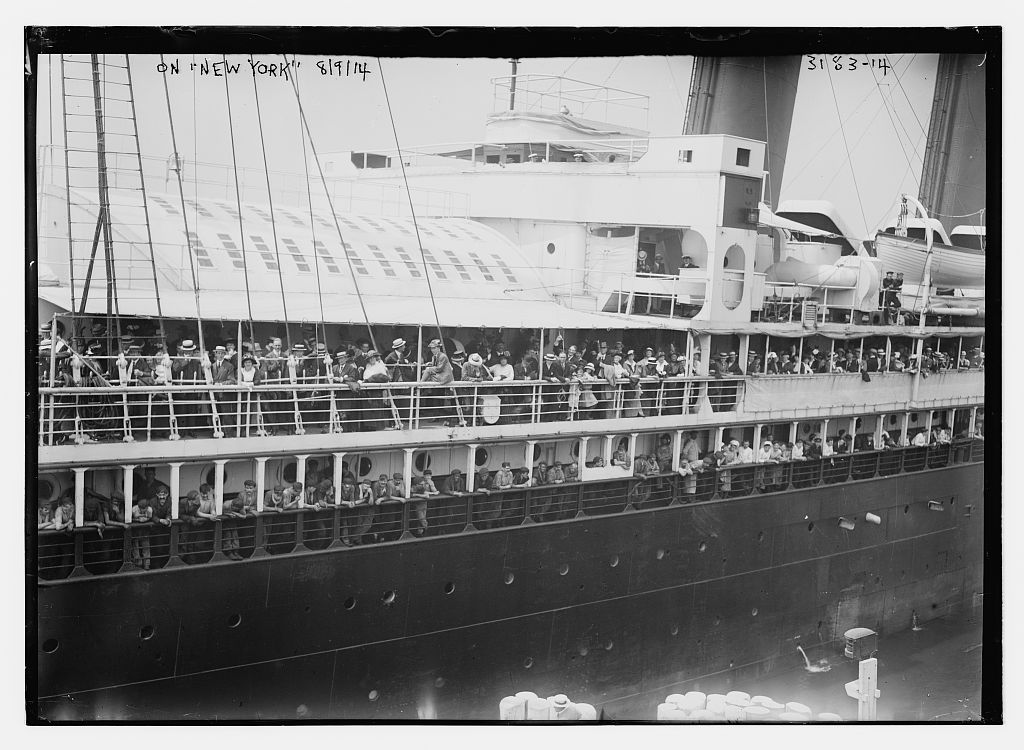
But look anyway at these smiling faces steel-engraved into the image. They are among the first refugee photographs of the Great War, and that is their claim on us and on memory. The claim isn’t visible within the image, however. Under that limiting spectral circumstance, the bodies pressed against a port-side railing on board the New York can be seen now only as representations of what is not present to the eye. As of August 9, 1914, in New York, the war zone is still elsewhere. We see the faces that have arrived from there, but as of August 9 we’ll never yet be ready to understand what there will look like and how history will remember it.

Instead, we (don’t we? don’t you?) scroll back up to look again at the pretty ship New York and its busily helping tugs, two of whom have names we can make out: Claremont and Excelsior. Excelsior is the motto of New York State and also the title of an easy-to-read inspirational poem by Longfellow, composed during an era when great ships were being strenuously conceived. But August 9, 1914, was one of the dates when reading poetry began getting harder. If you come close enough now to this picture of a ship approaching land, you may feel the little zephyr of a closing book.
—
Sources: “NEW YORK arrives, 8/9/14” and “On NEW YORK.” George Grantham Bain Collection, Library of Congress, http://www.loc.gov/pictures/item/ggb2005017039/ and http://www.loc.gov/pictures/item/ggb2005017040/. The two larger images have been photoshopped.
Mercenaries: St. George and his horse enlist on opposite sides of the Great War


Translations:
The text of the Russian poster, created by Georgi Pashkov and published by the provisional government in 1917, reads, “Subscribe to the freedom loan. The old system is defeated. Build a free Russia.” But the loan was a war loan.
The text of the Austrian poster, created by Maximilian Lenz, reads, “1914-1917. Subscribe to the sixth war loan.”
Rolling stock
1
This poster dates from 1915. In it, beside the artillery insigne on the boxcar belonging to Russia’s Northwest Railroad, a printed word says “Supplies,” and below that a chalk scrawl says “Due,” in the sense of a bill that has to be paid. In that picture and those words, the image illustrates the idea of a weapon being trundled through a snowy landscape toward the completion of its purpose. Like the picture on a banknote, it realizes one of the transactions which it is the business of a government to execute. Below the picture, a caption educationally adds: “War loan, 5½%. The more funds, the more munitions and supplies, the sooner the victory.”
 Source: http://blog.vintascope.com/post/100172424646/russian-poster-wwi-051. Photoshopped.
Not long after this edition rolled in its thousands out of a press, a different train delivered Lenin to the Finland Station, and then all those who had trusted that the Czar’s word was his 5½-percent bond lost their investment. Ironic interpretations followed. To the designers whose political labor brought this poster into existence, history was something toward which to roll. It was a future at the end of a line. A century later, we might read the poster differently — for instance, as an allegory of the term “wreck.” According to such an interpretation, wreckage may not be visible on the surface of the poster, but catastrophe always has been implicit in the design.
2
In Peconic, Long Island, New York, on March 3, 1942, a train collided with a car. At the site where I found this image of the aftermath, someone has taken care to note that the woman driving the car wasn’t injured.
However, matters of life and death aren’t the primary concerns of this page, because it is a picture history of the Long Island Rail Road. Asking us to read images as if we were not living men and women but creatures in a picture, this history deploys its picture archive only to direct our attention away from our lives and toward to a text. In turn, the text enters a strictly numeric register as it chronicles the beginning and end of the little station bearing the name “Peconic”: built, August 1876; torn down, April 1942, just a month after it was pictured with boarded-up windows across the tracks from the damaged automobile. For a moment during that interval, a train with a caboose passed down one of those tracks between the abandoned station and the wrecked car. For the duration of that time, someone in Peconic could have seen in the distance the smoke from the train’s steam engine. Both the caboose (an obsolete piece of rolling stock) and the steam engine (another obsolete piece of rolling stock) are gone now, of course. We’ll never see their like again. But the only thing in this image that can now matter to the text called history is the building’s unpicturable abstract hic jacet: 1876-1942.
 Source: http://www.trainsarefun.com/lirr/peconic/peconic.htm. Photoshopped.
3
“Nothing beside remains,” as the traveler from an antique land reported to Shelley. But the antique land itself pleads:
Credit this photo: State Archives of Florida, Florida Memory, http://floridamemory.com/items/show/157308
(please include photographer’s name when noted).
The photographer’s name isn’t noted, so I can’t grant to his memory what is due. But as if my word were my bond, I can at least point at the anonymous text appended to a dateless image found in the archive and say:
“Look. The words printed above it say, ‘Woman and girl stand near the train wreck — Lloyd, Florida.’”
The words — either my words or the words I’m now writing about — mean almost nothing. Outside Lloyd, Florida, at some unspecified time during perhaps (to judge from the clothing) the 1940s, they are probably all but lost to the text of history. In the phrase “the train wreck,” the definite article the can’t be read now as anything but a symptom of delusion. The train wreck? What train wreck?

But in the interstices between what the text of history designates as events, it’s still possible for light to fall, and for sight and memory to account for that other, wordless event. So long as we remain near the wreck ourselves, we wordlessly know it.