Locket

Two of the soldiers have lost their faces to motion, and the form of a third, passing rapidly behind a shroud, has been reduced all the way to blur. Simplified and diminished, he will never again be anything except a blemish on his own record. If we’re even to imagine visualizing him as a man, we’ll have to work outside the photographic values of his image frame — for instance, at a carrel in an archive.

As it happens, some carrel labor has already been expended because this image is already resident in an archive: the archive of the city of Vancouver, British Columbia, where it has been enrolled in history with a caption (“Empress of Japan leaving for Vladivostock [sic]”) and a tentative metaphysics: “Date(s) [ca. 1919] (Creation).”

http://searcharchives.vancouver.ca/empress-of-japan-leaving-for-vladivostock

The archaeologist who descends to the sub-basement of such an archive and begins to dig there will be able to unearth nothing but history. The artifacts that come to light under the fluorescents of the archive will be visible only in history’s delimiting temporal way: by reference to what lies buried in time before them and what will be interred in time afterward. Immediately, in the present, we are in the act of seeing something in the pit, but it’s the nature of archives to defer the understanding of what they show us. In the archive, everything that once was seen in unarchived immediacy has passed under an opaque patina of memory and explanation. When we try to get closer to the formerly immediate for a second look, that new outer layer will repel us. We won’t be able to understand how the light falls in this image, for instance, unless we can chisel it free from the archive’s scrupulously blurring word “Circa.”

Fortunately, the archive also provides us with a chisel. The moment they passed under archival control, everything in and around this photograph — the military uniforms, the date, the words Empress of Japan and Vladivostok — were organized by archive into an extra-photographic history — in this case, the history of the allied expeditionary force to Siberia that attempted to intervene against the Bolsheviks during the Russian civil war. Once we’re equipped with information like that, we’ll find it easy to chisel our way through the stacks to (for instance) a University of Victoria website called “Canada’s Siberian Expedition” at

http://www.siberianexpedition.ca/story/index.php

And there we’ll be able to work on the archive’s replica in words of what it may be that we once saw in an image: a ship on whose deck soldiers sit and stand and vanish into blur. As the archive built its facsimile man by man, it became one more document in the archival literature whose one story always ends, “As if they were still alive.” There in the archive, a caption now carols that the replica ship is, and will be as long as the archive endures, that which history has lovingly named, forever! Empress of Japan. In token thereof, the archive has also bestowed on the ship a choice of instants of namable, rememberable being: either October 11, 1918, or February 12, 1919, the only two times in history when the pre-facsimile Empress of Japan, carrying soldiers, weighed anchor in Victoria and set out for Vladivostok.

Heartened by feeling ourselves closer to something that existed before it could be archived, we may now try to see one of those two instants in detail. We might begin wondering, for instance, what the people in this image said when circumstances brought them together for a shared last moment under the rainy sky of Victoria, British Columbia. Did they talk about, for instance, the weather? As soon as we think that particular trivial thought, we’ll notice that nobody in this picture is bundled up against the cold, and then we’ll be all primed to join the men on the ship in some ice-breaking gossip. From the archive at

http://climate.weather.gc.ca

we’ll learn that there was no weather station in Victoria in 1918-19, but just across the strait in Vancouver the high temperatures for the two possible sailing dates of the Empress of Japan were 13.9 C (57 F) on October 11, 1918, and 5 C (41 F) on February 12, 1919. Welcomed into the archive and accessioned into the stacks surrounding the replica ship, this sociable little pair of new readings on the thermometer could fill out a whole archival newspaper. The paper’s fashion writer, for instance, could point out that the models shipping out on the replica are dressed for a cool fall day, not a cold winter day. Fine distinctions of couture will have acquired a significance, and that acquisition will reduce the degrees of historical freedom within the image’s range of datability to near-zero. Because the men’s hands are ungloved, their picture was almost certainly taken not in February but in October.

The paper’s feature writer could then check with other dates in the archive and report back that the photograph’s October reality grants it special historiographic status: the unique depiction of the very first departure into history of the Canadian expedition. If that still seems trivial, a future book reviewer suffering from Titanic in the head could hit the keystroke combination for Sentimental and alert us by bulletin to what would happen one month to the day after October 11, 1918: the end of the Great War. Sooner or later, right? we’ll be able to stop talking about the weather and move on to important things.

But somehow I can’t think of any important things. Stuck in the archive, I’m still just killing time by talking about the weather before the ship leaves and we can start getting lurid about the Bolsheviks. 

After all, my insensitivity is not unreasonable. While the replica is still pierside in the archive, the archive will cautiously remind us that Canada’s part in the Siberian Intervention of 1918-1922 was only a token contribution which ended after six months without a single Canadian death in combat. On the other hand and not a part of the reminder, Rasputin . . .

Now that was an interesting story. And the smudge of the barely worth remembering that’s now stuck to the top of my blogpost is also tiny.

In the course of time its history has suffered entropic loss, too. With Photoshop I’ve been able to reverse some of the chemical damage. But because the image and its story were never anything but small, I can’t restore them to a life-size that they never possessed. Try to enlarge your understanding of the little you can see and it will immediately vanish beneath pixelation and blur. Out of sight under the blur, the image’s many men and one woman must remain beyond the reach of archive’s power to grant eternal life in replica. The real collective image of their fraction of a second in history will continue being unseen in the dark. It will remain the archive’s secret.

And locked within its tiny casing will remain one more secret, image’s own: a knowable visible enlargeable generalizable meaning permanently sealed against being understood as what it once, for a fraction of a second on October 11, 1918, was.


Spiraling into control

The military postcard from World War I is completely covered with preprinted words. In nine of the languages of the Austro-Hungarian Empire – German, Hungarian, Czech, Polish, Ukrainian, Italian, Slovenian, Croatian and Romanian – the words warn a sender not to blemish the mosaic of themselves by adding even one word more.

The mosaic’s surface is perfect in the grammatical sense of the perfect tenses, which get their name from the Latin word perfectus, meaning “completed.” If we could see through the surface into a space not yet perfected, we might be tempted to top it up with words expressing completion in a future – for instance, “By the time you read these words, I may still be alive.” But a sentence like that would be nonsense. In the aftermath of the card’s preprinted now-and-forever Ich bin gesund, it would be like Chomsky’s “Colorless green ideas sleep furiously”: grammatical but meaningless. It would depend for its significance on the logically incoherent idea of a history with a future.

Therefore a military censor put a stop to the nonsense. In advance of whatever future is rationally conceivable, he ordered the postcard’s printer to fill in every unfilled space more than one character wide. His chosen blackout medium, too, was not mere amorphous ink, the raw material of writing, but a pair of already finished dingbats. The dingbats are spirals: one turning to the left in its line of text, the other to the right. They belong to all of the card’s nine alphabets but to none of its nine languages. All they do is execute self-canceling semicircles, clockwise and then counterclockwise. Pure wordless form, they communicate their one-letter Archimedean meaning only to themselves. But as they execute their pivot left and right, tessera by tessera, they assemble themselves into a sequence, deploy across the card’s surface, and join into a mosaic entanglement. To write past or around or through that, a soldier would have to cut through as if it were barbed wire and his only cutting tool were a scraper for clearing space on a palimpsest.

Mobilized line by line and made into a text which says nothing and enforces the saying of nothing, the meaningless little letters have spiraled into control of the card.

Source: http://historicaltimes.tumblr.com/post/140789125122/slovenska-zgodovina-during-the-first-world-war. Translation of the central and peripheral blocks: “I am in good health and doing fine” and “No other communication may be made on this card.”

Regina in the Tarnhelm

By the summer of 1922, ten years after the event, Meyer Wolfsheim had shaped its memory into a well formed, well rehearsed narrative, organized classically into beginning, middle, and end. “The old Metropole,” ran Mr. Wolfsheim’s beginning. “Filled with faces dead and gone. Filled with friends gone now forever. I can’t forget so long as I live the night they shot Rosy Rosenthal there.”

During the event’s immediate aftermath, of course, the classical hadn’t yet gone into effect. The very long article that the New York Times published on July 26, 1912, for instance, couldn’t settle down to its storytelling until it had jittered and rasped its way through a pre-classical lead-in groove communicating little more than surface noise. That was the pre-narrative sound-effect analogue of a stage direction reading, “Time: the present.”

Likewise, the contemporaneous photograph that accompanied the article was little more than beginner’s literature, with content predetermined by a didactic caption right up top and a moral communicated by a pair of overly obvious symbols: on one side of the image’s woman protagonist a dark portal, on the other a sign proclaiming, with sweatily indignant irony, “Tables for ladies.” The picture story’s supporting roles, too, betray negligence in the casting department. Pigeontoed gumshoe in ill-fitting suit, bald and distressed proprietor wanting to get back inside: the hiring decision that brought these types onto the scene was 9-to-5 hackwork. This photographed setting is just a trailer for a story that (the picture promises us) is fully communicated somewhere else. It satisfies nothing but whatever demand there may be for an illustration of the words “Dodging camera.” In a composition that amateurishly cancels out the overdetermined with the unseen, can Rose be more interesting than the dark behind the door to her right?

But now submit the image to the discipline of the classical. Delete the dark, for instance, and make Rose symmetrical by arranging for her to become a center. Then see:

The delicate mesh purse, the clutched glove, the ungloved fingers daintily curled beside the daintily tenacious thumb and index, the drooping plumes atop what was called, at the time, a picture hat . . .

Seen now merely as she is, freed from the interpretive shackles of her caption, Rose has become fully visible. Now the details of her image have acquired significance and become character attributes. They are honest agents of their protagonist now, working hard to conform themselves to the Aristotelian unities. A photographer has caught them in the act of policing themselves into subordination to the art of the photograph, which is the art of being caught in the act.

On a stage somewhere else, perhaps in the same moment, an artist in a different medium is making cognate gestures in obedience to the discipline of his own art. This artist is a worker in sound, but at the moment he has become quiet —

Vorsichtig löst er den Helm und hebt ihn der Schlafenden vom Haupte ab: langes lockiges Haar bricht hervor. Siegfried erschrickt.

(He carefully unfastens the helmet and lifts it from the sleeper’s head. Long, curling hair pours out. Siegfried is startled.)

— and as we watch, his silence pours from the stage, fills the theater, and becomes another episode, this one silent, of the story noisily illustrated elsewhere by a photograph and a set of stacked headlines. There on the sidewalk in front of Hanover Lunch, the corresponding part of the story turns out to be an American translation of the moment when the warrior woman Brünnhilde was put to sleep somewhere in Germany, there to await the future.

Looking at the photograph, we may still think it differs from the opera. But the classical organization of detail is the same in both works of art, and perhaps the only significant reason for difference is that the art of helmet-making underwent changes between Wagner’s time and, say, Otto Dix’s. In the days of the helmet-shaped picture hat, a single image of the deathly still could be beautiful enough to startle a heroic tenor into silence. Ten years later, it was only the subject of a picturesque anecdote told by Mr. Wolfsheim to his indulgent young friend Major Gatsby, who had already seen the sights from under a helmet of his own.


Source: George Grantham Bain Collection, Library of Congress, http://www.loc.gov/pictures/collection/ggbain/item/ggb2004007790/. Photoshopped.

Prewar incident: from the last moments of visage

In the far distance, seen from the American side of the Atlantic Ocean, the squabble seems almost comical. Little, of course, did the New York Times know what was about to start happening in the neighborhood of the zeppelin hangars, and so the Times’s editors saw no need to drive home their point any further by illustrating it.

But the image of what was to come was already in place and already signifying as hard as it could. See, in the image, the forms hovering impatiently on the ceiling of their barn, already fledged in streamline and about to slip free and feral.

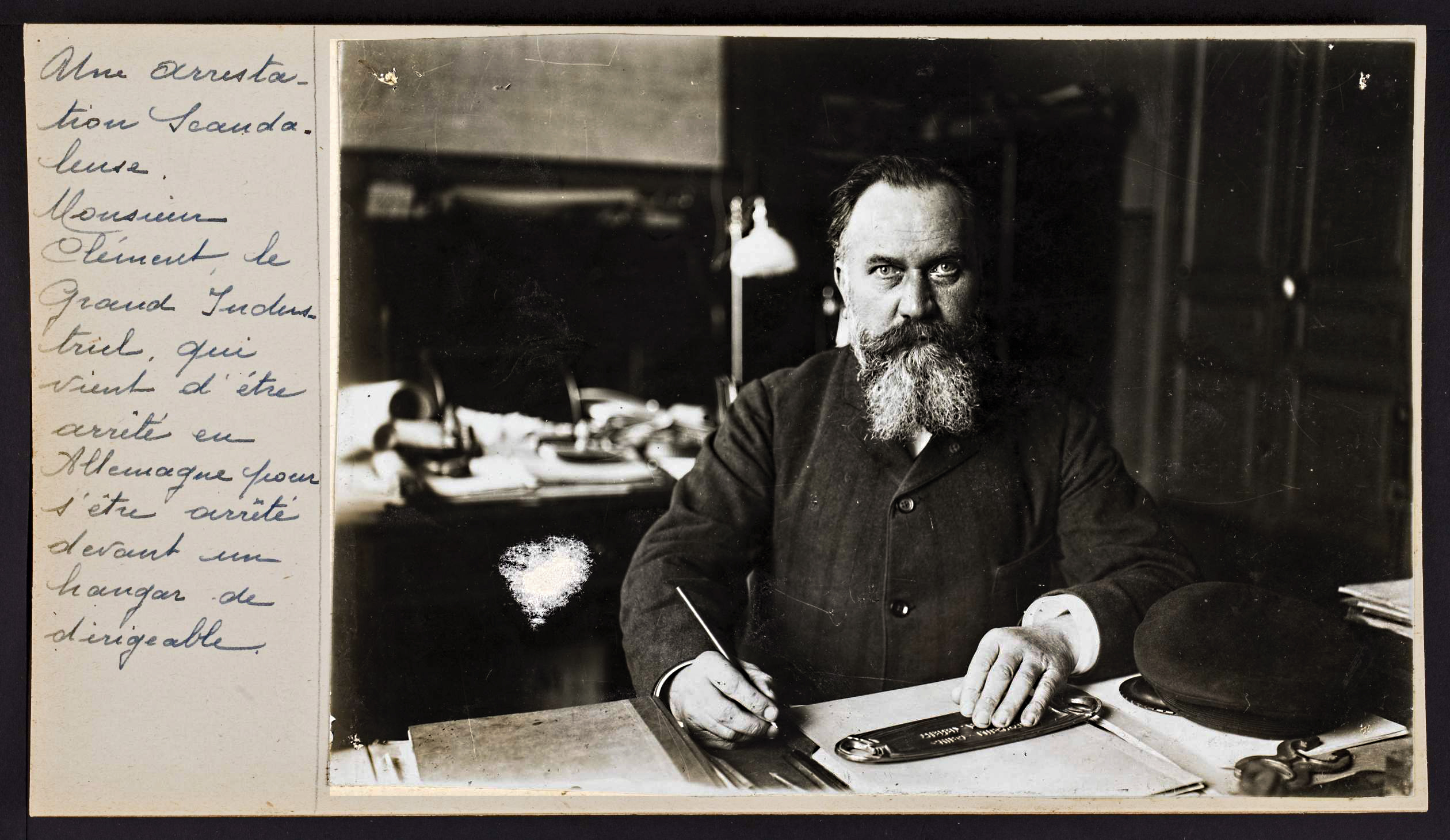
Translation: "The arrest of M. Clément in Germany. The hangar before which M. Clément was found at the time of his arrest."
Translation: “The arrest of M. Clément in Germany. The hangar before which M. Clément was standing at the time of his arrest.”

In the image, all but a few of the men who do see have their backs to the camera. They are looking up toward those ridged cylinders as if they’re waiting for them to emerge, cast off, and mount. They understand the cylinders’ purport. They may even have been taught that they’ll love what is about to happen to them.

But the man they have sent away from the bed of ascension is understanding in a different way: actively. His traveling cap is ready to don, he is holding a writing tool in each hand, and his eyes are in the act of piercing.

Translation: "A scandalous arrest. M. Clément, the great industrialist, who has just been arrested in Germany for having stopped in front of a dirigible hangar."
Translation: “A scandalous arrest. M. Clément, the great industrialist, who has just been arrested in Germany for having stopped in front of a dirigible hangar.”

Without the beard that grows beneath, they would be only eyes in a face — say, a face fronting one of the derbied Germans who have so deeply failed to interest the camera in themselves. With the beard, M. Clément’s face becomes an emblem of the time before the dirigible and the Freudian reinterpretation of will. During that long but abruptly vanished prehistory, men didn’t just face the camera when they posed; they faced the camera down. With their sensitive mouths covered deep under layers of masculine muff, some men of the last moments before the Great War seem actually to have believed that the momentarily living self they showed to the finder could be a visage, hard and glittering as a face self-sculpted in stone.

Source: Université de Caen Basse-Normandie, https://www.flickr.com/photos/universite_caen/15232404609 and https://www.flickr.com/photos/universite_caen/15232404839. Photoshopped.

Verso separates from recto

Because it is now a part of the collection of a great library, this demotic little document wants to be read on the library’s terms. These terms include the bibliographical words “recto” and “verso”: words that weren’t part of the card’s language when it was, so to speak, a card. There were immediacies to those communications which are gone now, and reading the card under library discipline can’t bring them back. There can be no feeling left to revive in the recto’s image of the beneficent Czar or the verso’s words about a dreadful bad cough. But feeling’s literary history can grow from the tomb under the gentle rain of additional information.

Initial information, then: in 1920 the card was written by somebody named Clara Leavitt to an address in Maine, and its phrase “dreadful bad” in the verso text is a Maine idiom. Knowing that much, I can begin assembling data into a shadow biography of the woman who wrote “dreadful bad.” In 1920, say some of the data, a Clara L. Leavitt, aged 24, was living in the village of Waldo, Maine, at two addresses: one on Sheldon Road, the residence of her parents, and the other on Patterson Road, where she worked as a housekeeper for a man named Roy C. Fish. Clara the housekeeper’s spelling is a little shaky, but her handwriting is assured and her language is clear: perhaps a testimonial to New England’s high educational standards, perhaps also a sign of what Clara actually was. And Waldo adjoins the town of Belfast, so now I can guess that the word “Belfast” is what the card’s postmark was trying to say to the historical record at 5:30 PM on February 4, 1920.

In New England in the early twentieth century, villages too small for a post office were the bleak settings of ­Ethan Frome and Edwin Arlington Robinson’s poems: something like orphanages for life, where life ended soon. In Waldo in 1920, for instance, Clara’s parents were also sheltering a seven-year-old granddaughter, Avis Leavitt, about whose parents the surviving records seem to retain no memory. She would live to the age of 56. As to Clara, she married Everett G. Payson of Waldo on March 18, 1929. Three years younger than Clara, he had been married previously to Margaret J. Gurney (1900 – ?), the mother of his daughter Anniebell Payson (1920-1923). To the 1930 census, he was a farm laborer who owned a house worth $200. Clara didn’t outlive him; she died in Belfast on April 7, 1967, probably around the time of her seventy-first birthday.

Half a century before then, the serious little Czar on the recto of her card had received his waiter’s salute. The card bearing that image was published in 1914 or 1915, but by the time Clara Leavitt wrote “dreadful bad” on its verso, the Czar had long since come to his own dreadful and well-deserved end. If that long-term change meant anything to Clara, it doesn’t show on her side of the cardboard. There on the verso, the communication seems to be only that the seasons went on – first in Mr. Fish’s home, then in Mr. Payson’s. The verso was only a blank space until Clara filled it, and when it was full she licked a stamp and brought that episode of her life to an end. But the recto wasn’t yet ready to end, because as of 1914 or 1915 it had five or six years of change to undergo. After 1914 or 1915 it never was blank, and then it kept itself busy signifying in new way after new way until the day it stopped signifying forever.

For the card, the five or six years began on the date when a courtier without a visible sense of irony wrote, “As the photo shows.”

Year by year from that moment on, people who looked at such photos actually saw less and less. Eventually they understood that the photos were going blank because they had no more to show, and then the Czar and his family were led down to the basement for their appointment with a firing squad. But what still does show amid the courtier’s now meaningless words is a trace of Clara’s pencil. Clara did some erasing before she mailed her card, but the Clara lines that remain are now going to remain forever, thanks to the immortalizing spirit of the archive. There will also remain a little segment of the card’s postmark: the black cancellation that came whamming down on the verso during the evening of February 4, 1920. That was what finally brought the change to a stop. From that moment, the card’s recto and verso would be divided between a before and an after, and the tailored little czar and the words “dreadful bad” would be separated from each other by a wall of time as opaque as a slip of cardboard.

Sources:

Winokur-Munblit Collection of the Russian Empire Postcards, Library of Congress, http://www.loc.gov/pictures/item/2012648262/. Photoshopped.

Online sources of information about Clara Leavitt:

http://www.mocavo.com/Clara-L-Leavitt-B1896-Waldo-Maine-1920-United-States-Census/09356065416247432197

http://www.mocavo.com/Clara-L-Leavitt-B1896-Waldo-Maine-1920-United-States-Census/00829956448961505575

http://marriage-divorce-records.mooseroots.com/l/76908968/Clara-L-Leavitt#

http://www.mocavo.com/1930-United-States-Census/126213/004950958/422#row-0

http://www.geni.com/people/Clara-PAYSON/6000000022524627808

Don’t read. Look in the mirror.

The historic photograph seems to display no published provenance, and its online caption is obviously a late addition. “German fraternity mirror selfie, 1912,” say the caption’s words. There are only five of them, and they offer no more reward for reading than that. No other names inhabit the caption: names of the boys, names of their corps or their university, locations of their future battlefield graves. At that, three words of the caption’s five aren’t even interesting. Online — for instance, at

http://www.reddit.com/r/HistoryPorn/comments/3bqiwg/german_fraternity_mirror_selfie_1912_1024x683/ ,

where I encountered the image on July 3, 2015 — the comment stream spawns dutiful ironies about the proximity of the phrase “German fraternity” to the date “1912,” and those you don’t have to read because you already know. Oh yes: just two years after 1912 will come 1914, and little do they know, these tragic boys in their lead-soldier uniforms. The commenters in their stream find this thought exciting, but perhaps it has previously occurred.

And whether you were among the excited or the unexcited, the idea’s bedazzling undergraduate words might almost convince you not to bother looking at the image they refer to. Nevertheless, the image still does cling to the caption’s border. Pathetically, it even tries to reach a little mirror up from the page and tempt us to look in, as if it had something to show us about ourselves. Look, it pleads; look with my help at the caption’s word no. 3 of 5, the one you’re skimmed past. In the mirror, look for an idea of mirror.

If you humor the request and do look, you’ll discover that during the instant when it made itself seen between two surfaces of a mirrored space, the camera in the picture began showing you an image and then didn’t stop. What the mirrored camera began bringing to light in 1912 is an image not only of the dead fraternity boys but of you who look at them now, you who are said to be alive.

I’ve photoshopped the faded original of this image for contrast, but I haven’t reversed its mirror property. Having been made a part of the image’s settings by the boy with the camera, that wasn’t in my prerogative to change. So the boys with their historical apparatus dated 1912 — the rifle, the bugle, the drinking horn, the scar-inflicting sword — continue looking now the way Alice looked at the moment she exited from our world. The world she entered then has grown more familiar by the day since its discovery by Lewis Carroll, but the world of this photograph is now unfamiliar henceforth. Somewhere in Germany, one day in 1912, a boy with a camera sealed himself and four of his friends behind glass and pumped out the time.

Out of time behind his glass, the boy is now holding the camera’s cable release clear of the imaging apparatus. It’s a long one; he has passed its plunger button all the way behind his back from his left hand to his right, which one day in 1912 held it up to the mirror while a last instant of pre-image history was changed with a click to something else. Something else has been among us ever since. It is the other half of our mirror image: the half that does not change and will not die.

And within its glass, bounded at the front by our world and at the back by the surface that reflects us back to ourselves, is the reaction zone where the two halves of the image, the mortal and the immortal, face each other. Looking at images every day, we cross the zone hour by hour in both directions. We’re as blasé about the daily trip as commuters, and maybe that’s why we turn away from the windows and look around our transport for something to read. If we’re beyond being moved to a sense of the real by a silent image, we may still be movable to excitement by a caption shouting at us like a CNN talker with time to kill. But perhaps there is a route across the zone that lets the traveler disembark for a moment, look around, and become alive to the zone’s interesting dangers. After all, Alice once took the route, and told us how. The secret of her itinerary seems to be a simple one, at least in principle. It may be this: just stop when the signs change to transparent.

Shadowing Domesday lines

Under fluorescent light on Philip Larkin’s desk in the library at the University of Hull lies a black-and-white photograph. Looking in, Larkin notices a midden of tiny broken English things. These he takes to be metonyms for a larger England which is about to be broken. In the image, under the famous cloudless sky of summer 1914, are men standing in lines to enlist for what is about to become the Great War. Observing the behavior of the shadows cast by the lines, Larkin writes out a forecast: in an amazingly short time from this illuminated moment, the sun will shine down on one more thing: the title of the poem Larkin is now about to write, “MCMXIV.” Then the word will be inscribed in the stone of a war memorial. But for now, in the photograph, it is not yet even a word. It is only a pre-verbal, pre-stone dust that nobody yet understands to be subject to future inscription:

. . . the shut shops, the bleached
Established names on the sunblinds,
The farthings and sovereigns . . .

A farthing was a copper coin worth one fourth of England’s old pre-decimal penny — that is, 1/960 of a pound. A sovereign was a one-pound coin made of gold. Long before England’s currency went decimal in 1965, both coins had disappeared from circulation — the farthing because its purchasing power had diminished to nothing, the sovereign because the gold it was made of had become worth more than the shrunken fiat pound. Larkin’s term for the vanished years of farthing and sovereign is “innocence.”

Never such innocence,
Never before or since,
As changed itself to past
Without a word . . .

Or, in prose: on the sunny day they signed up to die for the British Empire, the men of 1914 had their pockets full of soon-to-be-lost value. They lived before the loss began, poor innocent men, and the British Empire died with them, and now not all the antique shops in England can keep the Pakis out of Larkin’s neighborhood. For most of its length, “MCMXIV” expresses an idea, and that really is all the idea amounts to. As George Orwell remarks in “Inside the Whale” about A. E. Housman’s tragic young men in their emotionally similar situation: “Hard cheese, old chap!”

Nevertheless, all sentimentality discounted, on the other side of the brooks too broad for leaping there does lie a world different from ours. There everything in the present is seen at eye level, and the past isn’t seen but experienced by intuition. This sovereign landscape is pastoral, and its weather hints at pastoral’s delicate foreboding irony: the quality of both knowing and seeming not to know that it is a mere literary fashion.

And the countryside not caring:
The place-names all hazed over
With flowering grasses, and fields
Shadowing Domesday lines
Under wheat’s restless silence . . .

The earth-father of these Larkin lines is Wordsworth, and Larkin has obviously done the responsible thing and read Wordsworth’s report about the detection of splendor in the grass. But it’s hard to sense the grass-hazed coordinates of poetry’s specifics from on high, and during the Great War the coordinates of vision began acquiring a vertical axis. Here, then, is a counterimage to the one in “MCMXIV.” We see it from altitude, the War’s new sightline.

Onto the old world, says altitude, I have superimposed a new ruin: the aluminum frame of a German zeppelin bomber, all that remained after the zeppelin’s lifting gas burned off and recombined with its originating air. For the moment, the frame’s unburned streamlines are still contained within the rectilinear subframes of a pastoral landscape. In the poetry of Larkin and Housman and Edward Thomas and Hardy, these straight lines are taken to be metaphors for a natural order which incorporates human order into itself and makes the two orders one. Under the rules governing that genre, the only world there is is a world at ground level, seen from the height of a man. But the new ruin has begun to change that way of seeing. It descended on the land from above, and we see it now from above.

In ancient tragedy, only the gods see from above. The new image comes to us demonstrating that that’s no longer true. The original shadows of Domesday, level with the earth they were drawn on, have now been supplemented by lines surveyed from a higher angle. “MCMXIV” reads the new lines as an ironic antipastoral: not yet a new way of reading tragically, but a start.

For the start, poems like “MCMXIV” need more light, better distributed. Something verbal needs to be done, for instance, with the instance of light that penetrated for the first time into the skeleton of an airship. But time has been allotted for that to occur. After all, says the somber forecast from 1914, the new light is going to keep falling forever. With every declining sun in the century since a camera in the air first detected a fallen flightform, the lengthening, darkening, ever more almost-readable shapes of its roundness on the earth have shown us promises of more.

Source: George Grantham Bain Collection, Library of Congress, http://www.loc.gov/pictures/item/ggb2006001296/. Photoshopped.