 Source: “Am’n Ambulance Field service in Woevre Forest, Bell to warn of gas waves.” George Grantham Bain Collection, Library of Congress, http://www.loc.gov/pictures/item/ggb2005023124/. Photoshopped. Click to enlarge.
World War I
Piranesian group, 1916

Source: “Mrs. Lewis and Family,” England, September 24, 1916. National Archive of the Netherlands, https://www.flickr.com/photos/nationaalarchief/6934945744/. Photoshopped.
1914-2014

Source: “In pictures: Pulham St Mary WWI airship photos rediscovered,” 14 April 2012. Photograph by George Hamilton Wakefield, ca. 1916. http://www.bbc.com/news/uk-england-norfolk-17689509. Photoshopped.
Before history: plein-air composition with women and ship
Parasol, veil, widow’s weeds. The man in the derby may be speaking to the women, but the social group doesn’t include the second man, the one in the sombrero. Hat and all, that man is only a visual element which is adventitious to the composition. The legs are right but the face is in the wrong. At best, the juxtaposition of this figure with the other three or four is feebly ironic, with irony’s requisite little does he know minimally fulfilled by the man’s mere unawareness of the women behind him.

After all, the composition has failed to provide a reason why he should be aware. There’s no drama in this grouping. It’s mere real life.
But an artist once happened to bring the grouping into relation with a massive orthogonal structure forced into the image frame on the diagonal, and immediately a trigonometry took form along lines of sight and began instructing vision in trigonometry’s useful truths. Following one of those truths, a ship’s humble mooring line, white against black, powered itself up and began calling itself to notice. It had become entitled to visibility because it had composed itself and become part of a composition.

Forever after, then, the composition will reach out from the frame toward us, forcing vision on a triangulated course upward and away from the inconspicuous caption printed along the bottom of the picture. Even if we happen to notice the words down there, they will keep evading reading by directing the reading function back toward the image for a translation of what they don’t say. “Sept. 13, ’07,” read the caption’s abridged words, and if we look back upward from their pinched little apostrophe to the richness of the image we’ll be rewarded with an exuberance of millinery history. Here they’ll come, the parasol and the weeds and the hemlines: bursting from their closet after their term in the dark and confiding to us with happy giggles, “We are so [19]07.”
It would take a pedant to keep reading after that. For that matter, the original image in the Library of Congress at http://www.loc.gov/pictures/item/ggb2004000082/ is now so faded that the words can barely be seen, let alone read.

But yes: even in the unphotoshopped original, the first word remains visible to pedantry. It reads Lusitania.
And the moment we surrender and read, the widow’s weeds will have acquired a pragmatic force in the future tense. Precisely eight years from now, on schedule, they will become the most heavy-handed of ironies.

Fred Spear, 1915. From 60 Great Patriotic Posters DVD and Book, ed. Mary Carolyn Waldrep
(Mineola, NY: Dover, 2010)
Translated into a word in the imperative mood, the weeds will become moral. In 1907, until their picture was taken, they were a conventional index of membership in a social grouping. After they had been photographed, they became visible to viewers outside the social grouping and so took on formal meaning in the abstract calculus of visual composition. Within a few more years, Marcel Duchamp would be pushing his geometry of the female body toward Platonic invisibility with a glass model of a bride stripped bare. But in 1915 another significance pushed its way into the picture, capturing it in the name of morality with no more warrant than mere association with the not yet fully meaningful first word of its caption. To live on in the mode of that significance, as a historical memory with an associated morality, is to have become a fact: something known and believed to be real. But it’s a fact that lives only by having replaced with an idea what was once the image of a body.
Gloire
A Nerd’s World, a Toronto graphic design shop, currently holds a Verascope stereo camera used by a French army photographer during World War I, and the shop’s website has made available a collection of slides found in the camera’s case.
http://anerdsworld.com/verascope-world-war-1/
In this one, two soldiers help a wounded comrade up a hill.
 The Nerd’s World site also offers a GIF approximation of the stereo view, produced by rapidly alternating between the left image and the right.
http://anerdsworld.com/wp-content/uploads/2013/05/found-film-7.gif

Here’s a different approximation: an anaglyph. It’s still, unlike the Nerd’s World image, but its size is smaller, its resolution is lower, and the superimposition of the images has further reduced their sharpness.

Trying to improve my illusion while still holding to an idea that the past must be still, I photoshopped the slide. The image pair reverted before me to an approximation of clarity. But then something terrible happened.
My tiny original anaglyph had been fuzzy. Its low-resolution cloudiness worked against the barely distinguishable verticals of the trees like the diagonal brushstrokes in a Cézanne. The distress I felt before the picture of the suffering men, tiny figures struggling up a tilted Cézanne image plane, was therefore also an educated frisson. Yes, I thought as I looked at the blur; the Impressionists were there before us immer schon, teaching us how to see. I felt happy in my distress, as though I were sitting at the feet of Gertrude Stein and Papa Hemingway at a tutorial in the rue de Fleurus.
But Photoshop scrubbed the fuzz away. Deblurred, the trees’ broken branches stood up into their image, tiny still but now sharp and clear.

And then the didactic force that swiped the blur away slapped me back to first grade and taught me Seeing 1 over again. “Study sharpness,” the photoshopped anaglyph instructed me. “You didn’t get it right before. Learn to see outlines as if they’re clear and simple and educational. Speaking of education, study Meissonier’s trick of mixing his pigment with powdered glass to make his snow sparkle. Learn it. It isn’t just pretty; it’s glorious. Here in my tiny space there’s an army to teach you so.”

Meissonier’s didactic microcosm is, in fact, micro: only 51.5 by 76.5 centimeters. Tinily sparkling, it loomed over me with a lesson plan, and I had to learn it. Afterward, I knew for the first time what I had failed to understand before: that the way of seeing called Prewar is not dead. Alongside Apollinaire and Gaudier-Brzeska there still live Rupert Brooke and and a forever standing army of marble quarrymen : murderously undying as the idea of glory.
Hero: how to synthesize
As of September 28, 2013, the prose of Wikipedia’s article “Rudolf Berthold” pants with a breath smelling of nineteenth-century hygiene.
Throughout the summer of 1918 Berthold continued flying, increasingly relying on morphine for pain relief. Such was his strength of will he also taught himself to write with his left hand.
The image that comes to mind is less a picture than an idea, less an idea than a corpus of prose. Since the day of publication of A Farewell to Arms, at the latest, it hasn’t been possible to understand the phrase “Such was his strength of will” as anything but a phrase from a textbook. “Such was his strength of will” is language attempting to stand alone, without the aid of image.

But look at the image on its own terms, with its explanatory language (“Unser erfolgreicher Kampf-Flieger”) reduced to a remainder left flatfooted at the bottom.

Then follow the image’s hinted command, open Photoshop, and use the Dodge control on the eyes.

You must. Such was the image’s strength of will. And now you cannot stop seeing.
Budapest 1915:
at the vanishing point, sword, boot, cigarette, Franz Lehár body rhythm, towel to absorb that which is about to flow.
http://www.fortepan.hu/?&img=18059
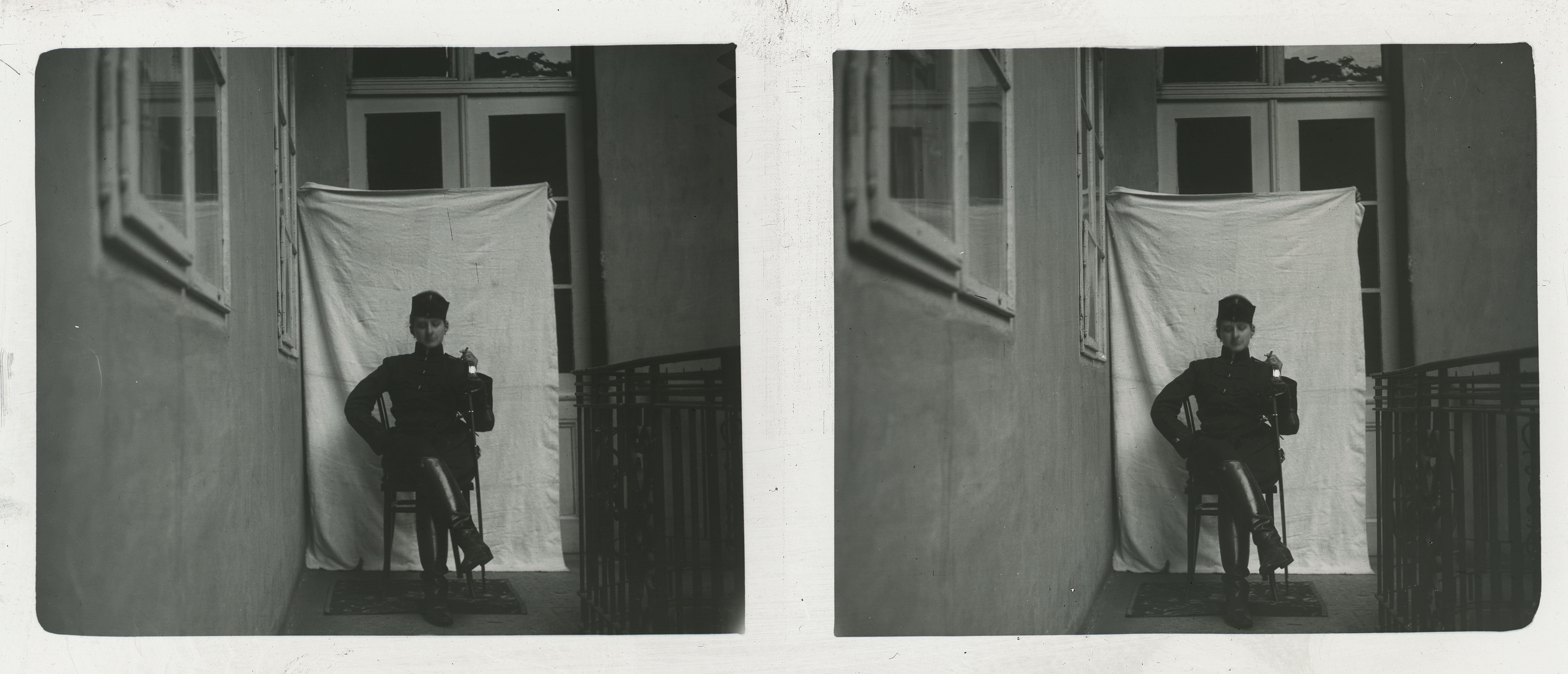

Requires anaglyphic (red and blue) glasses.
Many lips, photographed
1
From the window of Jay Gatsby’s car, Nick Carraway sees “A dead man . . . in a hearse heaped with blooms, followed by two carriages with drawn blinds and by more cheerful carriages for friends. The friends looked out at us with the tragic eyes and short upper lips of south-eastern Europe and I was glad that the sight of Gatsby’s splendid car was included in their somber holiday” (73).
2
Early in 1924, while F. Scott Fitzgerald was at work on The Great Gatsby, The Saturday Evening Post, the most important outlet for his magazine fiction, was serializing a book by the anti-immigration propagandist Lothrop Stoddard called Racial Realities in Europe. Week by week the serial unscrolled a physical anthropology of short upper lips before the Post’s readers, and it asked them to look at what was before and around them as a tragedy of the dolicho-blond.
The Nordic is essentially a high-standard man. He requires healthful living conditions, and pines when deprived of good food, fresh air and exercise. . . . Under modern conditions . . . the crowded city and the cramped factory weed out the Nordic much faster than they do the Alpine or the Mediterranean, both of which stocks seem to be able to stand such an environment with less damage to themselves. It is needless to add that the late war and its aftermath have been terrible blows to the Nordic race.
Racial Realities in Europe substantially repeats Stoddard’s earlier book The Rising Tide of Color Against White World-Supremacy, and it’s a commonplace of undergraduate annotation that Fitzgerald must have been thinking of Stoddard when he has the distasteful Tom Buchanan recommend “‘The Rise of the Coloured Empires,’ by this man Goddard” (17). If Tom views colored empires with Goddardian alarm, then perhaps (says The Great Gatsby’s communication at this point) that which will deliver Gatsby’s golden life to death may be Goddard’s Disease, malignant pallor. In the historical event, the propaganda campaign coordinated after the Great War by the racial thinkers Lothrop Stoddard, Madison Grant, and Henry Fairfield Osborn was to culminate in an act of congress, the Immigration Restriction Act of 1924, which effectively reduced the sonnet mounted on a plaque inside the Statue of Liberty (“I lift my lamp beside the golden door”) to an irony in a dead language.
3
But go back prewar and look at the photograph that illustrates Maria Todorova’s recent book review in the TLS. Most of the faces in this southeastern European street scene are broadly smiling, and their upper lips are so short that the faces have become comic masks. Mouths laughingly stretch themselves to lip their buddy noses, and the funniest, shortest-lipped face in the picture belongs to a boy whose whole body, clad in old, too-small clothes and old, too-big shoes, seems to be a happy retelling in clownface of a joke about innocence.
The book under review is Christopher Clark’s The Sleepwalkers: How Europe Went to War in 1914, and the photograph is captioned simply, “Belgrade, July 29, 1914.” Of course the effect of those words, 99 years later, is to instruct us to reread the comic image in a surprising new way. Their mobilization orders have just been posted, and these Serbs are happy. Little do they know. Somebody at the TLS predicted that a surprise like that would give readers a moment of tragic pleasure, and a request for reprint permission was accordingly placed with an agency called Bridgeman Art Library. For amplifying and clarifying a communication in the language of the heart, that request communicated an idea of money well spent.
It was a request with a history extending all the way back to that instant of photographic exposure in 1914. Even after the instant had reached the age of ninety-nine years, it was still covered by a copyright held by the German newspaper Süddeutsche Zeitung as successor to the photograph’s original publisher, Scherl-Verlag. The founder of Scherl-Verlag, August Scherl (1849-1921), was to German journalism what Pulitzer and Hearst were to American journalism, and in 1913 an American journalist, Frederic William Wile, wrote that the Scherl technique of teaching through journalism had permanently changed German ways of experiencing the emotional effects of history.

Of course, in retrospect, it appears that there’s a difference in meaning between the words about Scherl that Wile set down on his page in 1913 (“he had exploited almost every important field of human activity”) and the words we try to distinguish on the same page in 2013. The gulf between 1913 and 1914 aside, the admiring Wile was a Jew, and long after Scherl’s death Scherl-Verlag was taken over by the Nazi publisher Franz Eher. The retrospective difficulty that that causes for the reading of Wile’s words carries over to a difficulty in seeing Scherl’s images, and of course this difficulty is a general effect. Mutatis mutandis, it will interfere with any reading that ventures close to history. To marvel at the image below, for instance, would have been to experience one thing in 1914, something else in 1918, a third thing in, say, 1945, and a fourth in 2013, when a British publisher paid a British agency to arrange for the erasure of these German watermarks on behalf of the 21st-century book reviewer Maria Todorova.

So even now, after payment has been made and the cleaned image has been published in high resolution, we readers who follow in the trace laid down for us by Maria Todorova can’t see all of it. Long before the image passed under the control of copyright, it had been stamped with a primary watermark which was indelible because invisible. The mark imposed on the image by the Süddeutsche Zeitung in 2013 can be paid off and sent into erasure, but below it there remains the unseeable mark which was laid down forever as from July 29, 1914. Once upon a time on a street in Belgrade, a photographer aimed a camera at some men and some boys during an instant when they entered into an existence which (as it happens) was to become the subject of tragic fantasy a century later. According to the caption outside the image frame, the time was July 29, 1914. But at the instant of light in 1914 no one brought into in the image frame could have realized the momentary blaze within the camera as a change in the ways of being. A fraction of a second after history opened before a boy with a short upper lip, a shutter closed down again on the uninterrupted continuity of some lives that always had been and thenceforth always would continue to be in dark.
Now, 99 years later, on a page surrounding a frame filled with a photographically generated pattern of shadow and light, some words outside the frame offer you, in exchange for a credit card payment to the Süddeutsche Zeitung, a bigger, clearer view of whatever it is that’s in the frame. It may be history; it may be art. Within the frame there are also some words, distractingly reiterating Süddeutsche Zeitung Photo Süddeutsche Zeitung Photo. Pay me, promises Süddeutsche Zeitung, and I will clear those. You’ll see much farther into the frame then. At the least, you’ll be three words closer to the image plane.
But there are other words within the image plane itself, and those will have to remain uncovered by the terms of the exchange. They will be the names of everything there that is dead: the words that weren’t recorded during the instant when the camera opened itself to the light of July 29, 1914. Unspoken, they’ll always have rendered their speakers invisible, no matter what has been done in the dark since the instant of unspeaking.
Keep a stiff upper lip, then. Put the credit card back in your wallet and remind yourself: little will I know.
Sources
Fitzgerald, F. Scott. The Great Gatsby, ed. Matthew Bruccoli. 1925. New York: Scribner, 1992.
“Frederic W. Wile, News Columnist.” Obituary. New York Times 8 April 1941. Online.
Stoddard, Lothrop. “Racial Realities in Europe,” installment 1 of 12. Saturday Evening Post 22 March 1924: 14+. Rpt. in Racial Realities in Europe (New York: Scribner, 1925).
—. The Rising Tide of Color Against White World-Supremacy. New York: Scribner, 1920.
Todorova, Maria. “Outrages and Their Outcomes.” Review of The Sleepwalkers: How Europe Went to War in 1914, by Christopher Clark. TLS 4 January 2013: 9-10. This review contains a high-resolution four-column print of the Belgrade street scene.
Wile, Frederic William. Men Around the Kaiser: The Makers of Modern Germany. London: Heinemann, 1913.
As things fade to white
Between 1903 and 1917, a woman named Phoebe Snow traveled like a celestial body along the tracks of one of America’s regional railroads, the Delaware, Lackawanna and Western.
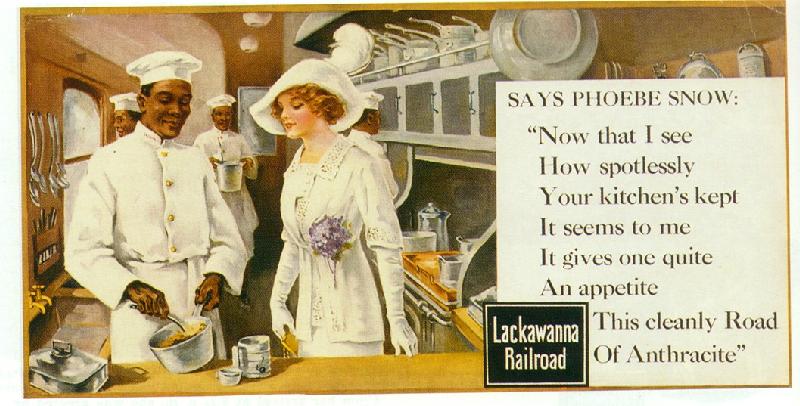
Click to enlarge.
The creature of one of the most successful advertising campaigns in American history, Miss Snow existed only to be unceasing: unceasingly in motion along a pounding iambic dimeter, unceasingly white, unceasingly bountiful of her whiteness. In her unceasingness, she was loved.

This illustrated history may help show you why. A comet always arriving, destined never to drop back into the dark and go still, Phoebe lived as light and motion, bestowing herself on everyone beside the track who existed to make her sidereal. Along the path of her orbit, brilliance illuminated the labor of engine crews, yard crews, porters and dining car waiters and the brilliantly white-clad cooks in the dining car’s galley. In her presence, light entered into the interior of what it seemed to mean to be human, dissolving secrecy and shame and shadow into a single all-encompassing whiteness.
http://scout901.hubpages.com/hub/Phoebe-Snow-Railroad-Advertising-Icon
The whiteness released her victims from darkness into love. It even extended underground, to the veins of coal and the men who worked them and the mules who worked alongside the men like brothers of Phoebe’s. There underground, Phoebe became her picture’s source of light. Descending into the dark and then ascending again, she traced letters from light across the darkness, and interpreted them to mean that all will be happy now, even in the face of death.

 —
On August 8, 1914, that consciousness was still alive and still animating a gentleman in love with nature. By then, however, it had abruptly become remarkable. On August 9, a reporter for The New York Times observed it in its descent toward incomprehensibility. Far down now in the third paragraph of an article, it was barely readable by then; too deep in the shade cast by the headline. The language of that headline was a dark new dialect whose words could not have endured in the sunshine vocabulary of Snow.

Not far from the pier, the transatlantic cables surfacing in New York were drowning Phoebe’s meters in irregular sobbings, and Belgian reservists were boarding a ship bound eastward, where the dark was rising.

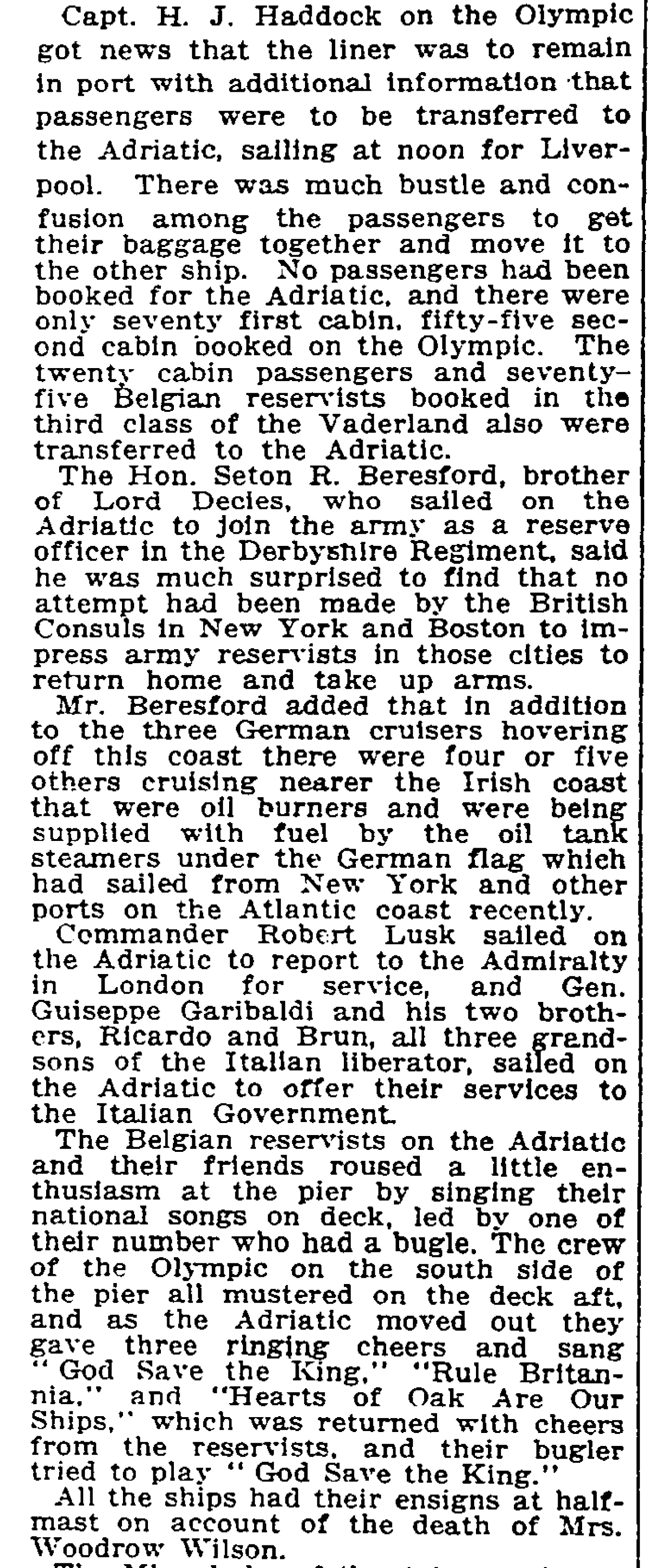
To understand, then, we have to look away from Phoebe and the gentleman entomologist.. A camera creature has surfaced from the dark flood, extending a black-and-white photograph of the Olympic’s cheering stewards to us.
 Source of this image and the next two:
http://www.loc.gov/pictures/item/ggb2005017010/
The next two have been Photoshopped for contrast.
From this angle in the photograph’s space, the time is the present. The stewards are and will always have been seen to be in mid-cheer. Panning toward the Olympic’s sister ship, the cameraman records the visual testimony of the Belgian reservists singing and cheering back. As they sing, marking time, they are moving outward. The stern of the Adriatic is being eased away from the pier.
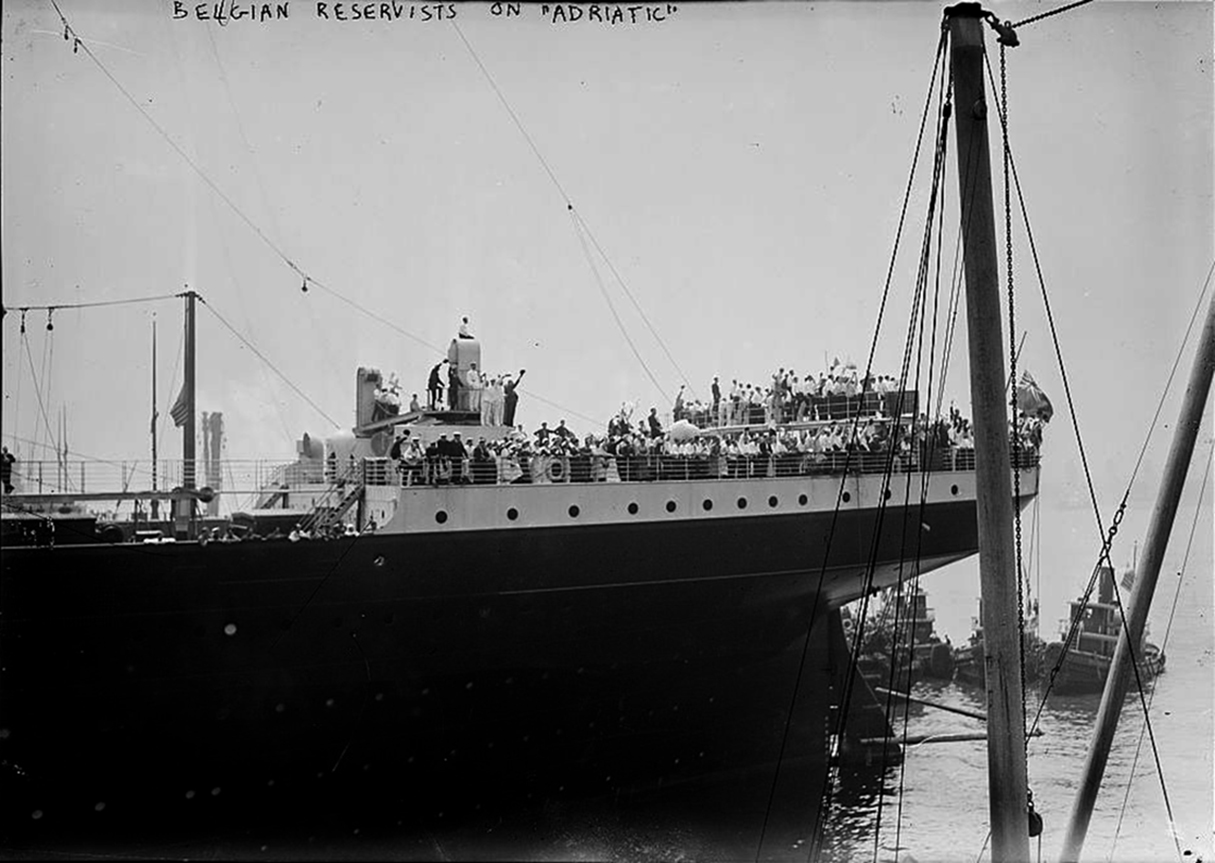
That motion has prepared us to receive an image that history, in due time, will call definitive. Now and forever, this image holds us back on August 8, 1914, at the watery verge of a pier in New York. At the far boundary of the space, receding as we watch, the White Star liner Adriatic is now becoming visible as a whole. On board the ship, certain men who will soon die can no longer be seen, though unillustrated abstract history provisionally asserts that they are still, for the moment of August 8, 1914, alive.

In comparison with the blankness into which the ship is now disappearing, Phoebe Snow’s immortally conceived whiteness was only a whim. Anthracite burns cleaner (a little cleaner) than soft coal, but to have believed in Phoebe’s absolute whiteness was never more than a suspension of disbelief. “Of course,” says Phoebe’s image to you, “I am only one of art’s happy ways of helping you imagine possibility. You always knew that.” To have looked at Phoebe’s picture, read her poem, and then bought a ticket on the Road of Anthracite was never a more significant act than, say, buying a ticket to a movie with the cheerful intent of surrendering for a couple of hours to an optical illusion. If Miss Marion Murray had been in this scene, she would have been stationed among us dark-clad neutrals left behind on terra firma, imagining like us rather than being imagined like Phoebe. The optics of this photograph don’t work only on the mind’s eye the way an image of Phoebe does.
Because as the Adriatic begins fading into the dazzle of a hazed atmosphere just at the moment when we take it in, it becomes less visible to the eye even as it becomes more conceivable to the imagination. On August 8, 1914, men and women on a pier and in boats and barges saw a ship loom up through space under clouds of coal smoke and then fade in accordance with the laws of physics. If we could only see it now, we would see it as they did: as a mortal body fading to white, as graceful as it traverses its bright vanishing instant as Miss Marion Murray ever was.
“Snap shots of an event that may become historic”
The microfilm readers in the University of Hawaii’s Hamilton Library are now linked to computers running Irfanview. Scholarly readers no longer have to work with a copy machine’s blurry approximations of the film; now they can scan an image from the film, save the scan to a thumb drive, and then Photoshop that digital copy. Here’s an example of what that labor can make available: visible again after decades of deterioration, three photographs taken in Honolulu harbor just after the United States broke diplomatic relations with Germany on February 3, 1917.

 Click to enlarge.
With the United States poised to end its neutrality and enter World War I, the crew of the interned German gunboat Geier had tried but failed to destroy their ship, and a photographer was there, recording. His editor called the results “snap shots of an event that may become historic.” And yes, an independent historiographic record of the event does exist. You can read about it at, for instance,
http://navalwarfare.blogspot.com/2010/05/sms-geieruss-schurz.html
But that record may not quite be history. Readers mark the distinction with a cliché. We don’t quite say the stern word “history” after we close a book about SMS Geier; instead, we tend to Disney-fy our newly read text by calling it something like “a footnote to history.” If it’s the short story of a little warship at the edge of the Great War, beached in a backwater that didn’t become canonical in the history of war until the war that followed this one, then of course (we think) it doesn’t belong in historiography’s large print. Fine-print footnotes like the anecdote about the gunboat Geier are detachable.
Here in Hamilton Library, both the thick books of history and the reels of microfilm testify that the anecdote named Geier was detached a long time ago. The newspaper from 1917 is gone, its microfilm archive is deteriorating, and these images are unlikely ever to be seen again where thick books about the Great War are written. As to the white-suited civilian that Photoshop has now brought back as if he had never left his spot on a pier in Honolulu, he can never again be more than a white footnote to the anonymous anecdote of Geier’s white sailors. The civilian’s hat is still on his head and the wrinkles in his clothes still say that he has a hand in his pocket, but his face has gone under permanent shadow and his body has come under the striped mark of the printing from 1917 that has now obliterated his name. Without Photoshop, he wouldn’t be visible in 2012. But even with Photoshop, he’s now one of the unreadable parts of his own history.

Illusive immortality, then; merely anecdotal monument and memory. Photoshop drills itself into a slip of microfilm, penetrates and reshapes the images there, and then rises with them, glowing, to the surface of a monitor. There, the newly illumined images will endure for the single moment before vision’s format changes again.
—
Update, June 6, 2014: the unphotoshopped original of this picture of Geier in Honolulu is image 000104 in the Al Menasco photo album in the San Diego Air and Space Museum Archive,
https://www.flickr.com/photos/sdasmarchives/14359722802/in/photostream/
It must have been taken in March 1916, when Menasco and his partner Art Smith stopped in Honolulu en route to a series of exhibition flights in Asia. (“Art Smith Has Ten Little Red Racers With Him,” Honolulu Star-Bulletin 8 March 1916: 6. http://chroniclingamerica.loc.gov/lccn/sn82014682/1916-03-08/ed-1/seq-6/)
