Battery

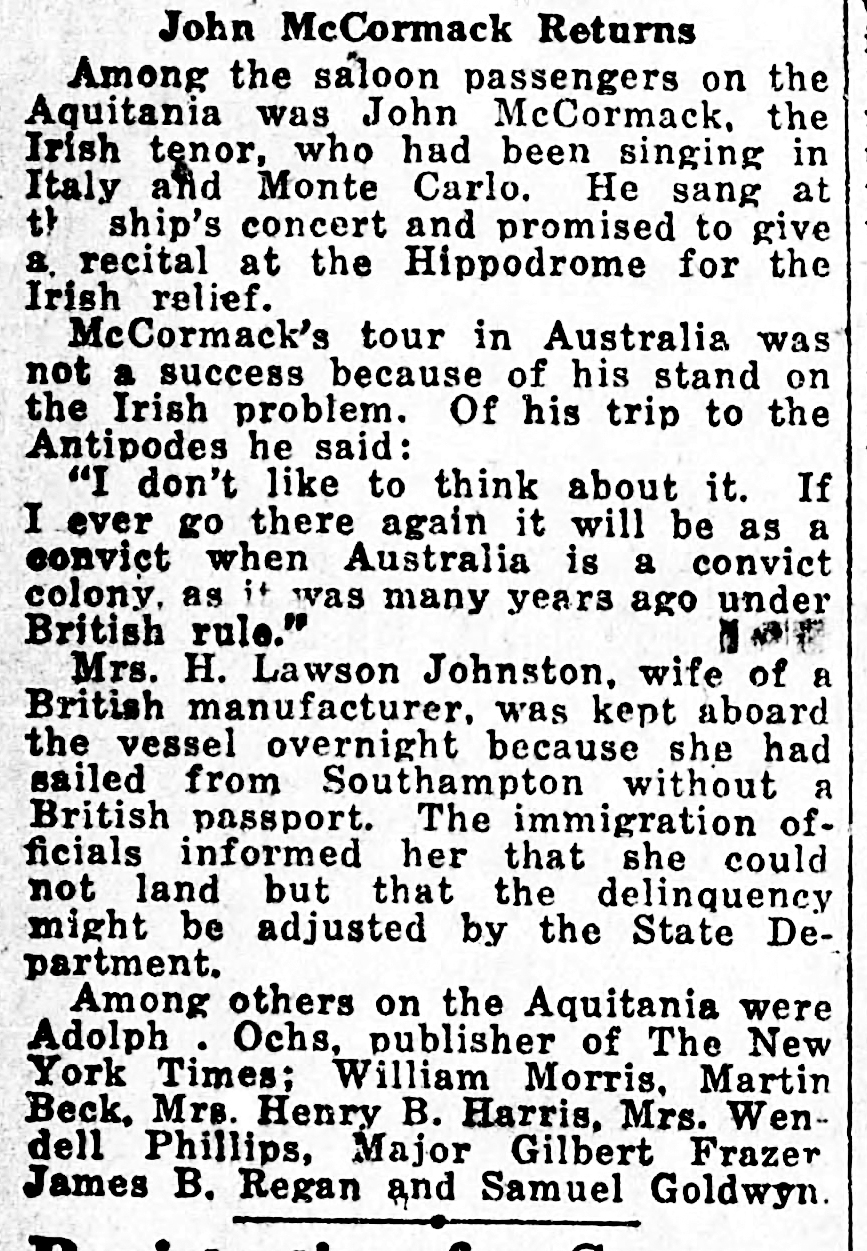
In New York on April 30, 1921, as the liner Aquitania sailed up the bay from quarantine, the tenor John McCormack, one of the most celebrated singers of the time, showed himself before the recording instruments of the media. The role he was performing approximated what his fellow Irishman William Butler Yeats was to call (in “Among School Children”) “a smiling public man.” A space of foggy air and wooden decking separated him from the battery of cameras.

32289uaiD

Then, though, the cameras moved in closer and the singer began to speak.

32292uaiF

The reporters took down his words. They turned out to be Irish words.

New_York_Tribune_Sun__May_1__1921B_
New York Tribune, 1 May 1921, page 12

Along with the celebrated singer, a celebrated newspaper publisher was on board the ship, and so was a celebrated Hollywood producer. We’re willing to believe they were because the story tells us so in indirect discourse. We don’t need the publisher’s or the producer’s actual words to bear witness. And as to the singer, in 1921 all the cameras had to be silent.

But perhaps we can see words forming on his face.

32292uaiG

Sources: George Grantham Bain Collection, Library of Congress, http://www.loc.gov/pictures/item/2014712442/ and http://www.loc.gov/pictures/item/2014712445/. Post-processed to restore detail and contrast.

Light falling on face

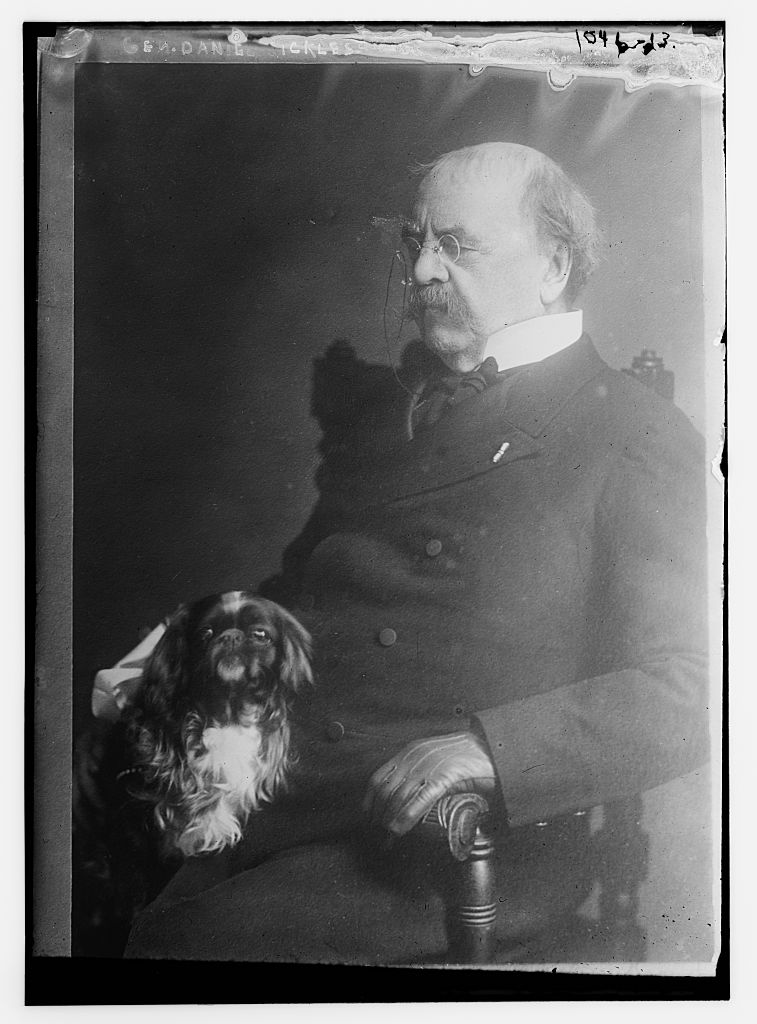
Undated in its archive at the Library of Congress but obviously taken in old age, this is a portrait of one of the most controversial men in nineteenth-century America, Daniel E. Sickles (1819-1914). On the historical record, Sickles is, among many other things, not just the first American to escape conviction for murder on the grounds of temporary insanity (his victim was his wife’s lover, the son of the lyricist of “The Star-Spangled Banner”) but also the only Union general at Gettysburg lacking a statue on the battlefield — whose preservation as a national historic site, however, is largely due to him. Another work of preservation remains the leg he had amputated during the battle, which is still in the National Museum of Health and Medicine. After the war he used to visit it. Thomas Keneally’s 2002 biography is titled American Scoundrel.

04985v

With a head full of Rembrandt, I subject the scoundrel’s portrait to Photoshop.

The little dog doesn’t belong in such an image — not with his upturned snoot and rolling eyes. He (she, Mrs. Woolf?) looks all too knowing, all too civilian. The kid glove, visible in at least one other portrait, may hint at one more military anecdote, but on its own terms in the image it is only an opacity. Under other circumstances the fringey little hem of bangs on the age-spotted scalp might look comically desperate, but in juxtaposition with glassy glint, hooded eyes and mouth pursed in what looks like thought, it communicates pathos in the face of mortality. In the shadows that I have brought up from the Plutonic with a Photoshop slider there is now visible a shade, advancing across the image field. In the original depiction of that shade some surface blemishes were visible as a kind of light-spun fabric in the vicinity of the right eye, so I blotted them out as I blotted out the silky little dog. There is almost nothing left to see now except dark.

04985uaiK

But see what remains visible there: an artifact formed from what nineteenth-century studio photographers called Rembrandt lighting. The lighting has not only created what looks like a flesh; it has made it into a carnal lyric. Scored on the dark, the lyric sings lightly when it sings to us:

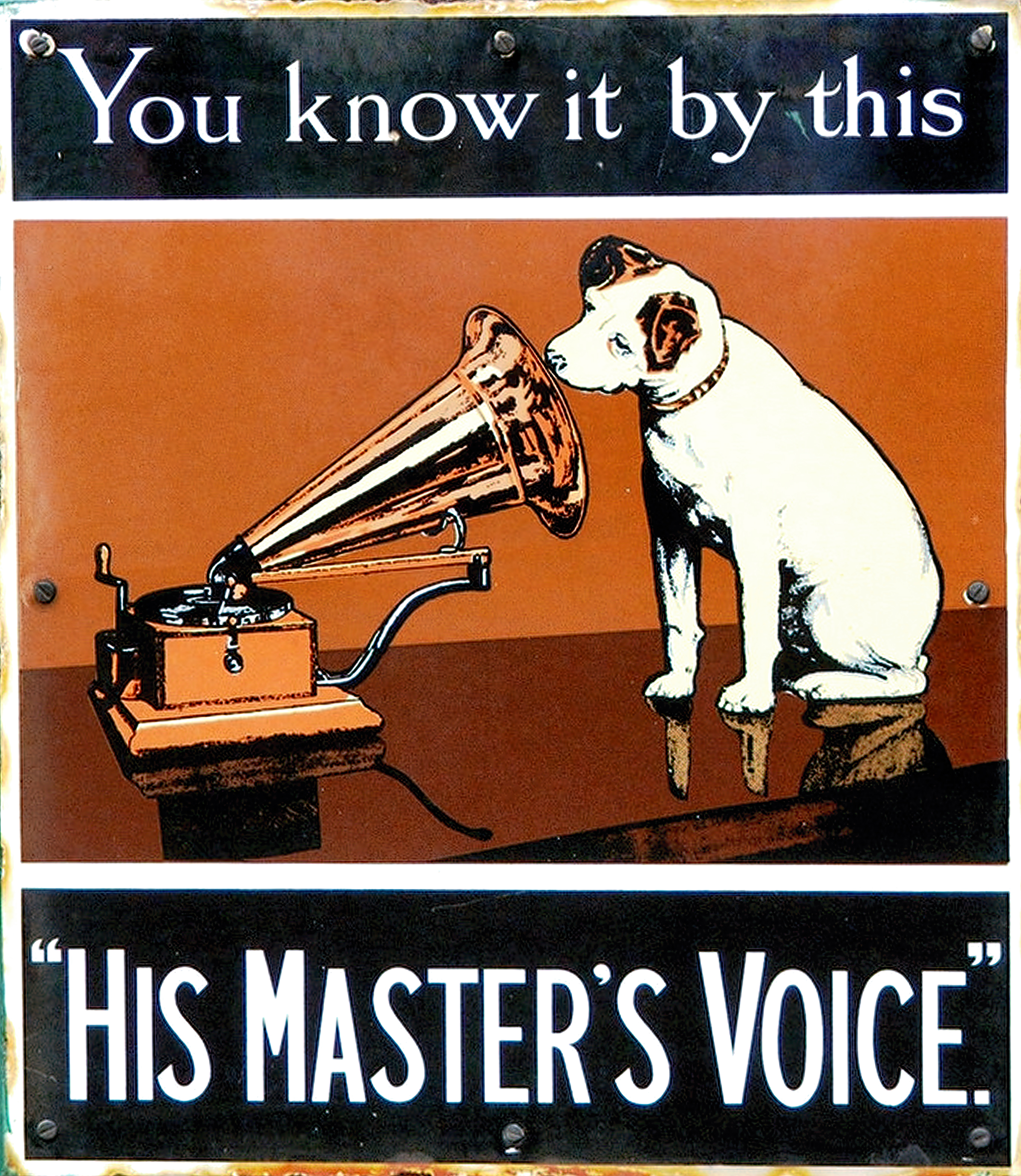
“I was dead flesh; I became living chiaroscuro. Now and forever, I will be for you who see me a lexicon of shades of meaning. As you read me, let’s be friends. You may call me HMV.”

3862718092_e26e1e98f1_baiB

Source: George Grantham Bain Collection, Library of Congress, http://www.loc.gov/pictures/item/2014684979/

A crateload of metonyms

Transliterated into German, the caption within this image reads, Er versorgt sie mit allem — “He provides them with everything.” The verb versorgt communicates connotations of cares and cares for, and the recipients of the gifts and the care, they, would be Jews fighting for America in the Great War. But the key transactional word in the sentence is alles. Within the image frame alles defines visual allness metonymically, piling example upon example. When you began wearing a uniform like mine, say the provider’s Jewish body language and Yiddish words, you lost some memory of what you are. But your words are still understood, have been understood all along. And now I bring you a cargo of word-things that will make your memory whole again.

43_40_240aiE

Rolled up in its mantle and held tight and alone under the provider’s left arm is the primary thing: a Sefer Torah, the unabridged text of the definition of Jew. But just below it, dangling from the provider’s left hand, is a string-wrapped bundle of other texts cheerfully inviting untying. These are books to be read on the six other days of the Jewish week. Their language is not Hebrew, the language of the synagogue, but Yiddish, the language of the home, and the authors’ names on their spines — Sholem Aleichem, Sholem Asch, I. L. Peretz — are contemporaneous with the clean-shaven, secular young Jew who is cheerfully hefting their supplementary weight. One more of the authors on the spines, a reminder that as of the date of this composition Yiddish was the living language of heym for the great majority of American Jews, is the now all but forgotten Avrom Reisen, who wrote a short story a week, year after year, for the Forverts. Then here before your eyes, say imaged names like Reisen’s, is what we mean when we say alles. To be comprehended, the words of All’s language require only to be read once again as they were read in your home the day you put on your uniform and left. They are still there, waiting only for you to return and speak them once more. Through the coming years of silence, they will not change. They will always be there to be understood and to understand you. The moment you reopen their books, they will rise from their pages and meet you. You will not have been forgotten.

And carried into the image frame on the welfare man’s right shoulder comes still more. For Jews to read there is a newspaper, presumably a Yiddish one. There are some round orange things which I’d guess may be dried fruit — comforting to have on hand when the meat in the mess hall is tref, and carrying connotations as well of Jewish tenderheartedness and Jewish mother love. And there is — oi, yes! — a violin.

Well, fund appeals during America’s participation in the Great War were coordinated across many cultural dialects. The blog cited below includes reproductions of posters in Polish and Chinese, not to mention one in English that demands, “Are you 100% American? Prove it!” The poster we’ve been looking at is a product of that coordinated effort: not a work of art but a work of war art. It is intended to evoke only clear and unmixed feelings. The emotional provisions that it delivers have been massed in the image frame only for the straightforward purpose of increasing military efficiency by strengthening morale. So it isn’t necessary to play that Jewish violin in a high theoretical register with a word like metonymy. Stereotype will work just as well.

But we want the Jew to play his violin, don’t we?

If we do, since we do, let’s thank our brown-booted provider for his welfare. Whatever the military intent of the Jewish Welfare Board may have been, a violin can at least remind us that the they in their image won’t always be in uniform. And the date preprinted on the poster happens to be Armistice Day.

—

Source: I first saw this poster by Josef Foshko on X-Ray Delta One, James Vaughan’s Flickr blog of old commercial images. But for the image that I photoshopped I went back to Vaughan’s source in the Museum of the City of New York, as reproduced in the exhibition blog “Posters and Patriotism: Selling World War I in New York,” https://blog.mcny.org/2017/04/04/posters-and-patriotism-selling-world-war-i-in-new-york/


My apologies

My apologies

Work cited (one of quite possibly hundreds available for analysis): https://www.cnn.com/2018/01/18/politics/kfile-carl-higbie-on-the-radio/index.html. The link is to a CNN article headlined “Trump appointee Carl Higbie resigns as public face of agency that runs AmeriCorps after KFile review of racist, sexist, anti-Muslim and anti-LGBT comments on the radio.” The article includes corroborative audio clips, plural, but it also includes this:

In a Tweet Friday morning, Higbie apologized for his comments. “I’m sorry. I’m not sorry that my words were published, I am sorry that I said them in 2013,” he wrote. “Those words do not reflect who I am or what I stand for, I regret saying them. Last night I informed the WH that I was resigning so as not to distract from POTUS’ many success. #noexcuses”

And in the link below, which dates from four months later in the ontological era, a New York lawyer with a significant history of being a loud aggressive racist in public is identified on video, gets in trouble at work, and then explains, “The manner in which I expressed myself is unacceptable and is not the person I am.”

https://www.cnn.com/2018/05/22/us/aaron-schlossberg-attorney-racist-rant-apology/index.html

“Unacceptable” is another term I don’t think I understand. Compare, “The dampness of this water is unacceptable.”

Instantaneous in Hoboken

For now, the image is still there, floating in hazy light.

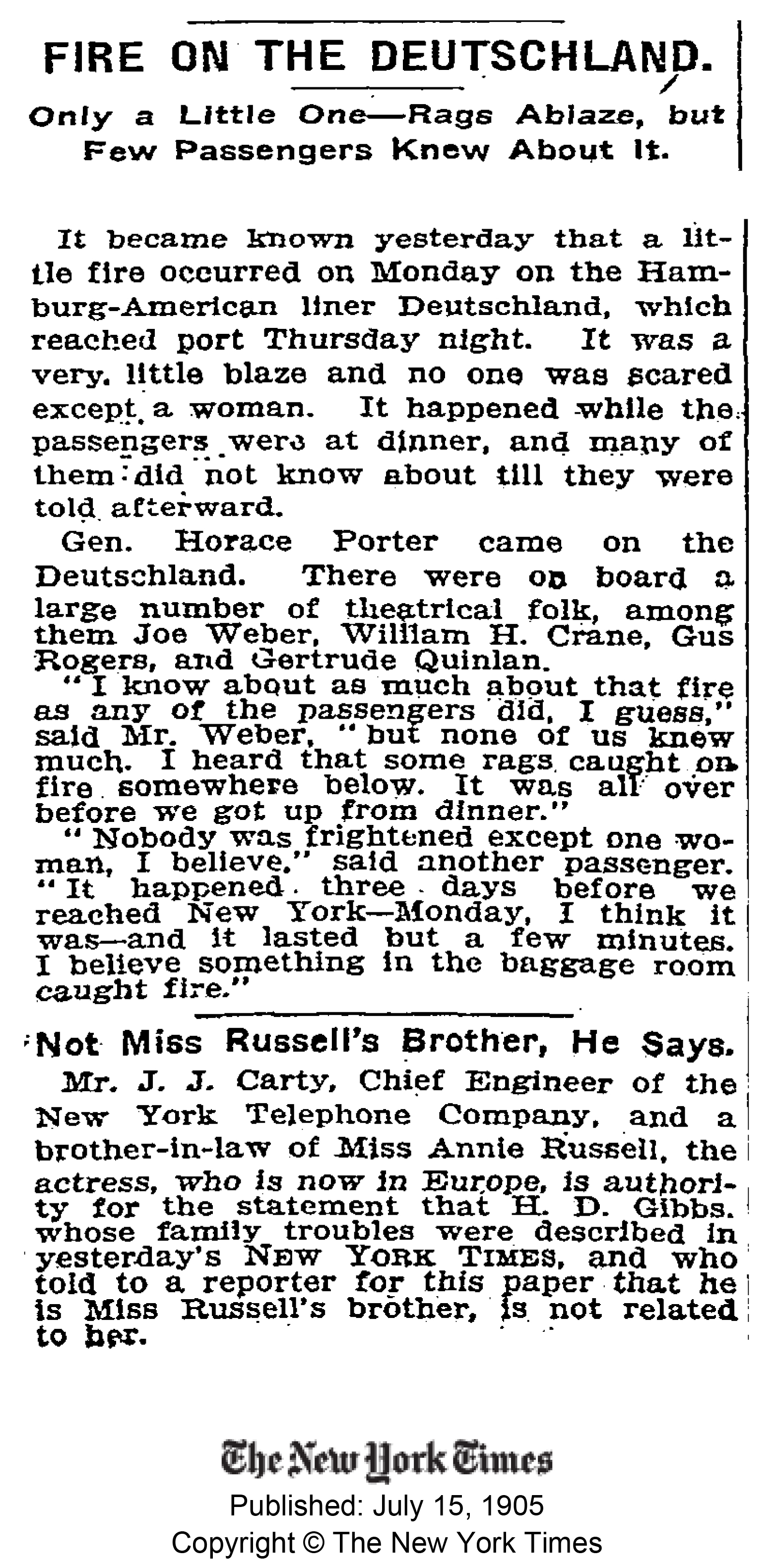
Big, luxurious, and the fastest ship in the world when it entered Atlantic service in 1900, the German liner Deutschland proved unpopular with passengers because its high-speed propellers made its decks shake. After ten years it was rebuilt as a slower, more comfortable cruise ship, rechristened with a less ambitious name, and sent on to oblivion. But here and for now, with its course away from memory not yet plotted, it lies in the river flowing past Hoboken, only momentarily still beneath moving clouds.

At the time, photographs like this one were called snapshots, and before then they were called instantaneouses. This instantaneous is breaking down now in craquelure, but it hasn’t yet ceased to put on display a large floating jewel, glittering with instant icons. This icon, see! represents the doctrine of three men painting a mainmast. This one represents the ship’s name in the squared-off, fraktur-inflected Bodoni of a German font. The iconic Deutschland is a free-standing word, generating connotation after connotation in a historical dialect that (its quiet blaze in the shade still signals) will never go extinct. And yes: by way of confirmation, aft of the word a little scow tidies up for a visit from history itself, preparing the palimpsest for a manual of what you will soon be required to see.

101828036

See, therefore. The icons (click to enlarge) will now perform their miracle. Someone inside Deutschland is at work with a shovel in a room full of ashes.

*

Elsewhere in Hoboken, light has different properties. The evidence at the river’s edge showed a clarity diffused outward under full control, originating in the dark within a hull and then moving outward to take dominion over all the light in the air. But along this sidewalk, seeing has been swaddled in blur from the beginning. For the moment, a little library is moored like a ship on the concrete, but its language can’t be read the way the word Deutschland is read because it doesn’t seem to belong in its composition. Deutschland is its ship. The sleek dark hull and its elegantly complementary wordform are equally at home in their sustaining water. But the sidewalk of Hoboken supports only a piece of indoor furniture and a jacket missing a button, and those are icons of a religion that isn’t alluded to in words like “Big Christmas number.” The jacket with its missing button is doctrine from the spoken language of the human and the social, as opposed to the written subdialect of words as such. And the words “Big Christmas number” tacked to a desk outside in the cold can’t be spoken in the same social accent as the name of a ship harmonized in gold on steel.

This instantaneous happens to be mounted on a card bearing more words, and that addition does spell out the instantaneous’s prehistory. But it isn’t continuous with the history in the photograph because its language isn’t photographic. It hasn’t originated in the image; it is only an afterword composed in the language of the photographer. Outside the image frame, separated from it by the confines that define and circumscribe the language of caption, the words of this third language try to mimic a voice — the voice of the photographer, Lewis Wickes Hine — in the act of saying:

Little girl, apparently 6 yrs. old – but didn’t know her name or age – tending stand at Washington and 3rd St. for older sister (#3234). Saloon on corner. 3 P.M. Location: Hoboken, New Jersey.

But in this translation the words telling of a saloon can only be heard and read, not seen in the way a river is seen. Because the saloon lies outside the image, it and the truths of its connotations can only be spoken of through the mediation of language, not known immediately as an icon’s truth is known. Outside the image frame, the words of the translation can only tell us a story of a Christmas when nothing descended from heaven to take form as a name.

And within the frame are no words to flood the image’s mouth and say, “This is my name. After six years I will be able to remember it.” Without the possibility of words, the image is not an icon; it is an instantaneous. The instantaneous is an image that has assumed its form without development through time. It had no mother tongue.

Sources:

Library of Congress, http://www.loc.gov/pictures/item/det1994010706/PP/
(1905; Detroit Publishing Company Collection) and http://www.loc.gov/pictures/item/ncl2004003797/PP/
(1912; National Child Labor Committee Collection).
Both images photoshopped.

Portrait behind pane

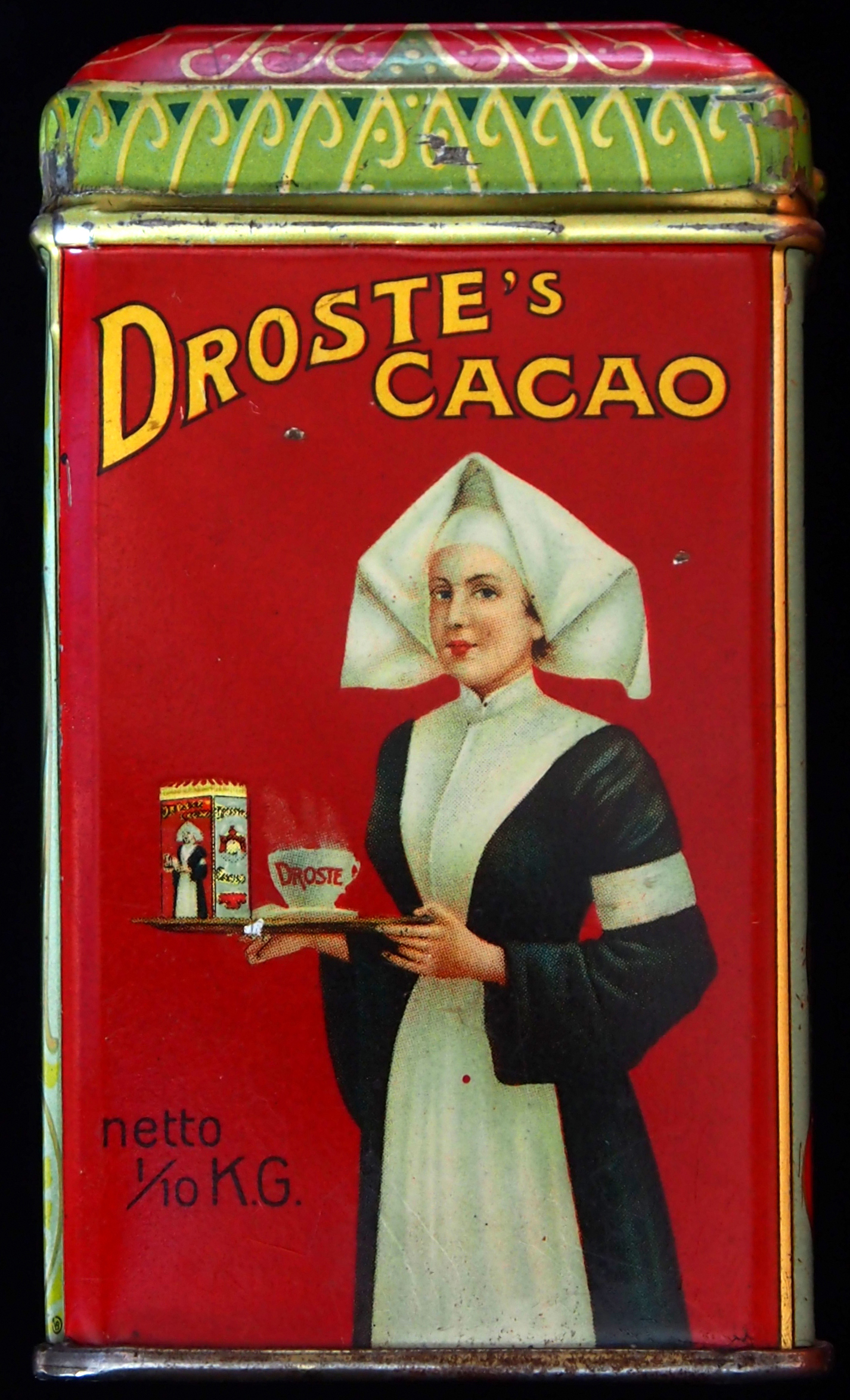
Literary theorists call the depiction of depiction mise en abyme, taking the term from heraldry’s coats of arms nested within coats of arms.

Graphic designers call it the Droste Effect, after a brand of chocolate.

Droste_cacao_100gr_blikje,_foto_02ADroste iterations don’t just lock themselves into their series; they lock in our vision too. They impose on us a task that can’t be completed: the task of seeing them. The little girl spilling the canister of Morton Salt on the canister of Morton Salt changes her clothes over the years, but (despite the coyly evasive caption of this advertisement from 1968) she will never be able to carry the change to completion and become a woman.

http://www.mortonsalt.com/our-history/morton-ads#ad16

As we begin to think we understand the paradox, we ourselves do change — but we change only into Keatses at the wedding feast of the still unravished bride. There at the feast, looking up from the table to catch the eye of Droste’s nursing sister, we may go roguish and ask her, “What is in your tin” — but the moment we get that far, we become conscious of having learned something scary about the limits of our ability to express. Actually, strictly speaking (the nun’s ruler comes down with a whack), what we have just thought isn’t yet ready, never will be ready, to be punctuated with a question mark. It hasn’t become a question because a question entails a terminally punctuated answer, and the series “What is in your tin is in your tin is in your tin . . .” is not that, whatever else it may be.

—

Now look at this other picture of a picture. It’s a nineteenth-century photograph of the kind called a tintype: a direct-positive image that registers on the eye by reflection from the photoreduced silver in an emulsion laid down on a sheet of black-painted metal. Tintypes were generally of low contrast and low quality, but they were popular as keepsakes because they were inexpensive. At the cost only of a small investment, they got busy on their return by helping memory work.

Backed up against her own layer of tin, Sister Droste does the same thing, and furthermore she advances toward memory unprotected by any frontal armor. By contrast, the low-contrast man in the tintype evades direct perception because he is enclosed in a case with a glass front. Between him and us is his pane.

37278vAAt the Library of Congress, this compendium of things to sense (tin and cardboard and velvet and glass and pigment enclosing an image enclosing tin and cardboard and velvet and glass and pigment) has been compiled under a single archival title, but the title’s first word is “Unidentified.” More title words follow, identifying clues like the flag in the background and the oddly buttoned jacket, and eventually a full-length caption develops: “Unidentified soldier in Union Zouave uniform with cased photograph in front of American flag backdrop.” You can learn the meaning of the term “Zouave” from a military dictionary, and it may also be useful to understand that the Library acquired the image (http://www.loc.gov/pictures/item/2013650144/; I’ve photoshopped it) as part of the Liljenquist Family Collection of Civil War Photographs. Such information is limited, yes, but limits are educational too. They let us frame what we know and separate it from the unidentified.

But within this particular frame the word “unidentified” prevents a Droste series from beginning because it precludes us from conceptualizing the enclosed images as a formal unity. Having been named with a word (“Unidentified”), the images now enter our minds as words: words approaching us not the way images do, in simultaneity, but as texts do, one by one, in a sequence whose constituents may or may not be related to one another. The soldier in the photograph may or may not be holding a photograph of himself, but we’ll never know. The cup of Droste will pass from us.

But whatever the soldier is holding now, at the moment of our perception, he holds it up to the pane that separates him from us. On our side of the pane, at this very instant, in bathrooms all over the world, people are busily acting out a belief that holding a cellphone up to a mirror will teach the cosmos what the word “self” means. But on the far side of the soldier’s unreflecting little slip of antique glass, Narcissus himself has gone invisible. One tantalizing moment after a hand behind the pane has beckoned to us, the pane goes unbreakable and the unidentified All behind the pane goes permanent.

Or, as Keats put it in a little shard of a poem that he didn’t get to protect from touch behind glass before he died:

This living hand, now warm and capable
Of earnest grasping, would, if it were cold
And in the icy silence of the tomb,
So haunt thy days and chill thy dreaming nights
That thou wouldst wish thine own heart dry of blood
So in my veins red life might stream again,
And thou be conscience-calm’d — see here it is —
I hold it towards you.

Story

We think the flower looks feminine. Expressed in a medium by an artist, the thought becomes an anecdote. In the museum, a gallery full of Georgia O’Keeffes or Imogen Cunninghams become an anecdote exchange. Soon everybody gets the joke.

—

Linking the sight with memories of stories we read when we were children, we decide that the insect looks armored in bronze. The men pictured in the books had broad shoulders, too. Shortly after that thought has been acted on with a camera, an anecdotal image of the insect begins communicating itself from Tumblr to Tumblr specialized in militaria and inspirational National Socialist anecdotes.

—

The communications become entrained by the economic mechanisms of desire. Getting the joke comes to mean acquiring it on an exchange. The interval during which value is transferred, that epoch between the just-seen subject of a future image and the completed and collected painting en route to a warehouse in the Caymans, is what in a story is called the middle. Into the image below, between records of the moment after one seeing and the moment after another, I insert a pictured page from a story. Click it to enlarge.

Gardenia, Perseus, mantis small

Unenlarged between two other images, the image in the middle may resemble the middle term of a single three-part idea, but it isn’t. The panels to its left and the right are wordless souvenirs of the seen, but the middle panel comes to us with an anecdotal pretext arguing that it represents not a seen moment but a known history — in this specific case, the history of the hero Perseus. Guardian and curator of the image, the history won’t allow you to see it as an image. It will impose a context. If the context isn’t visible to the unaided eye, the histoire will slip into its other English translation, “story,” and improvise a substitute out of invisibility. To the left of the middle, there will promptly emerge from the void a panel 1 in which Andromeda’s clothes are being taken off. To the right will emerge the necessary completion of the story, a panel 3 in which Perseus is hauling the dragon’s corpse away to the landfill.

And if you close the handbook of mythology long enough to effect a small change of wardrobe, panel 2 will show itself capable of migration to another story, provided only that the new story belongs to the same genre. The story in the image above and the story in the image below, for instance, are each about a hero. Visually, each is a two-part composition: dark and light, male and female, draped and undraped. The family solidarity of genre even allows the second image to retain its visual integrity after it has been reduced to the status of illustration and humbled by a didactic caption. After all, both the sophisticatedly allusive image above and the demoted image below are histoires. Because they narrate a passage through narrative time with a beginning, a middle, and an end, they transcend depiction in or as themselves. They have a literary history. Just as much as Perseus and Andromeda, the Klansman and his belle refer their meanings at this point in the story to earlier meanings.

(Thomas Dixon, The Clansman)

But the flower on the left and the insect on the right, the images seen only in the moment when they seemed to halt perception with held breath for a moment?

During that moment, they had ceased to become and only were. They had fallen out of the sequence of story. Outside sequence, they had lost their susceptibility to narrative’s power of explanation. We can’t tell a story about the image of the flower; all we can say about it is that during the moment before the words “Once upon a time” could be spoken of it, it may have been in a state of depiction. Supporting a story on either side but capable of referring vision only back to a not yet told story about themselves, such images are not yet readable. And about the moments like those when the told makes contact with the depicted, literary history tells us that after story has been brought face to facing page with a wordless image, it sometimes draws back into itself and goes silent.

At those moments, the story’s words are released from narrative into depiction, there to be seen only as what they are: words, alone or in new associations with other words. I think Pope’s string of naked words, “This long disease, my life,” must have had some genetic homology with the famous glitter of Pope’s eyes. An instant before the words could come to be, the eyes took into themselves the deformed little shape that they had seen in the mirror.

Sources:

Edward Burne-Jones, The Doom Fulfilled. 120 Great Victorian Fantasy Paintings CD-ROM and Book, ed. Jeff A Menges (Mineola, NY: Dover, 2009), image 022.

The illustration from Thomas Dixon’s The Clansman (New York: Doubleday, Page, 1905) is by Arthur I. Keller, online at http://docsouth.unc.edu/southlit/dixonclan/frontis.html.

“This long disease, my life” is from Pope’s Epistle to Dr. Arbuthnot, line 132.

The moment of the gardenia, according to metadata, was June 30, 2014, at 5:48 PM Hawaii Standard Time. The moment of the praying mantis was July 7, 2014, at 12:43 AM.

To symbolize, insert signifier

The little boy’s cap and coat are brand new. His shoes, however, are scuffed. He has been a little boy in them for some time and taken little-boy dominion. On scuffed floorboards his feet aren’t arrayed in proper new-clothes symmetry, but the cap and the coat are constraining his upper body to their form. Made in a factory, they still incorporate some of the factory’s architecture.

No wonder the little boy is unsmiling. The transaction that has covered him with new cloth may have been love, but he can’t yet feel it on his skin. During the instant when his photograph was taken, he was still in the factory, not yet home.

However, Costică Acsinte, photographer of humanity in the guises of its clothing, understood the problem and devised a fix. Into his image of a body restrained by buttons and buckles he inserted a second image, this one not of one body isolated but of two bodies touching. Merged into single fur, a lithe enclosing integument unites the two bodies in one.  Placed then under Acsinte’s control behind the little boy, the undoubled image takes on the intelligible function of an index of love. It mirrors the giver of the clothing to him- or herself as a body wearing that which has grown out from itself to make contact with another body.

And we are now admitted to the room where a body in a picture grew toward another body and a giver of covering for the body was helped to see.

Source: the Costică Acsinte archive, https://www.flickr.com/photos/costicaacsinte/13785204545/in/photostream/