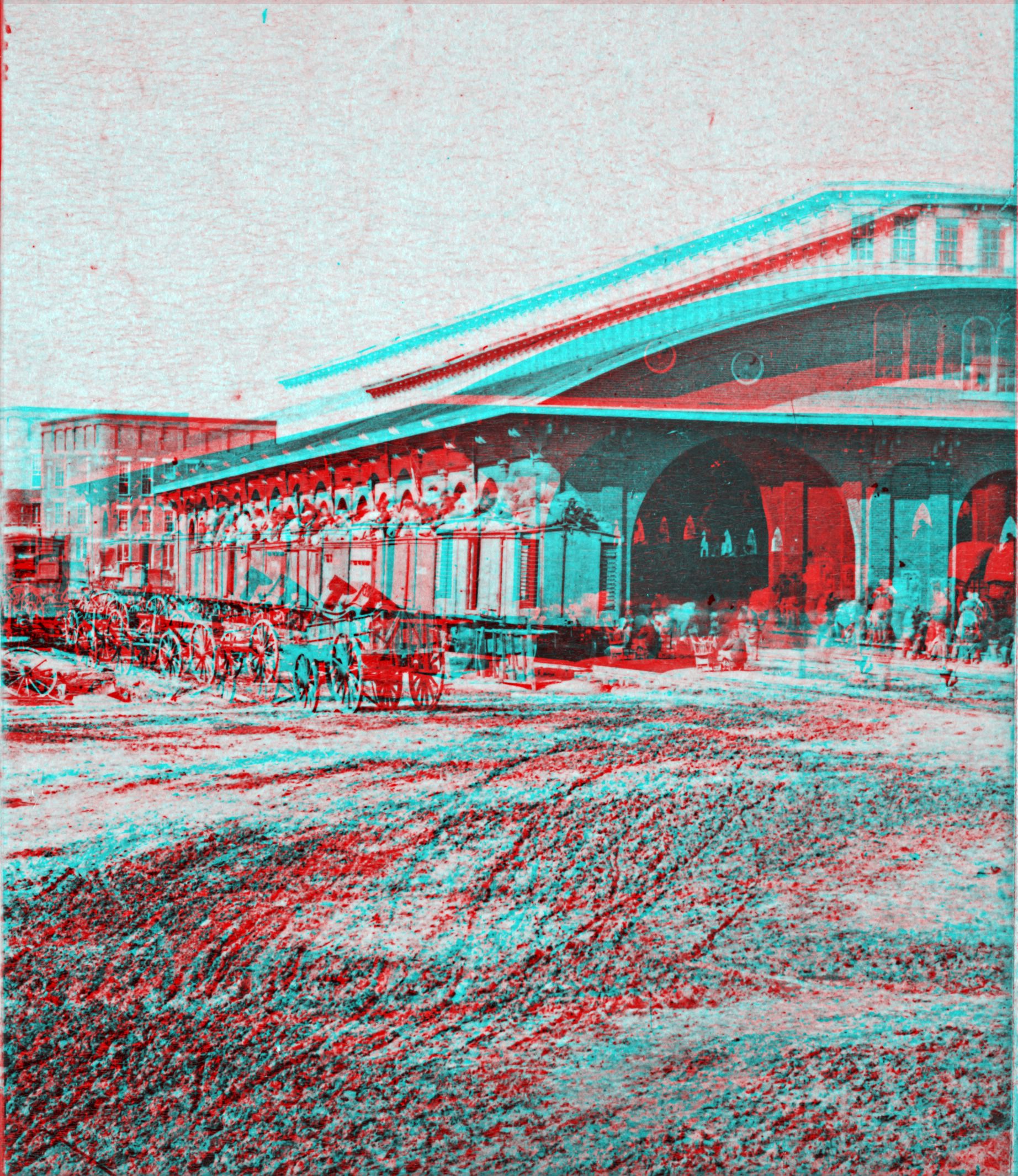
In the course of the siege of Atlanta, the building has undergone some damage. Part of the fascia has become detached from the roof and two or three panes in the second-story windows appear to be broken. A Union corporal is sitting in front of the building, but his back is to the structure and he isn’t reading any of the words written there: neither “Lamp, Pine & Kerosene oils” nor “Auction & Negro Sales” nor “Queensware.” He isn’t looking at the pictures, either, but they’re up between the windows on the second floor: a couple of paintings in classical style. They may have been intended to make the term “Queensware” an emblem: a pictorial representation of an idea.
George N. Barnard, 1864. “The slave market, Atlanta, Ga.” Library of Congress, http://www.loc.gov/pictures/item/2011647092/. Requires an anaglyphic (red and blue) stereo viewer.
—
Queensware, originally Queen’s Ware, was a cream-colored china which the classicizing Josiah Wedgwood created in 1765 for Queen Charlotte, the consort of George III. The next year, a Midlands newspaper announced, “Mr Josiah Wedgwood, of Burslem, has had the honour of being appointed Potter to Her Majesty.” In this building, the business transacted with only a conventional minimum of decoration on the first floor made possible the more luxuriant typeface on the second, and the chaste urns emblematizing a classical ideal of beauty.
—
It’s the word “urn” that throws sweet pathos over Herrick’s “Upon Prue, His Maid.”
In this little urn is laid
Prudence Baldwin, late my maid,
From whose happy spark here let
Spring the purple violet.
Herrick’s language ordinarily contemplates only women with single Roman names: Silvia, Perilla, Perenna, Anthea, Julia. Such classical women need only one name, because when they die they will be interred under many other words.
Frontispiece of Herrick’s “Hesperides,” 1648
But Prue’s two English names teach us that her tomb is no more than a small, plain stone. Above its humble English flower rises an urn made only of text: 21 lapidary words written in Prudence’s memory by a kind master.
—
Before he marched north to Savannah in the fall of 1864, General Sherman evacuated the remaining population of Atlanta and then burned all sites in the city with military value, including the railroad station.
After the last train left, the corporal with his book left too. No one was left then to read the words that once sang to Atlanta, “Queensware” and “Negro auction.” Unread, the words at the top of the image and the words at the bottom had come at last to belong to a common language. It was the silence of the urn.
As of September 28, 2013, the prose of Wikipedia’s article “Rudolf Berthold” pants with a breath smelling of nineteenth-century hygiene.
Throughout the summer of 1918 Berthold continued flying, increasingly relying on morphine for pain relief. Such was his strength of will he also taught himself to write with his left hand.
The image that comes to mind is less a picture than an idea, less an idea than a corpus of prose. Since the day of publication of A Farewell to Arms, at the latest, it hasn’t been possible to understand the phrase “Such was his strength of will” as anything but a phrase from a textbook. “Such was his strength of will” is language attempting to stand alone, without the aid of image.
But look at the image on its own terms, with its explanatory language (“Unser erfolgreicher Kampf-Flieger”) reduced to a remainder left flatfooted at the bottom.
San Diego Air and Space Museum Archive, catalog number 10_0017272
Then follow the image’s hinted command, open Photoshop, and use the Dodge control on the eyes.
You must. Such was the image’s strength of will. And now you cannot stop seeing.
1. Get through to denotes communication, but its originating metaphor connotes forcing, piercing, penetrating. To get through to is one way of communicating; to be gotten through to is another. The difference is a bloody matter of the difference between prey and predator.
2. The communication channel of getting through to is fear. In fear of being gotten through to, some people calm their pounding hearts by remembering that they believe in their gun and their Bible. Others choose to mask their susceptibility to communication behind deflecting layers of irony. The warehouse full of Basquiats, check; the Russian passport, check.
3. Getting through to can also be thought of as a speech act like voting or naming: a way of doing things with words. Under the control of speech-act technologists like Frank Luntz and Roger Ailes, language is a symbol system used by the people with the Basquiats to get through to people whose symbols are at pre-ironic stages of development.
Recalling with deep gratitude her encounter as a girl with Rilke’s Letters to a Young Poet, Margo Rabb belatedly Googled the biography of her benefactor. Her report on the experiment didn’t have a happy ending, however. In fact, it was so unsatisfactory that it couldn’t even reach a properly experimental conclusion. Deprived of what she once had thought was communion with a poet, Rabb had to stop turning the pages of her protocol. Before she could resume her happy reading she’d have to start a different experiment on Rilke’s words, but her own words weren’t adequate to writing the experimental design. Staring disconsolately at her idled lab bench, Rabb could only ask: “How could the kind prophet whose lengthy passages I’d copied into my teenage diary be a selfish, sycophantic, womanizing rat?” Herr Rilke wasn’t available to offer an answer, either, and when Rabb made the inquiry of the diary there was no reply.
The unanswerable question had been forced on her by a Google search delivering words of reproach from a book reviewer. There, summarizing Ralph Freedman’s Life of a Poet: Rainer Maria Rilke for The Washington Post, Michael Dirda called Rilke (in her dazed post-diary state, Rabb quoted the phrase) “one of the most repugnant human beings in literary history.” Dirda continued: “ . . . this hollow-eyed communer with angels, Greek torsos and death was not merely a selfish snob; he was also an anti-Semite, a coward, a psychic vampire, a crybaby.” The catalog of pejoratives didn’t stop there, either, and as it went on it became more and more specific. After Margo Rabb had completed her reading of the denunciation, it seemed to leave her memory of Rilke with nothing but silence and condemnation.
Not every reader remains engaged with the memory of a teenage diary, however. If we grownups are asked to think of a poet as damnable, we may find it poetically possible to think disinterestedly about the language through which we understand damnation. Suppose, for instance, we abstract Dirda’s dictionary of insults from its reference to the biography of Rainer Maria Rilke and the autobiography of Margo Rabb. If we do that, if we look at Dirda’s list of words as a vocabulary without a life attached, we may notice that it contains one curiosity: a noun phrase that resists further specification. What’s even more curious is that this particular noun phrase is semi-capitalized and semi-proper: an anti-Semite.
The difference between the way we read an anti-Semite and the way we read a selfish snob will thenturn out to be a matter of historical reference. Just like Rainer Maria Rilke, for instance, Evelyn Waugh was a selfish snob. He worshiped the titled and under the distresses of war he ate his children’s rationed bananas. But if we read Waugh’s letters side by side with Rilke’s we’ll discover that the term selfish snob signifies little more than biographical curiosa. Something that means much more than the biographical idea selfish snob ever could, for instance, is the literary idea that Waugh had a sense of humor and Rilke didn’t.
By contrast, the biographical blank ” _____ hated Jews” can be filled in with almost equal results for both Waugh and Rilke. It also turns out to apply to almost any other Christian writer of a modern European language. In the library (Dewey class 920, Biography) the hatred will be seen to express itself in different verbal ways, but the differences will finally amount to little more than biographical trivia. After F. Scott Fitzgerald wound up working in Hollywood with Jewish writers like Budd Schulberg and Nathanael West, for example, the Jewish part of his vocabulary outgrew its childishness. On the other hand, the Jew-hating Edith Wharton specifically loved The Great Gatsby for Wolfsheim. As to the very minor poet Charlotte Champe Eliot, she had a private word, insects, which she used to express her loathing of Jews, and her son T. S. Eliot picked up the term and went on to apply it to humanity in general. Meanwhile, the title page of Hilaire Belloc’s textbook of Jew-hate The Jews was transmitting a secret message to the Jews in secret Jewish code. Many more anecdotes like these are available for the reading in, for instance, George Orwell’s “Antisemitism in Britain.” In terms of their historical consequences some are more portentous than others, but finally they all seem almost equally trivial, almost equally nonsensical, almost completely ineffable. Nobody can understand the word “Jew”; nobody can stop saying it.
Ulysses was published in the same year as the words you have just read. The blind midwife James Joyce delivered Leopold Bloom from the matrix of a dark language centuries old. Another blind man, the compiler of histories of simultaneity Jorge Luis Borges, wrote a fiction about the moment of such a delivery and gave it, as title, the name of a letter in the Hebrew alphabet: “The Aleph.” Aleph happens to be a silent letter, but for the prose purposes of Michael Dirda and Margo Rabb it can be translated approximately into a string of speech sounds. One string, for instance, could be, “He was an anti-Semite.” It’s a boring sound, but the history of Christian civilization teaches us that it also happens to be a language universal. That may matter for a poetry such as Rilke’s which claims to communicate the ineffable. The monosyllable “Jew” might bring us even closer to the idea of a word that says the unsayable, and it would have the added sociohistorical advantage of being what a Waugh character might call discomfort-making.
—
Sources:
Belloc, Hilaire. The Jews. Boston: Houghton Mifflin, 1922.
Borges, Jorge Luis. “The Aleph.” Collected Fictions, trans. Andrew Hurley (New York: Penguin, 1998), 274-86.
Honolulu Star-Advertiser, August 16, 2013, page A9:
Glossary:
On the island of Hawaii, where slow-moving lava flows have been affecting the real estate market continuously since 1983, a flow will sometimes divert itself around both sides of something in its path, leaving a little area untouched in the middle of the new black rock. This little island of green is called a kipuka. It usually doesn’t remain undevastated for long.
When I think of the word oasis, the image that comes to mind is of a man scrabbling at a tiny flow of muddy water in the middle of an ocean of sand. Cue the music from Lawrence of Arabia.
In this context, what does sheltered mean? I’m not sure, but I think it’s intended to co-connote in tandem with gated. The only poetic problem with that is an unstable relationship among sheltered, oasis, community, charming, and gated. The differing ranges of tones around the words create a disharmony. Something in the paragraph feels unresolved. Nurse Ratched, you’re wanted on the emerald green fairway.
Below the fold is one more term to be glossed: the location of this kipuka, Ewa Beach. Ewa Beach (the first word is pronounced “evva”) is a small town on the Waianae coast of Hawaii’s urban island, Oahu. Distant from the centrality of Hawaii’s tourist economy in every way, it’s uneducated, impoverished, high-crime. It’s to distant zones like Ewa Beach that Hawaii’s Hawaiian people have been relegated.
Listen for the words, therefore. On the streets of Ewa Beach you may be able to hear the Hawaiian language spoken. All you’d have to do is venture beyond the gate.
At http://www.loc.gov/item/00694394, annotators have been employed by the Library of Congress to research and write this history.
The camera platform was on the front of a New York subway train following another train on the same track. Lighting is provided by a specially constructed work car on a parallel track. At the time of filming, the subway was only seven months old, having opened on October 27, 1904. The ride begins at 14th Street (Union Square) following the route of today’s east side IRT, and ends at the old Grand Central Station, built by Cornelius Vanderbuilt in 1869. The Grand Central Station in use today was not completed until 1913.
On the camera platform rode a voyager: Thomas Edison’s cinematographer W. G. “Billy” Bitzer. The date of his voyage was May 21, 1905. About the digitized restoration of his camera’s record now visible at
http://www.youtube.com/watch?v=J10-aYVG6HY,
employees of the Internet Movie Database have written a supplementary history. Reading it as testimony in advance, we suspend disbelief and begin thinking that we are about to see, in good verbal faith, this.
One of the 50 films in the 4-disk boxed DVD set called “Treasures from American Film Archives (2000)”, compiled by the National Film Preservation Foundation from 18 American film archives. This film was preserved by the Museum of Modern Art.
—
We read the words. Words have always taught us to think we know.
Click. See the sudden coming of the light where the dead still live. A moment after you’ve seen it, you’ll be carried off to finish the time you serve in the dark. But as you pass back into the dark you’ll remember the light as if it were a word speaking itself. In its silence, the light will have taught you to hear what words aren’t still enough to say.
Ernst Hanfstaengl had been a popular member of Harvard’s class of 1909. Wealthy, talented, gregarious and cosmopolitan, with an aristocratic German father and an American mother, he composed songs for the football team while he was in school and enjoyed productively networked friendships in New York afterward. Acquainted with both Theodore Roosevelt and Franklin D. Roosevelt, he was also briefly engaged to Djuna Barnes. In 1934, when the time came for his twenty-fifth Harvard reunion, he was named a vice-marshal of the class. By then, however, his country of residence was Germany, where he had become one of Hitler’s early intimates.
Hanfstaengl with Hitler and Goering in 1932, from Wikimedia Commons
By then, too, the nature of the Nazi regime was apparent. After students and alumni protested, Hanfstaengl resigned his honorary position at the head of his class, and on Harvard’s behalf President James Bryant Conant refused his thousand-dollar gift to his alma mater. Students also demonstrated against a visit of the German cruiser Karlsruhe to Boston, and arrests were made. In Cambridge, the spring of 1934 was a halcyon time for the emotions.
The emotions weren’t all on one side, either. At least two prominent members of Harvard’s humanities faculty, Francis Peabody Magoun, Jr., and George Kingsley Zipf, were openly pro-Nazi, and it was as Harvard’s Charles Eliot Norton Professor for the academic year 1932-33 that T. S. Eliot formulated his notion that there can be no place in a healthy society for Jews. Here, from the Crimson’s archive for May 17, 1934, is a little pragmatic souvenir of what the word “society” was capable of meaning during that time.To find our way through that, perhaps we should listen in the text for guiding imperatives. There is one: Royall Victor’s tune, crying to Harvard and to the after time, “Don’t spare my heart.” Reading in a way that doesn’t spare the heart, then, we’ll begin to comprehend that Ernst Hanfstaengl’s family business was art publishing and the boat was pretty. It was to sail prettily on until April 9, 1940, when it was sunk during the invasion of Norway.
Three hundred miles from Harvard, on the quiet Quaker campus of Swarthmore College, another young man felt that his heart had not been spared. When he tried to tell the editors of The Nation about his heart’s wound, however, they reacted only with bafflement. Baffled by others in the same way, they asked their readers on December 27, 1933, for help.
Eighty years later, the bafflement seems to have changed into a problem in the definition of terms. Because history’s lexicon in 2013 probably would define the Third Reich as indeed a regime of “men without conscience — in short, cruel, inhumane, selfish, and even immoral, lacking one redeeming characteristic,” speakers of a 2013 dialect of English will have difficulty communicating a sense of what David Lukens Price was trying to communicate in the vocabulary of 1933, before words like “cruel” had become encrusted with their post-1933 senses. And what makes our attempt to read the simple dead language of the past more difficult, not less, is that we actually have a single hint as to who David Lukens Price, speaker of a language once living but now dead, once seemed to be.
In Delaware County, Pennsylvania, we might be able to visit the courthouse and learn more. Anywhere outside Delaware County, however, the little that seems to be known of the history of David Lukens Price is that he was born into a Quaker family on October 27, 1908, graduated from Swarthmore High School, and continued living at home while he attended Swarthmore College, from which he graduated in 1932. The date at the foot of his letter to The Nation says he was still in the borough three semesters later. Literarily, that seems to be it, at least outside Delaware County. If he ever again wrote a word for the record of history, I haven’t found it. His obituary in the Delaware County Times for September 28, 1974, p. 4, says only that his last job was in Puerto Rico, as an area representative for a textbook publisher. No wife or children are mentioned. At the time of his death, the sole hint of what he might have been as a living man was a testimony more than forty years old. It had come whispering through a pair of verbal events separated by a year in the early 1930s, and it was named Halcyon.
Halcyon was the yearbook of Swarthmore College. The 1932 edition displays a small picture of the older than average senior David Lukens Price, with his local address and a list of the student organizations to which he belonged, notably German Club I, II, III, IV. But the yearbook during those years was a project of the junior class, and on the Price page in the 1931 edition somebody has tried hard to say something nice about junior Dave.
In Pennsylvania newspaper archives from the 1960s, a Charles E. Pugh shows up here and there, typically delivering a speech in his capacity as head of the Pennsylvania chapter of the American Automobile Association. I don’t know whether that man is the continuation through time of the cheerful frat boy in the right column above, but the fit would be seamless. In comparison . . .
In comparison, oh poor Dave. No wonder he wrote the word “destiny!” with an exclamation mark. In his head he had a picture of a girl (or boy) named Germany, and he liked to think that if he could just sing beautifully enough she (or he) would notice him. After all, the only substantive difference between Dave the musician and Ernst the musician lay in their venues of performance. In Cambridge and Berlin, members of the audience would rise inspired from their seats, go forth, and christen cruisers. From the air over Swarthmore, on the other hand, the sounds of the ocean were absent. Unable to send men forth, unable to make them join and love the songs he heard in his head, Dave could only go silent. On their yearbook page, Halcyon’s words about him bring forth no echo.
—
I also discuss the page from The Nation at http://jonathan-morse.blogspot.com/2010/04/how-not-to-write-while-incredulous.html. A critical history of policies toward Nazi Germany on American campuses in the 1930s is Stephen H. Norwood’s The Third Reich in the Ivory Tower: Complicity and Conflict on American Campuses (Cambridge University Press, 2009). David Lukens Price’s birth in Palymra, NJ, the son of Charles Evans Price and Gertrude Lukens Price, is recorded in the Friends’ Intelligencer, vol. 65, p. 686 (Philadelphia: Friends’ Intelligencer Association, 1908). His father’s obituary in the Delaware County Times, 30 January 1956, p. 54, is headed “Charles Price, Football Official” and says, “He played a year of football at Swarthmore College at the turn of the century.”
The papers that came in from the Hong Kong students weren’t in ESL. They weren’t incoherent, not at all. But they were incomprehensible. The year was 1977, my first as a professor of English at the University of Hawaii, and the assignment had been ordinary by American undergraduate standards: a reading of a text, five typed pages long. One of the Hong Kong students gave me what I’d asked for, but from each of the others I received only a startling surprise: a thick wad of lined notebook paper consisting of thirty pages hand-copied, word for word, right out of the textbook.
This wasn’t cheating — not in any ordinary sense of the idea. There couldn’t have been any intent to deceive. The students must have known that I’d read the book. But then what had they given me? Why in the world would anybody want to look at it? I tried asking the students, but that didn’t help at all. With tears glittering in their eyes, they protested that they had to do their work that way, because that was what they had been taught in school. And (with indignation added to the tears) NO!, they couldn’t type their papers either. They had to copy the words by hand. That was what they had been taught.
Finally the student who had done the assignment American-style rescued me. In Hong Kong as of 1977, she explained, there were two school systems: the British and the Chinese. She had attended a British school and received pretty much the same education she would have received in England. It transferred right over to the University of Hawaii, an American school in an Unamerican locale. But the Chinese schools were strictly Confucian. An English class there wasn’t about learning English; it was about learning to ascribe the moral authority of tradition to a repeated activity — in this case, a muscle activity called “writing.” My own sense of the word “writing” had nothing to do with it.
—
A few weeks ago somebody from an electric utility commented in Salon about how much his industry has been changed by the computer. In his building, for instance, there was once a large room full of draftsmen. No more — and when I read that word “draftsmen” on my screen I suddenly realized that I hadn’t read it at all, anywhere else, for who knows how many years now? An entire category of labor, its name and its idea, have gone obsolete.
The draftsman’s pipe is no more, and so is the draftsman. The War Production Board, likewise, fulfilled its purpose and then vanished into history. Labor and laboriousness, however, remain in effect and on wartime footing. Yesterday, for instance, I posted a note about a mysterious daily attempt, apparently originating from many sources in Poland, to reach a note about Margaret Bourke-White that I posted to this blog a year ago. I’d guess that that busily repeated simulation of a desire to read has something to do with a larger cyberprocess that has been going on all year now: a massive effort to take over computers running WordPress (like mine, for this blog) and turn them into automated spam engines. Here, for instance, is a screenshot that I took last night with the help of the tracking program StatComm. It displays a barrage of attempts to log into “The Art Part” by hundreds of cyberpersonae attempting to impersonate me.
And in this morning’s screenshot, the tracking program Wordfence displays a tiny part of the ongoing effort, universalized all through cyberspace, to take over any computer running a WordPress page passworded with the default name admin. To the algorithm running that process, the word part of the term password has nothing to do with that human thing, writing in words. It’s only a coefficient to be changed in order to change communication from a manpower to something with a less anachronistic name.
—
While we still can, however, let’s consider one more labor function from the past. At the right of Ford Madox Brown’s Victorian allegory Work, two writer-sages, Frederick Denison Maurice and (in the hat) Thomas Carlyle, contemplate a repeated muscle activity under the aspect of its ideal form. In his poem addressed to Maurice, “Come, when no graver cares employ,” Tennyson envisioned that ideal as a series of laborious imperatives:
How best to help the slender store,
How mend the dwellings, of the poor; How gain in life, as life advances,
Valour and charity more and more.
A century and a half later, the shovel and the horse and the barefoot man with vegetation on his head are as obsolete as any draftsman, and the vocabulary word “charity” means something different when its culture’s writer-sage is Ayn Rand. Still, wouldn’t Frederick Denison Maurice and Alfred, Lord Tennyson have wanted us to hope that there may still remain something valorously human in Polish cyberspace — some impulse, for instance, toward actually reading my post about Margaret Bourke-White?
In that hope, let’s honor Maurice and Tennyson and Bourke-White as my students once honored Confucius. I registered Bourke-White’s photographs with the help of the fine muscles of my eyes, but then I wrote about them with the help of unembodied language. What I wrote may be unrepetitive after all, and subject to non-mechanical variation, and therefore untranslatable except in an error-prone, merely human way. Napisz komentarz w polu!