Libraries: antique shops of language

In a depressing article the other day about academic anti-“Zionism,” one of the Jewish newspapers I read published a photograph of a restaurant reservation form from the twentieth century which asks, “Are there any Hebrews in your party?” and then requires applicants to certify their answer with an affidavit beginning, “I hereby swear.”* That view from a newly rereadable past inspired me to hit up Archive.org for Laura Z. Hobson’s Gentleman’s Agreement, a 1947 bestseller about American social antisemitism whose movie version featured the novelty of actual names actually named, such as those of the Jew-free New York suburb of Darien, Connecticut, and the flamboyantly antisemitic Mississippi congressman John E. Rankin, a swaggering caricature of a racist prick who once started a fistfight on the House floor. Otherwise, though, the movie isn’t very interesting (it stars Gregory Peck) (this is not a non sequitur), so yesterday I took out my e-loan and started reading. Archive’s copy of the book was brown with age and bore the markings of an owner’s penmanshipped name in browned ink and a “Withdrawn” stamp from a Catholic college library.

https://archive.org/details/gentlemansagreem0000unse_v8n0/mode/2up

But the prose was immortally bestseller. It went clunk clunk at me for about sixty pages, and then I shut the book. At the instant the cover closed over her, Laura was still clunking away at our divorced hero’s awakening interest in our heroine, without yet a Jew in view. Lots of historical business with Scotch-or-rye and crisply clicking cigarette lighters, though.

* https://www.tabletmag.com/sections/arts-letters/articles/cold-war-against-jews
Two remedies for distress

In my state, the current lieutenant governor spends one day a week working his other job as an emergency room physician. He also makes media appearances to discuss the course of the COVID-19 pandemic.

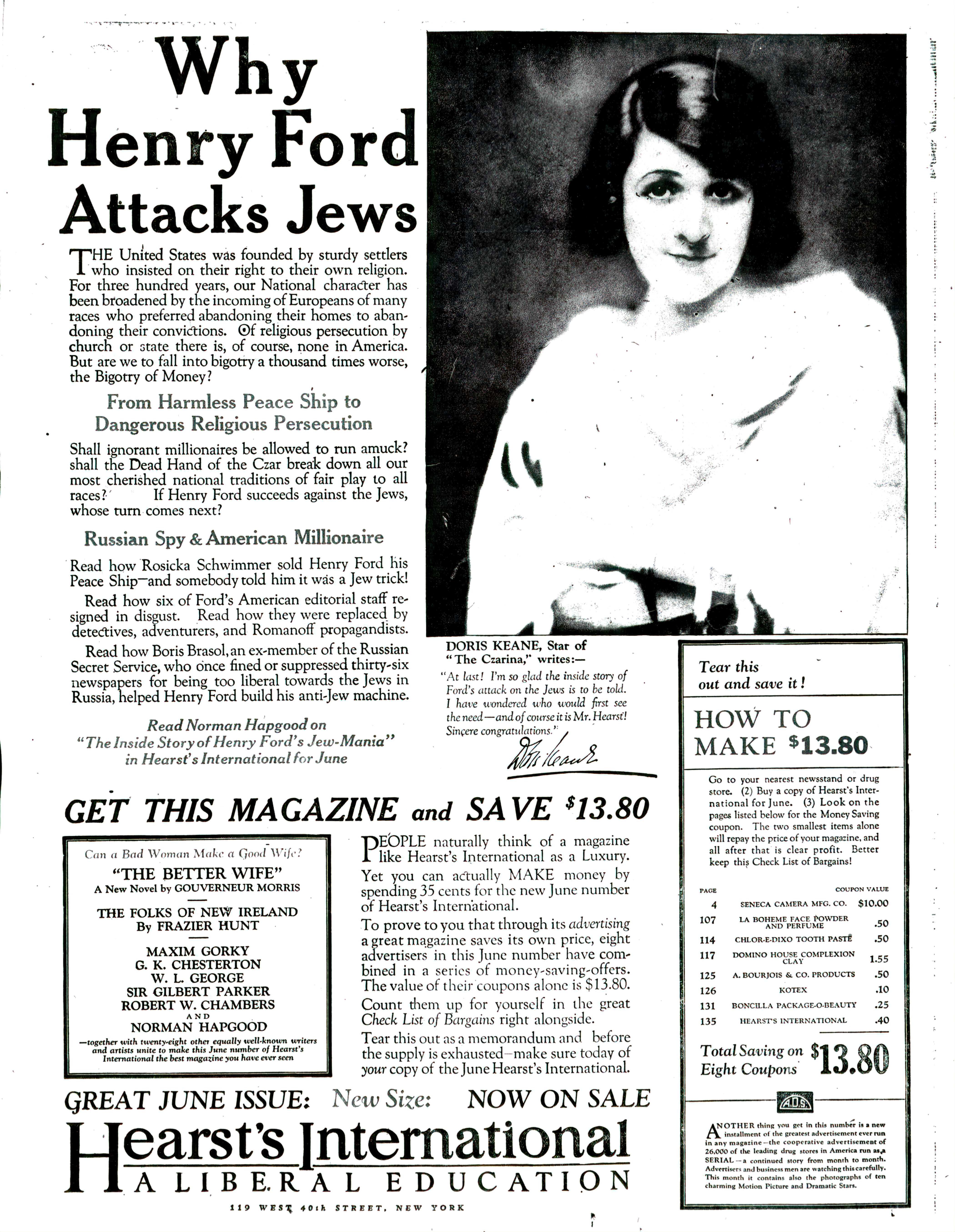
But because he promotes science and because he is a Jew, the congregants of a Christian chapel now picket his residence at night, flashing strobes and creating noisy disorder. In the comment stream of the local newspaper they also discuss health policy in language whose wordplay seems to show the influence of Ezra Pound. There, the words attributed to the lieutenant governor are a sheeny dialect from about 1908, the year that Pound left the United States and cut himself off from American language. Of course if you turn on the TV in 2022 you won’t hear the lieutenant governor speaking like that, but Pound was the poet who wrote for eternity, “Literature is news that STAYS news.”

The dictum must also be true for other ways of thinking in language, such as politics and religion. So would you yourself like to be cured of distress, reader? Then perhaps the time has come for you to open your mind to one or both of these ancient word-cures. Their strength is still unexpired.

Hear it. Open a window anywhere in America. The air that flows in will be filled with voices chanting, “Gimme that ol’ time,” and time will be mingled with them. Once more, time sings through the varied carols of America, and once again, as once in 1849, it writes this lyric prescription for healing. Take it now. You are no longer in the past, but the past will be to you a nutritional supplement.

Handbill, Duke University Libraries, https://repository.duke.edu/dc/eaa/B0178. Contrast and detail restored.

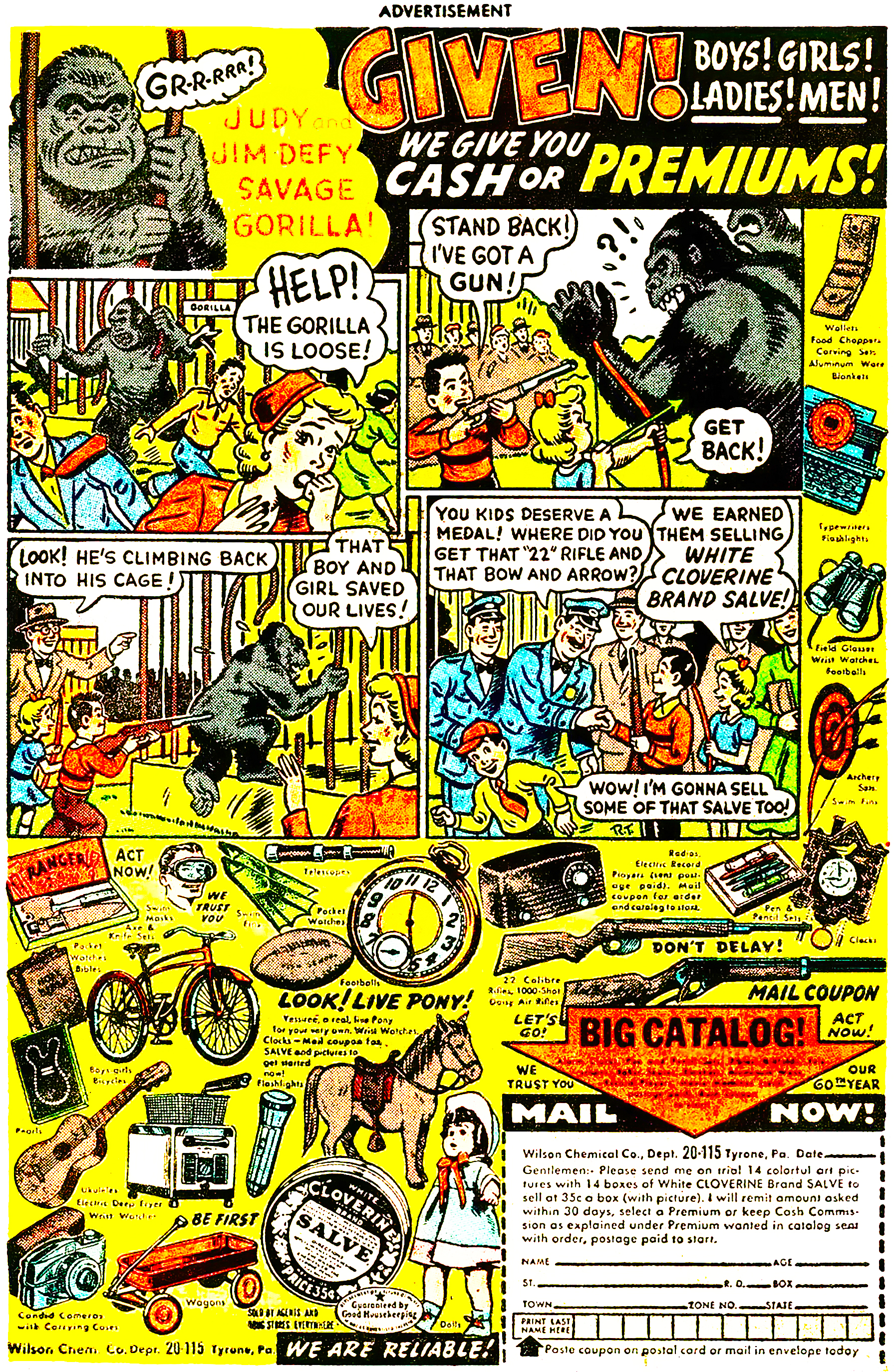
And this second revelation, datable to an American childhood in the Eisenhower years, has turned out to be a text immune to time. In your old age it now teaches you, at last! that all you have ever needed is the happiness of feeling with your body a red hat, a red tie, and a gun for threatening with.

Contrast, color and detail restored. About the line “Our 60th year,” this source says the Wilson Chemical Company was founded in 1895: https://perma.cc/96CR-QS3A.

You may address your prayer to the fulfillment department.


Syntax: current ethnopolitics

Yes, says the OED: the adverb inadvertently does have an antonym, advertently, and it’s in current use.

So read on below to page 3, think about the difference between “listed inadvertently” and “inadvertently listed,” acknowledge that tone-deafness and inadvertency are inescapable, and then consider that that inescapability is one more of the murderous reasons why Zionism is necessary.


https://www.jta.org/2022/01/27/united-states/barnes-noble-removes-the-protocols-of-the-elders-of-zion-from-its-site. “JTA” stands for Jewish Telegraphic Agency.


Teaching aid: I prepare to teach “Ulysses” for the last time

A Note about Joyce and the Jews

Toward the end of the Ithaca episode in Ulysses, the conversation between Stephen and Mr. Bloom turns to the subject of their two ethnicities, Irish and Jewish, and Stephen sings Bloom a ballad about a Jewish woman who cuts off the head of a little boy named Harry Hughes. The ballad is a folk version of the legend of Hugh of Lincoln, which English majors will recognize (oh well: ought to recognize) from another version: the ending of Chaucer’s Prioress’s Tale.

Chaucer died in 1400. The roots of the murderous canon of Christian tales about Jews go deep into English culture. As George Orwell’s excellent 1945 essay “Antisemitism in Britain” will demonstrate, Jew-hatred became impolite in England after the rise of Hitler, but it has always been present and – impolite or polite – it has never gone away.

Among Joyce’s important literary contemporaries, for instance, the expressed attitudes toward Jews generally ranged from snide (George Bernard Shaw, T. S. Eliot, and, yes, at the beginning of his career, George Orwell) through defamatory (the professional Catholic G. K. Chesterton and his collaborator Hilaire Belloc), with suggestions of genocide audible offshore from Eliot’s Jew-hating mentors Charles Maurras (French) and Ezra Pound (American). Virginia Woolf sincerely loved her Jewish husband, but she despised his family and every other Jew who crossed her path. Over the years a few non-Jewish authors have raised their voices against the general detestation, but only a few. From the Victorian era I can single out George Eliot and Charles Dickens; from the desperate years just before World War II, J. R. R. Tolkien and Basil Bunting; from today, J. K. Rowling. But today, also, literary England has a flourishing population of open Jew-haters with solidly established reputations, from A. N. Wilson on the political right to Tom Paulin on the left. About the hate, down the centuries, little to nothing has changed.

To all this the great exception is James Joyce.

One biographical explanation is straightforward. From 1905 to 1915 Joyce taught English in a commercial language school in Trieste, a city that’s now in Italy but was then part of the cosmopolitan Austro-Hungarian Empire, and one of his students there was a Jewish businessman named Ettore Schmitz. Schmitz was also a novelist, he and Joyce became friends, he introduced Joyce to some members of Trieste’s Jewish community, and the rest is literary history.

Or, say, a small part of the rest. The big part, the interestingly mysterious part, we might think about in the form of a question: what immunized Joyce against his culture’s normative attitude toward Jews?

No, I don’t expect you to answer. I certainly can’t, myself. But what I can ask you to do is be aware of how different Joyce was and is from his European Christian culture, how profound was his rejection of it, and how radical was his experiment in synthesizing a replacement culture out of words alone.

— English 440 (James Joyce), University of Hawaii at Manoa, spring 2019

Book review, two portraits, and short story beginning, “Als Gregor Samsa eines Morgens aus unruhigen Träumen erwachte, fand er sich in seinem Bett zu einem ungeheueren Ungeziefer verwandelt.”

Jackson_Daily_News_Wed__Mar_7__1906A topJackson_Daily_News_Wed__Mar_7__1906A bottom

Jackson [Mississippi] Evening News, March 7, 1906, page 2

Nicola Perscheid, “Prof. Dr. phil. Theodor Lessing — Schriftsteller,” about 1925. Staatliche Landesbildstelle Hamburg, http://sammlungonline.mkg-hamburg.de/de/object/Prof.-Dr.-phil.-Theodor-Lessing—Schriftsteller-/P1976.857.936/mkg-e00137302. Photoshopped to restore contrast.

Theodor Lessing’s contribution to language is the title of his 1930 book about Otto Weininger: Jüdischer Selbsthaß, “Jewish self-hate.”

Language note: the possessiveness of the pronoun “our”

The Department of Asian Studies at my university is now circulating a petition which reads, in part:

In response to and strong condemnation of recent expressions of hate directed at Muslim and Jewish communities in Hawaii, we endorse the following statement:

Over the past weeks the Manoa Mosque has been the target of multiple hate messages via social media, email, and voicemail. Individual Muslims have been harassed in public, including children. Also, Temple Emanu-El was targeted with a bomb threat against its Jewish pre-school.

We stand together with our Muslim and Jewish communities and any individuals who are subjected to harassment based on religion, immigration status, national origin, race, gender, LGBTQ+ status or disability. No one should go through this experience alone.

That’s how compassion expresses itself in current academic language: categorically, sorting its intended beneficiaries by administrative identifiers: “religion, immigration status, national origin. . . .” And along with the compassionate categories, as a logically required complement, there are also anti-compassionate categories: for instance, “the US” in a recent contribution from my department titled “The Homes of Zionism: Circuits of White Supremacy between the US and Israel.” There, the Marxist term “the US” functions in the same way as the Republican term “Democrat Party”: as an ugly, unidiomatic locution meant to make its subject sound ugly and alien. But that’s the way my department talks, and the attitude toward Jews represented by conflating Israel with the Klan is what a consensus lexicon sounds like.

Considered that way, as the lingua franca of everybody who matters, it has an important thing in common with the compassion-categories of the petition: it is the vocabulary of a collective mind named “we.” If we were to try thanking that “we” for its compassion for the Jewish community, we might acknowledge the significance of the generous impulse by pointing out that Israel too is a Jewish community — in fact, a Jewish community created expressly to protect against the social consequences of hate. But of course, that time, our gratitude wouldn’t be wanted. It would not only be rejected; it would be misunderstood, uncomprehended, estranged from meaning.

Grammar would have accomplished the alienation. In the instant of its being heard, the possessive pronoun “our” in the petitioners’ phrase “our Jewish community” controls and limits admission to the meaningfulness of the term “Jewish community.” By modifying “Jewish community” to “our Jewish community,” it changes the reference of both “community” and “our” from terms that include to terms that exclude. Modified in that possessive way, the term “our Jewish community” instructs its speakers to think of Jews as theirs to possess — pets, say, who belong where the human community says they belong and nowhere else.


*

A footnote to the note: William Safire’s The New Language of Politics: A Dictionary of Catchwords, Slogans, and Political Usage (rev. ed., 1972) traces the history of the term “Democrat Party” back to Thomas E. Dewey in the 1940s. During the same era, cartoons in Socialist Camp periodicals like Ogonyok routinely identified villains as American by depicting them wearing the U. S. Army’s “U.S.” lapel badge. The artistic fascination with that un-Cyrillic squiggle lives on in North Korea, even when the artists get it backward: