
Annotation from the record in the Library of Congress’s George Grantham Bain Collection: “Photograph shows Nephele A. Bunnell (b. 1897), a participant at the automobile fashion show held at Sheepshead Bay Race Track, New York City, June 23, 1917. The event was a fundraiser on behalf of the Actors’ Fund of America. (Source: Flickr Commons project, 2015).” Link: http://www.loc.gov/pictures/item/ggb2006000143/. Photoshopped.
World War I
From the age of Synthetic Cubism: interior with tabula rasa

Source: Holger Damgaard, French uniform with gas mask, 1915. Royal Library, Copenhagen, http://www.kb.dk/images/billed/2010/okt/billeder/object140232/en/. Photoshopped.
Estampe XLII: air construction with sunbeam and tree

Source: “Le zeppelin ‘L 49’ abattu à Bourbonne-les-Bains [le 20 octobre 1917].” Photograph by Agence Rol, Bibliothèque nationale de France, http://gallica.bnf.fr/ark:/12148/btv1b530036907/f1.item. Photoshopped.
Military maternity, perilous token of courtly love, and, on the prison road, touch: three women in wartime


Click to enlarge. The gunboat Geier, detached from the German Navy’s doomed Pacific squadron at the beginning of World War I, was interned in Honolulu during the period of American neutrality. After the United States broke off diplomatic relations with Germany in February 1917, Geier’s crew attempted to burn the ship at its dock before it could pass under American control. An earlier post about the incident, based on undigitized images, is at http://theartpart.jonathanmorse.net/snap-shots-of-an-event-that-may-become-historic/ .
Diag
For Franz Kline

—-
The image of the Cunard liner Mauretania in World War I dazzle paint is on the web, but I haven’t found its original source. The anonymous posting that I downloaded and photoshopped dates the image as April 2, 1917, but that is clearly wrong because the flags indicate that the picture was taken in an American port and the United States didn’t enter the war until April 5. I’d guess that the picture was taken in New York on December 2, 1918, at the same time as the image I posted about on October 23, 2016.
Estampe XXXVIII: the return through mist
 December 2, 1918: days after the end of the Great War, the Cunard liner Mauretania, flying the Royal Navy’s White Ensign and still camouflaged with anti-submarine dazzle painting, brings American soldiers back to New York. Source: George Grantham Bain Collection, Library of Congress, http://www.loc.gov/pictures/item/ggb2006003377/. Photoshopped.
Like the dyer’s hand
Year by year during the second and third quarters of the nineteenth century, organic chemists fashioned transformations upon the unassuming body of a smelly liquid called aniline. Under their godmothering guidance, aniline submitted to change after brilliant change from her transparent pale yellow to a whole wardrobe of dyes, color after lovable color. Every season Cinderella would re-emerge from the laboratory to be seen anew, and the chemistry of progress made sure that she was seen with ever more excitement as the century went on.
So when the long nineteenth century ended with excitement in 1914, the Russian artist I. D. Sytin was equipped to showcase the change. For effects of the lurid he had tube after tube of bright new primary colors, but for ironic contrast he also had something delicate. Sytin’s lithograph “War in the Air,” its flame yellows and flame reds set off by midnight blue, is printed on paper tinted pink.

Thanks to the pink, the whole lithograph, in both its primary image and its explanatory text, has a ground of rosy conflagration-color. That doesn’t just make the flames in the figure seem to burn hotter; it also desaturates the no longer bright blue of the river shining innocently under starlight and consolidates the fine-print nuances of the text into a single hysterical scream in rubric red. The catalog of the Hoover Institution Poster Collection stubbornly insists that the two elements unified by pink within the image frame are still separate, and it formats its insistence as an equivalent pair of sentences in archival black-and-white: “Painting depicts aerial battle with airplanes and airships. Text underneath describes modern aerial warfare.” But what Sytin’s stones impressed on his picture wasn’t a separable pair of stimulants to sense-impression; it was an ensemble. In its presence a century later, the excitement we have been roused to isn’t archival, it’s historical.
Perhaps the distinction is that the historical sense at least hints at an idea of ensemble: a single consciousness sharable between a record and its reader. A historical record, perhaps, is a text that can be experienced as immediately as the color pink. At any rate, in the presence of this particular array of colors, the historical sense may remind us that it and we now subsist in a world no longer conceivable in black and white. Three quarters of a century before I. D. Sytin set to work, chemists began excitedly coloring in the world’s blank spaces, and it is no longer possible to see what the world was like before that moment. By 1914, says a Russian chronology written in aniline pink, the synthesized product was even filling in the sky.
Source: Hoover Institution Poster Collection (http://www.lunacommons.org/luna/servlet/HOOVER~1~1), item no. RU/SU 365. Photoshopped.
Transport VI: song with herms

Source: the opera singer Geraldine Farrar performing at a Liberty Bond rally in New York during World War I. George Grantham Bain Collection, Library of Congress, http://loc.gov/pictures/resource/ggbain.26652/. Photoshopped.
Language note: in a time of austerity, the conscience undergoes change
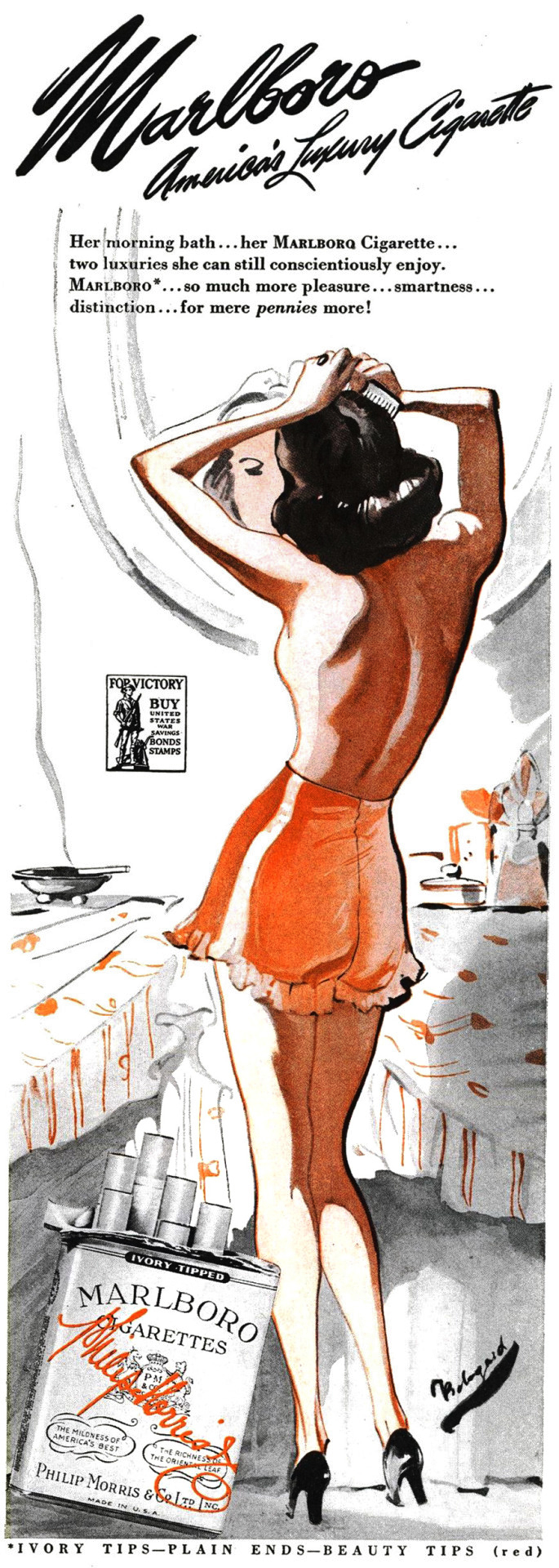 During the early 1970s, Marlboro cigarettes, formerly a niche brand, rocketed to the top of the market and became the best selling cigarettes in the world. The reason is well covered in histories of advertising: Marlboro’s manufacturer switched niches. If the cigarettes haven’t killed you yet, you associate Marlboros with masculinity, thanks to the extraordinary success of an advertising campaign whose icons came coughing onto the page beginning in 1954 — first as men with tattoos, then as cowboys. Look to your left, however, and you’ll see that as of 1944 Marlboros were a woman’s cigarette, tipped with red to hide lipstick stains. At http://tobacco.stanford.edu/tobacco_main/images.php you’ll find a richly illustrated history of the gender reassignment. This note is about a language change that seems to have occurred concomitantly, and perhaps a moral change too.
Yes, in this advertisement even the illustration has a moral. Between the woman and her ashtray stands Daniel Chester French’s image of the Minuteman of Concord, steadfastly posted eyes-front at breast height. Almost as an afterthought, the advertisement’s text is duty-bound likewise. “Two luxuries she can conscientiously enjoy,” it explains about the illustration, and it half-conceals its heroine’s lineaments of conscientiously gratified desire behind a turned back and a mirror image guarded by a raised arm.
Nineteen-forty-four, after all, was a year when openly acknowledged desire must have seemed shameful. In the sixth year of the Second World War, all of the unashamed rest of America was austere. In window after window hung a little flag bearing at least one star, each star the symbol of a son in the Armed Forces or (if the star were gold) of a son dead on the field. In magazine after magazine, too, the advertisers who articulated the language of America’s economy somberly explained the necessities of shortage and pleaded for willing submission to the unending sacrifice. Turning her back and refusing to look at anyone but herself, Miss Marlboro counterpleaded, with feminine emphasis and a feminine diminutive, for “mere pennies,” but the 1943 penny itself was a memento mori. Not made of copper that year because copper was desperately needed for shell casings, it was minted instead in galvanized steel: no longer the red of a Marlboro beauty tip but gray, gray. “In this refulgent summer, it has been a luxury to draw the breath of life,” Ralph Waldo Emerson had cried with defiant joy as he stood before Harvard’s divinity school in 1838, but 106 years later the threat to joy was no longer a three-quarters-dead regional Puritanism but death itself, fully dressed against the summer in menacing black.
But no, pretty miss in heels and peach-colored panties: even under that dread circumstance, you need not feel ashamed of your bath. It makes you not just clean but clean-feeling, and that harmless benefit comes to you free of any charge, either in money or in currencies of the soul. The world outside has descended fully into 1944, but in this room with the ashtray on the vanity you are about to sink into a bath conscientiously. The original sense of that adverb happens to have been in good conscience.
Postwar, I get the impression that that sense has all but disappeared from American English. The word conscientiously now seems to connote little more than rational but uninspired acceptance of a duty. Yes, yes; I do, conscientiously, try to practice good dental hygiene. But except perhaps as a vestigial technicality in the legal term conscientious objector, any sense of conscience as a motivating joy seems almost to have vanished from English. In 1914, in the first poem of the sonnet sequence he called 1914, Rupert Brooke compared men about to volunteer for the war with “swimmers into cleanness leaping,” but as early as 1918 some of the Englishmen to whom that simile had once seemed to mean something were saying, “Went to war with Rupert Brooke, came home with Siegfried Sassoon.”
So conscience understands that it will be different this time when you take off your panties and leap. But do leap. It seems possible that the calendar will never again advance from 1944, and the leap will at least make you feel clean until you resurface in the smoky air. As a poet who thought himself postwar once sang:
Never such innocence,
Never before or since.
Sources:
http://rbrower45.tumblr.com/post/147185242401/gameraboy-marlboro-ad-1944. Photoshopped.
Ralph Waldo Emerson, “The Divinity School Address”
Philip Larkin, “MCMXIV”
“Nor have they then a makeshift body”
In front of television cameras in 1998, Representative Henry Hyde regressed for a moment to a pre-television English. As he prepared to consider the impeachment of President Clinton before the House Judiciary Committee, he asked the clerk, “How much time have I?” I still remember being startled by that idiom, the inversion of subject and main verb in a question. For decades before 1998 I had heard it only in old movies, yet suddenly Representative Hyde, on color TV, was speaking the language of a black-and-white newsreel.
Well, the anachronism isn’t mysterious. In 1998 Representative Hyde was 74 years old, and he was simply continuing to speak English as it had been spoken when he was young — for instance, in the year 1938, when a physician in William Carlos Williams’s short story “The Girl with a Pimply Face” asked about a sick baby, “Has it diarrhoea?” (119). I haven’t conducted a systematic search, but from books and movies I get the impression that during the first half of the twentieth century that inverted construction (“Has it diarrhoea?”) gave way rapidly and almost completely to the construction with an auxiliary verb, along with a related change in pronoun reference (“Does she have diarrhea?”). As infant mortality became unusual in the Anglophone world, speakers of English no longer had a practical use for the self-protective reflex of referring to babies as only provisionally human it-objects. But Representative Hyde, by that time in his own history, was no longer noticing.
Outside sickrooms, however, the old idiom’s final years coincided with the aftermath of the war and plague of 1914-1918. Even in health during that time, speakers of American English must have felt the fear of mortality in new ways. At any rate, advertisers seemed to have intuited such an insecurity, for the idiom of their advertisements began straining after the perdurable. Fonts went lapidary, vocabulary went Latinate, and syntax began pacing itself slower to accommodate the dignified walking rhythms of the healthily portly. For the portly in one such advertisement, the penalty of Adam was to be mitigated by something called the Enclosure, and the vocabulary that prepared souls to enter the Enclosure sang of eternal life. Its syntax, too, modulated itself into a gently rocking iambic tetrameter with a feminine ending as it intoned, “Nor have they then a makeshift body.”

But the rite of the Enclosure drew its deepest power from its simplest trait: mobility, the assurance it extended to the enclosed that it wasn’t just an Enclosure but an Enclosure on wheels. After 1918, especially, that assurance drew strength from a new, post-1918 knowledge: the knowledge that at a not unimaginably great distance from the hard stable surface under the Enclosure’s wheels, a body lay barely moving in a bed. The sense of that difference took form as a solemn didactic happiness, and it taught itself to riders in the Enclosure with a single noun scratched deep into its own photosensitized surface. Cripple, said the noun to the world of 1918, in a photographic caption carefully worked into a Socratic lesson plan. And the world of just after 1918 happily responded in the counter-language it had newly learned, “The Enclosure cannot rattle or squeak.”
But to the world no longer inhabited by Henry Hyde the old noun still cries Cripple. A blogger with a taste for the comedy of the antique may have posted the pompous disyllable cannot because “cannot rattle or squeak” makes a more nineteenth-century sound than “can’t rattle or squeak,” but cripple seems unaffected by the passage of time. Affixed to its glass backing, the depicted body of the cripple has a permanent context. The glass is cracked but not altered in its transparency to meaning.

But the cripple’s glass has been paired with another hard permanent document, and that one is reassuringly opaque. Within the image itself, erected directly over the cripple’s bed, a wooden slab promises in knotty pine, “I can’t speak, but if I could I would say, ‘I say unto thee, Arise, and take up thy bed.’ My name, which none of us need to speak because all of us know it, is Makeshift.”
Even more reassuring, Makeshift has another name, in actual speakable language: the word design. Design is a word from the universe of meaning that Keats, making use of a mobile metaphor (“Much have I travell’d”), called the realms of gold. Singing from a libretto scratched deep into the cripple’s image, design assures us who are not yet crippled that in coming times it will enchant us as well. It will dance, too, as it comes. It will dance right through the glass that will begin enclosing us when we sink into our bed. After all, the sinking will still be a motion of the body.
So rejoice, sings the word design. So long as you remain only partially crippled, I will be with you. While you still are able, raise your paintbrush and let it touch me and transmit my strength to you. For the time being, now am I your makeshift body.
Sources: William Carlos Williams, “The Girl with a Pimply Face.” The Collected Stories of William Carlos Williams (New York: New Directions, 1996) 117-30. The story was first published in book form in Life Along the Passaic River (1938).
The automobile advertisement originally appeared in Literary Digest 24 November 1923. I copied it and Photoshopped it for sharpness from http://blog.vintascope.com/post/145306079472/oakland-motor-car-company-19231124-literary
The undated photograph of the man in bed is one of a group of World War I hospital images apparently taken in France. George Grantham Bain Collection, Library of Congress, http://www.loc.gov/pictures/item/ggb2006002284/. Photoshopped.
From 1922, some contemporary satire of the pretentious diction of American advertisements can be found in Sinclair Lewis’s Babbitt.