
Miniature railway, Coney Island, New York, 1905. Source: Detroit Publishing Company Collection, Library of Congress, http://www.loc.gov/item/det1994015437/PP/. Photoshopped.
train
“Disaster” means “ill star”
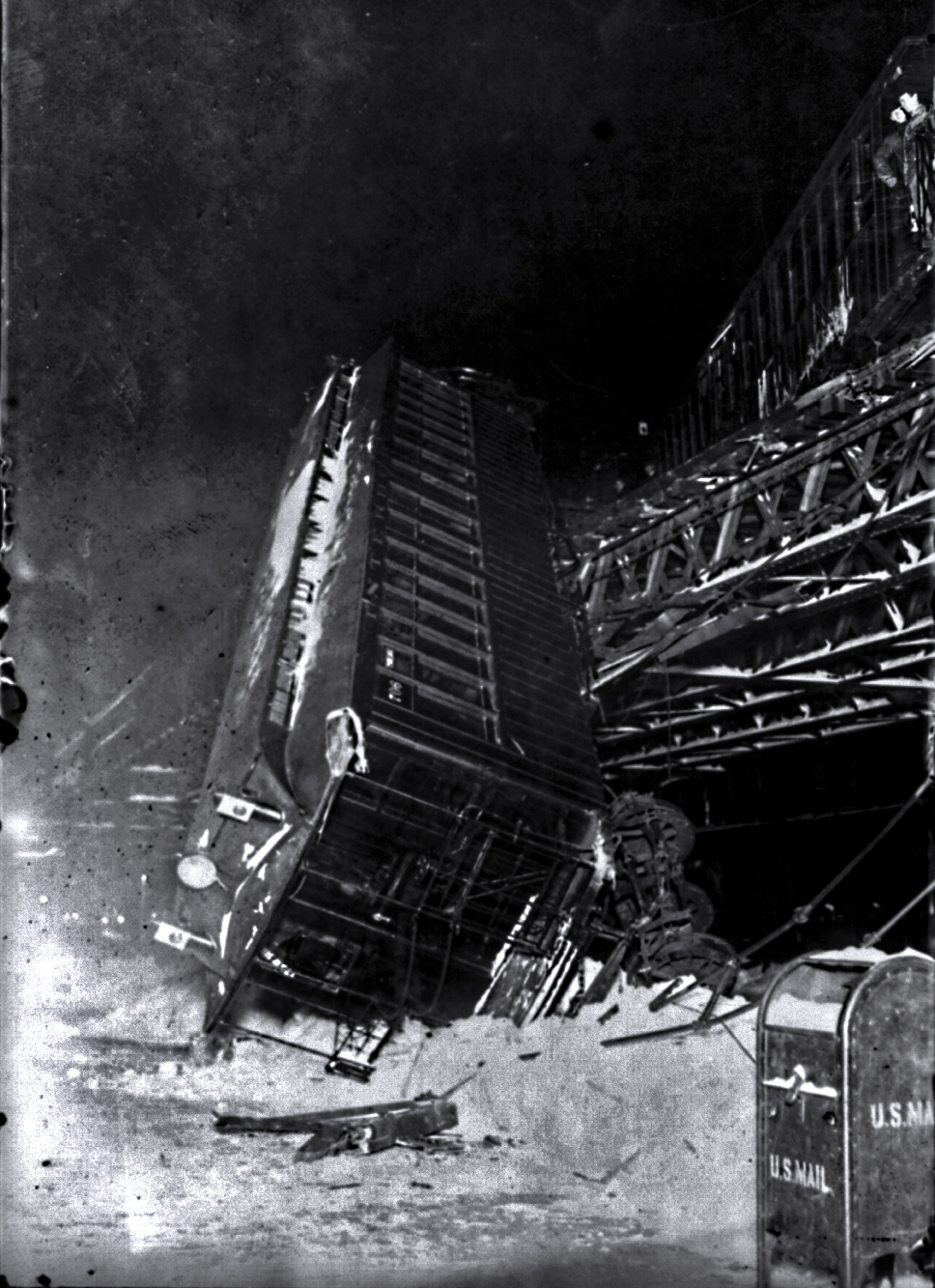
Source: “Elevated car falls to street 2/16/14.” George Grantham Bain Collection, Library of Congress, http://www.loc.gov/pictures/item/2002699891/. Photoshopped.
The express from Byzantium
In the Library of Congress at http://www.loc.gov/pictures/item/det1994016929/PP/, this photograph has gone white with lost detail. We pretty much have to take the librarians’ word that it depicts a famous American train from the turn of the twentieth century, the New York Central Railroad’s Empire State Express, on its way though Syracuse. For their own part, the librarians can only approximate the date of the passage. The faded image and its owners’ records tell them only that this photograph of the Express’s transit was taken some time between 1900 and 1915.
 But parts of the transit can be retraced by post-processing, and I suppose that may aid in fine-focusing its history. Clicking away from this image to the next one, for instance, a railroad historian might be able to do something with the more legible number on the Express’s locomotive, and a fashion historian might be able to make something chronological of the dress worn by the one woman I can now see again. For historians of Syracuse, too, Photoshop has put the century-old signs back up on Syracuse’s businesses. See how that has put the big building on the left back into communication with time. Carved deep into its rock there on an upper-story frieze, the two monosyllables The Yates look once more the way they did on the date of the transit: as if they’d traveled to The Yates by express from Mount Sinai. The history of The Yates, says reread stone, hasn’t had to die after all. The lost, says Photoshop, may be restorable.
 But to read the history of the image as a whole we’d need to know the history of the light that filled a camera in Syracuse for a sunny moment some time between 1900 and 1915, and the lighting script for that moment has been rewritten. Syracuse’s light isn’t now what it was during the century and a half of the steam era. Seen through smoky light as it was seen then, the Express under its moving cloud has passed through Syracuse forever, and it won’t be back. Light no longer works the way it did when locomotive no. 3897 offered up its smoke to the air. On the building to the left, the frieze that the sun lighted in those years was lighted for those years only. Then its inscription, “The Yates,” was to be read only by day, under layers of soot; now it’s to be read by day or night, carbonless by day and with its night colors changed by sodium vapor.
Because the way we read is always changing in this way and others, a poet once dreamed of a writing as resistant to change as metal. He was old, he cried, and about the light and shadow of the changing earth on which his body lay he cried, “That is no country for old men.” Funnily, he had a name homophonic with “Yates,” and in his hard Yates poem he sang,
Once out of nature I shall never take
My bodily form from any natural thing,
But such a form as Grecian goldsmiths make
Of hammered gold.
And yes: framed here on your monitor, The Yates does look lapidary, hammered into a permanent place in a permanent image. But compare the original image with my photoshopped version and you’ll understand that the lapidary look is only an effect of artifice and temporal confusion. Next to an image of a vanishing cloud of smoke, an image of a stone building looks immortal by comparison. The symbolism of this particular building’s Renaissance architecture, too, is an evocation in stone of ideas like traditional. But a tradition expressed within an image must have originated outside the image, before the image existed, while on the other hand the image’s work of evocation can begin only within the image. First an artist envisions an empty frame, and only then does it begin to fill itself with picture. Look up, for instance, to the dappling light near the top of The Yates where smoke seems to touch and fill and then withdraw from shadowed stone. It’s the pictured dapple, only, that hurts your heart. And as to you with the hurting heart who take your picture from an upper-story window, you have set up your camera on the Express’s side of the street, where nothing is still.
Leave the camera there and descend. Cross from the single hard-edged shadow of your building into the unclear polyshadow of the smoke. Approach the still glass front of The Yates along the roadway where Syracuse’s slow light is moving a horse and a tall-helmeted policeman into position. Step between the horse and the policeman. The light reflected from their bodies will help you when you begin looking into the window. For now, the window in the image lets you see only two glittering words, The Yates, and a tall-helmeted reflection. While the shadow of the smoke lasts, there will be nothing else. But when the shadow moves off and the Express is gone and the dark glass is restored to full reflectivity, the Syracuse light may unseal its record. And then, under glass in the smoky light that once illuminated the dead, you may see that you too have been changed by passages over you of cloud and light.

Estampe XVII: Photoshop against encroaching decay
 Source: Detroit Publishing Company Collection, Library of Congress, http://www.loc.gov/pictures/item/det1994017520/PP/. Photoshopped.
Estampe XII: activity at the edge of an emptiness

On November 16, 1919, someone named George B. Parks notified what was then called The New York Times Review of Books that a book purporting to be a war memoir was so factually inaccurate that it couldn’t be non-fiction.
George B. Parks was undoubtedly correct. The book he was examining is only 84 pages long, and in that tiny intimate volume the facts stand out only because they are so few and so vaguely described. On the other hand, an extratextual fact, this one startling, is that as of November 1919 this book had already been in print for a full year. Just days after the end of the war, the Times had announced its publication this way.

The book was so well received that its author eventually came forward and identified herself as the journalist and writer of children’s books Grace Duffie Boylan. The facsimile published by Forgotten Books bears a title page date of 1919, and the digitized copy at Archive.org bears a title page date of 1920.
But why? The book itself is not just vapid but almost totally empty. In heaven, wirelesses the dead soldier to his mother, the souls in khaki do, you know, stuff. They have dogs and cats and horses to keep them company, and the dogs travel busily back and forth between the astral plane and the terrestrial but the cats are looked on with suspicion. No reason for this is given. However, we do specifically learn that everybody spends time discussing the text “They shall be one flesh.” What the doughboys in the clouds wonder is: if a woman has been married more than once, with which one of her husbands will she be reunited in Paradise?
(Grace Duffie Boylan herself was married four times.)
—
Well, the answer to the question “Why?” is in the history books. It isn’t surprising: in the horrible stillness after the guns of the Great War went silent, millions of readers went gleaning for grains of comfort in bookstores, where businesspeople were waiting to accommodate them.
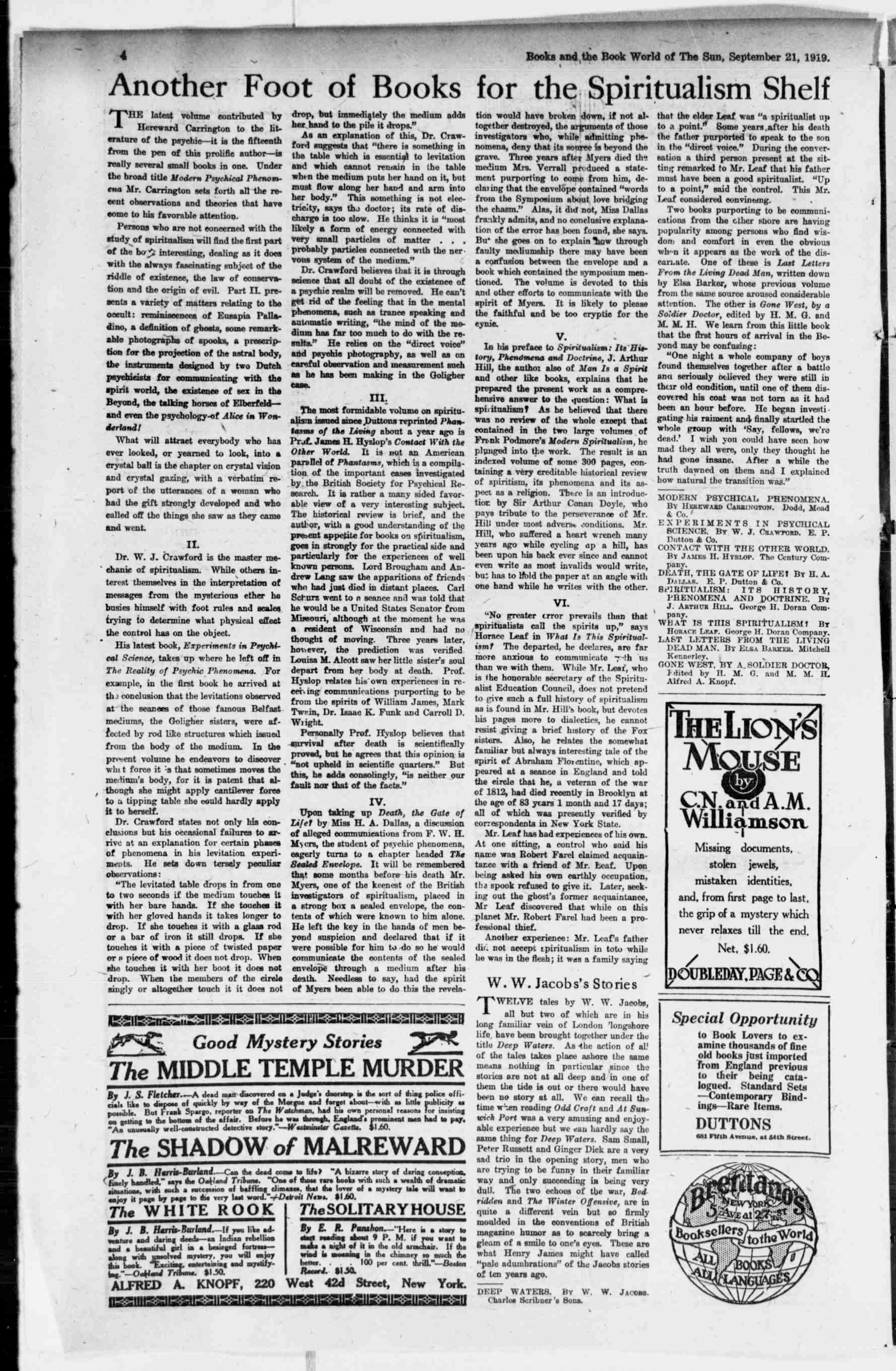 Click to enlarge.
The same thing had happened after the Civil War, when Elizabeth Stuart Phelps’s consoling theological fiction The Gates Ajar provoked Mark Twain into a full-length parody, Captain Stormfield’s Visit to Heaven.
But you wouldn’t read The Gates Ajar or Thy Son Liveth the way you’ve read my paragraph of literary history about them. The consolations of Thy Son Liveth were made available in 1918 and 1919 and 1920 by the respectable Boston firm of Little, Brown, and Company for the reasonable price of 75¢, and of course it was a large predicted multiple of 75¢ that motivated the literary labor of Mrs. Boylan, Mr. Little, and Mr. Brown. The old-fashionedness of that symbol ¢ is the kind of topic that literary history is loquacious about, but emptiness in the heart of a grieving mother is mute. Around the wordless emptiness there bustle George B. Parks and the journalists of the New York Times and Sun and assorted Little, Brown businesspeople, but by contrast with their cheerful realism (“Another foot of books for the spiritualism shelf” [laughs]) the emptiness is only darker, more unimaginable, and more mute, if there could be degrees of muteness.
—
Ten years earlier, a vast excavation was being hollowed out under New York for the new Grand Central Station. As fast as it was created, it was filled again. In this hole, life was ongoing. As of 1908, someone looking at it through a fence might have felt exhilarated on behalf of the excavation’s embodiment of life growing up toward the light from deep in the earth. But ten years afterward, Grand Central was complete and its newsstands were selling fictions purporting to speak in a language from beyond the grave. The excavation had been completed by then, and light no longer shone into it.
 Detroit Publishing Company Collection, Library of Congress, http://www.loc.gov/pictures/item/det1994001893/PP/
Photoshopped. Click to enlarge.
Estampe VI: a correction for the passage of time
The original: “Buffet library car on a deluxe overland limited train,” between 1910 and 1920. Detroit Publishing Company Collection, Library of Congress, http://www.loc.gov/pictures/item/det1994002352/PP/. Click to enlarge.

A century ago, it wasn’t as easy to see as it is now. The lighting wasn’t as good, and the air coming through the open clerestory of the buffet library car would have been smoky. A century afterward, too, it no longer seems possible to determine the exact date on which this 6.5-by-8.5-inch glass negative was exposed. But the negative’s unchanging physical property of large exposed area has preserved into the future a large latency of light and form. A 35-millimeter negative, a standard way of archiving the records of light until the day before yesterday, has the exposed dimensions of 24 by 36 millimeters, or 864 mm². A 6.5-by-8.5-inch negative comprises 35,645 mm², or 41 times as much potential terrain for light and lens to fill with detail.
Now, claiming that detail on behalf of my own time in the future, I digitally effect entry into the image. Entering, I move closer to one of its pictorial elements than I ever could have in what’s called real life, when the pictorial element was a still living man with a word printed on his cap and, perhaps, a sensitivity to having it and his face looked at together, close up in the same frame of reference.

No, I can’t quite read the word yet. But with Photoshop’s help, I can now see that the failure to be readable is only a minor error of institutional history. As it turns out, the word is hard to read because the negative has been printed backward. Correcting the error, I re-reverse the image. Up comes the word then, and it turns out to say “Porter.” Now that I can see the word correctly on the porter’s cap, I can also see the porter correctly. At least partially, I have learned to read the man’s face and body and their printed label as they were read when men rode the deluxe overland limited in a library. The word “Porter” has become part of the lexicon of body language.

In body language, then, let’s reread the text of the men in their library, this time oriented correctly on their page.

Seen reading as they pass through time, the men with their spittoons and the servant who cleans them are once again outlined as sharply as they were when books enclosed within their covers illustrative engravings in black and white.
Structural


The first image is a photograph by Walter Kimmich, taken between 1908 and 1917, in the Library of Congress at http://www.loc.gov/pictures/item/2012646342/. Photoshopped.
Starring Ray Collins as Wallace Stevens
A New York Central System timetable, November 15, 1937:

From the frontiers of capital, prosperous new year!
As things fade to white
Between 1903 and 1917, a woman named Phoebe Snow traveled like a celestial body along the tracks of one of America’s regional railroads, the Delaware, Lackawanna and Western.

Click to enlarge.
The creature of one of the most successful advertising campaigns in American history, Miss Snow existed only to be unceasing: unceasingly in motion along a pounding iambic dimeter, unceasingly white, unceasingly bountiful of her whiteness. In her unceasingness, she was loved.

This illustrated history may help show you why. A comet always arriving, destined never to drop back into the dark and go still, Phoebe lived as light and motion, bestowing herself on everyone beside the track who existed to make her sidereal. Along the path of her orbit, brilliance illuminated the labor of engine crews, yard crews, porters and dining car waiters and the brilliantly white-clad cooks in the dining car’s galley. In her presence, light entered into the interior of what it seemed to mean to be human, dissolving secrecy and shame and shadow into a single all-encompassing whiteness.
http://scout901.hubpages.com/hub/Phoebe-Snow-Railroad-Advertising-Icon
The whiteness released her victims from darkness into love. It even extended underground, to the veins of coal and the men who worked them and the mules who worked alongside the men like brothers of Phoebe’s. There underground, Phoebe became her picture’s source of light. Descending into the dark and then ascending again, she traced letters from light across the darkness, and interpreted them to mean that all will be happy now, even in the face of death.

 —
—
On August 8, 1914, that consciousness was still alive and still animating a gentleman in love with nature. By then, however, it had abruptly become remarkable. On August 9, a reporter for The New York Times observed it in its descent toward incomprehensibility. Far down now in the third paragraph of an article, it was barely readable by then; too deep in the shade cast by the headline. The language of that headline was a dark new dialect whose words could not have endured in the sunshine vocabulary of Snow.

Not far from the pier, the transatlantic cables surfacing in New York were drowning Phoebe’s meters in irregular sobbings, and Belgian reservists were boarding a ship bound eastward, where the dark was rising.

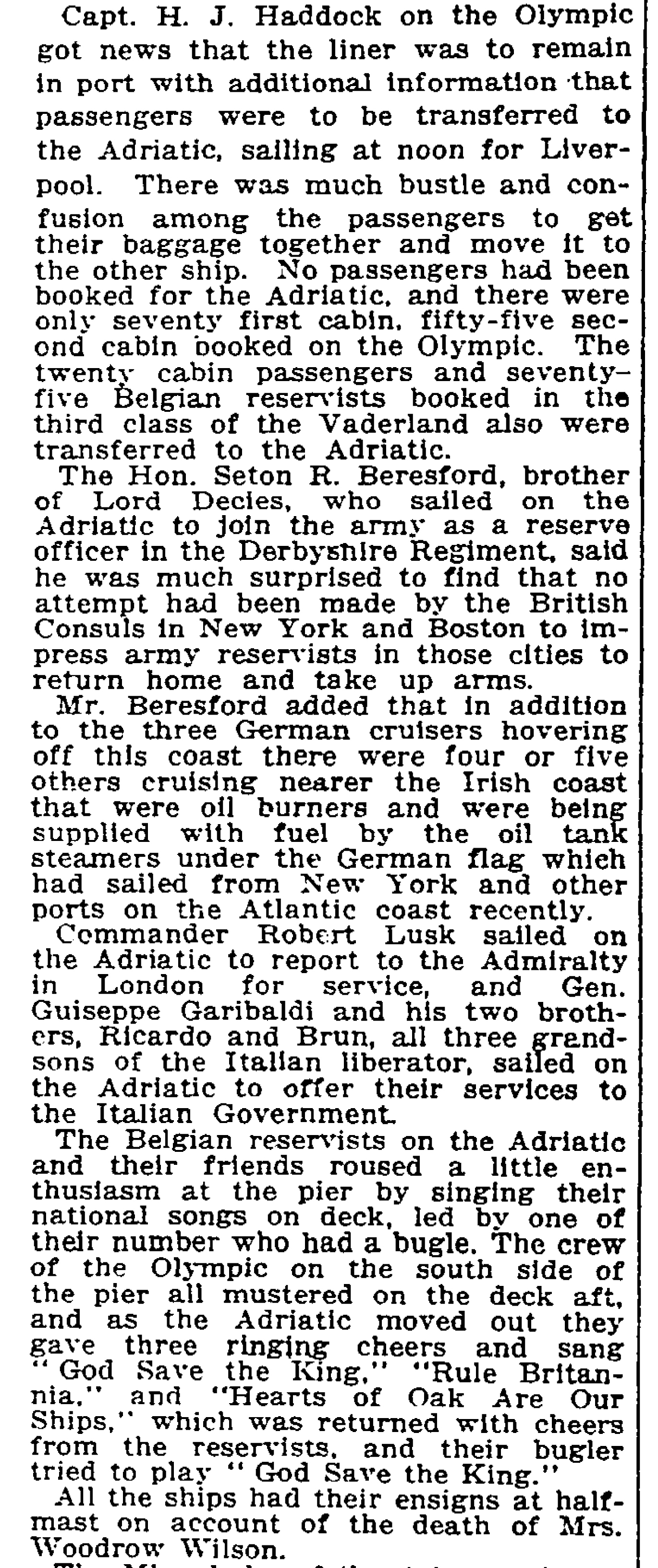
To understand, then, we have to look away from Phoebe and the gentleman entomologist.. A camera creature has surfaced from the dark flood, extending a black-and-white photograph of the Olympic’s cheering stewards to us.
 Source of this image and the next two:
http://www.loc.gov/pictures/item/ggb2005017010/
The next two have been Photoshopped for contrast.
From this angle in the photograph’s space, the time is the present. The stewards are and will always have been seen to be in mid-cheer. Panning toward the Olympic’s sister ship, the cameraman records the visual testimony of the Belgian reservists singing and cheering back. As they sing, marking time, they are moving outward. The stern of the Adriatic is being eased away from the pier.
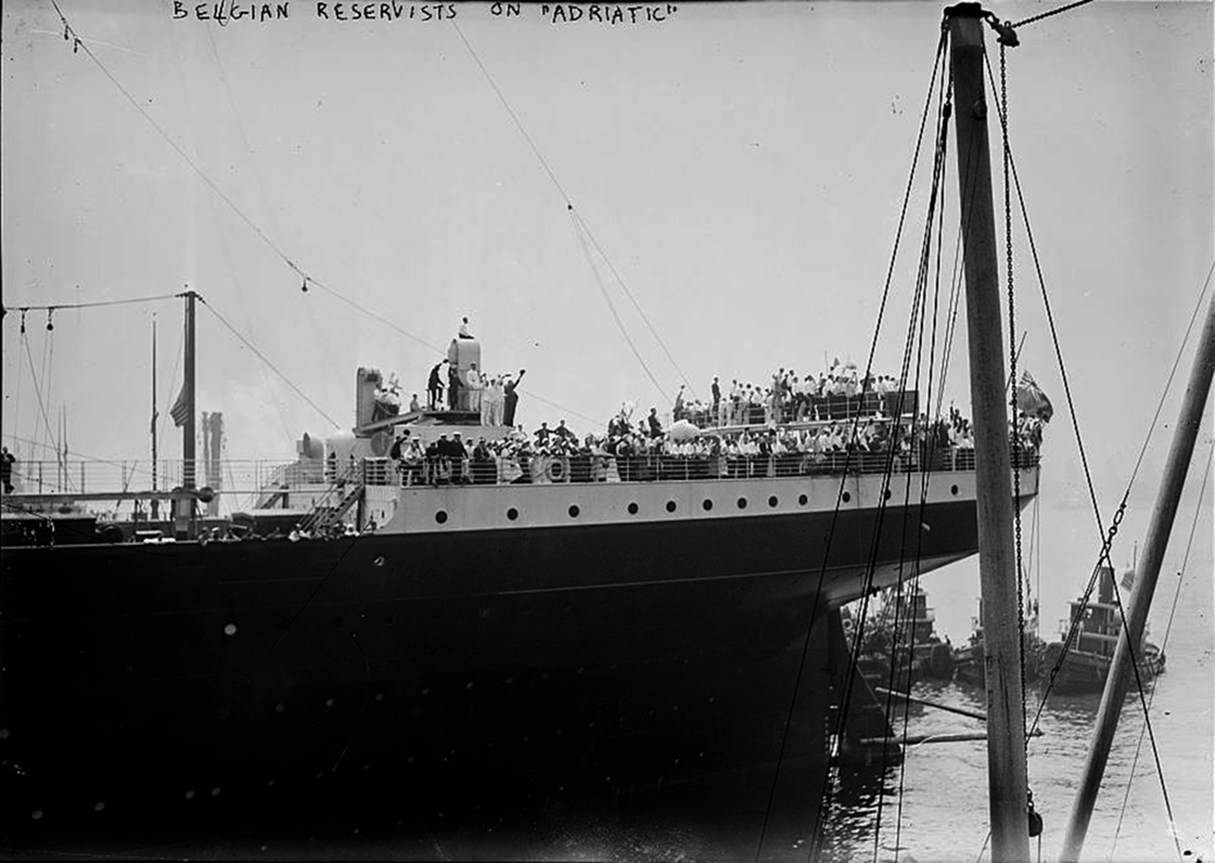
That motion has prepared us to receive an image that history, in due time, will call definitive. Now and forever, this image holds us back on August 8, 1914, at the watery verge of a pier in New York. At the far boundary of the space, receding as we watch, the White Star liner Adriatic is now becoming visible as a whole. On board the ship, certain men who will soon die can no longer be seen, though unillustrated abstract history provisionally asserts that they are still, for the moment of August 8, 1914, alive.

In comparison with the blankness into which the ship is now disappearing, Phoebe Snow’s immortally conceived whiteness was only a whim. Anthracite burns cleaner (a little cleaner) than soft coal, but to have believed in Phoebe’s absolute whiteness was never more than a suspension of disbelief. “Of course,” says Phoebe’s image to you, “I am only one of art’s happy ways of helping you imagine possibility. You always knew that.” To have looked at Phoebe’s picture, read her poem, and then bought a ticket on the Road of Anthracite was never a more significant act than, say, buying a ticket to a movie with the cheerful intent of surrendering for a couple of hours to an optical illusion. If Miss Marion Murray had been in this scene, she would have been stationed among us dark-clad neutrals left behind on terra firma, imagining like us rather than being imagined like Phoebe. The optics of this photograph don’t work only on the mind’s eye the way an image of Phoebe does.
Because as the Adriatic begins fading into the dazzle of a hazed atmosphere just at the moment when we take it in, it becomes less visible to the eye even as it becomes more conceivable to the imagination. On August 8, 1914, men and women on a pier and in boats and barges saw a ship loom up through space under clouds of coal smoke and then fade in accordance with the laws of physics. If we could only see it now, we would see it as they did: as a mortal body fading to white, as graceful as it traverses its bright vanishing instant as Miss Marion Murray ever was.
Second homes
March 20, 1939: Gershom Scholem, in Jerusalem, writes to Walter Benjamin, in Paris:
I’ll be traveling to Port Said at the beginning of next week, to see my mother for three hours once again when her ship [carrying her from Germany to exile in Australia] puts into harbor there: this is likely to be our last meeting by human reckoning. I’ll be writing much more soon. I will certainly make use of any opportunity I might somehow, somewhere, come across for you. I am asking myself whether you shouldn’t try to get into the U.S.A. while you still can, and whether that wouldn’t be better for you than anything else. (251)
September 25, 1942: snow falls in Iowa and Illinois, USA. For the weather bureau in Des Moines this is the first September snowfall on record, and elsewhere in the state the football game between Garner and Buffalo Center has to be called after wet, wind-blown snow breaks seven lights on the field. On a train, the conductor and brakeman are impressed enough to make a note. In chalk, one of them writes “1′ / of Snow 9-25 5 PM” on one of the rafters that support the roof of his caboose. The words will still be there four months later, when the photographer Jack Delano records a moment in the history of the caboose for the Office of War Information.

http://www.shorpy.com/node/9733
Click to enlarge.
To posterity, Delano will later explain: “Freight train operations on the Chicago and Northwestern Railroad between Chicago and Clinton, Iowa. The caboose is the conductor’s second home. He always uses the same one and many conductors cook and sleep there while waiting for trains to take back from division points.” After Delano, other viewers of the image will follow his narrative to its completion. To the comment stream where I found the image on Shorpy.com, one will contribute the weather report for September 25, 1942, while others will observe the splatters of tobacco juice on the floorboards and the different sorts of girls’ pictures on the bulkheads. Those data are precious to the commentators because they are history, because there are no cabooses now. The commentators explain: brakemen are no longer needed to watch for fires under the train because wheel bearings are no longer packed with oil-soaked rags; and switches now are thrown electrically under radio control, not manually by a brakeman who has climbed down from a caboose; and air pressure in the train’s brake lines is now read and communicated to the engineer by electronic sensors, not by a brakeman swinging a lantern.
But the brakeman in Jack Delano’s picture doesn’t know. For the camera he is wearing new overalls and a new shirt and smoking a pipe, as many American men did in January 1943, the month that shows on the calendar beside his head. Photography has done its magic again; looking, we believe the moment can be 1943 forever, with the pipe scenting the air along with coal smoke from the iron stove. And above the conductor’s head, as he sits at his desk, is the punctum of the men’s presence in the moment: inconspicuous on the bulkhead behind the girl prettily standing on tiptoe to hang laundry on a line the way American women did in 1943, an air pressure gauge. Until that indicated a certain number to a brakeman, a train in 1943 couldn’t move. But of course there’s nothing left of any of this information, now, except a still photographic image bearing pictures of a conductor and a brakeman and some scribbled words and some pretty girls who are less likely than the two men in their little portable home to have gone invisible to memory.
As to Gershom Scholem’s mother, she disappears from the text of The Correspondence of Walter Benjamin and Gershom Scholem after the sentence I’ve quoted above. The correspondence itself ends fourteen pages later. We know how it turned out. In an appendix, Scholem notes that cemetery attendants in Port Bou “who, in consideration of the number of inquiries, wanted to assure themselves of a tip” (268) used to show visitors an enclosed plot of ground and tell them it was Benjamin’s grave. But it wasn’t a grave.
Here below are some more plats of homes from which Walter Benjamin was absented. And Susan Schultz, whose mother now listens as an attendant in what’s called a home reads to her from The Little Prince, thinks of exile and a lost kingdom and writes:
There was a happy ending, at least for a time. Using dowsing sticks, they found a spot, unmarked by stone or twig, dug until they reached a vein of water. They drank from the same bucket, sharing more than the cold water. But then the daughters came, and their retinues, and their resentments, even the youngest one’s recovered love. There were swords and bitter words, nothing water could wash away, not yet.
*


*

http://www.shorpy.com/node/10430 “Haifa, British Mandate Palestine, circa 1940. ‘Swimming pool at the Casino, Bat Galim neighborhood.’ Medium-format acetate negative by the American Colony Photo Department/Matson Photo Service.”
Works cited:
The Correspondence of Walter Benjamin and Gershom Scholem 1932-1940. Ed. Gershom Scholem, trans. Gary Smith and Andre Lefevere. New York: Schocken, 1989.
Schultz, Susan. “King Lear Enters The Little Prince.” http://tinfisheditor.blogspot.com/2011/04/king-lear-enters-little-prince.html, 25 April 2011.