In 1910, she dreams

of 1910, which is less a time than a world which fully contains her life, giving it a body and clothes to shape and color it.

Source: E. S. Yates, lithograph “Twentieth Century Transportation,” 1910. Popular Graphic Arts Collection, Library of Congress, http://www.loc.gov/pictures/item/97514565/. Photoshopped.

Partial spectrum

There is no more sound. The archived document doesn’t include sound’s range of frequencies along the electromagnetic spectrum. There is no more color, there is no more third dimension. The document’s way of being seen is only planar. There is no more motion, which means that the document can be seen in only one state of time, without a before or after.

There is still a Czar.

In the archive, a fraction of a second in time has been preserved as a record whose dimensions don’t include time. There, Stevensian order is reversed. In the archive, seem is finale of be.

Source: “A captain, Russian navy,” photographed in Newport News, Virginia, during the International Columbian Naval Rendezvous of 1893. Detroit Publishing Company Collection, Library of Congress, http://www.loc.gov/pictures/item/det1994010286/PP/. Photoshopped.

The poem by Wallace Stevens is “The Emperor of Ice-Cream.”


Locket

Two of the soldiers have lost their faces to motion, and the form of a third, passing rapidly behind a shroud, has been reduced all the way to blur. Simplified and diminished, he will never again be anything except a blemish on his own record. If we’re even to imagine visualizing him as a man, we’ll have to work outside the photographic values of his image frame — for instance, at a carrel in an archive.

As it happens, some carrel labor has already been expended because this image is already resident in an archive: the archive of the city of Vancouver, British Columbia, where it has been enrolled in history with a caption (“Empress of Japan leaving for Vladivostock [sic]”) and a tentative metaphysics: “Date(s) [ca. 1919] (Creation).”

http://searcharchives.vancouver.ca/empress-of-japan-leaving-for-vladivostock

The archaeologist who descends to the sub-basement of such an archive and begins to dig there will be able to unearth nothing but history. The artifacts that come to light under the fluorescents of the archive will be visible only in history’s delimiting temporal way: by reference to what lies buried in time before them and what will be interred in time afterward. Immediately, in the present, we are in the act of seeing something in the pit, but it’s the nature of archives to defer the understanding of what they show us. In the archive, everything that once was seen in unarchived immediacy has passed under an opaque patina of memory and explanation. When we try to get closer to the formerly immediate for a second look, that new outer layer will repel us. We won’t be able to understand how the light falls in this image, for instance, unless we can chisel it free from the archive’s scrupulously blurring word “Circa.”

Fortunately, the archive also provides us with a chisel. The moment they passed under archival control, everything in and around this photograph — the military uniforms, the date, the words Empress of Japan and Vladivostok — were organized by archive into an extra-photographic history — in this case, the history of the allied expeditionary force to Siberia that attempted to intervene against the Bolsheviks during the Russian civil war. Once we’re equipped with information like that, we’ll find it easy to chisel our way through the stacks to (for instance) a University of Victoria website called “Canada’s Siberian Expedition” at

http://www.siberianexpedition.ca/story/index.php

And there we’ll be able to work on the archive’s replica in words of what it may be that we once saw in an image: a ship on whose deck soldiers sit and stand and vanish into blur. As the archive built its facsimile man by man, it became one more document in the archival literature whose one story always ends, “As if they were still alive.” There in the archive, a caption now carols that the replica ship is, and will be as long as the archive endures, that which history has lovingly named, forever! Empress of Japan. In token thereof, the archive has also bestowed on the ship a choice of instants of namable, rememberable being: either October 11, 1918, or February 12, 1919, the only two times in history when the pre-facsimile Empress of Japan, carrying soldiers, weighed anchor in Victoria and set out for Vladivostok.

Heartened by feeling ourselves closer to something that existed before it could be archived, we may now try to see one of those two instants in detail. We might begin wondering, for instance, what the people in this image said when circumstances brought them together for a shared last moment under the rainy sky of Victoria, British Columbia. Did they talk about, for instance, the weather? As soon as we think that particular trivial thought, we’ll notice that nobody in this picture is bundled up against the cold, and then we’ll be all primed to join the men on the ship in some ice-breaking gossip. From the archive at

http://climate.weather.gc.ca

we’ll learn that there was no weather station in Victoria in 1918-19, but just across the strait in Vancouver the high temperatures for the two possible sailing dates of the Empress of Japan were 13.9 C (57 F) on October 11, 1918, and 5 C (41 F) on February 12, 1919. Welcomed into the archive and accessioned into the stacks surrounding the replica ship, this sociable little pair of new readings on the thermometer could fill out a whole archival newspaper. The paper’s fashion writer, for instance, could point out that the models shipping out on the replica are dressed for a cool fall day, not a cold winter day. Fine distinctions of couture will have acquired a significance, and that acquisition will reduce the degrees of historical freedom within the image’s range of datability to near-zero. Because the men’s hands are ungloved, their picture was almost certainly taken not in February but in October.

The paper’s feature writer could then check with other dates in the archive and report back that the photograph’s October reality grants it special historiographic status: the unique depiction of the very first departure into history of the Canadian expedition. If that still seems trivial, a future book reviewer suffering from Titanic in the head could hit the keystroke combination for Sentimental and alert us by bulletin to what would happen one month to the day after October 11, 1918: the end of the Great War. Sooner or later, right? we’ll be able to stop talking about the weather and move on to important things.

But somehow I can’t think of any important things. Stuck in the archive, I’m still just killing time by talking about the weather before the ship leaves and we can start getting lurid about the Bolsheviks. 

After all, my insensitivity is not unreasonable. While the replica is still pierside in the archive, the archive will cautiously remind us that Canada’s part in the Siberian Intervention of 1918-1922 was only a token contribution which ended after six months without a single Canadian death in combat. On the other hand and not a part of the reminder, Rasputin . . .

Now that was an interesting story. And the smudge of the barely worth remembering that’s now stuck to the top of my blogpost is also tiny.

In the course of time its history has suffered entropic loss, too. With Photoshop I’ve been able to reverse some of the chemical damage. But because the image and its story were never anything but small, I can’t restore them to a life-size that they never possessed. Try to enlarge your understanding of the little you can see and it will immediately vanish beneath pixelation and blur. Out of sight under the blur, the image’s many men and one woman must remain beyond the reach of archive’s power to grant eternal life in replica. The real collective image of their fraction of a second in history will continue being unseen in the dark. It will remain the archive’s secret.

And locked within its tiny casing will remain one more secret, image’s own: a knowable visible enlargeable generalizable meaning permanently sealed against being understood as what it once, for a fraction of a second on October 11, 1918, was.


Picturing postcard

Once, in the age of steam, perspective moved through space like an engine and generated a postcard. In there, along a diagonal, it erected a high-sided chute and spilled into it some Italians whose arms and legs were movable in promenade gait. Per design, one of them also functioned to create an additional sense of motion in haste: his blazer buttoned backward, his flyaway hat just recaptured, his feet at trot, his pants rippling. Swinging and pivoting along minor axes, he serves the postcard in the capacity of a small extra part, jiggling. To be so close to this detail that you see what the machinery is doing to it is to receive the postcard’s communication that a man once lived a moment in the wonder of the present tense.

In the present tense, emitting sounds of small talk and chugging steam, the machine that is the mailship König Albert comes toward you, then moves past on your left. Where it was for a moment, the horizontals of the composition’s right side slide left and refill the postcard with vacancy. A moment after a shutter closed at some time between 1899 and 1914, the sentence in the present tense was over and König Albert passed into what is not yet and never again will be picture.

Source: Library of Congress, http://www.loc.gov/pictures/item/2002720829/. Photoshopped. According to Wikipedia, König Albert was in service for North German Lloyd between 1899 and 1914, after 1902 primarily on routes between Italy and the United States.

Instantaneous in Hoboken

For now, the image is still there, floating in hazy light.

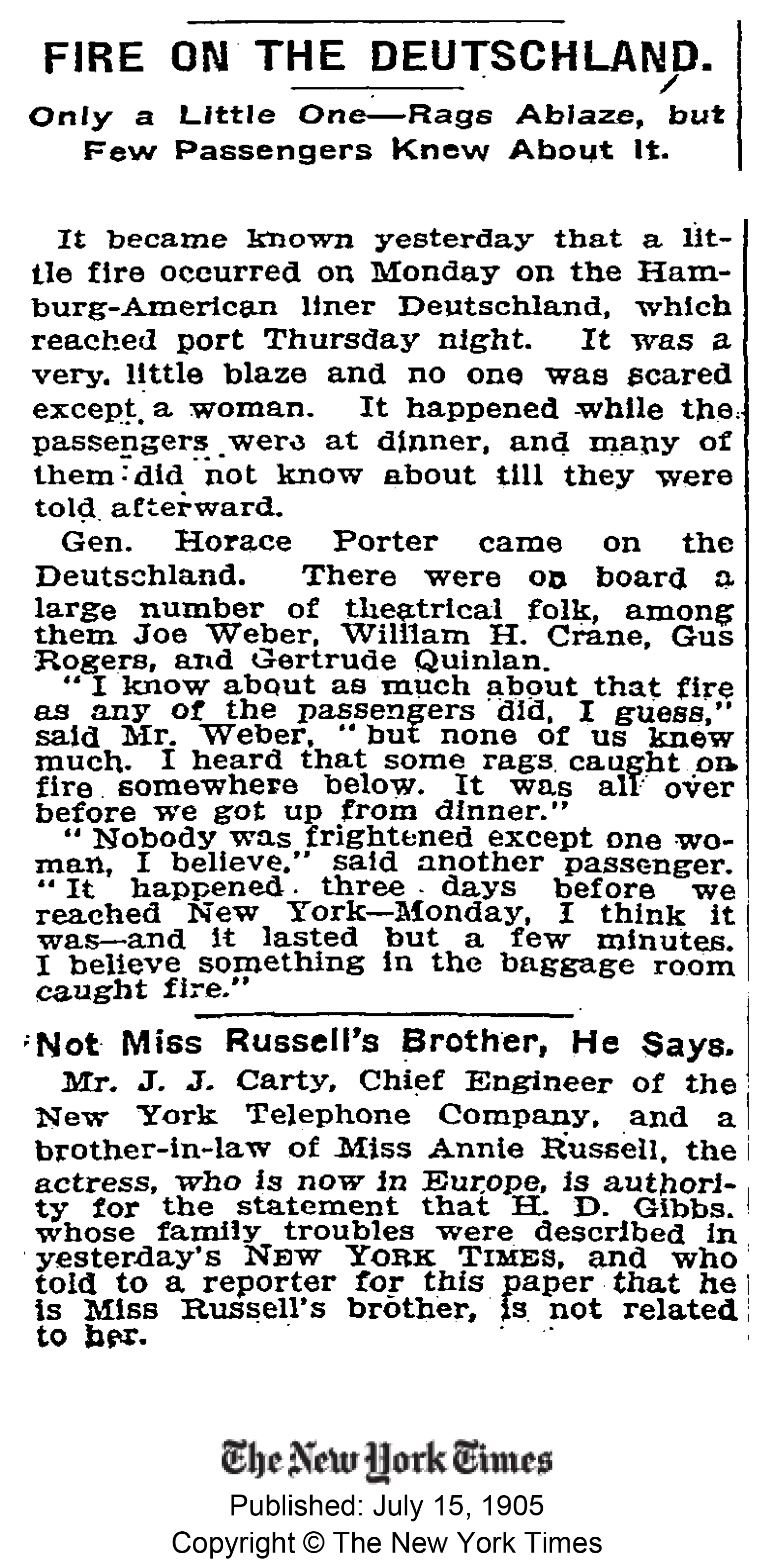
Big, luxurious, and the fastest ship in the world when it entered Atlantic service in 1900, the German liner Deutschland proved unpopular with passengers because its high-speed propellers made its decks shake. After ten years it was rebuilt as a slower, more comfortable cruise ship, rechristened with a less ambitious name, and sent on to oblivion. But here and for now, with its course away from memory not yet plotted, it lies in the river flowing past Hoboken, only momentarily still beneath moving clouds.

At the time, photographs like this one were called snapshots, and before then they were called instantaneouses. This instantaneous is breaking down now in craquelure, but it hasn’t yet ceased to put on display a large floating jewel, glittering with instant icons. This icon, see! represents the doctrine of three men painting a mainmast. This one represents the ship’s name in the squared-off, fraktur-inflected Bodoni of a German font. The iconic Deutschland is a free-standing word, generating connotation after connotation in a historical dialect that (its quiet blaze in the shade still signals) will never go extinct. And yes: by way of confirmation, aft of the word a little scow tidies up for a visit from history itself, preparing the palimpsest for a manual of what you will soon be required to see.

101828036

See, therefore. The icons (click to enlarge) will now perform their miracle. Someone inside Deutschland is at work with a shovel in a room full of ashes.

*

Elsewhere in Hoboken, light has different properties. The evidence at the river’s edge showed a clarity diffused outward under full control, originating in the dark within a hull and then moving outward to take dominion over all the light in the air. But along this sidewalk, seeing has been swaddled in blur from the beginning. For the moment, a little library is moored like a ship on the concrete, but its language can’t be read the way the word Deutschland is read because it doesn’t seem to belong in its composition. Deutschland is its ship. The sleek dark hull and its elegantly complementary wordform are equally at home in their sustaining water. But the sidewalk of Hoboken supports only a piece of indoor furniture and a jacket missing a button, and those are icons of a religion that isn’t alluded to in words like “Big Christmas number.” The jacket with its missing button is doctrine from the spoken language of the human and the social, as opposed to the written subdialect of words as such. And the words “Big Christmas number” tacked to a desk outside in the cold can’t be spoken in the same social accent as the name of a ship harmonized in gold on steel.

This instantaneous happens to be mounted on a card bearing more words, and that addition does spell out the instantaneous’s prehistory. But it isn’t continuous with the history in the photograph because its language isn’t photographic. It hasn’t originated in the image; it is only an afterword composed in the language of the photographer. Outside the image frame, separated from it by the confines that define and circumscribe the language of caption, the words of this third language try to mimic a voice — the voice of the photographer, Lewis Wickes Hine — in the act of saying:

Little girl, apparently 6 yrs. old – but didn’t know her name or age – tending stand at Washington and 3rd St. for older sister (#3234). Saloon on corner. 3 P.M. Location: Hoboken, New Jersey.

But in this translation the words telling of a saloon can only be heard and read, not seen in the way a river is seen. Because the saloon lies outside the image, it and the truths of its connotations can only be spoken of through the mediation of language, not known immediately as an icon’s truth is known. Outside the image frame, the words of the translation can only tell us a story of a Christmas when nothing descended from heaven to take form as a name.

And within the frame are no words to flood the image’s mouth and say, “This is my name. After six years I will be able to remember it.” Without the possibility of words, the image is not an icon; it is an instantaneous. The instantaneous is an image that has assumed its form without development through time. It had no mother tongue.

Sources:

Library of Congress, http://www.loc.gov/pictures/item/det1994010706/PP/
(1905; Detroit Publishing Company Collection) and http://www.loc.gov/pictures/item/ncl2004003797/PP/
(1912; National Child Labor Committee Collection).
Both images photoshopped.

Estampe XXVI: chiaroscuro for the turn of a century

Source: “U.S. Cruiser Atlanta #2.” Detroit Publishing Company Collection, Library of Congress, http://www.loc.gov/pictures/item/det1994022110/PP/. Photoshopped.

Noting that the image has no Detroit Publishing Company number, the Library dates it only to the range 1900-1920. However, the Atlanta was decommissioned in 1912, and the 45-star flag in the photograph wouldn’t have been flown after 1907. Most of the naval ships in the Detroit Publishing Company collection appear to have been photographed in New York, and if that’s the case for this image, we can use Wikipedia’s article “U.S.S. Atlanta (1884)” (accessed 24 October 2015) to date it tentatively to September or October 1900.