How with this rage shall beauty hold a plea?


Sources:
The Great American Magazine: The Periodical Collection of Steven Lomazow, MD. https://www.americanmagazinecollection.com/. Photoshopped.
“Cables Detail C.I.A. Waterboarding at Secret Prison Run by Gina Haspel.” New York Times 10 August 2018, https://www.nytimes.com/2018/08/10/us/politics/waterboarding-gina-haspel-cia-prison.html
National Security Archive, https://nsarchive2.gwu.edu//dc.html?doc=4704836-Document-16-Thailand-black-site-report-to-CIA

Every summer between 1894 and 1914, with the exception of 1906, Germany’s Kaiser Wilhelm II made a cruise to Norway on the imperial yacht Hohenzollern II. In this image from the collection of the Museum für Kunst und Gewerbe, Hamburg, cruise passengers on (probably) the German liner Viktoria Luise view the yacht in the setting of a Nordic mountainscape.

And here, with Hohenzollern in the background, the emperor approaches to receive Viktoria Luise’s salute and manifest himself before his people. Precious image of the nation that he is, he comes lavishly gift-wrapped.

His Majesty favored wrap-around capes partly because they were military and partly because he was self-conscious about letting people see his paralyzed left arm, which was about 15 cm shorter than his right arm.
As I write this post on June 13, 2017, some media controversy is being generated by a New York production of Julius Caesar featuring a Caesar accessorized, like the United States’ current President, with a too-big suit, a too-big tie, an elaborate blond wig, and a Slavic-accented Calpurnia. One problem with that à clef association, as reviewers have pointed out, is that Shakespeare’s Caesar actually was a great man. Another problem is that the military couturiers of early Imperial Rome practiced their art under the guidance of a Stoic sense that there is such a thing as too much.
But perhaps the styles and etiquettes of Wilhelmine Germany have something more historically precise to contribute to a twenty-first-century allegory of the Caesarian.
Source of the images:
http://www.europeana.eu/portal/en/record/2048429/item_3MGYCHXPAXIEQ3G24TJNBG5KE23A4AT2.html
and
http://www.europeana.eu/portal/en/record/2048429/item_GRAO2T5ZQJZ3QNBPZPZZLA26MJLNJCZC.html
Photoshopped and converted to anaglyphs.
“What the hell is this,” he snarled, “a Tom show?”
— Nathanael West, The Day of the Locust, chapter 11
When the posters for this Tom show came out of their lithograph press in 1898 they were stacked face to face. The damage to this surviving example has been permanent. It is still marked with the ghost of another face, in reverse. So far, however, damage has made this piece of printed matter more readable, not less. The ghostly countertext makes us work more productively at seeing the survivor, and as the paper has turned brown it has contributed shading after shading of new complexity to the survivor’s spectral record. The parade is more intelligent now.
In 1898, on the street, it was some horses, some mules, some dogs, and a model house made portable on a wagon. In the mind, it was a communication from a text off-poster — a text whose full title was Uncle Tom’s Cabin; or, Life Among the Lowly. There, off-poster, the on-poster word “sumptuous” seemed not to refer to anything. But in 2017, with all sense of what “sumptuous” might have meant in 1898 obliterated by what’s called progress, the palace cars can be seen as such, only as elements within a picture. And there, now, solely within the picture, at last! the palace cars have become one with the classical architecture of their mounting: in an ideal approximation of color, their shading completed by the passage of time, no longer on a mere overpass but on a plinth, no longer cramped smelly boring as they would have been in 1898 but, as the poster’s words promise, regal. In 1898 the pageant was a crudely literal play within a play and Al. W. Martin’s employees with their mule-propelled cabin were only rude mechanicals like Bottom and the boys in A Midsummer Night’s Dream. In 2017, surviving through time as a provisionally immortal snapshot, the pageant is seen at last as snapshot sees: mules and dogs and little black actress, stilled in transit toward us, passing just now and forever beneath a palace in the air.
Having become a fossil, the mammoth production invites us to enter its matrix and see it within lithograph stone.

Source: Library of Congress, http://www.loc.gov/pictures/item/2014636392/. Photoshopped.
Year by year during the second and third quarters of the nineteenth century, organic chemists fashioned transformations upon the unassuming body of a smelly liquid called aniline. Under their godmothering guidance, aniline submitted to change after brilliant change from her transparent pale yellow to a whole wardrobe of dyes, color after lovable color. Every season Cinderella would re-emerge from the laboratory to be seen anew, and the chemistry of progress made sure that she was seen with ever more excitement as the century went on.
So when the long nineteenth century ended with excitement in 1914, the Russian artist I. D. Sytin was equipped to showcase the change. For effects of the lurid he had tube after tube of bright new primary colors, but for ironic contrast he also had something delicate. Sytin’s lithograph “War in the Air,” its flame yellows and flame reds set off by midnight blue, is printed on paper tinted pink.

Thanks to the pink, the whole lithograph, in both its primary image and its explanatory text, has a ground of rosy conflagration-color. That doesn’t just make the flames in the figure seem to burn hotter; it also desaturates the no longer bright blue of the river shining innocently under starlight and consolidates the fine-print nuances of the text into a single hysterical scream in rubric red. The catalog of the Hoover Institution Poster Collection stubbornly insists that the two elements unified by pink within the image frame are still separate, and it formats its insistence as an equivalent pair of sentences in archival black-and-white: “Painting depicts aerial battle with airplanes and airships. Text underneath describes modern aerial warfare.” But what Sytin’s stones impressed on his picture wasn’t a separable pair of stimulants to sense-impression; it was an ensemble. In its presence a century later, the excitement we have been roused to isn’t archival, it’s historical.
Perhaps the distinction is that the historical sense at least hints at an idea of ensemble: a single consciousness sharable between a record and its reader. A historical record, perhaps, is a text that can be experienced as immediately as the color pink. At any rate, in the presence of this particular array of colors, the historical sense may remind us that it and we now subsist in a world no longer conceivable in black and white. Three quarters of a century before I. D. Sytin set to work, chemists began excitedly coloring in the world’s blank spaces, and it is no longer possible to see what the world was like before that moment. By 1914, says a Russian chronology written in aniline pink, the synthesized product was even filling in the sky.
Source: Hoover Institution Poster Collection (http://www.lunacommons.org/luna/servlet/HOOVER~1~1), item no. RU/SU 365. Photoshopped.

Source of the photoshopped image at the foot of the page: “Helen Rook,” George Grantham Bain Collection, Library of Congress, http://www.loc.gov/pictures/item/ggb2005024344/. Helen Rook, on the right, was a Broadway actress of the 19-teens. In the New York Evening World, May 2, 1918, p. 7, the Bloomingdale’s advertisement promised that she (“Lieut. Helen Rook of the Camp Recreation Corps”) would sing at a white sale. Lieutenant Helen was also on hand the next month when (New-York Tribune, June 3, 1918, p. 6; Historic American Newspaper Collection, Library of Congress) a shipload of Australian officers landed in New York:

At the foot of the page, a band of patriotic milk dealers added:

—
But in spite of the imperative “End!,” Miss Rook still remains available after hours. Touch your keyboard for her and she will come back to unfailing life. See:

1. A record of a life, partially erased

2. Some news, some weather, and some poetry, brought together in time and preserved sans rature on a page in an archive. Click to enlarge.
3. “S.S. Lucania, July 28, 1894.” Photograph by John S. Johnston
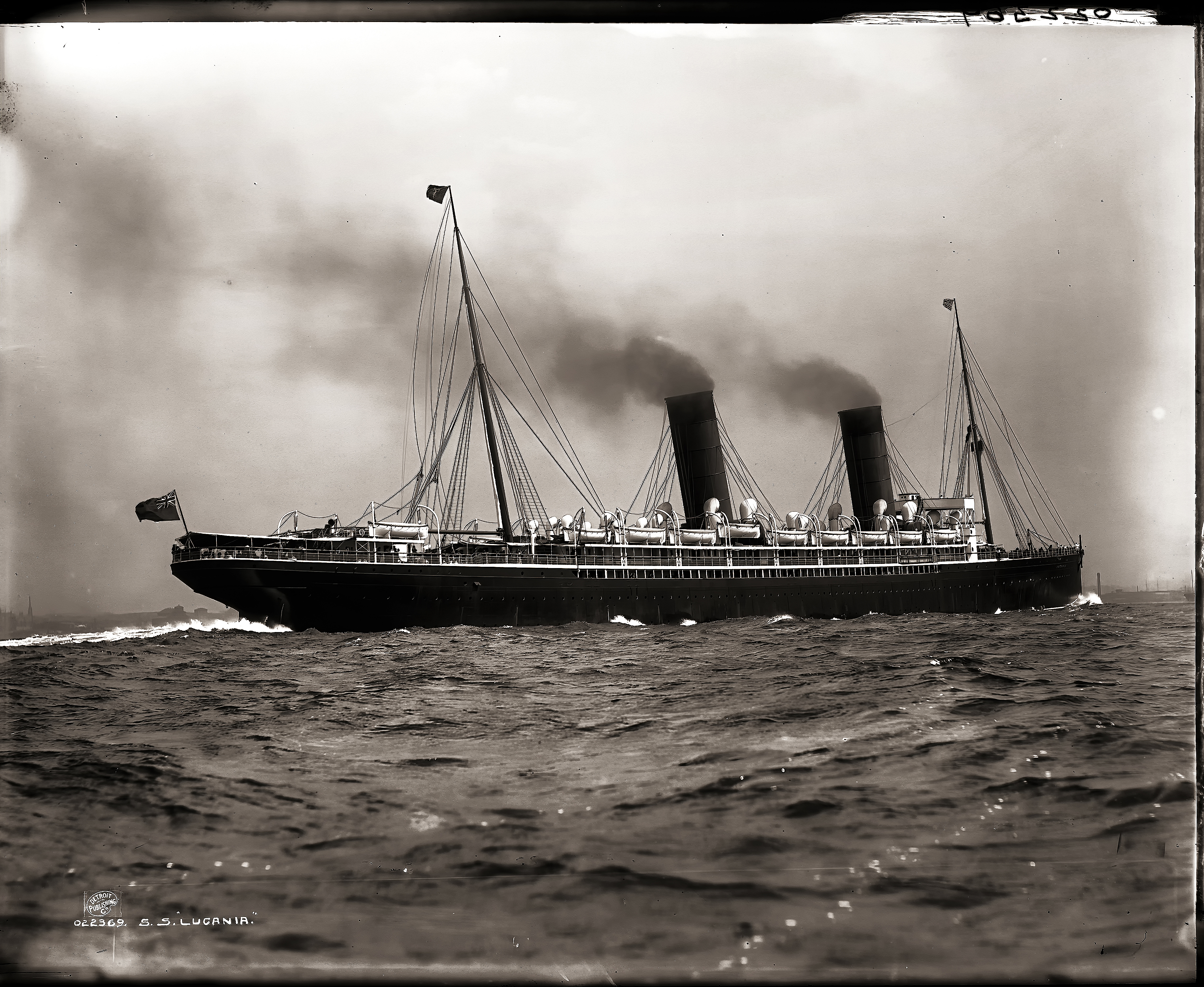
Source: Detroit Publishing Company Collection, Library of Congress, http://www.loc.gov/pictures/item/det1994011734/PP/. Photoshopped.
When John S. Johnston squeezed a rubber bulb which actuated the shutter release on his 8-by-10-inch view camera, his closing hand juxtaposed into existence an array of detail in time and space. It isn’t a permanent array; it won’t last forever in the way the diagrams in Euclid will. It is merely historical. A part of its beauty is owed to the humorous operation of mere coincidence in space and time. On the hottest day in thirteen years, with the sky the color of copper, brush your teeth with the white hand of Beauty and fill your mouth with the taste of hay. For the moment, you might as well. Good hay, sweet hay, as Nick Bottom reminded us one night when the weather report was different, hath no fellow.
But before a backdrop of coppery sky with sun-ball suspended, John S. Johnston’s hand once did close around something that admitted to memory, for a while, a lacework of davits and railings, a haze of coal smoke, and a flag on thick damp cloth flopping in the steady breeze of a passage across time.
The photograph’s composition is unbalanced. The building on the left isn’t matched by anything comparably massive on the right, and the line of people extending all the way from margin to margin has no margins of its own. The people aren’t arranged in any obvious order, either. Some of them are looking at the harbor scene in the distance but others aren’t.
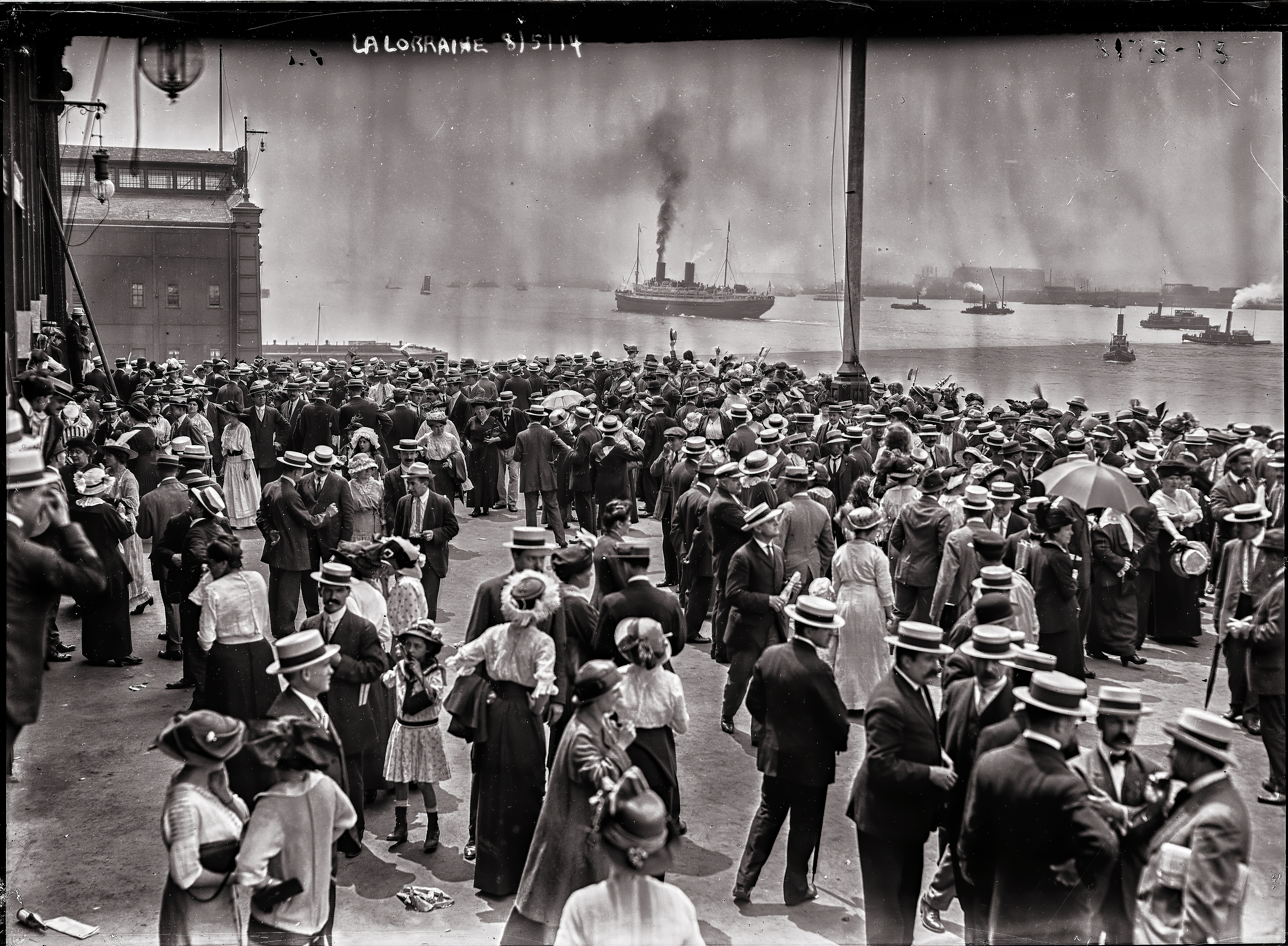
Within the image, we can see only detail by detail, each sub-image in isolation from the rest. It will take some help from literary cliché before we can even decide what’s represented by the details. In the crowd, for instance, there does exist an image of a skipping little girl in antique clothing, her feet poised forever above an item about to be swept away and a matched pair of shadows that will vanish likewise when the little girl skips away.
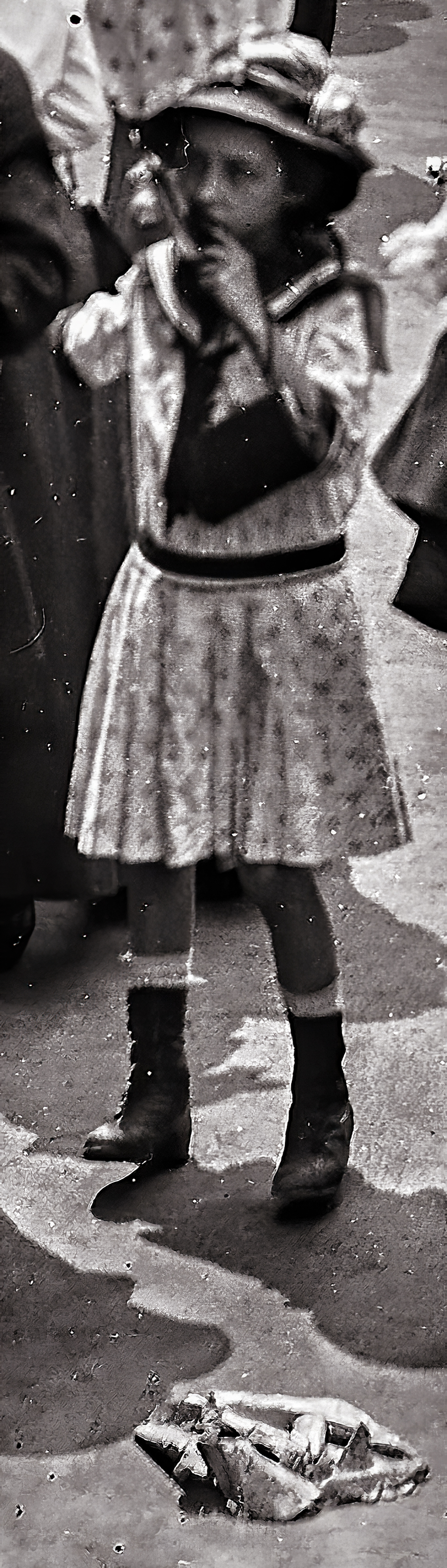
Counterbalancing that eheu fugaces platitude is another. No doubt, says this one: All the world’s a stage / And all the men and women merely players. In the play, a cynical emphasis falls on the “merely,” and here in the imaged crowd stands a predictable allusion. This one’s task is to illustrate man’s stage 6, the one named Pantaloon: his youthful hose, well saved, a world too wide / For his shrunk shank.

And all of this is too easy. Platitudinous moralizing is one of the clichés routinely evoked by street photography and its photographers. Look, cry Diane Arbus and Bruce Gilden: people suffer, and I laugh at them!
But here’s a third detail: one that barely shows us any people to laugh at, one before which moralizing and sadism slip away and evade our desire to be made to laugh or cry. Yes indeed: why are some members of this crowd still waving to the distant ship? They must know their signal can no longer communicate itself to anyone on board. What they’re doing isn’t even laughable. It’s only indefinable.
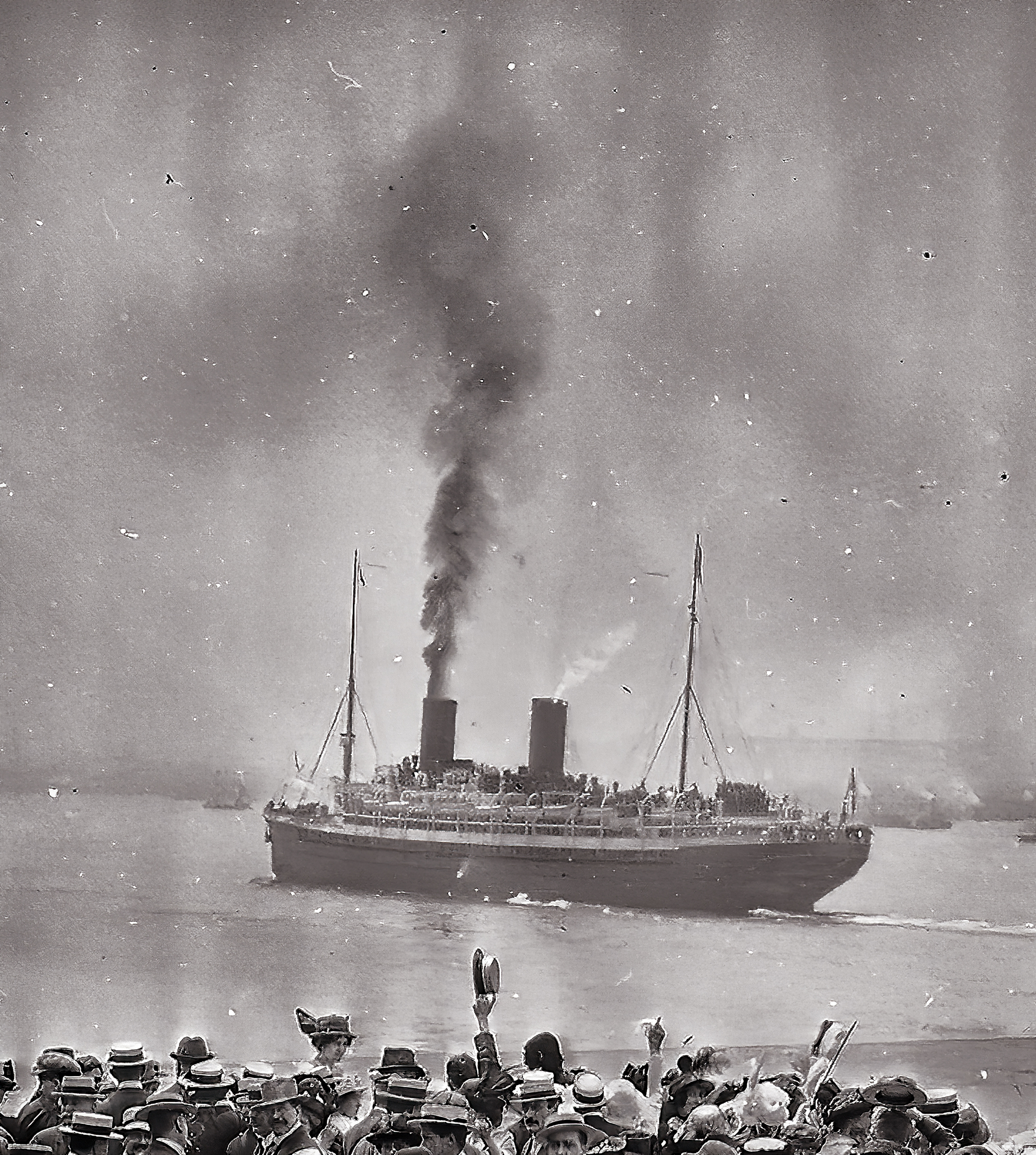
Well, language can help with at least that. Language asks us to take note of the barely legible words at the top of the image — “La Lorraine 8/5/14” — and then entrust ourselves to what lies outside the image frame, in the world. There in the world, some words preserved in a library can begin breaking the news that the cryptic inscription refers to the French Line ship La Lorraine on a date in the twentieth century. Furthermore, the date refers to far more than a mere maritime timetable, and the maritime business being transacted isn’t what is transacted on other days. The harbor is New York, the French ship is carrying French reservists home from the United States, and as of August 5, 1914, World War I is about to begin. Something henceforth central to history has begun occurring.
Heraldry, a visual genre of literature, has a technique for creating analogues for centrality. On either side of a genealogy chronicled across generations by a coat of arms, heraldry often places allegorical human or animal figures which face the symbols of history and encompass them with images of the living. Standing between the changing symbols at the document’s center and their not yet changed interpreters at the edge, these figures are called supporters. Signifying in their own representational way, they stand beside and second whatever it is that abstract symbolism seems to have to say.

And look: just before the photographer of August 5, 1914, set down for history his wide-angle memorandum of crowd and departing ship, he was able to move in for a different view: a tight shot sustained by supporters. That image, too, is still readable in the library. We could look it up, for instance, in a textbook of photographic composition. Unfortunately, however, the chemistry of decay has reduced the image’s central element to indecipherable glare.
 But it is recoverable. There, flanked by supporters, two lovers are now seen to part. Wordlessly, the unsupported central part of the image tells us that much.

And the supporters tell us the wordy rest. The supporter on the left may see the camera, may even understand thereby that his allegorical function is to represent the idea of a communication that has begun and will end in a single instant. But the supporter on the right has no need for either the lovers or the image into which they are about to enter. Holding his American flag and his Royal Navy ensign, he is looking straight ahead toward posterity. He is the custodian of the part of this image that is about to vanish. He is in charge of that which tells its story outside the image frame, in the library. On his side of the frame, the intent is to reassure. Don’t worry, say the supporter’s flags, waving to us spectators at the image’s front margin. Don’t worry; wave your summer hat at the ship. Don’t worry; we two wave and these two live, forever.
Only the decaying center where the lovers are would suggest otherwise.
Sources: George Grantham Bain Collection, Library of Congress, http://www.loc.gov/pictures/item/ggb2005016973/ and http://www.loc.gov/pictures/collection/ggbain/item/ggb2005016965/. Post-processed for contrast and detail.
