
Sources: Detroit Publishing Company Collection, Library of Congress, http://www.loc.gov/pictures/item/det1994011033/PP/ and http://www.loc.gov/pictures/item/det1994005883/PP/. Photoshopped.
Sources: Detroit Publishing Company Collection, Library of Congress, http://www.loc.gov/pictures/item/det1994011033/PP/ and http://www.loc.gov/pictures/item/det1994005883/PP/. Photoshopped.
Aslant on a tilted surface, a ship’s steel curves align themselves into a complex array of near-verticals and are changed from a simple prow into a Richard Serra multiform. Emitting excited puffs of steam as they prepare to nuzzle the new shape, the ship’s companion tugs bustle into line as merrily as if they were executing poses for the jovial approval of Raoul Dufy. As in the sunny vacationland France of a Chelsea gallery, all here in New York harbor is innocence, luxe, and the thoughtfully capitalized beauty of gaits trained by dance. The big ship and her brood of little boats seem to have prepped for their appearance before the camera in a boutique full of Lartigues.

There, after the primpers undercoated the sky with pink and the water with blue, they finished off the big ship’s funnels with a dramatic application of buff.

A hundred years ago, that tint at the source of cloud was a form that hope had chosen for an emblem. Buff cylinders multiplied over water were the insigne of the Hamburg-America Line, the most important transport link between Europe and the United States for the desperate Jews of Russia during the last years of the czars. Imagine you can hope now in the way they hoped then. In the mind’s eye, see a yellow glow travel from right to left across the ocean. See it take on readable form as water and sky unscroll before it.

When the ship with bright funnels comes into its haven, its passengers will disembark into the boutique’s chosen range of the spectrum and commence a different way of being seen.
Sources
The photograph is in the George Grantham Bain Collection, Library of Congress, http://www.loc.gov/pictures/related/?&pk=ggb2005013361&st=gallery&sb=call_number#focus
The immigration image is at Wikimedia Commons, http://commons.wikimedia.org/wiki/File:Jewish_immigration_Russia_United_States_1901.jpg. The information there transcribes the copyright date in the lower right corner as 1901, but I read it as 1909 or possibly 1902. A fashion historian might be able to date the clothing. The Hebrew text carried by the American eagle is found in several Jewish prayers. Adapted from Psalm 17.8, it reads, “And hide us in the shadow of thy wings.”
All three images have been Photoshopped for contrast and tone.


—


Put on your suit of Rhodesian wool and costume your senior retainer in her native garb. Then board a vessel flying the burgee of the Korean Mail Steamship Company, hoist anchor, steam toward the Peninsula, and conquer.

Source: http://pinktentacle.com/2010/05/japanese-steamship-travel-posters/ , photoshopped
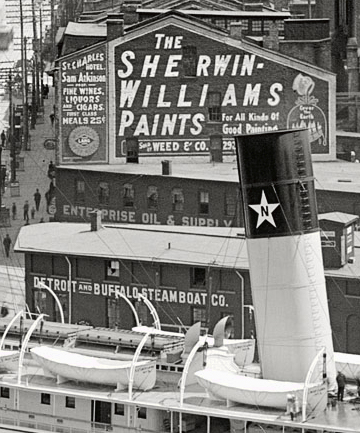
Crystal by crystal, the promise was made unbreakable. One sunny day in 1905, a Mr. Sam Atkinson offered to lift us down from our vantage in the sky and feed us a first class meal. Read now from an 8-by-10-inch glass plate spangled with silver halides by employees of the Detroit Publishing Company, the news of his offer is still spreading. Fixed to the glass by a chemical taxidermy, both Mr. Atkinson’s word and the firm wall that holds it up to the camera are now good forever. Within the borders of that plate, too, all of the land surrounding the word-upholding wall of Sam Atkinson’s St. Charles Hotel has become a containing plenum for the Atkinson transaction. Filled to overflowing with images of the first-class, it is a fertile earthen ware. Once upon a time a camera stopped to take on light from that vessel, and what entered the opening shutter then was receding perspective, cloud, blurry busy motion, traces of time cycling through the persistence of vision. For a fraction of a second, the camera recorded history going about its business of shaping its urn on the wheel.

Before the camera there also lay, once, a first class steamer, and athwart the gray city it was white. Sleek skin of a hot pulsing machinery, the white form moved into the camera’s field to mark the passage of a different color through life. Along such a passage, every voyage is an ascent. And once, a camera belonging to the Detroit Publishing Company was waiting in the sky for that ascent: prepared to receive the first class craft, make the liquid curve of its hull comprehensible as an image, and then lay it to rest on clear glass.
—
Sources
The photograph “Looking up Main Street, Buffalo, N.Y.” is in the Detroit Publishing Company collection in the Library of Congress, http://www.loc.gov/pictures/item/det1994011399/PP/, with copyright date of 1905 in the MARC record. However, the image reproduced above is the version photoshopped by Shorpy.com at http://www.shorpy.com/node/10659. Click it to enlarge. In detail, the sign looks like this.
Detroit Publishing Company, “S. S. William G. Mather — stern view before launch.” Great Lakes Engineering Works, Ecorse, Michigan, October 1905. http://www.shorpy.com/node/13149 . Click to enlarge.
Rising through the black verticals of men’s upright bodies and the sheer of the William G. Mather’s side, your eye soars upward. At the top, a climax to the shape begun by the ship’s rudder, the ship’s stern executes a curve. The curve is a parabola, the arc traced by a body rising and then falling back on itself, but this rise reaches its limit only when it has passed out of the ship’s body and reached the sky.
On that day it was a lightly clouded, all but touchable sky. Far beneath it, legs spread wide and steady, a tripod held up a camera in which waited an 8-by-10-inch glass negative. Then the lens opened wide the camera’s rosewood box, and it poured in cloud and steel and flesh and light. It molded them there into the round of the image’s great dome. Ever since, it has been launching the dome back upward.

As of 1905, that gesture in the light might have taught Ecorse to see itself as a universe made of tangible things — the camera’s glass and wood, the ship’s bronze and steel, the men’s bodies. In an embodied universe like that, in an Ecorse under its dome of light, you don’t look at the dome, passively. Instead, you watch it be. Changing through time as it lights the ship which is about to descend the ways and begin moving outward from Ecorse, the dome has a beginning and will have an end. In the old sense of the word, meaning “complete,” it is perfect.
Thy firmness makes my circle just,
And makes me end where I begun.
—
But to look at Ecorse today is to look not outward but downward.

The Great Lakes Engineering Works went out of business in 1960, and if any trace of it remains, it isn’t visible from orbit. To Bing Maps (early in the disapearance) and Google Maps (later), the most prominent feature of Ecorse in 2012 is the bulldozed ruin of what was once a steel mill.

This full-color image, captured from space by a process unrealizable in 1905, depicts an economy which itself has been derealized. If any people were visible in this 21st-century Ecorse, they would be seen differently by the lens because their bodies would have a different relationship to the eye. They would have to be conceptualized eyelessly, with the mind alone, because they are now subjects of a bodiless economy. In an Ecorse without a Works, their exchanges with one another are governed not by anything with a heartbeat but by capital’s Platonic idea of buying and selling per se. Ecorse in 1905 became perfect for a single instant: the fraction of a second it took a shutter to open and fill a rosewood box with light. But Ecorse in 2012 is imperfect everywhere. Its economy is now only an exemplum of the idea of money operating at a distance, far from the light that once could complete a picture by localized duplication as it reflected itself upward from flowing water to completing dome.
Have the laws of perspective in this new economy been established yet?
Perhaps they will be. If and when they are, let’s spare a moment to remember Ecorse. By then, perhaps, we’ll be seeing upward toward the domed sky of a new Ecorse. That may help light our way out of the art of the long twentieth century.
Between 1903 and 1917, a woman named Phoebe Snow traveled like a celestial body along the tracks of one of America’s regional railroads, the Delaware, Lackawanna and Western.
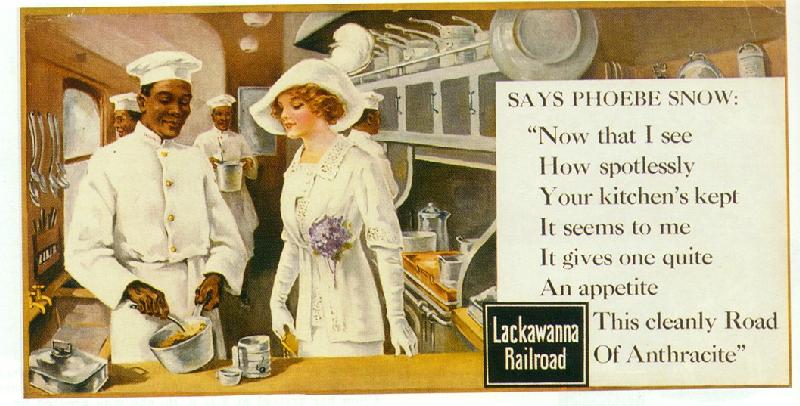
Click to enlarge.
The creature of one of the most successful advertising campaigns in American history, Miss Snow existed only to be unceasing: unceasingly in motion along a pounding iambic dimeter, unceasingly white, unceasingly bountiful of her whiteness. In her unceasingness, she was loved.

This illustrated history may help show you why. A comet always arriving, destined never to drop back into the dark and go still, Phoebe lived as light and motion, bestowing herself on everyone beside the track who existed to make her sidereal. Along the path of her orbit, brilliance illuminated the labor of engine crews, yard crews, porters and dining car waiters and the brilliantly white-clad cooks in the dining car’s galley. In her presence, light entered into the interior of what it seemed to mean to be human, dissolving secrecy and shame and shadow into a single all-encompassing whiteness.
http://scout901.hubpages.com/hub/Phoebe-Snow-Railroad-Advertising-Icon
The whiteness released her victims from darkness into love. It even extended underground, to the veins of coal and the men who worked them and the mules who worked alongside the men like brothers of Phoebe’s. There underground, Phoebe became her picture’s source of light. Descending into the dark and then ascending again, she traced letters from light across the darkness, and interpreted them to mean that all will be happy now, even in the face of death.

 —
—
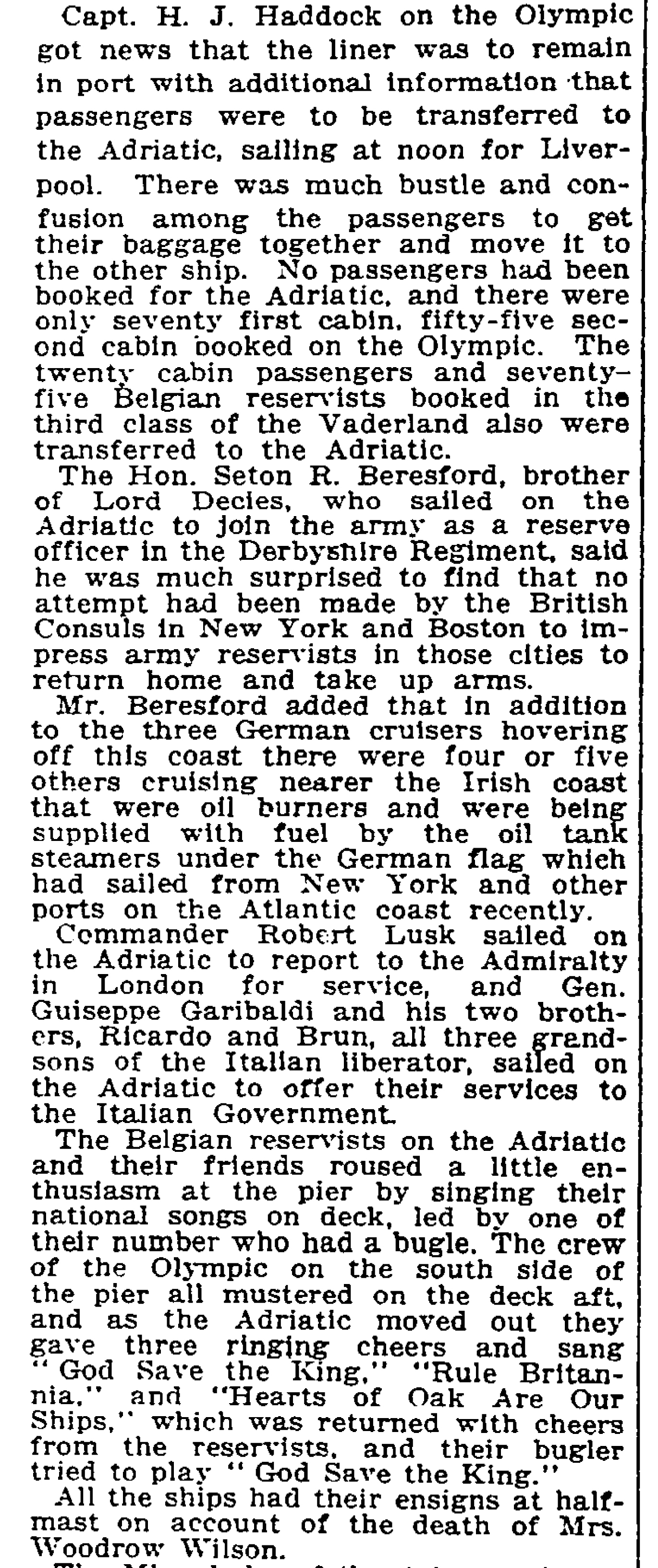
On August 8, 1914, that consciousness was still alive and still animating a gentleman in love with nature. By then, however, it had abruptly become remarkable. On August 9, a reporter for The New York Times observed it in its descent toward incomprehensibility. Far down now in the third paragraph of an article, it was barely readable by then; too deep in the shade cast by the headline. The language of that headline was a dark new dialect whose words could not have endured in the sunshine vocabulary of Snow.

Not far from the pier, the transatlantic cables surfacing in New York were drowning Phoebe’s meters in irregular sobbings, and Belgian reservists were boarding a ship bound eastward, where the dark was rising.

To understand, then, we have to look away from Phoebe and the gentleman entomologist.. A camera creature has surfaced from the dark flood, extending a black-and-white photograph of the Olympic’s cheering stewards to us.
 Source of this image and the next two:
http://www.loc.gov/pictures/item/ggb2005017010/
The next two have been Photoshopped for contrast.
From this angle in the photograph’s space, the time is the present. The stewards are and will always have been seen to be in mid-cheer. Panning toward the Olympic’s sister ship, the cameraman records the visual testimony of the Belgian reservists singing and cheering back. As they sing, marking time, they are moving outward. The stern of the Adriatic is being eased away from the pier.
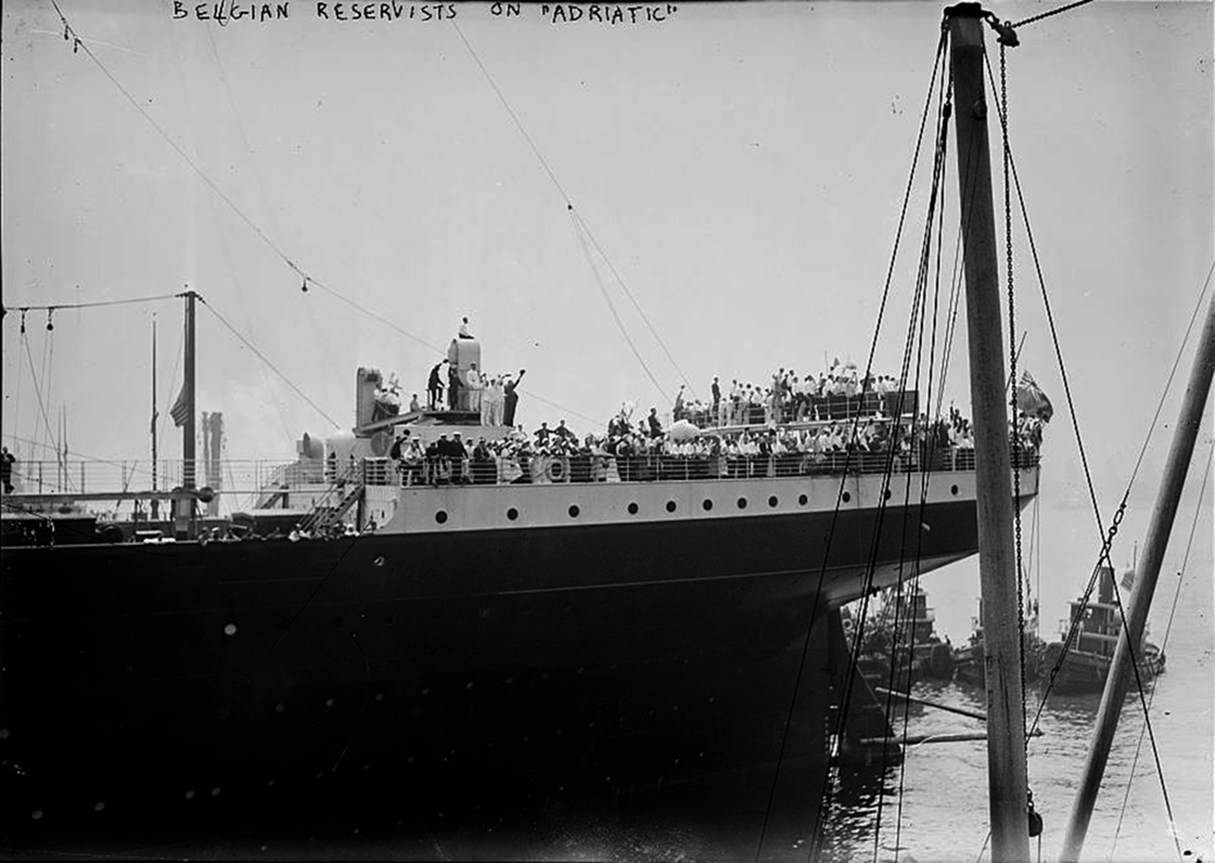
That motion has prepared us to receive an image that history, in due time, will call definitive. Now and forever, this image holds us back on August 8, 1914, at the watery verge of a pier in New York. At the far boundary of the space, receding as we watch, the White Star liner Adriatic is now becoming visible as a whole. On board the ship, certain men who will soon die can no longer be seen, though unillustrated abstract history provisionally asserts that they are still, for the moment of August 8, 1914, alive.

In comparison with the blankness into which the ship is now disappearing, Phoebe Snow’s immortally conceived whiteness was only a whim. Anthracite burns cleaner (a little cleaner) than soft coal, but to have believed in Phoebe’s absolute whiteness was never more than a suspension of disbelief. “Of course,” says Phoebe’s image to you, “I am only one of art’s happy ways of helping you imagine possibility. You always knew that.” To have looked at Phoebe’s picture, read her poem, and then bought a ticket on the Road of Anthracite was never a more significant act than, say, buying a ticket to a movie with the cheerful intent of surrendering for a couple of hours to an optical illusion. If Miss Marion Murray had been in this scene, she would have been stationed among us dark-clad neutrals left behind on terra firma, imagining like us rather than being imagined like Phoebe. The optics of this photograph don’t work only on the mind’s eye the way an image of Phoebe does.
Because as the Adriatic begins fading into the dazzle of a hazed atmosphere just at the moment when we take it in, it becomes less visible to the eye even as it becomes more conceivable to the imagination. On August 8, 1914, men and women on a pier and in boats and barges saw a ship loom up through space under clouds of coal smoke and then fade in accordance with the laws of physics. If we could only see it now, we would see it as they did: as a mortal body fading to white, as graceful as it traverses its bright vanishing instant as Miss Marion Murray ever was.
