Humors and time

According to the Library of Congress, the oldest photograph of a cat in the collection is probably a daguerreotype cataloged as “Unidentified man with cat, three-quarter length portrait, full face, seated” and given the call number http://hdl.loc.gov/loc.pnp/cph.3d01979. Annotating it for a 2026 blogpost titled “Kittintypes,” the Library conscientiously stipulated that it is nothing but an image. It isn’t even an image of a cat, because it has no cat papers. Libraries exist to transact documents, but this cat and her man are undocumented. We don’t know their names, or where they lived, or how. The nominal when issued to them by the Library (“Between 1840 and 1860”) was only an approximation deduced from the general history of photography, and the only why that’s perceptible on the daguerreotype’s silver surface is a mirror image of your lensed self, reader!, in the instant of your reading at present. History’s one-word language, was, whited itself out before it could turn into is or I know or I am.

But is it an inaudible smile that we hear echoing, even so, through the silent aftermath retrospectively called Unidentified Man with Cat?

If it is, perhaps it signifies that the body fluids called humors have all along been filling the bodily spaces that we happen smilingly to share with Cat, even though we are Men. We weren’t always unidentified. Perhaps one day we will be identifiable again: and this time knowably, because this time to ourselves.

Inside the frame that has protected the daguerreotype image’s delicate silver-mercury amalgam down the years from the touch of fingers, something seems to have illuminated everyone’s visual understanding of a man showing a cat to you with an Egyptian gesture. Open the image frame, clear the haze with your computer, let the silver cat reflect light into your face, and watch yourself. In the catlight, you seem to have known all along that you are happy after all.

.


Kristi Finefield, “Kittintypes: Nineteenth-Century Cats in the Daniel Carter Beard Collection.” https://blogs.loc.gov/picturethis/2026/06/kittintypes-nineteenth-century-cats-in-the-daniel-carter-beard-collection/?loclr=eaptb
Geometer

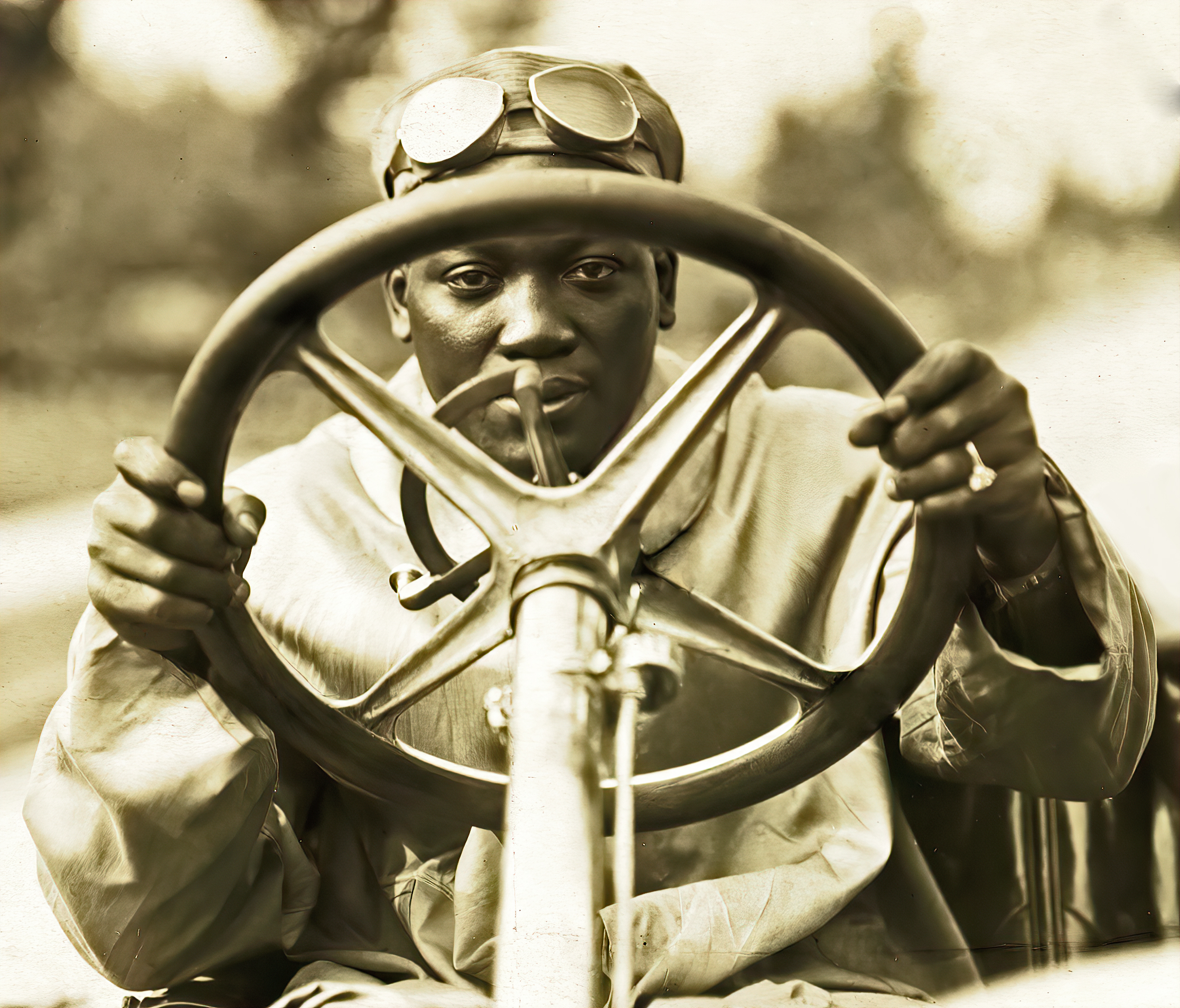
Laying hands on a circle and a quadrant, he brings them into alignment with his eyes. It is as if he is working with a pair of instruments for guiding light. What he holds he sees through and  into and with.

31942uA300gaiN

Slightly eccentric with respect to each other, a body formed of metal and idea and a body formed of flesh and sense have approached, for an instant, and been held steady, for an instant, in a touch. For an instant, they have become a coupled form imposing an ordinance of light which they obey.


Source: Louis Van Oeyen, “Champion Jack Johnson at wheel of his 90 horse power Thomas Flyer,” September 6, 1910. Library of Congress, https://www.loc.gov/pictures/item/2011649816/. Image cropped and post-processed to restore contrast.

Photographing the perfect

Detroit Publishing Company, “S. S. William G. Mather — stern view before launch.” Great Lakes Engineering Works, Ecorse, Michigan, October 1905. http://www.shorpy.com/node/13149 . Click to enlarge.

Rising through the black verticals of men’s upright bodies and the sheer of the William G. Mather’s side, your eye soars upward. At the top, a climax to the shape begun by the ship’s rudder, the ship’s stern executes a curve. The curve is a parabola, the arc traced by a body rising and then falling back on itself, but this rise reaches its limit only when it has passed out of the ship’s body and reached the sky.

On that day it was a lightly clouded, all but touchable sky. Far beneath it, legs spread wide and steady, a tripod held up a camera in which waited an 8-by-10-inch glass negative. Then the lens opened wide the camera’s rosewood box, and it poured in cloud and steel and flesh and light. It molded them there into the round of the image’s great dome. Ever since, it has been launching the dome back upward. 

As of 1905, that gesture in the light might have taught Ecorse to see itself as a universe made of tangible things — the camera’s glass and wood, the ship’s bronze and steel, the men’s bodies. In an embodied universe like that, in an Ecorse under its dome of light, you don’t look at the dome, passively. Instead, you watch it be. Changing through time as it lights the ship which is about to descend the ways and begin moving outward from Ecorse, the dome has a beginning and will have an end. In the old sense of the word, meaning “complete,” it is perfect.

Thy firmness makes my circle just,
And makes me end where I begun.

 —

But to look at Ecorse today is to look not outward but downward.

The Great Lakes Engineering Works went out of business in 1960, and if any trace of it remains, it isn’t visible from orbit. To Bing Maps (early in the disapearance) and Google Maps (later), the most prominent feature of Ecorse in 2012 is the bulldozed ruin of what was once a steel mill.

This full-color image, captured from space by a process unrealizable in 1905, depicts an economy which itself has been derealized. If any people were visible in this 21st-century Ecorse, they would be seen differently by the lens because their bodies would have a different relationship to the eye. They would have to be conceptualized eyelessly, with the mind alone, because they are now subjects of a bodiless economy. In an Ecorse without a Works, their exchanges with one another are governed not by anything with a heartbeat but by capital’s Platonic idea of buying and selling per se. Ecorse in 1905 became perfect for a single instant: the fraction of a second it took a shutter to open and fill a rosewood box with light. But Ecorse in 2012 is imperfect everywhere. Its economy is now only an exemplum of the idea of money operating at a distance, far from the light that once could complete a picture by localized duplication as it reflected itself upward from flowing water to completing dome.

Have the laws of perspective in this new economy been established yet?

Perhaps they will be. If and when they are, let’s spare a moment to remember Ecorse. By then, perhaps, we’ll be seeing upward toward the domed sky of a new Ecorse. That may help light our way out of the art of the long twentieth century.