How to read satisfactorily

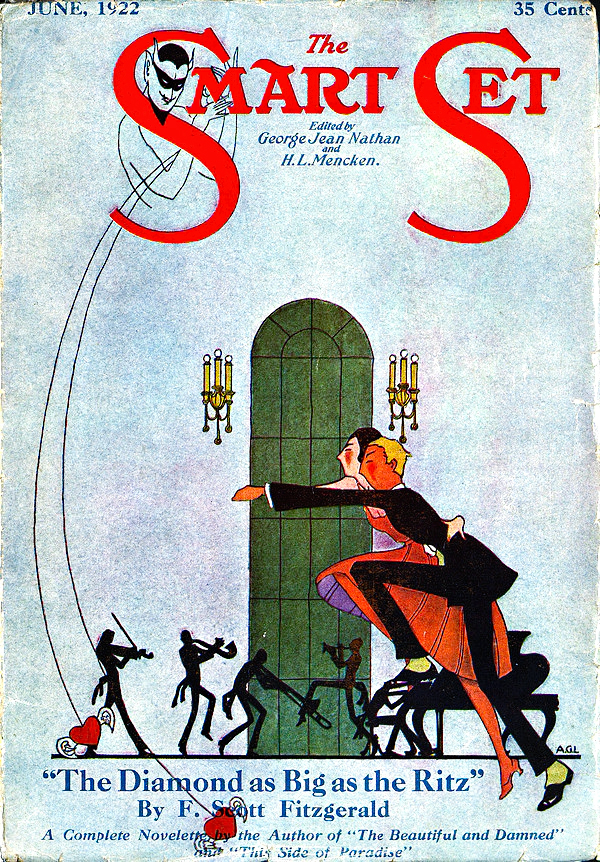
Source: The Modernist Journals Project, http://www.modjourn.org/render.php?id=1425423439777263&view=mjp_object. Photoshopped.
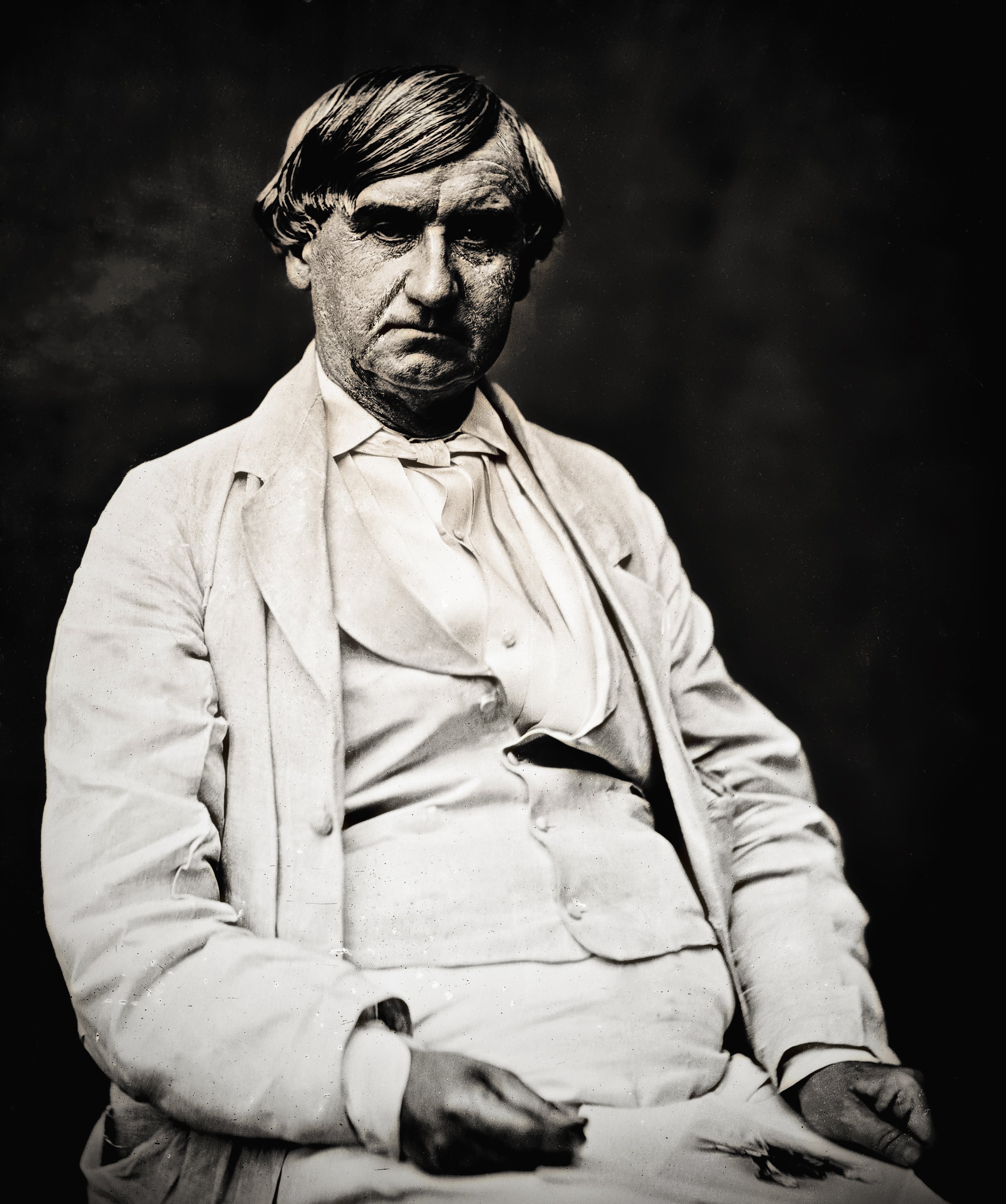
The book is a ten-page pamphlet by the chief prosecutor of the conspirators in the murder of Abraham Lincoln. The prosecutor, Judge Advocate General Joseph Holt, had attempted to prove that President Davis of the Confederacy was aware of the conspiracy, and Davis’s sympathizers responded by attacking him in print. In print, he replied:

—
Printed in 1866, the paper has gone brown with age. The florid rhetoric looks old as well. Since at least the era of Hemingway, our taste in prose about moral conflict has trended monochrome.
But there were also monochrome effects in 1866. Before, during, and after the black-and-white absolutes of the Civil War, Washington was a Southern town where white was what gentlemen wore in the summer. In the presence of white, both time and the conflict seemed to halt at the wardrobe door. Fashion sometimes looks like a parallel morality, and as of the second half of the nineteenth century one of its commands began, in a body language which seemed to transcend the mortal changeableness of the body: “Thou shalt wear . . .”
Experiment with the command yourself. Think of this photograph of Judge Holt by Mathew Brady’s studio as a frontispiece to the pamphlet. Then ask: after I’ve seen this image of an author’s body in absolute white, will I have any desire to turn the page and read his words’ transient brown? Won’t I lose as much as I gain when I leave the white behind, back there at the innocent beginning where faces are fortunes, books are judged by their covers, and to appear seems to be?
Sources: Holt’s Vindication is online at Archive.org, https://ia600302.us.archive.org/21/items/vindicationofju3693holt/vindicationofju3693holt.pdf.
The photograph of Judge Holt is in the Brady-Handy Collection, Library of Congress, http://www.loc.gov/pictures/collection/brhc/item/brh2003001193/PP/. I have photoshopped it.
It matters not what the clocks say or the attitudes and labors of men. Morning is when I am awake and there is a dawn in me.

There was a small public park on the north side of the square. In one of its linden trees an ear and a finger had been found one day – remnants of a terrorist whose hand had slipped while he was arranging a lethal parcel in his room on the other side of the square. Those same trees (a pattern of silver filigree in a mother-of-pearl mist out of which the bronze dome of St. Isaac’s arose in the background) had also seen children shot down at random from the branches into which they had climbed in a vain attempt to escape the mounted gendarmes who were quelling the First Revolution (1905-06). Quite a few little stories like these were attached to squares and streets in St. Petersburg.
— Vladimir Nabokov, Speak, Memory, chapter 9
Every few seconds for the last two days, a cyberentity in Russia has been attempting to break into this blog. According to several bloggers, this represents the activity of something called a brute-force password-guessing attack on WordPress’s XMLRPC function.
It claims to originate from an address in St. Petersburg. Of course that claim may be a mere act of literature – say, something like a May Day hommage to Andrei Bely, author of the great Modernist novel of terror and masquerade, Petersburg. In any case, the cyberentity claims to be headquartered not in St. Petersburg but in Moscow, where it calls itself the Super Professional Servers Network.
But its street address in Moscow is all Bely, all Petersburg. It is:
1st Magistralny Blind Alley, 30
And naturally, as a prudent reverence before literature’s power to blind and erase (the pseudonym Bely means “white”), I configured this blog long ago to reject all attempts at communication from Russia.

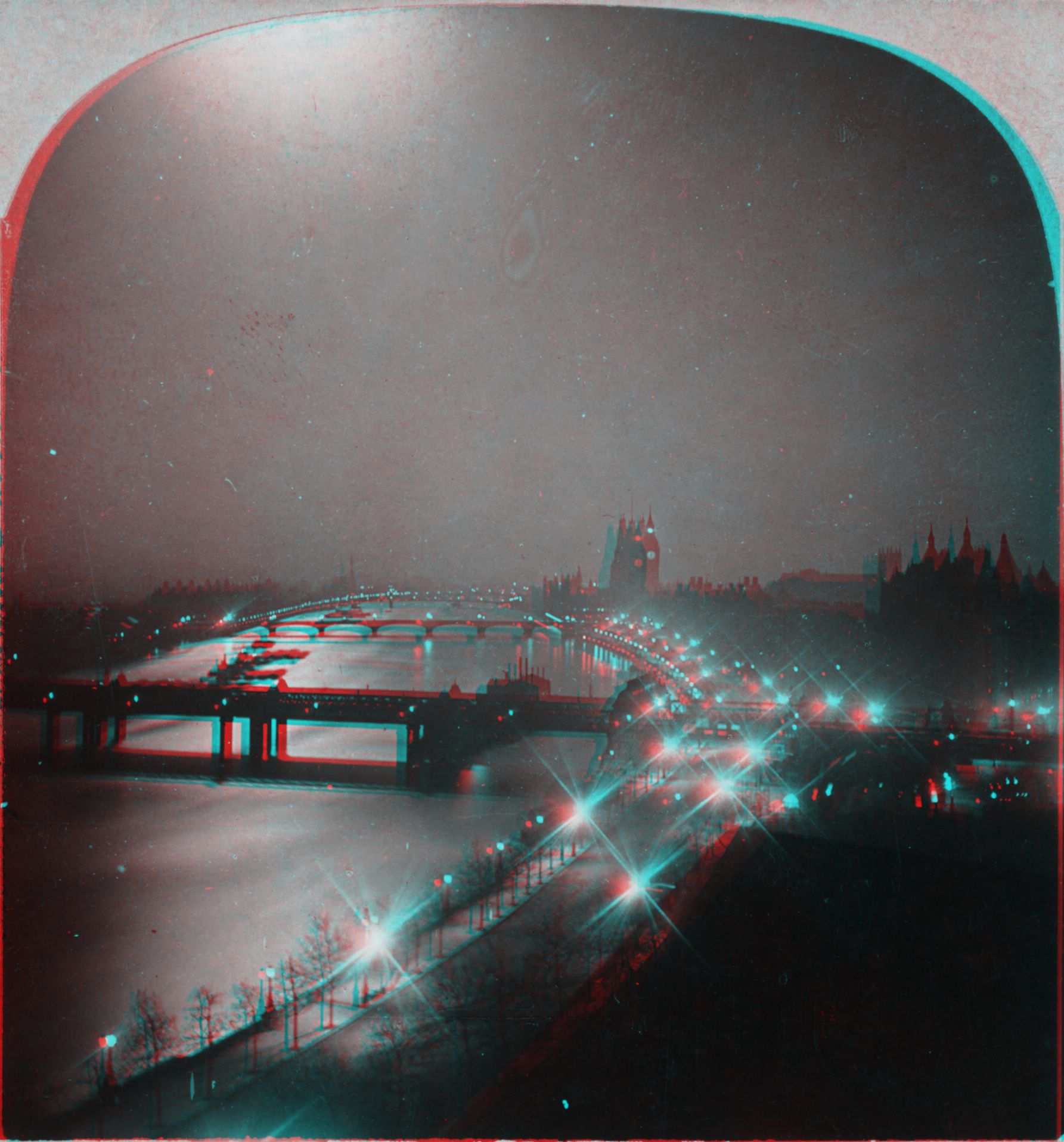
Benjamin L. Singley, “Overlooking the Thames at 11 o’clock at Night, London, England.” 1903. Library of Congress, http://www.loc.gov/item/91793505/
 My photoshopped anaglyph (requires red-and-blue stereo viewer):
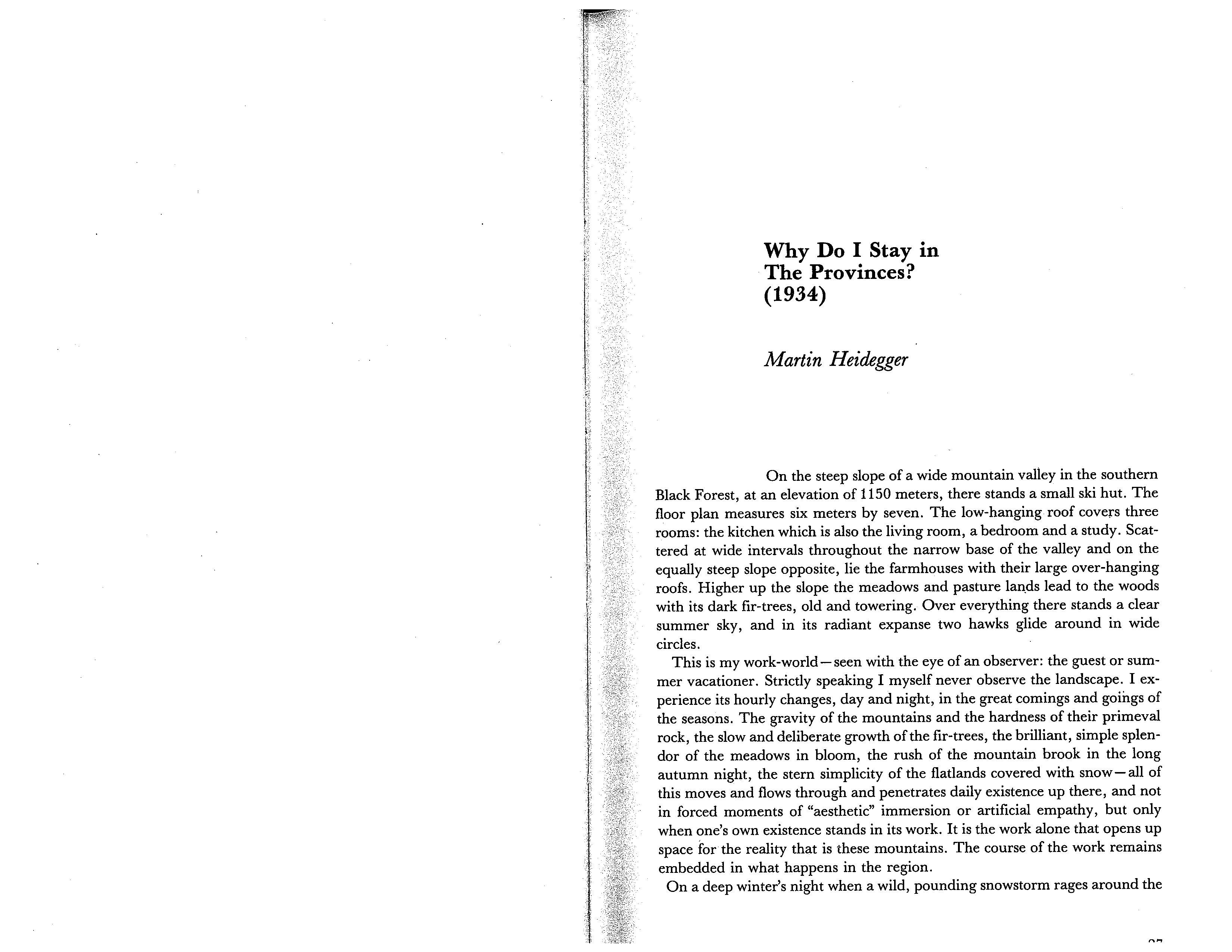
Ostensibly a work of modern non-fiction, Martin Heidegger’s autobiographical essay “Why Do I Stay in the Provinces?” (text below) is written in the language of a pastoral genre that had been popular in Germany since the nineteenth century: the novel of blood and soil (Blut und Boden), “which idealized its subject and painted the mythology of peasant life, far from the crossroads of the world” (Mosse 138). During the Third Reich the genre was cultivated like an agribusiness crop, and as its formulas became part of the vocabulary of the state they acquired a derisive nickname, Blubo. Heidegger himself disliked the term Blut und Boden, but the narrator of his essay speaks its language like a native.
“Why Do I Stay in the Provinces?” was published in 1934. As of 2015, many wars and a holocaust later, an international consortium of astronomers is attempting to build a great telescope atop Hawaii’s 14,000-foot extinct volcano Mauna Kea, one of the world’s premier sites for an observatory. However, the road to the construction site is being intermittently blocked by a group of native Hawaiian cultural practitioners who claim that to build anything atop Mauna Kea except altars to the volcano goddess is (as their media releases put it) a desecration. Speaking of desecration, Heidegger’s great object of hate René Descartes wrote a theory of the telescope, and I’m sure that if Heidegger were in Hawaii now he’d be up there at the roadblocks himself.
As he raised his voice in a chant of protest, he’d be joined by some of my post-colonialist colleagues from the University of Hawaii. For them and for Heidegger, then, this collegial contribution in the rational language of Descartes and Photoshop. It depicts the mountain hut where Martin Heidegger grew his deep thoughts out of the Boden. One peak higher, goddess willing, will arise the Thirty Meter Telescope.

Sources:
George Mosse, ed. Nazi Culture: Intellectual, Cultural and Social Life in the Third Reich. New York: Grosset & Dunlap, 1966.
Heidegger’s “Why Do I Stay in the Provinces?”:

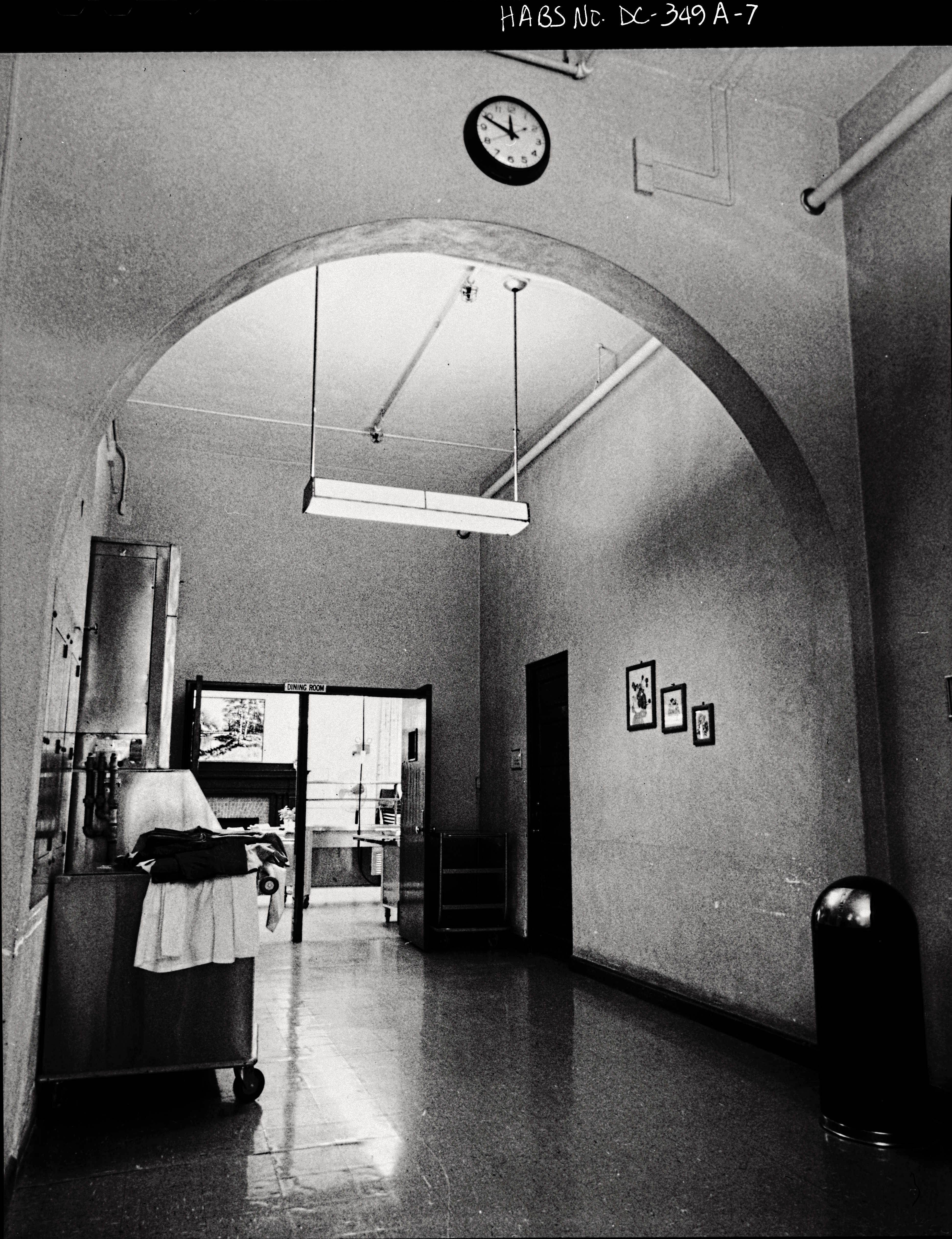 St. Elizabeths Hospital, Washington, 1979
Source:
Historic American Buildings Survey Collection, Library of Congress, http://www.loc.gov/pictures/item/dc0362.photos.027542p/. Photoshopped.

1
Beware, says the United States Department of State. If you’re an American on a street in Ukraine, you risk being read adversely.
Street crime remains a serious problem in Ukraine. The country continues to undergo significant economic, political, and social transformation, and income differences have grown accordingly. As a result, you and other foreign visitors may be perceived as wealthy and as easy targets for criminals. United States citizens often stand out in Ukraine, and are therefore more likely to be targeted than in Western European countries, where incomes are higher and U.S. citizens may blend in better. The police are poorly paid, motivated, trained, and equipped, and also are considered to be one of the most corrupt organizations in Ukraine.
“Ukraine: Country Specific Information.” http://travel.state.gov/travel/cis_pa_tw/cis/cis_1053.html
2
This morning the statistics counter for the blog you’re reading showed this. Click it to enlarge.

The page view marked with an American flag was mine. Everything else on the page — all those hits flying in from an ever-changing array of internet protocol addresses and then touching down, exactly seventeen seconds apart, on every single tag for every single one of my blogposts — came from a spambot in Ukraine. The term “page view” implies that some human being is looking at language in a language-enabled way, but the bot that generated this arrival log is the agent of a different purpose. What that purpose might be, however, isn’t clearly discernible.
3
Indiscernibility has a literary value in its own right, of course. Anne Carson’s adaptation of Sophocles, Antigonick (New Directions, 2012), comes to us as a printed text with interspersed pictures. Some of these images are illustrations obviously related to the text; others seem to be primarily mood pieces. All of them are printed on translucent paper.
Which means (so to speak) that you can’t fully see the pictures because the text makes itself seen under them, and you can’t fully read the text because the pictures make themselves seen over it. The text itself, studied with the aid of a blank sheet of paper, is a facsimile of Anne Carson’s not particularly legible handwriting. It begins with Antigone and Ismene talking about Beckett and Hegel, but its presiding theoretical genius is clearly Brecht, he of the alienation effect. Don’t even try to read me, says this book. Or, if you must, if you’re an Antigone and not an Ismene, then read me in spite of myself.
But when Brecht thought of Verfremdung he had a textual consequence in mind: to get his readers out of their plush seats and march them on down to the nearest Revolution Books.
Drum links, zwei, drei! Drum links, zwei, drei!
Wo dein Platz, Genosse, ist!
Reih dich ein in die Arbeitereinheitsfront
Weil du auch ein Arbeiter bist.
So hup 2 3! So hup 2 3!
Comrade, this here’s the place for you!
Enlist your ass right now in the Workersunityfront
Cuz you know, like, you’re a worker too.
(“Einheitsfrontlied”)
Beckett preferred to sing his songs to Anne Carson less scrutably.
4
The Curtiss JN-4 “Jenny,” beloved craft of the barnstormers who rode the skies of America in the years just after the Great War, was notoriously underpowered. The fat man in this picture probably wouldn’t have qualified to leave the ground in this airplane on that sunny day at the end of winter. But for his contemporaries in 1922, the great year of Ulysses and Babbitt, The Waste Land and Reader’s Digest, the fat man loaded an argosy with a vernal freight of literature.

5
“The city” in the caption is Washington, but the exact words of the fat man’s literature don’t seem to be mappably deducible from there. But that’s all right. After all, the Klan called itself the Invisible Empire. Here’s another view of the invisible men and their vessel, with insigne.

6
Ninety years after this picture, literature is still afloat in the aether, not yet aground on meaning. It’s indecipherable where it is, but haven’t conditions always been undecipherable up there? What could be the meaning of a page view staked out with a flag, or of a packet of literature being stowed for a bomb run, or of a painted symbol to which history hasn’t yet affixed words? The missing words mean that significance hasn’t yet completed its descent to us. For now, as one of its captions warns us at the outset of reading, we can only wrongly say.

—
Photographs of the Klan airplane by Herbert A. French. National Photo Company collection, Library of Congress. URLs:
http://www.loc.gov/pictures/item/2002695742/
http://www.loc.gov/pictures/item/npc2007005902
Translation of the French caption about the Lafayette Escadrille, a unit of the French air force during World War I which was made up of American volunteers: “An airplane of the Lafayette Escadrille. It has wrongly been said that the Indian head [visible on the fuselage aft of the swastika] was the insigne of the Lafayette Escadrille. This designation was chosen by a pilot of the unit for his airplane.”
As of July 3, 2012, the Wikipedia article “Lafayette Escadrille” is illustrated with two images of the Indian-head insigne. One, on a banner in the National Museum of the U.S. Air Force, shows the headdress decorated with a swastika. The other, perhaps a post-1945 recension, shows the headdress decorated with a cross.
