An old-fashioned nationalist

In January 2015, the cyclical history of Martin Heidegger’s post-World War II rehabs and relapses entered a new phase when the chairman of the Martin Heidegger Society resigned his position, stating, “As chairman of a society, which is named after a person, one is in certain way a representative of that person. After reading the Schwarze Hefte, especially the antisemitic passages, I do not wish to be such a representative any longer. These statements have not only shocked me, but have turned me around to such an extent that it has become difficult to be a co-representative of this.” (http://dailynous.com/2015/01/19/germanys-heidegger-society-chair-resigns/)

The phrase Schwarze Hefte (“black notebooks”) refers to a group of previously unpublished manuscripts which are only now appearing in print, on a schedule dictated by Heidegger. The notebooks are bound in black oilcloth, and in the first instance “black” is all the word schwarze means. But of course it also has moral connotations. These dark texts seem to make clear, if anything in Heidegger’s ambit is clear, that racism was one of the fundamental, constitutive parts of his thought.

Well, the history of the Fascist years is filled with stories in the style of Henry James about eminent people shadowed by their past. The reputations of E. M. Cioran and Mircea Eliade, for instance, were at least a little tarnished by their association with the Iron Guard, Romania’s peculiarly nasty Fascist party. On the other hand, the Nazi section of Herbert von Karajan’s curriculum vitae did him no harm in after years. If anything, it only added more excitement to his bad-boy reputation. Until recently, at least, Heidegger’s reputation seemed to luxuriate in an ambiguity strong on both sides, as when he deplored the Holocaust as just another instance of the inauthenticity of plowing with tractors instead of horses like God intended. Unfortunately, history doesn’t seem just now as if it will continue indulging Heidegger’s reluctance to resolve his dilemma. The dilemma itself seems to be little more than silliness on one horn and careerism on the other. But when the moral ambiguities of the Hitlerzeit were forced up against the moral ambiguities of the Cold War era, the human consequence was sometimes larger and more interesting.

In 1950, for instance, the German field marshal Erich von Manstein was convicted of war crimes and sentenced to eighteen years in prison. This was soon reduced to twelve years, and in the event he served only three. Almost immediately after his release, he was recruited to build a new army for West Germany, to be deployed against the enemy in which he had always specialized, the Soviet Union. Thereafter and therefore, official history decreed the former Manstein and his Wehrmacht to have been strictly apolitical, wholeheartedly humane, and motivated only by the ancient military virtues of uprightness and chivalry.

Look, therefore, at this image of the former Manstein leading his Romanian armies against the Bolsheviks.

Postwar, you’re intended to see an apologetic in every element of the composition. Fluently dictating from a prescribed lexicon,  it tells you: Marshal Manstein, like his moral compeer Martin Heidegger, was (the phrase enters the mind prefabricated, a brick of cliché) an old-fashioned nationalist. You experience the whole history of the word “old” in his upright posture and stern, unflinching attentiveness to the world, in all of its evil and all of its tragic good. Within this image frame, nothing except the old-fashioned has been allowed to survive. If you try to read through or past or around the image to anything in its background (anything called history, for instance) you’ll probably fail. Standing firm and still within his car, Marshal Manstein is on his way to taking dominion everywhere.

That’s easy to prove. See for yourself: having experienced the image of Marshal Manstein, didn’t you flinch when you began experiencing this other image?

It was captured by the photographer Costică Acsinte (1897-1984), who between 1930 and 1960 operated a studio in a Romanian farm town named Slobozia. After the studio closed, his glass negatives were stored for decades under neglectful conditions until they were rediscovered by another photographer, Cezar Popescu, who is now preserving and cataloging them. His online archive is at http://colectiacosticaacsinte.eu/.

The paragraph you’ve just read is one way of accounting for the image’s history. Another way might be to open a book and start reading about Romania during the 1930s and ’40s, when the photograph was probably taken. A guide to Romanian officers’ uniforms could provide further detail, and in Slobozia there may, even now, survive someone who can attach a name and a war diary to the image of the young law enforcer, club at the ready, who is pointing his pistol at someone not visible in this image at this time — someone who happens to be standing to the right of the photographer.

What expression is on the face of the person facing the muzzle of the officer’s automatic? The officer is backed by a set from The Seagull or The Cherry Orchard, with flowers bordering a window and a door, but we’ll never learn who is about to walk forward from the camera’s vantage, speak the password that will make the officer reholster his gun, and enter the scene. Such an entrance would be an event. If the word could be spoken, the young man could relax his vigilance and begin speaking in his own turn. Until then, however, he can be nothing but a Manstein: a shape on photosensitive paper, serving a purpose off-camera.

His time on camera is short, too. Even as he waits for his event to begin, time is peeling his form away from its transparent backing. A break in the image’s continuity has already opened itself right across his eyes. He won’t be able to keep watch within the image frame much longer, and behind the image’s transparent support there seems to be nothing but dark. Still, the dark has a grammatical force of its own. Radiating forward to the image, it keeps it from communicating off camera. On camera, the officer’s uniform, a symbol written in a specialized code, may say “nationalism,” but it doesn’t seem able to translate the sentimental off-camera adjective “old-fashioned.” That which is old-fashioned is either thought to be dead or thought to be dying, and the historical record between Heidegger’s time and ours seems to show that the man with the pistol will live forever, just as he is imaged on camera here and now. The old-fashioned nationalist will never live to become old-fashioned because he isn’t going to die.

Sooner or later, too, we who still live in history may be able to imagine the pistol swinging in our direction. If that act of the imagination becomes possible, we will know that in this image Costică Acsinte achieved a work of art worthy of art’s terrible task of outliving.

Shadowing Domesday lines

Under fluorescent light on Philip Larkin’s desk in the library at the University of Hull lies a black-and-white photograph. Looking in, Larkin notices a midden of tiny broken English things. These he takes to be metonyms for a larger England which is about to be broken. In the image, under the famous cloudless sky of summer 1914, are men standing in lines to enlist for what is about to become the Great War. Observing the behavior of the shadows cast by the lines, Larkin writes out a forecast: in an amazingly short time from this illuminated moment, the sun will shine down on one more thing: the title of the poem Larkin is now about to write, “MCMXIV.” Then the word will be inscribed in the stone of a war memorial. But for now, in the photograph, it is not yet even a word. It is only a pre-verbal, pre-stone dust that nobody yet understands to be subject to future inscription:

. . . the shut shops, the bleached
Established names on the sunblinds,
The farthings and sovereigns . . .

A farthing was a copper coin worth one fourth of England’s old pre-decimal penny — that is, 1/960 of a pound. A sovereign was a one-pound coin made of gold. Long before England’s currency went decimal in 1965, both coins had disappeared from circulation — the farthing because its purchasing power had diminished to nothing, the sovereign because the gold it was made of had become worth more than the shrunken fiat pound. Larkin’s term for the vanished years of farthing and sovereign is “innocence.”

Never such innocence,
Never before or since,
As changed itself to past
Without a word . . .

Or, in prose: on the sunny day they signed up to die for the British Empire, the men of 1914 had their pockets full of soon-to-be-lost value. They lived before the loss began, poor innocent men, and the British Empire died with them, and now not all the antique shops in England can keep the Pakis out of Larkin’s neighborhood. For most of its length, “MCMXIV” expresses an idea, and that really is all the idea amounts to. As George Orwell remarks in “Inside the Whale” about A. E. Housman’s tragic young men in their emotionally similar situation: “Hard cheese, old chap!”

Nevertheless, all sentimentality discounted, on the other side of the brooks too broad for leaping there does lie a world different from ours. There everything in the present is seen at eye level, and the past isn’t seen but experienced by intuition. This sovereign landscape is pastoral, and its weather hints at pastoral’s delicate foreboding irony: the quality of both knowing and seeming not to know that it is a mere literary fashion.

And the countryside not caring:
The place-names all hazed over
With flowering grasses, and fields
Shadowing Domesday lines
Under wheat’s restless silence . . .

The earth-father of these Larkin lines is Wordsworth, and Larkin has obviously done the responsible thing and read Wordsworth’s report about the detection of splendor in the grass. But it’s hard to sense the grass-hazed coordinates of poetry’s specifics from on high, and during the Great War the coordinates of vision began acquiring a vertical axis. Here, then, is a counterimage to the one in “MCMXIV.” We see it from altitude, the War’s new sightline.

Onto the old world, says altitude, I have superimposed a new ruin: the aluminum frame of a German zeppelin bomber, all that remained after the zeppelin’s lifting gas burned off and recombined with its originating air. For the moment, the frame’s unburned streamlines are still contained within the rectilinear subframes of a pastoral landscape. In the poetry of Larkin and Housman and Edward Thomas and Hardy, these straight lines are taken to be metaphors for a natural order which incorporates human order into itself and makes the two orders one. Under the rules governing that genre, the only world there is is a world at ground level, seen from the height of a man. But the new ruin has begun to change that way of seeing. It descended on the land from above, and we see it now from above.

In ancient tragedy, only the gods see from above. The new image comes to us demonstrating that that’s no longer true. The original shadows of Domesday, level with the earth they were drawn on, have now been supplemented by lines surveyed from a higher angle. “MCMXIV” reads the new lines as an ironic antipastoral: not yet a new way of reading tragically, but a start.

For the start, poems like “MCMXIV” need more light, better distributed. Something verbal needs to be done, for instance, with the instance of light that penetrated for the first time into the skeleton of an airship. But time has been allotted for that to occur. After all, says the somber forecast from 1914, the new light is going to keep falling forever. With every declining sun in the century since a camera in the air first detected a fallen flightform, the lengthening, darkening, ever more almost-readable shapes of its roundness on the earth have shown us promises of more.

Source: George Grantham Bain Collection, Library of Congress, http://www.loc.gov/pictures/item/ggb2006001296/. Photoshopped.

Asks air silence; seeks sign

In his Amherst years, David Todd (1855-1939) had been the astronomer who almost but not quite discovered the moons of Mars. He was also the husband of Mabel Loomis Todd, who became first the mistress of Emily Dickinson’s brother and then the first editor of Dickinson’s poems and letters. It was David, an obsessive record-keeper, who induced Mabel to start keeping the sex diary which in later years made her one of the heroines of Peter Gay’s The Bourgeois Experience: Victoria to Freud — specifically volume 1, the volume subtitled Education of the Senses.

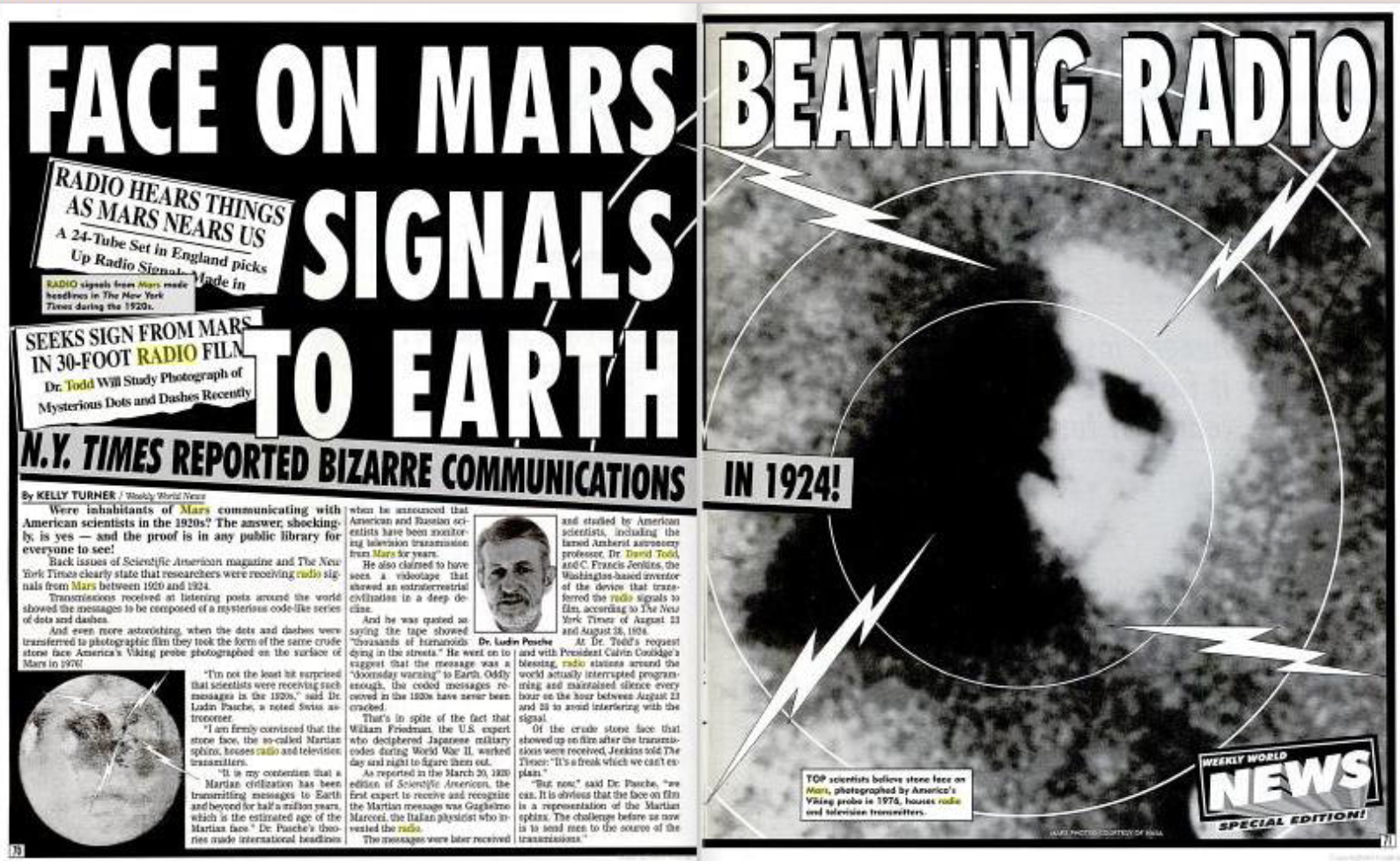
By 1924, David was in retirement, living out his years in a discontinuous series of mental hospitals. In August of that year, however, he was at liberty, and perhaps he was able then to catch the ear of President Coolidge, an Amherst alumnus. At any rate, here he is in Washington on August 21, 1924, with a démarche to Mars, an apparatus for recording the response, and (in the rear) the inventor of the apparatus, the radio pioneer C. Francis Jenkins.

And here is the report he filed from Mars.

And with those words “freak which we can’t explain,” this chapter in the history of air silence came to an end. Ever since, the static noises of freak have been equally a part of air silence’s language with explanation and poem.

Weekly World News, July 6, 1999

But back in Amherst Miss Dickinson’s three apparatuses were tuned to receive silence, only. Mrs. Todd used to visit her house and play Bach for her on her piano, but she saw Miss Dickinson’s face only once: in her coffin. In memory of piano, house, and long prepared deathbed, then,

this antenna array.

Sources:

Peter Gay, The Bourgeois Experience: Victoria to Freud. Volume 1: Education of the Senses. New York: Oxford University Press, 1984.

Polly Longsworth, Austin and Mabel: The Amherst Affair and Love Letters of Austin Dickinson and Mabel Loomis Todd. New York: Farrar Straus Giroux, 1984.

“Dr. David Todd & C. F. Jenkins, 8/21/24.” National Photo Company Collection, Library of Congress, http://www.loc.gov/pictures/item/npc2007011972/. Photoshopped. The image is also discussed at http://www.shorpy.com/node/12482.

The image against the idea

1

Interviewer Thomas Vašek: You speak of a “metaphysical antisemitism” . . .

Donatella di Cesare, vice president of the Martin Heidegger Society and author of Heidegger e gli ebrei. I “Quaderni Neri” [Heidegger and the Jews: The “Black Notebooks”], forthcoming in English translation: [Heidegger] outlines a metaphysics of the Jew. That is, he doesn’t speak of specific Jews in their individual differences and he isn’t interested in the history of the Jewish people. Rather, he asks: What is the Jew? What is the nature of the Jew? And when he does that he falls back into metaphysics, against which he guards himself at all other times. That’s why I would speak of a metaphysical antisemitism.

2

Sources: “Heidegger-Enthüllung” [“Unmasking Heidegger”]. Hohe Luft 10 February 2015, http://www.hoheluft-magazin.de/2015/02/heidegger-enthuellung/. Online.

The Warsaw Ghetto in Photographs: 206 Views Made in 1941. Ed. Ulrich Keller. New York: Dover, 1984.

Healthy color

FSA/8a38000/8a389008a38938a.tif

In the left half of the image, the receding diagonal ends at a wall of white washing. That left half is where the striding man is tall and upright and wearing white-collar made still more white by contrast with his black wristwatch.

In the right half, the Adams zones have been remapped. There the receding diagonal goes back and back to the end of the image plane and darkens as it goes, and the man with one shoulder higher than the other walks his own darkness into the dark. Except for his tin lunchpail, nothing on his side is not black. Into the middle of a descriptive geography of this black, the United States Farm Security Administration has written a diagnosis: “Coal miner going home with friend after work. Many miners are lame. Omar, West Virginia.”

In color the values are distributed more equally. There, in light, bouquets burst into visibility before an unbroken plane of human raw material moving forward like bright lava from the dark earth. That’s the story that the color tells.

You do want to believe the story, don’t you?

Then take the color cure. Let the steam cars carry you to their colorful mountains of decently covered coal. Then put on the white bustle, drink the white remedy, and be healed of your lameness.

Sources:

Marion Post Walcott, 1938. “Coal miner going home with friend after work. Many miners are lame. Omar, West Virginia.” Library of Congress, Farm Security Administration / Office of War Information Black-and-White Negatives,  www.loc.gov/pictures/item/fsa1998011311/PP/. Photoshopped.

Wills Robinson, “Risking Their Lives in Stalin’s Rusting Cable Cars,” http://mbtimetraveler.com/2013/09/29/miners-forced-to-ride-death-defying-metal-coffins/

“Dr. Kilmer’s Female Remedy,” Boston Public Library, https://www.digitalcommonwealth.org/search/commonwealth:tm70n383f. Photoshopped.


Toward the end, a new way of reading the word “light”

In New York, one cold morning as the long nineteenth century drew to its close, the front page of the New York Sun bustled with news of the continuing revolution in transportation. Off the coast of Massachusetts, said the Sun, the passenger liner Roma, carrying 500 souls, had been driven by a gale onto the rocks of an island called No Man’s Land, where it was stranded for four hours before being safely refloated. In Florida, Lieutenant J. M. Murray of the Naval Aviation Corps had been killed when his airplane nose-dived into Pensacola Bay. This was the naval station’s first fatal air accident. On the other hand, in California Silas Christofferson had flown from Bakersfield to Los Angeles, reaching an altitude of 7000 feet and effecting history’s first crossing of the Sierras by air. And at the bottom of the page, a one-sentence story datelined London declared: “It is announced that the new Cunard liner Aquitania will sail from this side on her maiden voyage to New York on May 30.”

The page was dated February 17, 1914. Just one more decade afterward, with the long nineteenth century definitively in the past, Le Corbusier would claim the Aquitania as a paradigm for his pedagogy of twentieth-century space.

No people are on view in these images. For Le Corbusier, the people always were secondary to the geometry. But as of 1914 the Sun was still following journalism’s chatty nineteenth-century convention of humanizing events by giving them
names —

(Who, exactly, was Silas Christofferson? No, reader, you don’t know either. But as soon as it crossed your mind that you don’t know, you realized that you live now by means of a sensibility from which the nineteenth century’s ways of perceiving and reacting have departed. Only in the artificial nineteenth century imagined by the twentieth-century ironist P. G. Wodehouse could Jeeves praise Bertie’s new shirts by observing in the spirit of Le Corbusier that the monograms would come in handy if Bertie should forget his name.)

— and this front page had one more chatty story to tell.

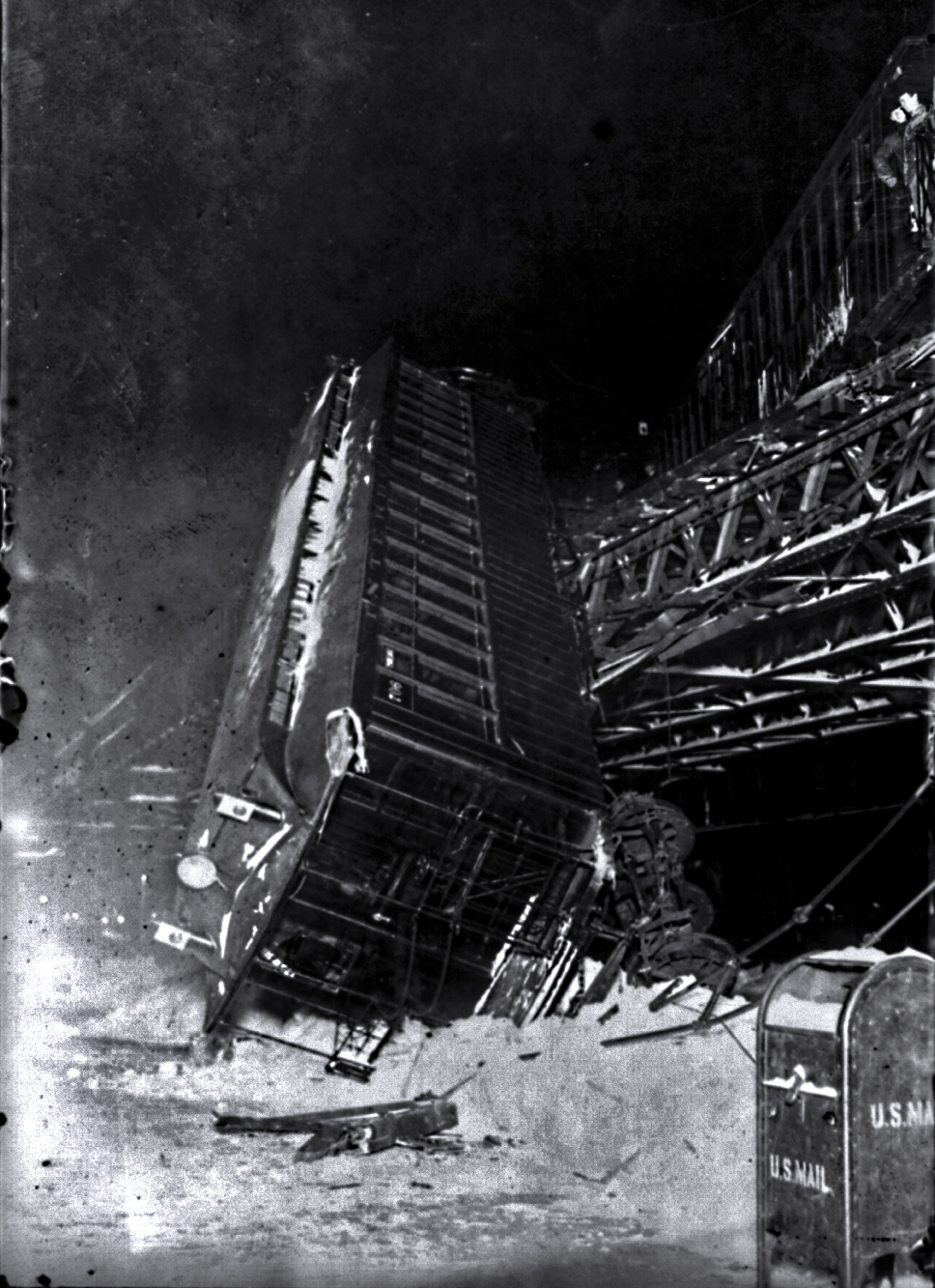
At about 7:15 on the night of February 16, said the story, a train on Manhattan’s Ninth Avenue elevated line derailed at 138th Street and sideswiped a car on the adjacent track, sending it over the side of the trestle with one end hanging from the rails and the other down on the street in a pile of snow. The car was empty except for its motorman, John Becker, and he wasn’t hurt. But the nineteenth-century conventions of journalism insisted on completing the anecdote by furnishing the named and extricated Motorman Becker with a quip to say, and so to the immortal record Motorman Becker was then said to have said:

“Well, here I am. Guess I’ll go get my dinner.”

To enlarge the quip and try to imagine it as an oration, click it. The click won’t get you far, though, because this nineteenth-century front page is all text, no pictures.

But the long nineteenth century also brought perception the gifts of a camera and a tripod and a frying pan filled with powdered magnesium. In the right hands, these turned out to make it possible to understand in the dark. And so, at the end of this particular century of development, readers began seeing their reading matter in a new way: without words.

Here, for instance, is the wordless version of the anecdote of Motorman Becker. Right at the start, its language is distanced from reading by the effect of translation — in this case, translation from text to chiaroscuro, with the surprise effect of a suddenly vertical railroad car finding its balancing irony in the surprise effect of a suddenly illuminated night. Imagining Motorman Becker locked in his dark cabin in the image’s interior, we on the image’s exterior are locked in a frame full of brilliant reflections. If we do any reflecting of our own there, it won’t be in words. We may think of words later, sitting at (for instance) a typewriter in a newspaper’s city room, but here and now we can have nothing in mind except light and dark, in silence. The Sun story is full of excited conversations in the crowd and the noise of the Eighth Avenue streetcar that eventually hauled the El car back down to horizontal, and because we’re now reading the sound-words in sound-words of our own, the sounds continue. But as you begin seeing your way into this oblong of black, the story is light and dark (seen), and silence (not heard), and nothing else.

In scenes like these, filled with nothing else in a way that isn’t available to text, frying pans loaded with new light began helping readers at the end of the long nineteenth century to draw a dark line around a moment of time and say, “Forever after, anything outside this frame will be named The End.”

Sources:

Le Corbusier, Toward an Architecture, second edition, trans. John Goodman (1924; Los Angeles: Getty Research Institute, 2007), [154].

“Elevated car falls to street 2/16/14.” George Grantham Bain Collection, Library of Congress, http://www.loc.gov/pictures/item/2002699891/. Photoshopped.

The New York Sun from 1914 is online at the Library of Congress’s Historic American Newspapers collection, http://chroniclingamerica.loc.gov/.

The lecture about botany

It’s a standard thing to point out in the introductory class: although Wordsworth was a nature poet, he also wrote a sonnet about London, “Composed Upon Westminster Bridge, September 3, 1802,” whose first line is “Earth has not anything to show more fair.”

1

Much more typical for Wordsworth, however, is “I Wandered Lonely as a Cloud,” whose lines overflow with a still yet ceaselessly moving

host of yellow daffodils,
Beside the lake, beneath the trees,
Fluttering and dancing in the breeze.

At the poem’s end, Wordsworth (or rather his sister, whose diary he raided for the description and the emotion) understands with his body what he has seen and what he is about to write down:

And then my heart with pleasure fills,

2

3

And dances with the daffodils.

4

At about the time this picture was being taken, Ezra Pound, who had no respect for William Wordsworth, found himself in the Paris metro being overtaken by something like Dorothy Wordsworth’s sense of light flowing through earth and surfacing in blossom. Pound’s flowers, however, then and later, blossomed in the dark.

The apparition of these faces in the crowd;
Petals on a wet, black bough.

Source: George Grantham Bain Collection, Library of Congress, http://www.loc.gov/pictures/item/ggb2006001714/. Photoshopped.