No poet, no artist of any art, has his complete meaning alone. His significance, his appreciation is the appreciation of his relation to the dead poets and artists. You cannot value him alone; you must set him, for contrast and comparison, among the dead.
“I saw the hardware store from across the street. I didn’t know you bought flat-irons by the pound.”
2.
The speaker will decide on two, weighing six pounds each. He is The Sound and the Fury’s Quentin Compson, and he will use his purchase to weigh down the body when he drowns himself. The date of the event, in unpunctuated lapidary uppercase, will be JUNE SECOND 1910.
3.
In 1910, customers would ordinarily have bought their irons in pairs as Quentin did. The appliances were made of cast iron, they resembled the fourth of these tokens from a 1935 Monopoly set,
and while one was in use the other would have been heating on the stove. But the metals were changing.
4.
The iron made of iron gave its metonymic name to a building erected in 1902 on a triangular lot in New York formed by the diagonal intersection of Broadway with Fifth Avenue and East 22nd Steet. In 1904, an era when photography emulated what were then called the beaux arts, Edward Steichen shaped this image.
See this one contra-Steichen: from top to bottom, starting with the printed date. For a year in a magazine about changing social fashions, that’s a point of origin. As of 1922, for one instance, 1922 was the year when the American novelist Sinclair Lewis published a social satire named Babbitt which by 1930 would make him the first American writer to win the Nobel Prize for literature. It’s all but forgotten now, but in 1922 its description of an evening cityscape seemed memorable. It was full of styles. But just as a matter of professional practice, Lewis didn’t build anything in 1922 that Dickens in 1852 hadn’t built with more imaginative use of material in chapter 1 of Bleak House. More, and decisively: 1922 happened to be a year when the technology of writing English entered a new stage of development. With T. S. Eliot’s The Waste Land and James Joyce’s Ulysses, a poem and a novel did to literature what the steel skeleton had done to architecture. Babbitt was to remain in the iron age. The Waste Land and Ulysses were wired for steel.
6.
In front of a high steel tower in 1922, a low steel tower moved traffic through gridded Manhattan. Entering stage right, a man in spats and a top hat came dancing through the grid. The zigs of Archie Gunn’s cartoon architecture were now ready to be seen as a jazz.
In large letters, his muse inspires him to despair. Wishing is futile, sing her lyrics, because even under high tension his brain will accomplish little. His city is New York, the year is the year of The Waste Land, and the choir giving voice to its libretto of events is named The Lonesome Million.
But the fine print will deliver doubled Peter to hearty laughter and constant protection against all the troubles of the world. All he’ll need in advance of that is whiteness, 75¢ a month, and facility with the etiquette of the word thus.
Once, at a moment in history when ships’ bridges were so new to language that they literally and non-metaphorically were bridges, light broke through clouds above a bridge and people were saved. For that we have the testimony of a picture with words.
From left to right, the fine-print captions under the image read Lockwoods, Pensylvania [sic], Life Boat, St. Andrew, Victoria, and Day & Haghe, Lithrs. to the Queen. Then, larger, comes this confident explication.
The barely legible words at the end appear to be “The Publishers,” perhaps originally in a different color.
But it’s the caption’s other words that are the hard ones to read. The reason is that their key verb, “rescuing,” belongs to a genre that is now extinct: the genre of religious adoration of the present time. In the moment of that genre, the Transcendentalist painter and poet Christopher Pearse Cranch (1813-1892) could write a text called “The Spirit of the Age” which ended:
The mute machine is moved by a law
That knows no accident or flaw,
And the iron thrills to a different chime
Than that which rang in the dead old time.
For Heaven is taking the matter in hand,
And baffling the tricks of the tyrant band.
[. . .]
And some who from their windows mark
The unwonted lights that flood the dark,
Little by little, in slow surprise,
Lift into space their sleepy eyes;
Little by little are made aware
That a spirit of power is passing there,–
That a spirit is passing, strong and free,–
The soul of the nineteenth century.
But because one of your first emotional reactions to the lithograph probably included a distancing term like “museum piece,” you have a historiographic problem with seeing. A century and a half before your time, the soul of the nineteenth century passed into the scene of rescue, but then it continued on through and out, taking with it much of the word rescue’s emotional context. Now this image of rescue is just an item in a museum, but in its own time it was readable in the home as an allegory of salvation. Some happiness then followed. But the picture isn’t making you happy now. Its caption no longer teaches you to adore.
Because (for one reason among many) in the twentieth century, Cranch’s grandnephew T. S. Eliot was to turn the soul away from his ancestor’s poem’s olfactory regime of coal smoke in favor of French cigarettes and then of Anglo-Catholic incense. Before Eliot’s disdainful gaze the unwonted coal-gas light ebbed as well. Under redarkened heavens there no longer remained enough energy to read hope by.
are a continuing revelation. Letters filled with passionate avowal from a man to a woman would ordinarily be called love letters, but these letters were written by T.S. Eliot, and history has opened the trunk of the machina just in time to make delivery during the Trump era. There, the marvel of the letters turns out to be their dreadful familiarity, in ways that would have been hard to credit just five years earlier. From them we now learn, for instance, that Eliot was capable of explaining to the woman he said he loved that if he were to divorce his estranged wife, the Church of England would suffer its most grievous loss since the conversion of John Henry Newman (Dickey’s posts “Temptation and Duty,” 5 February 2020, and “Establishing Patterns,” 17 February 2020).
We read such texts this year as we read Twitter this year: in hope that there may be a world outside the text.
Even if the text does seem for the moment to be all that there is, we yearn for a counterbulletin. For the author of the texts to Hale, then, perhaps as if from the beings that he classed as Grishkin and Sweeney, this tentative counter-hope from the gutter.
The gutter creatures
are two cattle egrets and a mongoose. The mongoose has been dining on food that people leave on the ground in his Honolulu park for feral cats. Like the birds who would be his prey if it weren’t for that gutter kindness, he is beautiful directly, without what Eliot might have called dissociation. When he opens his mouth to bite, he is obeying only one law: a law whose pure text originated before speech and now reveals itself in indifference to anything said in speech afterward. The spring to the kill or the flapping ascent into air are, poem or no poem.
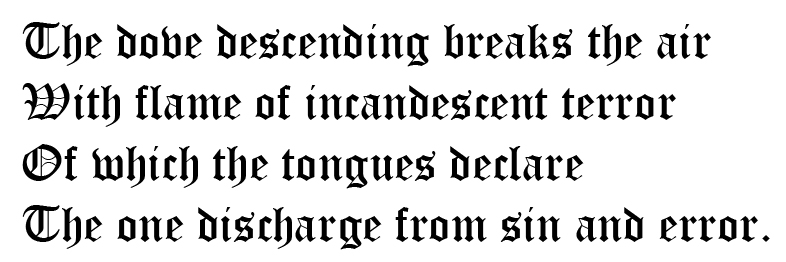
the last poet who might have gotten away with using the phrase “sin and error” about the Battle of Britain was probably Emily Dickinson (d. 1886), she who successfully wrote a poem (Fr479, “Because I could not stop for death”) containing the word “immortality.” By the time of T. S. Eliot (b. 1888), that era in the possibilities of language had passed. The Wright Brothers, sons of a bishop, had vouchsafed to Eliot’s time a descriptive lexicon that made obsolete some key words of the Book of Common Prayer, but Eliot didn’t journey to the airfield to pick up the mixed parcel of words and mathematics that held his new heritage. Instead, sheltering from bombs, the great modernist poet regressed to black letter. Throughout the Quartets he is articulate about what can’t be easily read through that ornamented face (EastCoker II: “A periphrastic study in a worn-out poetical fashion”), but he is a man of letters, articulate only in letters.
Yet the light and air through which another dove is descending as you look are text-free. In the text above, the word “dove” stands in ways not related logically or representationally for both an icon in stained glass and a night-gray Heinkel 111, but the feathered luminance in the image below is merely and wholly a body. It is not an allegory of body; it is body as such. Words wear out, says a T. S. Eliot poem written in words, but the whistling, flapping sounds of descent aren’t words. They subsist in the audible as they have never stopped subsisting: audible only; immortally un-paraphrasable in mortal language. To hear them under that aspect, holding in conscious abeyance the idea of a meaning beyond nature, is a joyous fear. A text in black letter tells us that fear before the supernatural is the beginning of wisdom, but joy is in the understanding that light comes to us by laws of nature as a continuation without an end. What it communicates is not a predication but a melody.