
Source: the opera singer Geraldine Farrar performing at a Liberty Bond rally in New York during World War I. George Grantham Bain Collection, Library of Congress, http://loc.gov/pictures/resource/ggbain.26652/. Photoshopped.
Source: the opera singer Geraldine Farrar performing at a Liberty Bond rally in New York during World War I. George Grantham Bain Collection, Library of Congress, http://loc.gov/pictures/resource/ggbain.26652/. Photoshopped.


Poster by James Montgomery Flagg, 1918. Source: Library of Congress, http://www.loc.gov/pictures/item/2002712085/. Photoshopped.

Source: Fenno Jacobs, “Amusement Park,” part of a suite of photographs taken between May 23 and May 30, 1942, for the U.S. Office of War Information. The suite is collectively titled “Southington, Connecticut. An American town and its way of life.” Farm Security Administration / Office of War Information black and white negatives, Library of Congress, http://www.loc.gov/item/owi2001038690/PP/. Photoshopped.
Source of the photoshopped image at the foot of the page: “Helen Rook,” George Grantham Bain Collection, Library of Congress, http://www.loc.gov/pictures/item/ggb2005024344/. Helen Rook, on the right, was a Broadway actress of the 19-teens. In the New York Evening World, May 2, 1918, p. 7, the Bloomingdale’s advertisement promised that she (“Lieut. Helen Rook of the Camp Recreation Corps”) would sing at a white sale. Lieutenant Helen was also on hand the next month when (New-York Tribune, June 3, 1918, p. 6; Historic American Newspaper Collection, Library of Congress) a shipload of Australian officers landed in New York:

At the foot of the page, a band of patriotic milk dealers added:

—
But in spite of the imperative “End!,” Miss Rook still remains available after hours. Touch your keyboard for her and she will come back to unfailing life. See:

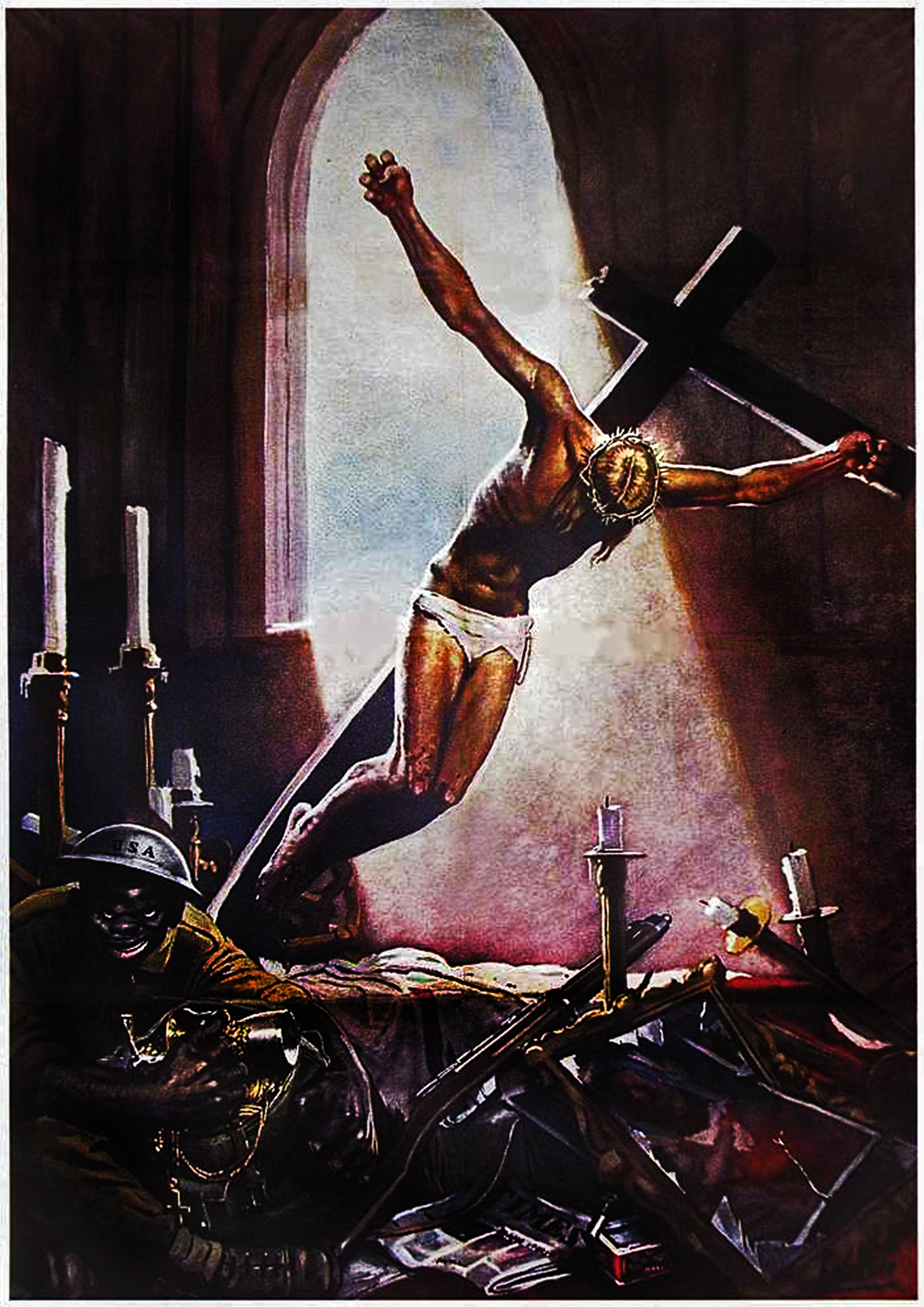
Toward the end of its era, Fascism embarked on a campaign of cultural self-pity. Italy has been attacked by darkness, Fascism told Italy. Everything that Italy has inherited from its past is being violated. In the chiaroscuro, it may seem that nothing remains for us but to grieve. Our candles are out; our heads are bare and bowed before the advent of the black helmets. However, our light will return. Something that will not die bows down to us in our grief and whispers light’s vindicating truth.
But even as the black helmets were making their slow way from temple to darkened temple, the land under Italy’s temples was being cleared day by bright day from the air. Most of the bombers that came flying through the light to accomplish that task of war were Consolidated B-24s, and these bore a propaganda name of their own: Liberators.

In the sheets of light beneath liberation’s radiant onslaught, Fascist art could do nothing except to repeat its now meaningless trope of darkness. Desperate to continue depicting the trope, it once went textual and tried to supplement its now meaningless self with an explanation outside the picture:
“Liberators take liberties!”
Outside the picture, the pun is too witless even to be visualizable. But the image’s trope of darkness retains some meaning nevertheless. Seventy years after the fall of Fascism in Italy, it still speaks to the politics of the United States. It does so because it articulates a myth, and myths are hard to make die.

After all, there can be no light without darkness. That is one sense of the myth of Pluto and Persephone.
 Bernini
That myth says: Light goes down into the underworld and is reborn there from death to life. This will be the happy ending of the art-stories of the looted church and the rape which has been redeemed for art by a successfully understood allusion to Italy’s cultural heritage. When he wrote the history of anecdotes such as those, Ezra Pound was fond of using the word splendor, which means brilliance or radiance. But a splendor returned from the underworld has been in that which is dark, and when it reascends it can never again be immaculate. Bearing shadows within the folds of its mantle, splendor must bring darkness back with it. At nightfall, splendor’s darkness will rejoin the primal dark. Then, after morning comes, we may pick up our brushes once again, seventy years later, and charge them once again with black.
At the present linguistic moment, the Pound-word “heritage” is one shade of that black. Spoken today by reenactors remaking themselves as ghosts on battlefields, it is a word that darkness has taken to itself and refashioned as a mode of immortal yet unliving form.

Look at heritage’s eyes. Look at its pointed fingers delicately touching its slender musket. Understand, as you look, the lesson that heritage is wordlessly teaching you: the lesson that darkness, having once been comprehended by art and shaped by it into myth, can never wholly return, forgotten, to the past and to death.
—
Sources: the Italian propaganda posters come from a collection at http://ic.pics.livejournal.com. The image of the B-24 comes from a site for airplane modelers, Wings Palette, at http://wp.scn.ru. Its Russian caption translates as, “98th Battle Group, Libya, 1943. Shot down August 1, 1943, by [Bulgarian] Lieutenant Stoyan Stoyanov.”
The image “Unidentified soldier in Confederate uniform with bayoneted musket and knife” is in the Liljenquist Family Collection of Civil War Photographs, Library of Congress, http://www.loc.gov/pictures/item/2014646219/.
All images photoshopped.


Translations:
The text of the Russian poster, created by Georgi Pashkov and published by the provisional government in 1917, reads, “Subscribe to the freedom loan. The old system is defeated. Build a free Russia.” But the loan was a war loan.
The text of the Austrian poster, created by Maximilian Lenz, reads, “1914-1917. Subscribe to the sixth war loan.”
1. The short view:
I have heard that hysterical women say
They are sick of the palette and the fiddle-bow,
Of poets that are always gay,
For everybody knows or should know
That if nothing drastic is done
Aeroplane and Zeppelin will come out,
Pitch like King Billy bomb-balls in
Until the town lie beaten flat.

2. Wyndham Lewis, a contemporary of Mr. Yeats who views himself as a destructive mechanism, charges his palette.

3. Ascending in the mechanism, Mr. Yeats takes the long view.

There, on the mountain and the sky,
On all the tragic scene they stare.
One asks for mournful melodies;
Accomplished fingers begin to play.
Their eyes mid many wrinkles, their eyes,
Their ancient, glittering eyes, are gay.
1.


2.


3.


Sources and translations
The Oldsmobile advertisement, from 1942, is at http://www.flickr.com/photos/jon_williamson/11982067064/
The image of women on the battlefield can be found in many locations online. It was taken by Dmitri Baltermants in Kerch, 1942.
The painting of the girl writing to the soldier wearing Norwegian mittens in Germany’s SS Wiking division, like the two other propaganda images in color, is by the Norwegian Nazi artist Harald Damsleth. All three of the Damsleth images are at http://gasskammer.blogspot.com/2013/02/en-nasjonal-samling-bilder-av-harald.html
Austrvegr, literally “eastern road,” is an Old Norse word referring to Russia. I have also written about this image at http://jonathan-morse.blogspot.com/2010/01/home-front-art-familiarizing-defamiliar.html
Enten eller translates as “Either / or.” The red-and-yellow sun disk was the emblem of the Nasjonal Samling (National Gathering), Vidkun Quisling’s Norwegian Nazi party. In the image titled Kultur-Terror, the dialogue at the bottom translates as, “The U.S.A. will save Europe’s culture from destruction. . . . with what right?” I thank Domhnall Mitchell for correcting the translations.