
Source: Detroit Publishing Company Collection, Library of Congress, http://www.loc.gov/pictures/resource/det.4a07180/. Photoshopped.
Source: Detroit Publishing Company Collection, Library of Congress, http://www.loc.gov/pictures/resource/det.4a07180/. Photoshopped.
 Source: “Pass Street boat docks, passenger boats and docks, Buffalo, New York.” Haines Photo Company, Conneaut, Ohio, 1909. Library of Congress, http://www.loc.gov/pictures/item/2007661196/. Photoshopped. Click to enlarge.

Source: George Grantham Bain Collection, Library of Congress, http://www.loc.gov/pictures/item/ggb2006000152/. Photoshopped.

Source: George Grantham Bain Collection, Library of Congress, http://www.loc.gov/pictures/item/ggb2004004461/. Photoshopped.
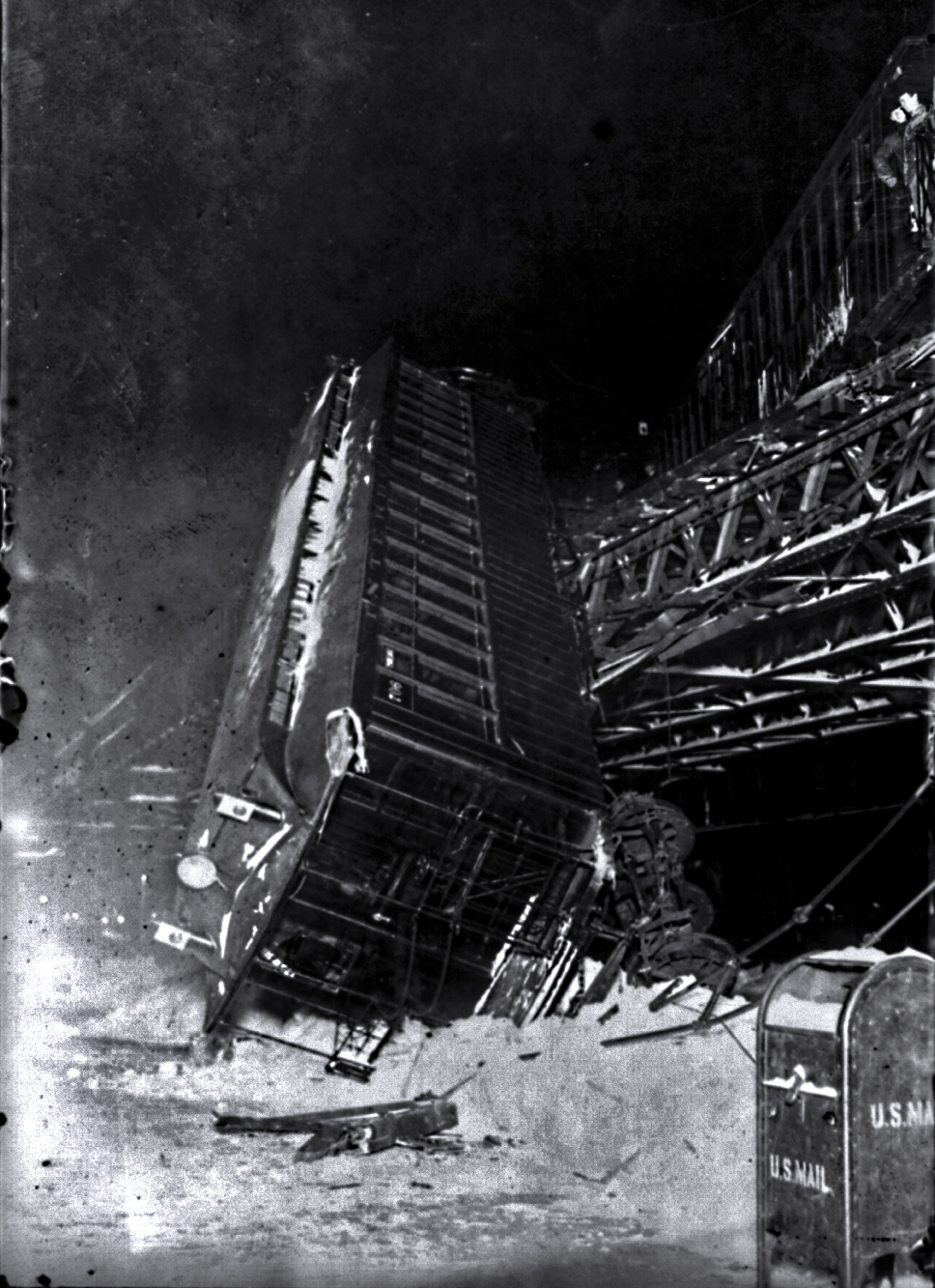
Source: “Elevated car falls to street 2/16/14.” George Grantham Bain Collection, Library of Congress, http://www.loc.gov/pictures/item/2002699891/. Photoshopped.
After that I lived like a young rajah in all the capitals of Europe — Paris, Venice, Rome — collecting jewels, chiefly rubies, hunting big game, painting a little, things for myself only, and trying to forget something very sad that had happened to me long ago.
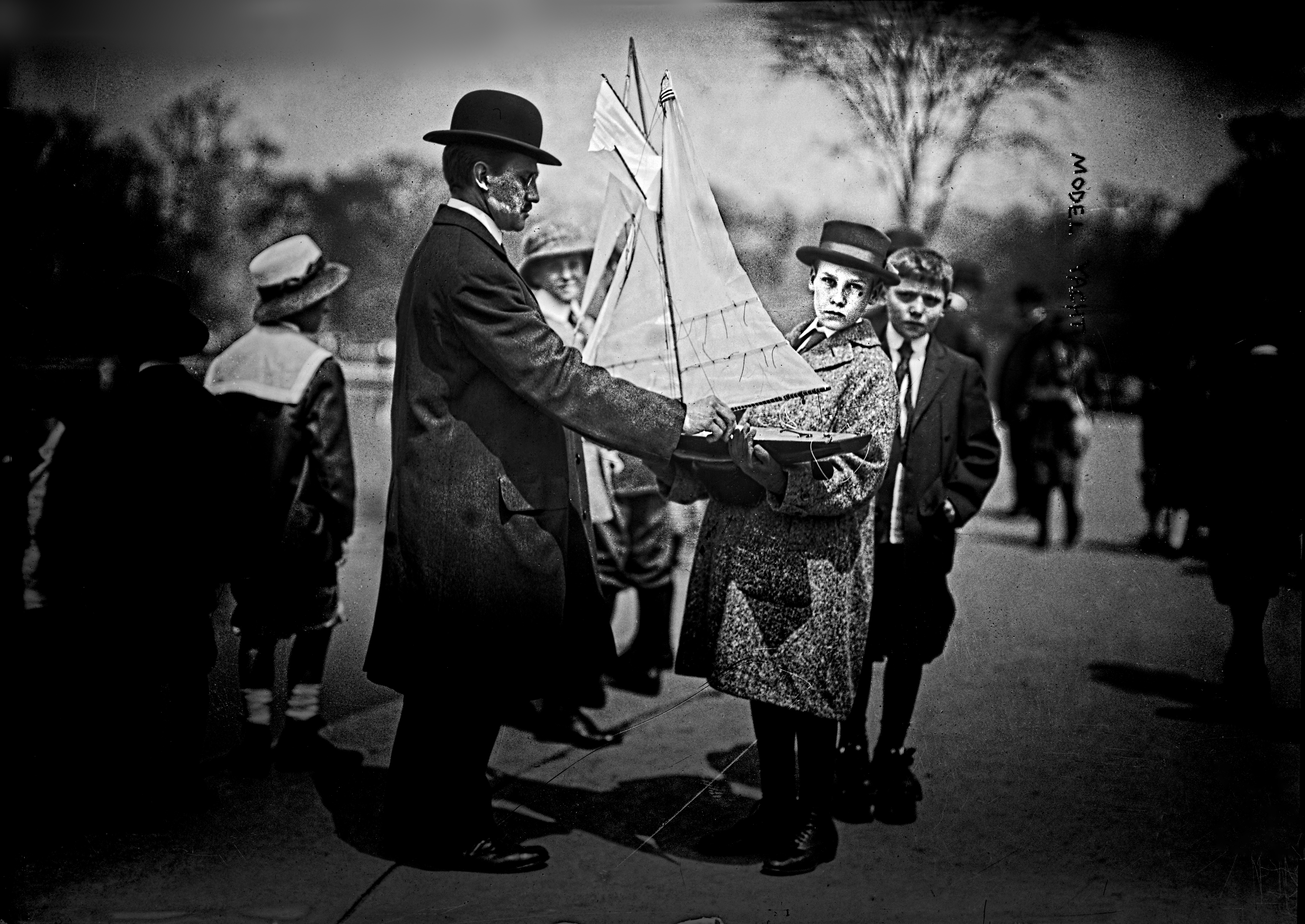
Source: “Model Yacht,” George Grantham Bain Collection, Library of Congress, http://www.loc.gov/pictures/item/ggb2005018958/. Photoshopped.

On November 16, 1919, someone named George B. Parks notified what was then called The New York Times Review of Books that a book purporting to be a war memoir was so factually inaccurate that it couldn’t be non-fiction.
George B. Parks was undoubtedly correct. The book he was examining is only 84 pages long, and in that tiny intimate volume the facts stand out only because they are so few and so vaguely described. On the other hand, an extratextual fact, this one startling, is that as of November 1919 this book had already been in print for a full year. Just days after the end of the war, the Times had announced its publication this way.

The book was so well received that its author eventually came forward and identified herself as the journalist and writer of children’s books Grace Duffie Boylan. The facsimile published by Forgotten Books bears a title page date of 1919, and the digitized copy at Archive.org bears a title page date of 1920.
But why? The book itself is not just vapid but almost totally empty. In heaven, wirelesses the dead soldier to his mother, the souls in khaki do, you know, stuff. They have dogs and cats and horses to keep them company, and the dogs travel busily back and forth between the astral plane and the terrestrial but the cats are looked on with suspicion. No reason for this is given. However, we do specifically learn that everybody spends time discussing the text “They shall be one flesh.” What the doughboys in the clouds wonder is: if a woman has been married more than once, with which one of her husbands will she be reunited in Paradise?
(Grace Duffie Boylan herself was married four times.)
—
Well, the answer to the question “Why?” is in the history books. It isn’t surprising: in the horrible stillness after the guns of the Great War went silent, millions of readers went gleaning for grains of comfort in bookstores, where businesspeople were waiting to accommodate them.
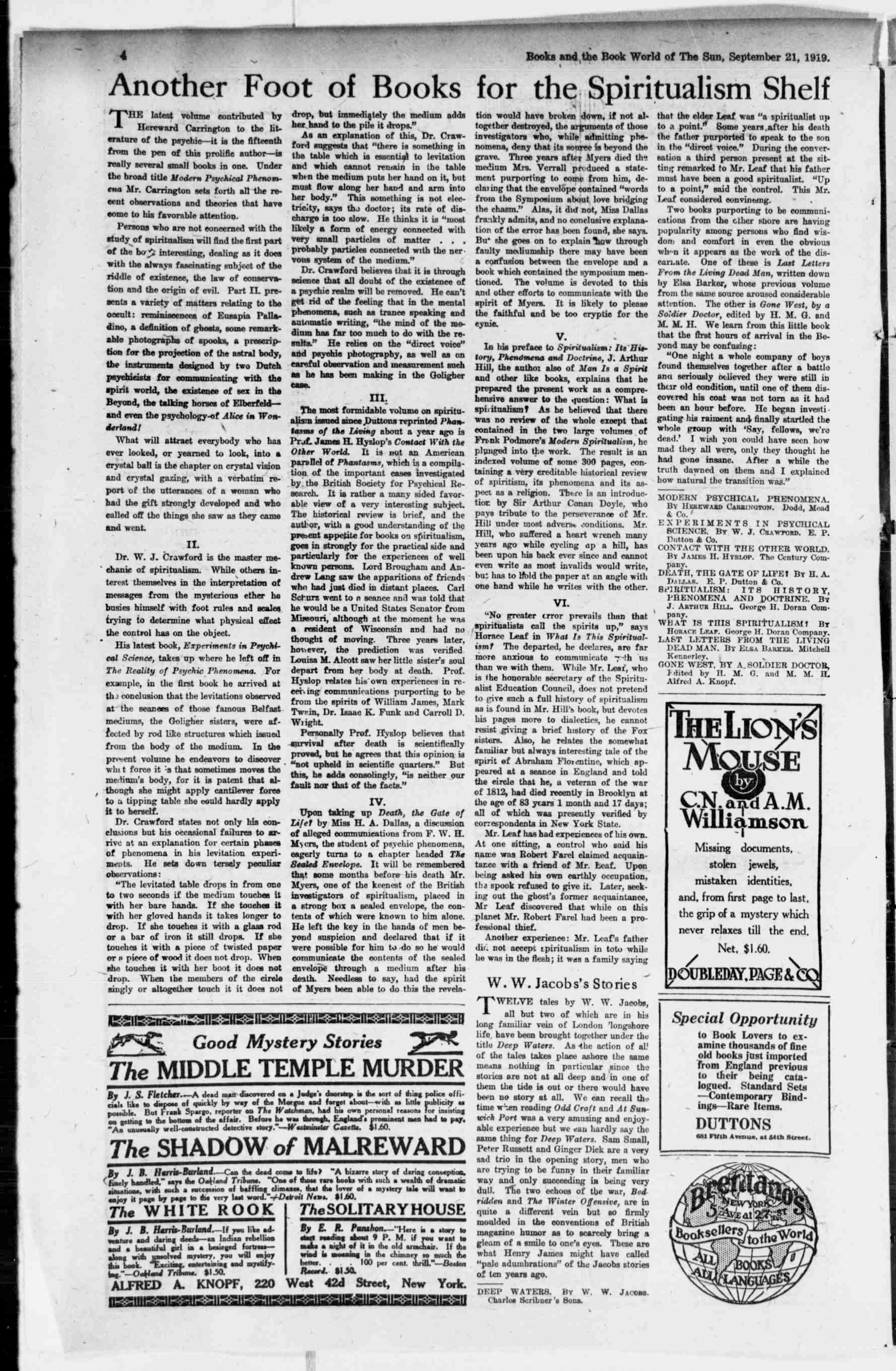 Click to enlarge.
The same thing had happened after the Civil War, when Elizabeth Stuart Phelps’s consoling theological fiction The Gates Ajar provoked Mark Twain into a full-length parody, Captain Stormfield’s Visit to Heaven.
But you wouldn’t read The Gates Ajar or Thy Son Liveth the way you’ve read my paragraph of literary history about them. The consolations of Thy Son Liveth were made available in 1918 and 1919 and 1920 by the respectable Boston firm of Little, Brown, and Company for the reasonable price of 75¢, and of course it was a large predicted multiple of 75¢ that motivated the literary labor of Mrs. Boylan, Mr. Little, and Mr. Brown. The old-fashionedness of that symbol ¢ is the kind of topic that literary history is loquacious about, but emptiness in the heart of a grieving mother is mute. Around the wordless emptiness there bustle George B. Parks and the journalists of the New York Times and Sun and assorted Little, Brown businesspeople, but by contrast with their cheerful realism (“Another foot of books for the spiritualism shelf” [laughs]) the emptiness is only darker, more unimaginable, and more mute, if there could be degrees of muteness.
—
Ten years earlier, a vast excavation was being hollowed out under New York for the new Grand Central Station. As fast as it was created, it was filled again. In this hole, life was ongoing. As of 1908, someone looking at it through a fence might have felt exhilarated on behalf of the excavation’s embodiment of life growing up toward the light from deep in the earth. But ten years afterward, Grand Central was complete and its newsstands were selling fictions purporting to speak in a language from beyond the grave. The excavation had been completed by then, and light no longer shone into it.
 Detroit Publishing Company Collection, Library of Congress, http://www.loc.gov/pictures/item/det1994001893/PP/
Photoshopped. Click to enlarge.
Framed by his open rear window, the conductor of the Putnam Avenue trolleycar has his eye on the curved track rising behind him. The car is moving on schedule through space and time. It and its track, all the other cars and all their tracks, have become the seen parts of a steel and stone structure rising buttress by buttress toward two piers in the hazy sky, and a wall of towers rising still higher beyond them. This construction in space and time dates from the summer of 1908. Click to enlarge.
 Toward the image’s right edge some words offer us a way of reading New York 1908. Our own New York, it turns out, is different. “Try Horsalene Salve today,” counsels a billboard advertising a skin-care product — but then the words spoken in 1908 canter away from us, laughing as they whinny, “if you want to use your horse.” Oh yes: Horsalene as in ha ha Horse! And to the left of the horsewords another billboard informs us that one of Broadway’s biggest stars, Maxine Elliott, will soon — that is, far in the past — be at the Grand in a new play, Myself — Bettina. Read into the past, the billboard’s nouns and pronouns (“Maxine,” “Myself”) become imperatives. They require us to transfer our desired object of vision from a single image we will not be able to see to an archive of images once actually seen by others.
In the archive, closed off from such distractions as the woman actually seeable on the sidewalk far below the Putnam Avenue car, we’ll find that Myself — Bettina happened to arrive on a different schedule from the one published on the billboard. It didn’t open at the Grand in November; it opened at Daly’s in October. In fact, it barely even made it into November. According to the Internet Broadway Database, it ran only 32 performances, from October 5 to November 1. All four of the reviews I’ve read online (in The Forum, The Smart Set, and the New York Times and Tribune) are negative. Twelve years after Harold Frederic’s novel The Damnation of Theron Ware offered reviewers an opportunity to visualize a small American town populated in its religious district by a sophisticated Catholic priest, his atheist friend, a cigarette-smoking aesthetic girl, and a bumbling Methodist minister, the reviewers lined up along Broadway to complain that the small-town religious architecture of Myself — Bettina was visually obsolete.
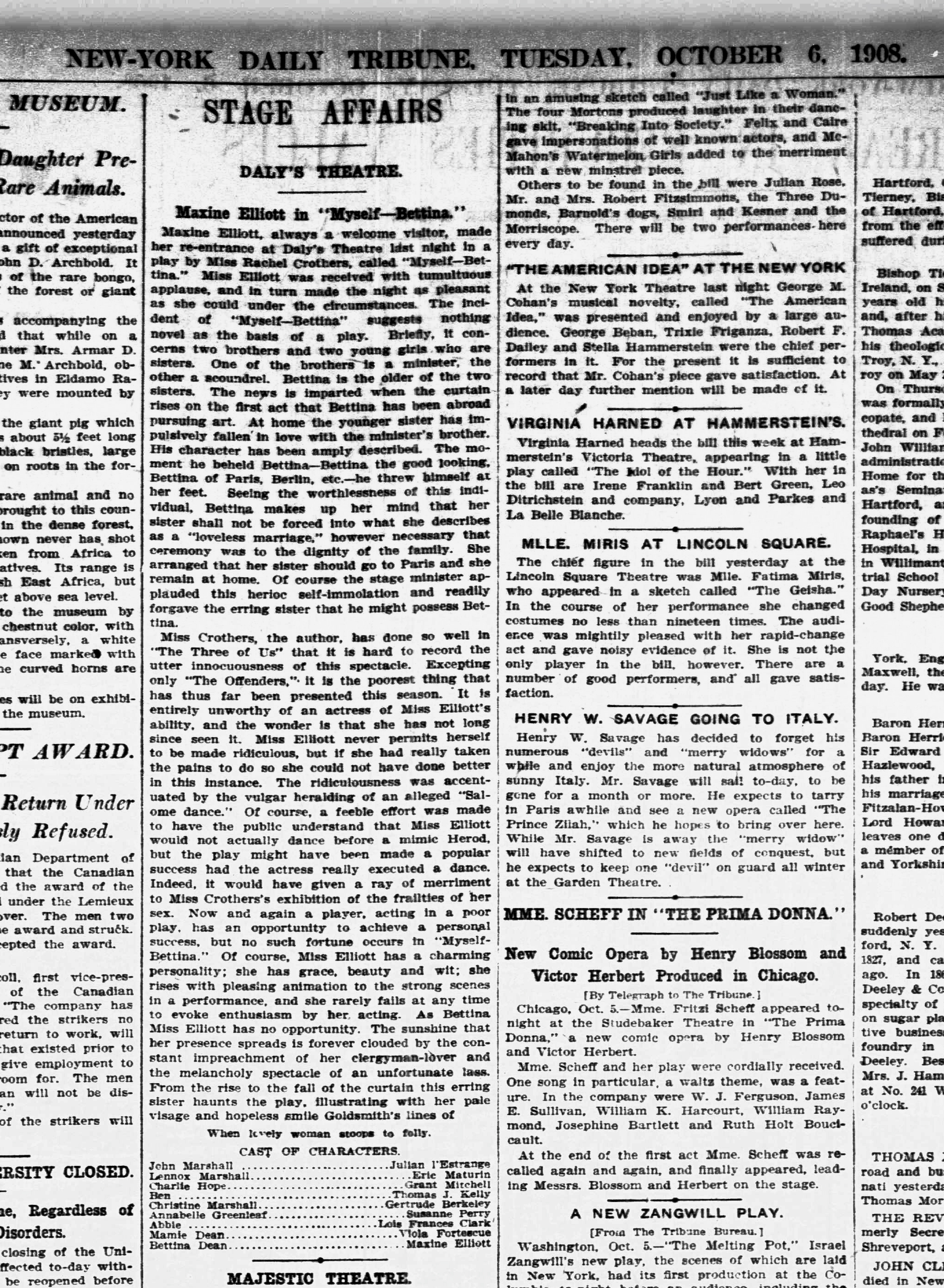
Imagine reading this review as you rode the Putnam Avenue car onto the bridge. Imagine, then, deciding not to proceed uptown to Daly’s Theatre and see the show. But just below and to the right of the Tribune’s view of Myself — Bettina, another headline announces the scheduled arrival of a play which in the event will stay and stay and stay onstage, and then transit into literary history. It’s a melodrama just as silly as Myself — Bettina, but unlike Myself — Bettina it came to Broadway from London equipped with a title that was useful on the approaches to the Brooklyn Bridge. Under New York’s smoky skies, it suggested: “With Ellis Island busying itself in the harbor, your world is changing. So stop thinking of yourself with that antique conception, ‘Myself.’ Instead, think of yourself as a thing: a thing continually changing into a newer thing — a thing as wonderful as, say, a bridge capable of spanning the world. You can do it! After all, you are in [pause; then, with emphasis] The Melting Pot.”
But here on the buttresses of the approach, melting has not yet occurred. The innocent words of the billboards facing into traffic still speak to us only of using our horses and eating our superior macaroni. Hart Crane has not yet imagined the Brooklyn Bridge as “harp and altar, of the fury fused.” But see the buttresses and read the reviewer’s complaint about a drama unwilling to register that which, on the immediately available evidence of the senses, was then seen to be making the Putnam Avenue trolleycar rise to the towers along a buttress’s curve. As of 1908, Hart was only a nine-year-old in Cleveland, waiting. But the bridge was already open for business.
Sources: “Approach to Brooklyn Bridge, Brooklyn, N.Y.” Detroit Publishing Company Collection, Library of Congress, http://www.loc.gov/pictures/item/det1994005064/PP/. Photoshopped.
New-York Tribune, 6 October 1908, p. 7. Library of Congress, http://chroniclingamerica.loc.gov/lccn/sn83030214/1908-10-06/ed-1/seq-7/. Photoshopped.
Performance history of Myself — Bettina: Internet Broadway Database, http://ibdb.com/production.php?id=6595


Source: “Broadway at night from Times Square, New York, N.Y.” Detroit Publishing Company Collection, Library of Congress, http://www.loc.gov/pictures/item/det1994021936/PP/. Photoshopped.
At http://www.loc.gov/item/00694394, annotators have been employed by the Library of Congress to research and write this history.
The camera platform was on the front of a New York subway train following another train on the same track. Lighting is provided by a specially constructed work car on a parallel track. At the time of filming, the subway was only seven months old, having opened on October 27, 1904. The ride begins at 14th Street (Union Square) following the route of today’s east side IRT, and ends at the old Grand Central Station, built by Cornelius Vanderbuilt in 1869. The Grand Central Station in use today was not completed until 1913.
On the camera platform rode a voyager: Thomas Edison’s cinematographer W. G. “Billy” Bitzer. The date of his voyage was May 21, 1905. About the digitized restoration of his camera’s record now visible at
http://www.youtube.com/watch?v=J10-aYVG6HY,
employees of the Internet Movie Database have written a supplementary history. Reading it as testimony in advance, we suspend disbelief and begin thinking that we are about to see, in good verbal faith, this.
One of the 50 films in the 4-disk boxed DVD set called “Treasures from American Film Archives (2000)”, compiled by the National Film Preservation Foundation from 18 American film archives. This film was preserved by the Museum of Modern Art.
—
We read the words. Words have always taught us to think we know.
But then
Click. See the sudden coming of the light where the dead still live. A moment after you’ve seen it, you’ll be carried off to finish the time you serve in the dark. But as you pass back into the dark you’ll remember the light as if it were a word speaking itself. In its silence, the light will have taught you to hear what words aren’t still enough to say.