Treadle

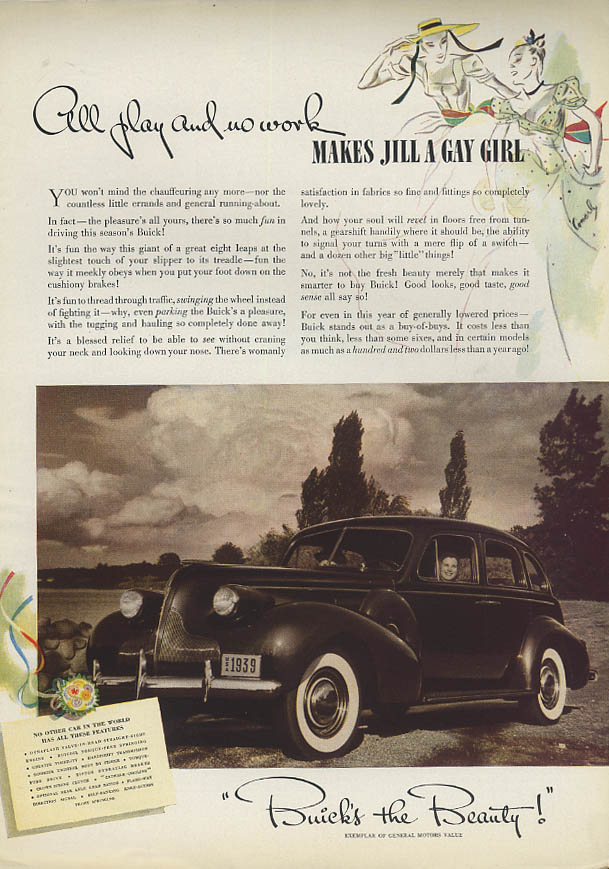
Published eighty years ago, probably on cheap paper in a mass-circulation magazine (online, it’s unattributed), this page has physically deteriorated in the course of nature.
mgd1202

But we can be helped to see it with refreshed regard. Tear out the page, carry it into a dressing room, read it into a computer, and the light reflecting from the mirror will grow bright again. The film of age will seem to have been windexed away.

mgd1202gaiR

Brightened, the pictures (of hat, of corsage) have been repaired and restored to what they seem to have been at the time of their conception: cultural emblems, metonyms of the feminine. Look at me, they say; in myself, as such, I am pretty. That is my primary meaning. But the color pictures bracket a page of words in black, and those have their primary meaning only off the page. They are less a text than a musical score — a score for woman’s voice, solo.

In current performance, this score’s fidelity to register is low. Its reception has been made partially obsolete by advances in recording technology. “Slipper,” the voice was intended to whisper in sibilant soprano. “Meekly obeys,” it was meant to murmur with a smilingly knowing evocation of a vow at a wedding. When it sings, “Put your foot down,” the voice is probably intended to perform a messa di voce, swelling and diminishing between masculine loud and feminine gentle. But after eighty years we hear the shellac rasp and see the whiskers showing through the soloist’s makeup. History is beginning to mime from the aisle that it’s time to cut the performance short and leave. “Treadle” is 1939 sewing-machine nomenclature, but not even a feminine exclamation mark formed with a dainty little circle can make an audience believe now that Buick the Beauty had ruffles around her pedals.

Text

No; despite the page’s restoration in historical space, its time has continued being 1939, decay and all. Photoshop has refreshed the colors of the page’s language console, but the console itself is not a live vocabulary but a Victrola running at 78 rpm. Never to rise away from 1939 and go free, its sound from the time of black and white only fills and refills the yellow-filtered Edward Steichen atmosphere of the stage which Buick traverses. There it enters her open windows. And there in her, treadling as he holds back his tears, slippered gay Jill drags through his errands.

—

* A treadle, under the unmotorized sewing machine. You rock it with your feet.

Excelsior sewing machine aiB

Keats and Shklovsky at the zoo

It was a windy day in Honolulu, but I stilled the air by shooting at 1/2000 second. In my hands, a camera’s mechanism recorded an image of whipping fronds immobilized and fixed to an image plane. That record now presents you the option of glancing at the plane, closing your eyes, and no longer seeing the imaged trees but experiencing them as optical illusion and as thought. A bug in the thinking part, however, is that in this instance the mind you think with happens to be vacationing in a tourist economy. Because people were paying to see these palms and these clouds long before you arrived on your own ticket, your own first view of them wasn’t really first and your belief in what you saw on first impression was an oversight. Whatever followed for you from that, whatever idea of palm, was aborted by irony before it had a chance to communicate. Did a Norton Anthology of Poetry word such as tresses recall itself to your memory, for instance? Sorry, that won’t work now. Your memory has already been polluted by poems and shampoo commercials, and the only honest reading of tresses will be a flatfooted dumbing-back-down to trees.

DSC_3053aiM

And it won’t even be your own unique dumbing-down. After all, every Saturday of every year along the fence around the Honolulu Zoo, artists sell pictures to tourists of what tourists have come to Honolulu to see: viz., palm trees. The artists call the pictures “real oil paintings,” and the only thing false about that claim is the plural marker at the end of paintings. In reality, of course, there is only one painting, repainted weekly by different painters. Its vacationing buyers buy it as a visual mnemonic, to remind them that once in the presence of a palm they experienced the miracle of first. But a mass-produced memory (the industrial term is souvenir) is perennial: experienced in community, like language, and expressible, like language, only through symbols (paint marks; words) that preexist it. How can it be reconciled with first?

John Keats’s solution was to assimilate first by simile into the continuum of beginnings across time. When Keats’s Cortez stared for the first time at the Pacific Ocean, he was on the brink of realizing that first can also, wonderfully! be all along (like the ocean) and, an instant afterward, forever (like the ocean) — and I (says Keats) felt a moment ago, in the presence of Homer, as Cortez once, for the first time, felt, and thenceforth began to feel forever. I can never feel that way again; I can never not feel that way again.

But the left side of my own composition is palmless.

In the tourist economy, the palms in my composition are also compositions: plantings at a shopping center. If I were to post their picture uncropped, you’d see that at their base is a gas station and to their right is a Starbuck’s. But, per Viktor Shklovsky, who said, “Art is the way of experiencing artfulness,” I cropped. Out of negative space I carved a diptych of trees and, on the other hand, sky. Then, for good measure, I modified my image’s pixels with controls bearing such names as Vibrance / saturation and Graduated neutral density filter. If that manipulation was aesthetically productive, you may have experienced a catch in the throat which you took to be a consequence of tropical light. But if the catch did come, it came as an aftermath of something planned and deliberate and related to the photomechanically produced surface of the picture, not the living palm.

Because you know now that you’ve known that truth all along, you’ll never again be able to experience the peak in Darien in silence. You’ll have to recognize that a camera and a computer have been up there with you all along. You might as well climb back down to sea level. On the other hand, down there you might as well also stop looking for trees in the painting you bought at the zoo and start looking for oil. But that too, it will turn out, has been there all along, and this all along will be seen to be all to the good.

A real oil painting: the picture has always told you that truth about itself. To the veteran wildcatter Viktor Shklovsky, I dare say, whatever is within its frame looks like a real gusher. His investment advice will be to see the picture’s paint as paint and let it make you wealthy in oil’s own way.

61yz++NPgFL

Dogmatic note: Shklovsky’s epigram from “Art as Technique” is usually translated as “Art is a way of experiencing artfulness.” But Shklovsky wrote in Russian, a language without direct equivalents to the English words a and the, and I’ve taken that as my warrant for preferring the.

No remedies, all

Published in 1888 for the Cotton Bale Medicine Company of Helena, Arkansas, this pair of store display cards, each one measuring about 11 by 14 inches, is housed in the Library of Congress in relic state: faded and damaged and mounted for preservation on a backing sheet. In 1888 it wouldn’t have been seen this way. To imagine it as it was then, we probably won’t be able to escape our education. I, at least, find myself imagining literarily. When I display the poster before my mind’s eye, I find myself thinking it into a setting like Jason’s store in The Sound and the Fury, smelling of pine and heat.

09468v
Library of Congress, https://www.loc.gov/pictures/item/2005687684/

But I also have the photoresources to reconstruct it physically, without regard to any shelfspace it may fill in the library of the imaginary.

09468u aiW

I look at what I have done and I think I have helped something made of pictures and words escape from time. That thought turns out to be the consequence of an optical illusion, however. The illusion has enabled me to think I can now move in close to “Merit and Success” and read again the fine-print phrase “free to all,” but of course I can’t. When I teach Ulysses in the years that have followed its day in 1904, I have to bracket a word into the text to make sure the class reads Poldy’s throwaway in “Lestrygonians” as a constative, not an imperative: “All [are] heartily welcome.” All used to be understood to mean everybody, but that sense seems to have gone obsolete. Rhetoric has lost something that sounded somehow grander than everybody: not restricted to the mere body or the mere human but universal.

And of course the fine print in the lexicon of the Remedies also says free.

I have reconstructed that word too, but reconstructed it in a time when the people of the bales can read it and write memos of their own. In 1888 that word on this page wouldn’t have been read as ironic by the readership for which it was intended, but it turns out that reading takes place now across a different spectrum. I have also reconstructed the page’s 1888 colors, but even that purely spectral act turns out to be complicated by words. Post-1888 terms that we have to know now when we read this page, for instance, include not just color but also colored and the colored.

And in the sky, cottony clouds . . .

Metaphor too has undergone a change of clothes. There are no remedies for this ceaselessness. Language, it turns out, never was color-fast.


Not comprehended by the sense of the text

DSC_2413sD

The book’s title is A Comprehensive Grammar of the English Language. To give you an idea of scale in the image, its length is 1789 pages.

What you’re trying to comprehend on the other side of  all those words is one of Hawaii’s big cane spiders, Heteropoda venatoria. As the Latin name venatoria implies, it’s also known in English as the huntsman spider. But it hunts unspeakingly, without horn calls or ritual cries or marking of the cheeks of its offspring with the blood of its prey.

My apologies

My apologies

Work cited (one of quite possibly hundreds available for analysis): https://www.cnn.com/2018/01/18/politics/kfile-carl-higbie-on-the-radio/index.html. The link is to a CNN article headlined “Trump appointee Carl Higbie resigns as public face of agency that runs AmeriCorps after KFile review of racist, sexist, anti-Muslim and anti-LGBT comments on the radio.” The article includes corroborative audio clips, plural, but it also includes this:

In a Tweet Friday morning, Higbie apologized for his comments. “I’m sorry. I’m not sorry that my words were published, I am sorry that I said them in 2013,” he wrote. “Those words do not reflect who I am or what I stand for, I regret saying them. Last night I informed the WH that I was resigning so as not to distract from POTUS’ many success. #noexcuses”

And in the link below, which dates from four months later in the ontological era, a New York lawyer with a significant history of being a loud aggressive racist in public is identified on video, gets in trouble at work, and then explains, “The manner in which I expressed myself is unacceptable and is not the person I am.”

https://www.cnn.com/2018/05/22/us/aaron-schlossberg-attorney-racist-rant-apology/index.html

“Unacceptable” is another term I don’t think I understand. Compare, “The dampness of this water is unacceptable.”

From the era before the airfoil and the plural number

The noun air line (“chiefly U.S.,” says the OED) originally referred to the shortest distance between two points: a straight line, as might be drawn on a map. During the nineteenth century the term became a selling point that American railroads incorporated into their names.

sal_time_1928A
This railroad’s name dates from 1900.

In 1910 Ferdinand Graf Zeppelin began operating his airships on scheduled routes between cities in Germany, and that was the beginning of the airline industry as we know it now. Count Zeppelin tagged his business DELAG, but that word was only an acronym, not yet a name ready to escape into breathed air as an independent noun. Still flat on its ground, it stood in humble compound form only for Deutsche Luftschiffahrts-Aktiengesellschaft (“German Airship Travel, Inc.”). Nor in the English that Americans understood in 1910 was the name air line yet ready to slip the surly bonds of earth and fly.

But by 1910 life was playing around with the mooring ropes. The more famous of the two twentieth-century American magazines named Life was a mid-century weekly that specialized in photojournalism, but the earlier Life was less an illustrated history of its time than a word game played for eternal stakes. It was a humor magazine, and on January 6, 1910, it put the words air line into play and began doodling some thoughts on paper about what they were actually saying, not what they were merely meaning.

And so:

nypl.digitalcollections.510d47e0-d121-a3d9-e040-e00a18064a99.001.wK

On December 17, 1903, the Wright Brothers had made their first powered takeoff, and six years and a few days later it’s obvious that the cartoonist still hasn’t actually seen a wing. But he always has known the language of air. He came to crying life on the day it began filling his lungs, and now the play with the mooring ropes has spun off a name. There it is, written across what in 1910 is still probably called a pier: United Air Line. It has no plural ending because it actually is united. It is a single line segment with a beginning and an end: an air line, extending (say the other words on the pier) all the way to London.

But the London at the other end of the line isn’t a city in England. It’s a word, it’s in you, and it’s on schedule to be reached happily ever after.

Source: New York Public Library, https://digitalcollections.nypl.org/items/510d47e0-d121-a3d9-e040-e00a18064a99. Post-processed in Photoshop. The original cartoon is captioned “Bon voyage.”


Lyric

On Ash Wednesday, February 14, 2018, a man with an AR-15 rifle strolled into a high school in Parkland, Florida, and killed fourteen students and three teachers. Unusually, the event remained in the news for days afterward. In consequence, President Trump made a television appearance in which he hinted that he might be in favor of some form of gun control.

President Trump’s Republican party joined in the mourning. On March 1, Republican strategist Rick Wilson searched his language, found the word “horror,” and gave it a larger meaning by connecting it with other bad things, this way.

Trump has seen the fresh-faced, well-spoken Parkland kids, with stories of the genuine horror they witnessed, their push for strict gun control, including the banning of semiautomatic rifles, particularly AR-15s, and for a general rollback of Second Amendment liberties.

Those who witnessed the killing, Mr. Wilson’s language explained, had experienced, in the recent past, horror. But in the present, those who possess semiautomatic rifles may be about to experience rollback. Read literally, that metaphor rollback refers not to a thing, such as a statute governing the sale of firearms, but to an occurrence taking place across time: a change; something not (for instance) written down but in process of being written down. And if the language of statute teaches itself to contemplate rollback, the Second Amendment, whose “well regulated militia” originated with the slave patrols that prevented liberty and killed those who sought it, will be in peril of losing its unchanging ideal meaning as a liberty an sich. It may prove to be rollable back from that interpretation, like a rock from before a tomb.

That would be a horror far worse than anything merely genuine, for once the rock has been rolled back, what can the changeless idea of the genuine mean? In Mr. Wilson’s sentence, the word, having lost its meaning, makes the whole predication ungenuine. “The horror they witnessed,” with no modifier, would have been simple and clear, and a modifier signaling itself to be a rhetorical limiter, such as “the so-called ‘horror’ they witnessed,” would have established a unity of tone with the rest of the sentence. But in “the genuine horror they witnessed,” the nakedness of “genuine” just looks like a typo. It tells a truth that its speaker himself refuses to think. Abstracted from life and the human, it is a verbal phenomenon reduced to nothing but its physical minimum, sound. It would be a word if it had a referent, but it doesn’t have a referent. It is only a lyrical sound.

The party of semiautomatic rifles throws back its head and howls the lyric. It is a next step in the evolution of music.

Source: Rick Wilson, “When you let a closet Democrat like Trump lead the GOP, this is what you get.” Washington Post, March 1, 2018, https://www.washingtonpost.com/news/posteverything/wp/2018/03/01/we-kissed-conservatism-goodbye-when-we-let-trump-lead-the-gop