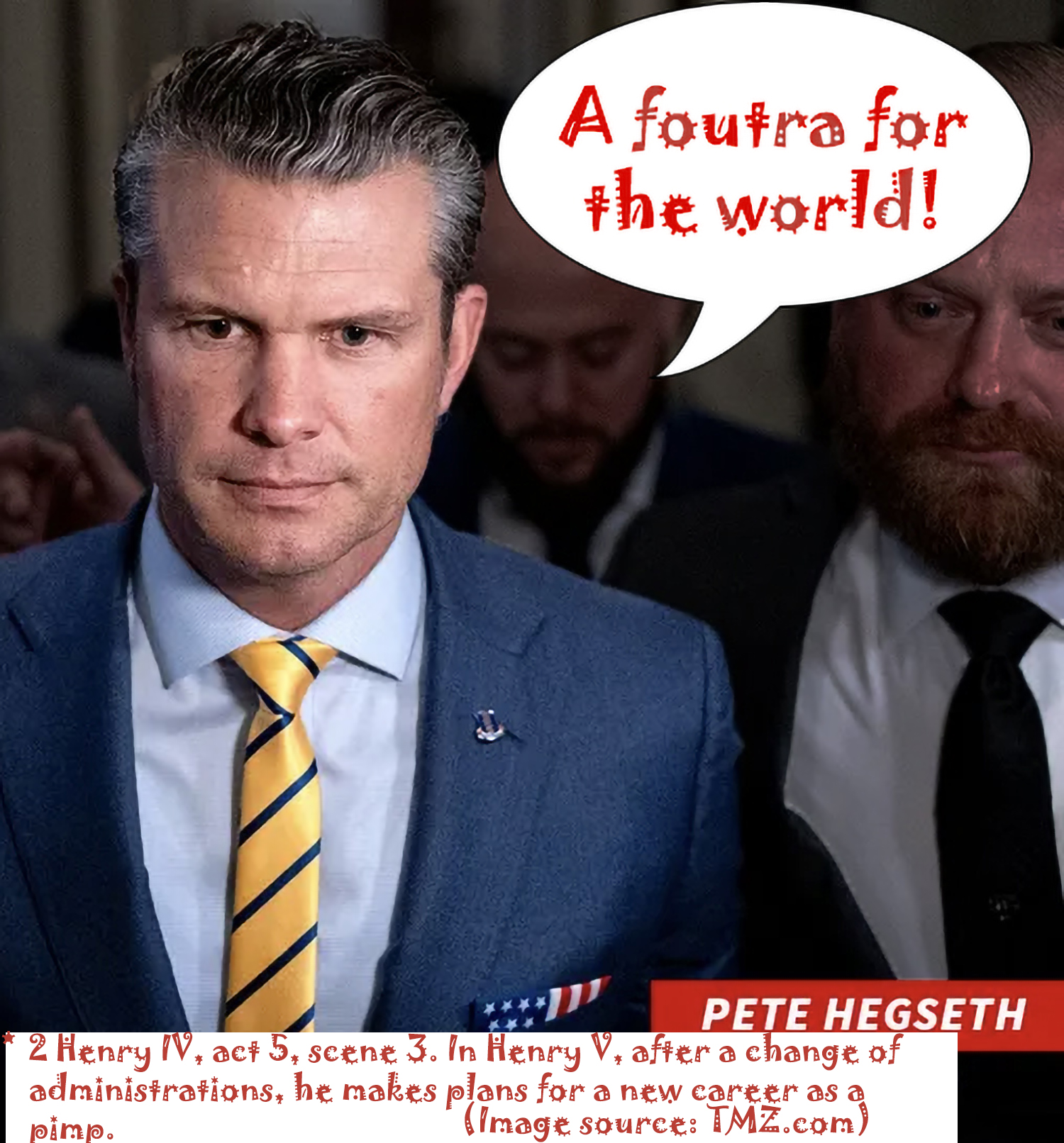
Donald Trump
Waldo’s Destruction Company
Topical, July 2025: healthy again; masked nominee

Rochester Democrat and Chronicle, Saturday, October 20, 1906, page 15
Iste perfecit opus
In Browning’s “Fra Lippo Lippi,” the artist who narrates the poem asks us to consider a painting filled to the margins with brilliantly illuminated images of men and women, every one of them as singularly alive as it’s possible for a human creator to make. Among all of those, one will bear a caption: Iste perfecit opus, “This man made the work.”
Browning read those words as the credo of the kind of artist who mines his way through the material of any world that comes to his hand. The credo’s key word is the one that guides Fra Lippo’s kind of art-labor: the adverb intensely.
This world’s no blot for us,
Nor blank; it means intensely, and means good:
To find its meaning is my meat and drink.
.
—
,
Intensely through the course of his career, Donald Trump has often made it known that he’d like to see a new colossus blasted into the granite of Mount Rushmore, in addition to or instead of the existing four. This would be, obviously, the one depicting himself. However, the analysis of John Branch and Jeremy White concludes that that desire won’t be fulfilled. Geology prohibits it.
.
To an ordinary artist, that would count as a rejection. But an artist possessed by intensity will resculpt rejection into a constructive consolation. Properly, a labor that is intense will be powered by nothing but biology. It will transcend human tools, even the power drills and dynamite that Gutzon Borglum used when he subjugated the granite of Mount Rushmore to fame. After all, even that fame was a limited one, incomprehensible beyond the limits of a single nation’s history. Its scope was physically ambitious but deficient in desire. But the moment when desire understands that what it desires is only desire itself – desire unfulfillable because unending and unending because illimitable – the limiting specifics of its implements will cease to matter.
.
—
After all, the implements might be a mere chisel, a mere paintbrush, a mere pen. How much work has been done with those!
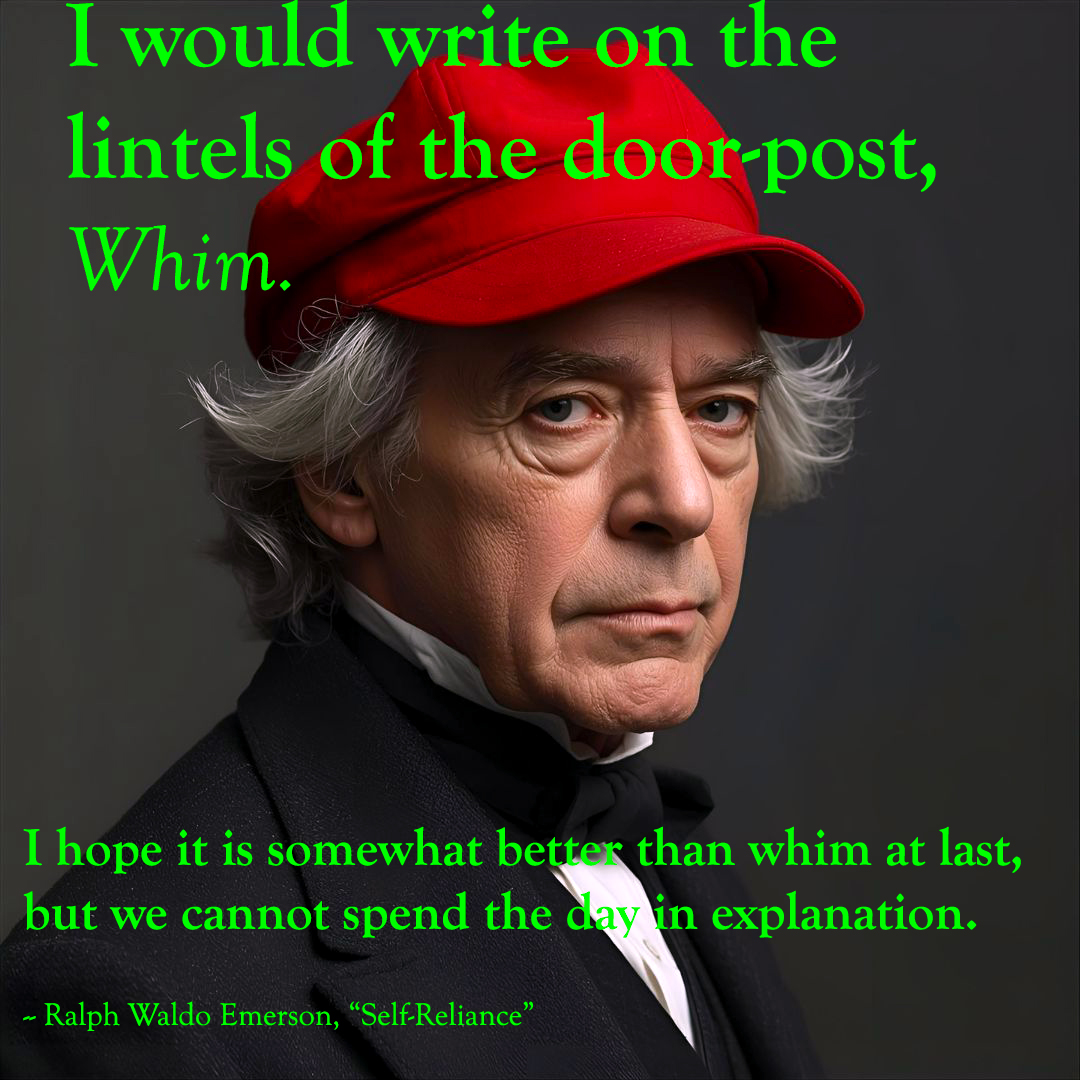
Or, for another mere instance:
—
John Branch and Jeremy White, “Should (or Could) Trump Be Added to Mount Rushmore?” New York Times, June 27, 2025
Event, entirely current
Somebody else who didn’t stop lying was Paul de Man. Following his death (in 1983, shortly after his sixty-fourth birthday), the news broke in two scandalous waves: first that as a journalist in occupied Belgium during World War II de Man had been not a member of the resistance, as he claimed, but a collaborator with the Nazis; then that otherwise, during the war and after, in Belgium and the United States, he was a scoundrel out of nineteenth-century melodrama: a forger, a thief, an exploiter and betrayer of friends and family. In that record, it was little more than a peccadillo that he also didn’t pay his bills.
Many years later, reviewing Evelyn Barish’s biography The Double Life of Paul De Man (Liveright, 2014), Jonathan Friedman recounted the scandal’s prehistory as he observed it from the outside. “I didn’t know Paul de Man —” he wrote for the Los Angeles Review of Books, “and it turns out, no one else really did either. I was a graduate student at Yale at the time of his greatest authority, the late 1970s and early 1980s. All the cool kids went to de Man’s seminars in Comp Lit, adopted his attitude of gnomic superiority, even mimicked his smile — halfway between a Cheshire cat’s and a rictus of suppressed gastrointestinal pain. I stayed away. [. . .] It wasn’t until his illness that I noticed him as anything more than yet another sartorially challenged prof who tromped around in a hideous gray raincoat.”
And then Friedman added:
One summer, he returned from somewhere — a vacation? a stint at the School of Criticism and Theory? — a bright and unnatural orange.
Source: Jonathan Friedman, “Deconstructing De Man in the Digital Age,” LARB, April 12, 2014. https://lareviewofbooks.org/article/deconstructing-de-man-digital-age/
Spectrum après la lettre: search “donald trump makeup.”
May 30, 2024: dream following loss
Night after night I made them love me.
“Love me,” I told my creatures in my dream.
Billion by billion, they made me billions more
In e-love, reinvested from e-dream.
With the dawn came disinvesting:
The vigorish lost, the sunlight drab offline.
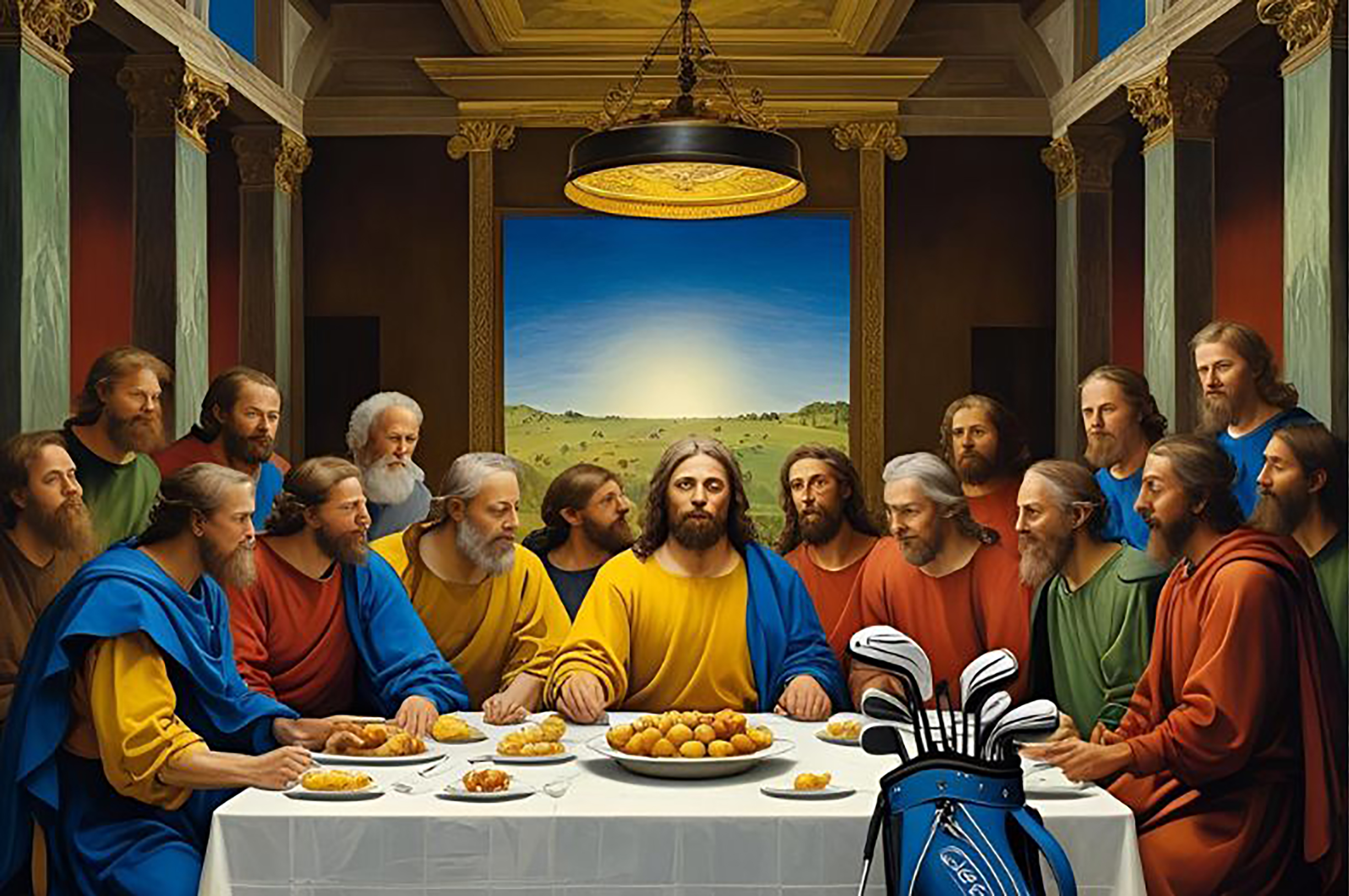
Only some hats remained, unvirtual,
And love no longer red with love’s love sign.
Two remedies for distress
In my state, the current lieutenant governor spends one day a week working his other job as an emergency room physician. He also makes media appearances to discuss the course of the COVID-19 pandemic.
But because he promotes science and because he is a Jew, the congregants of a Christian chapel now picket his residence at night, flashing strobes and creating noisy disorder. In the comment stream of the local newspaper they also discuss health policy in language whose wordplay seems to show the influence of Ezra Pound. There, the words attributed to the lieutenant governor are a sheeny dialect from about 1908, the year that Pound left the United States and cut himself off from American language. Of course if you turn on the TV in 2022 you won’t hear the lieutenant governor speaking like that, but Pound was the poet who wrote for eternity, “Literature is news that STAYS news.”
The dictum must also be true for other ways of thinking in language, such as politics and religion. So would you yourself like to be cured of distress, reader? Then perhaps the time has come for you to open your mind to one or both of these ancient word-cures. Their strength is still unexpired.
Hear it. Open a window anywhere in America. The air that flows in will be filled with voices chanting, “Gimme that ol’ time,” and time will be mingled with them. Once more, time sings through the varied carols of America, and once again, as once in 1849, it writes this lyric prescription for healing. Take it now. You are no longer in the past, but the past will be to you a nutritional supplement.

And this second revelation, datable to an American childhood in the Eisenhower years, has turned out to be a text immune to time. In your old age it now teaches you, at last! that all you have ever needed is the happiness of feeling with your body a red hat, a red tie, and a gun for threatening with.
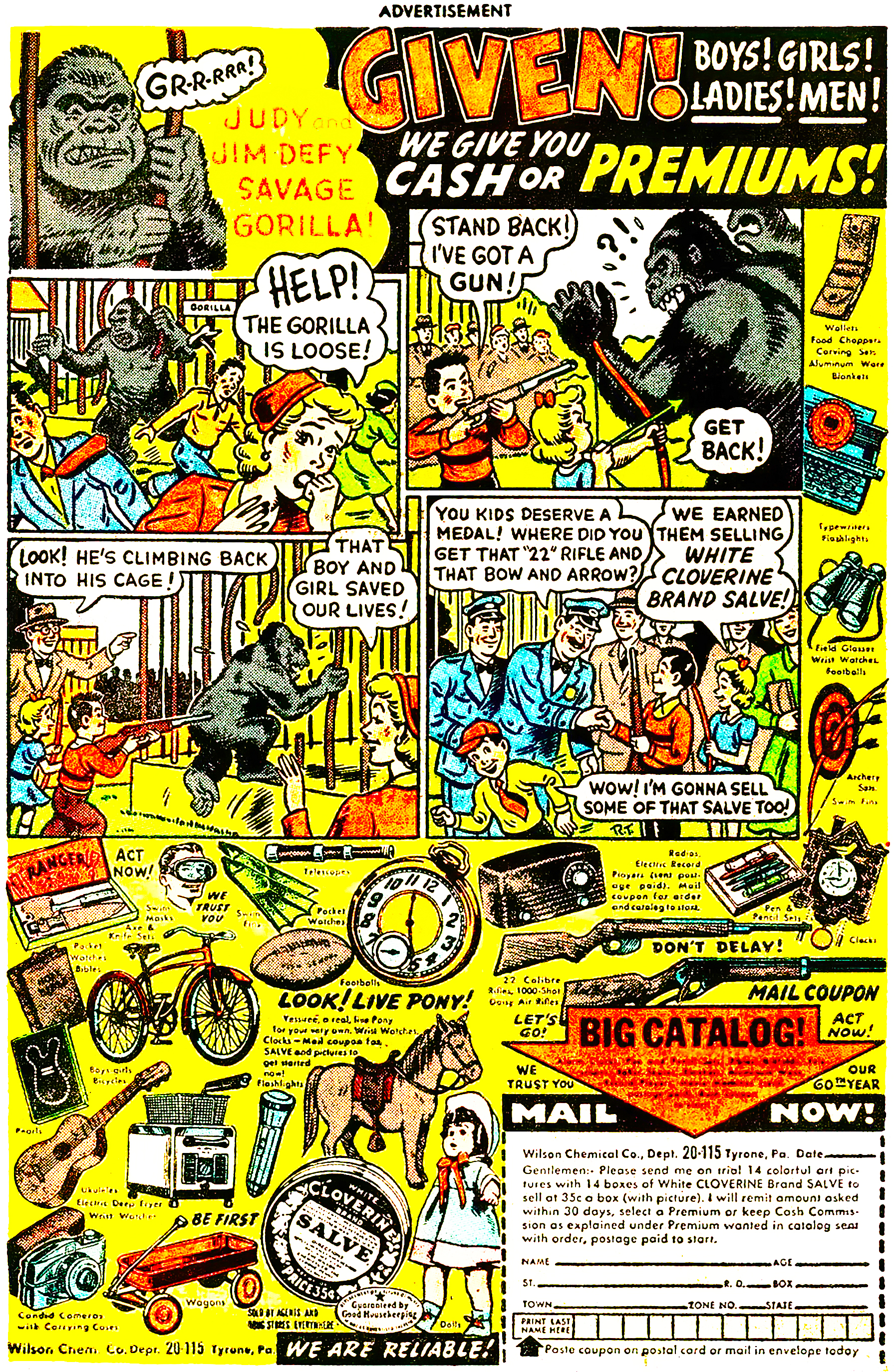
You may address your prayer to the fulfillment department.
Scientifically cool, with new cartoon
Observation on the basis of iconography: American cultural history and American literary history seem to be arguing for new study of the once famous, now forgotten Georgia novelist Erskine Caldwell (1903-1987). See below. The second icon depicts the office of House Majority Leader Nancy Pelosi during the Republican insurrection of January 6, 2021, when the United States Capitol was occupied by a paramilitary force of Caldwell grotesques.
Grotesques were a Caldwell specialty; grotesques and lurid sex scenes. A cruel laughter pervades. But Caldwell was also a serious liberal who collaborated in 1937 with the photographer Margaret Bourke-White on a documentary book, You Have Seen Their Faces, which showed its readers some of the things that the South’s chain gangs and sharecropper economics had done to faces and bodies. Soon to become Caldwell’s wife, Bourke-White was one of the foremost photojournalists of the twentieth century, but when You Have Seen Their Faces is read in the twenty-first it’s read only for educational comparison with James Agee and Walker Evans’s Let Us Now Praise Famous Men, which was published in 1941 and went virtually unread at the time. In her history of that exchange of reputations, Janet Holtman suggests a reason why: Caldwell’s attitude toward humanity, which was naturalist tending toward eugenicist. In retrospect, where the literary judgments are made, Caldwell’s characters have turned out not to be fully human. We remember Agee’s three families for their souls, but we recognize Caldwell’s type species only for their pathognomonic signs. And the faces photographed by Bourke-White in the service of Caldwell’s vision were reduced by his captions to the function of medical illustration.
But oh, go ahead and notice the Bible in the pocket in Caldwell’s image 3. The Caldwell way of seeing is still available to you after all — if not photographically, at least verbally. After all, too, the initials N.A.L. stand for New American Library. So go ahead: read. Then, if you can, laugh. Laughing, close thy Agee. While thou art at it, close thy sentimental Steinbeck too. Instead, if only as an experiment, open Caldwell and see if he can be thine. Consider it possible that the maimed humor characters who swarm through his language actually are happy with what it has done with them: summoning up their bodies from the pathology text, making them live and move and hit and tweet and kill. Then, please, try to understand what your disbelieving laughter is teaching thee about our country.



Janet Holtman, “‘White Trash’ in Literary History: The Social Interventions of Erskine Caldwell and James Agee.” American Studies, vol. 53, no. 2, 2014, pp. 31-48.
And it was Diogenes Teufelsdröckh in Carlyle’s Sartor Resartus who said, “Close thy Byron; open thy Goethe.“
Household god dating from the Republican period

100% hand painted: classical liberalism and its revolutionary treatment of perspective
See how the right shoulder vanishes!
