Pity: a change

For the royal Mr. Kurtz who farmed rubber in the Belgian Congo at the turn of the twentieth century, the punishment for workers who didn’t meet their quotas was amputation, and the amputations were documented in a photograph album. To have seen those is to undergo a reductive surgery on one’s own ability to name and mean. Once the word arm has been retextualized as a term erasable letter by letter, even the gold braid on the King of the Belgians’ sleeve is hard to see through tears of pity. You can experience the procedure yourself at

https://rarehistoricalphotos.com/father-hand-belgian-congo-1904/

But when the site of a pity changes, pity can change. See what happened, for instance, when Belgian pity retreated home during the Great War. The moment that happened, the Congolese album closed on pity’s former color scheme. In the new pity’s fashion shot, set off by decorations, blackness was only a fascinating new noun set off by a new black verb. Remember, called the black verb. Belgium, responded the black noun. Remember Belgium, the merged black predicate became. Read once more on its century-old fashion page, it is still thrilling. Because it has become an image, it dwells in your consciousness with an idol’s immortality.

Ellsworth Young, USA, 1918. Color restored.

In its image frame, its silhouette is the only thing with a meaning. Only its name, “Belgium,” is a worded utterance. Everything else namable in the frame — conflagration, pickelhaube, moustache over unspeaking mouth — is an alien import into meaning from a dictionary. Its lexical space is an Andrew Marvell wordscape: a poet’s garden of annihilation. Within it, Belgium is dragged toward her frontier. Soon she will cross it into the silence of non-Belgium.

But we who unzip now in her memory have been benefited by her value. That was extractive, like the Congo’s rubber, and it still bears interest. Black Congo is now only a page in an unopened album, but the value in pity of Belgium’s streaming hair remains a gold standard for pornography.

Marvell link: https://www.poetryfoundation.org/poems/44682/the-garden-56d223dec2ced

Enjoy the spectacle. This offer will not be repeated.

I called the picture that I posted on my Tumblr page “Onyx.”

http://jonathanmorse.tumblr.com

But the Japanese Tumblogger who reposted it had another name in mind. “HIGE,” she wrote in capital letters — a word that means “WHISKER.” Rewhiskered, my cat’s image was then instantly reblogged by dozens of other Japanese sites. Every one of them was kawaii: a Japanese word that translates as “cute,” but with a richer connotation than the English word. Kawaii is the uniformly thick coloring-book line that metes and bounds Hello Kitty, and the big hair and big eyes of manga and anime, and the infantine nightmare figures of Takashi Murakami, and the dress-up ritual (Yukio Mishima converses with Philip Larkin about spanking the maid) that is known by a pseudo-English name, “cosplay.” Reblogged, my cat now (as of April 6, 2013) cosplays with playmates in Tumblrspace, here.

Elsewhere on the same site, more costumes are worn and more smiles are smiled.

Onyx reblog 1

Unlike the girl in white with white confection and white teeth, these images are obviously old. Their reblogger certifies them as such with a pair of antique dates: December 17 and 19, 1937. But they too are kawaii. In a cute world, they are cute. How cute they are, after all, these smiling soldiers hugging smiling little kids. A newspaper, Mainichi Shimbun, immortalized the smiles, and now their dentition will last forever, reblogged aere perennius.

On December 18, 1937, a different newspaper, The New York Times, mentioned those same smiles in words equally black and white but perhaps less immortalizing because merely words. An image of the headline under which the words spoke looks merely like this

Except for the neutral shapes of the letters themselves, there is nothing to see here. However, a few more inches down the column  a game of cosplay begins. Playfully swinging from newspaper to newspaper, the New York Times grabs Mainichi Shimbun’s imperial photographs out of their Tumblframe, spins them around, and boots them all the way back to 1937. There, mugging and juggling, it mimes an explanatory 1937 caption to the 2013 pictures of cute soldiers cavorting with my cute cat.

Still aglow from their proximity to the sweatless volleyball girl with her perfect teeth, the words “greatly enjoyed the spectacle” bask briefly in the disciplined beauty of art. Just as the girl underwent orthodontia, the New York Times journalist served an apprenticeship to journalistic convention. But in the nature of poor brief mortality, his kind of communication from whatever form history might once have had before it was reblogged can’t last much longer. Now, in the final years of their pre-Tumblr existence, some unpictured pages from the history of China come before us in antique fonts and antique verbal conventions to plead:

Find a Chinese, Filipino, or Korean who is old enough to remember the Japanese occupation. Say to that person, “We Americans feel guilty about Hiroshima and Nagasaki.” Listen conscientiously then to what you will be told in reply.

But no, of course you won’t believe it. A line like “You should have your head examined” isn’t cute enough to enter into the Tumbldeathlessness of art. It doesn’t have pictures.

Allegorical monument to late capitalism

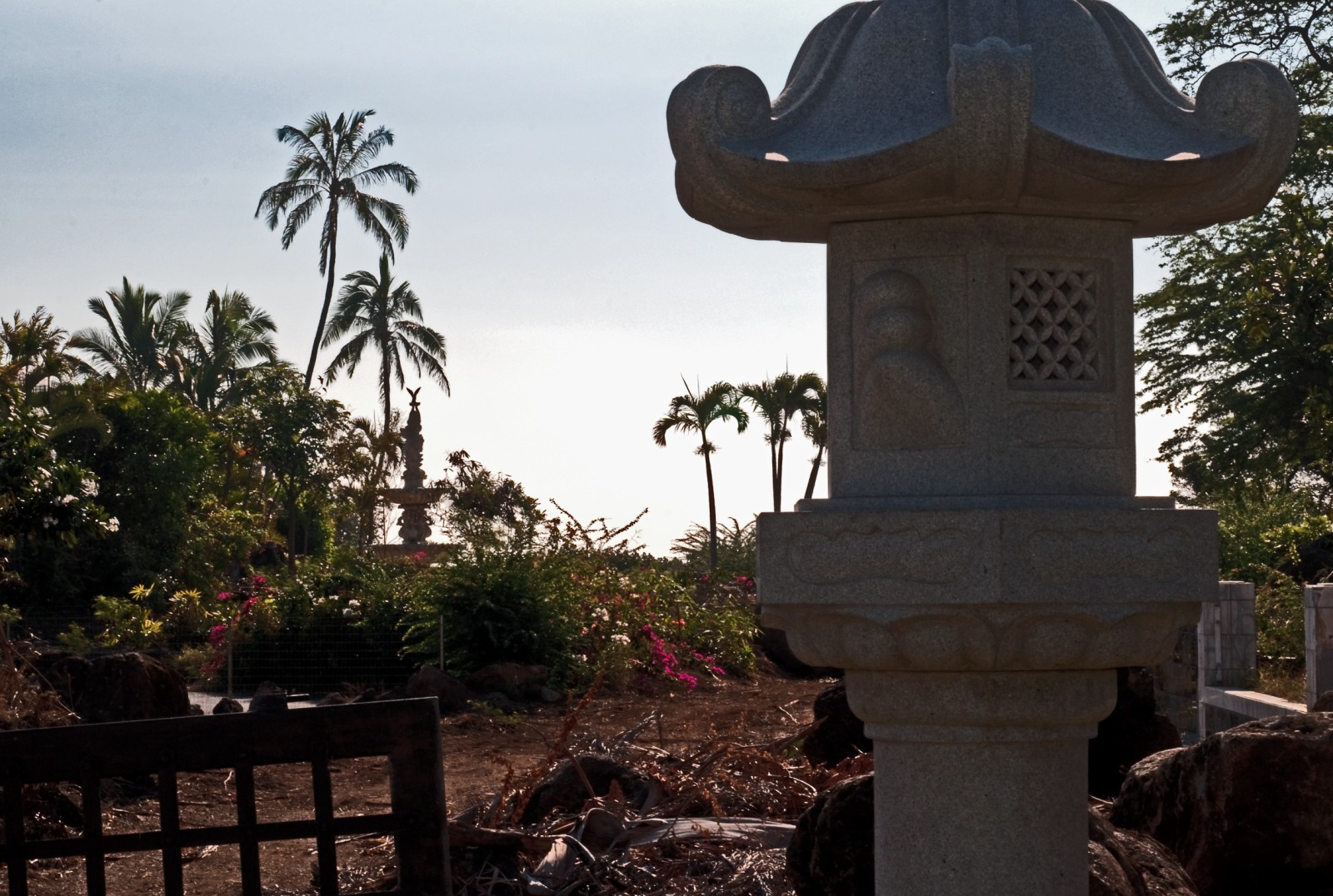
For the past several years the Donald Trump of Japan, a billionaire named Genshiro Kawamoto, has been buying multimillion-dollar houses in an oceanfront neighborhood of Honolulu. Once he has bought a house he partially demolishes it, then abandons its ruins. From time to time during this period he has descended on Honolulu, proclaimed his intention of building a museum on his consolidated property, and then returned to Japan. Meanwhile, nothing has grown on his shore beside Hawaii’s rich sea except an expanding ring of blight.

Now, however, the museum appears to be under construction. Click on the images to see it, rising tall and enigmatic in the distance —

perhaps a fountain where Godzillas may drink deep.