She goes crinkly with change

“Uprear,” mused a lithographer in about 1898, and then he sat down before his stone and heaved a great black-and-yellow ship out of the water. You can still almost hear the image he pulled up from the rock as it glided through a ninety-degree arc and moved into juxtaposition with four exhibits from the older strata of the New World. As people liked to say at the time, the engineer was the new builder of cathedrals.

50050vB

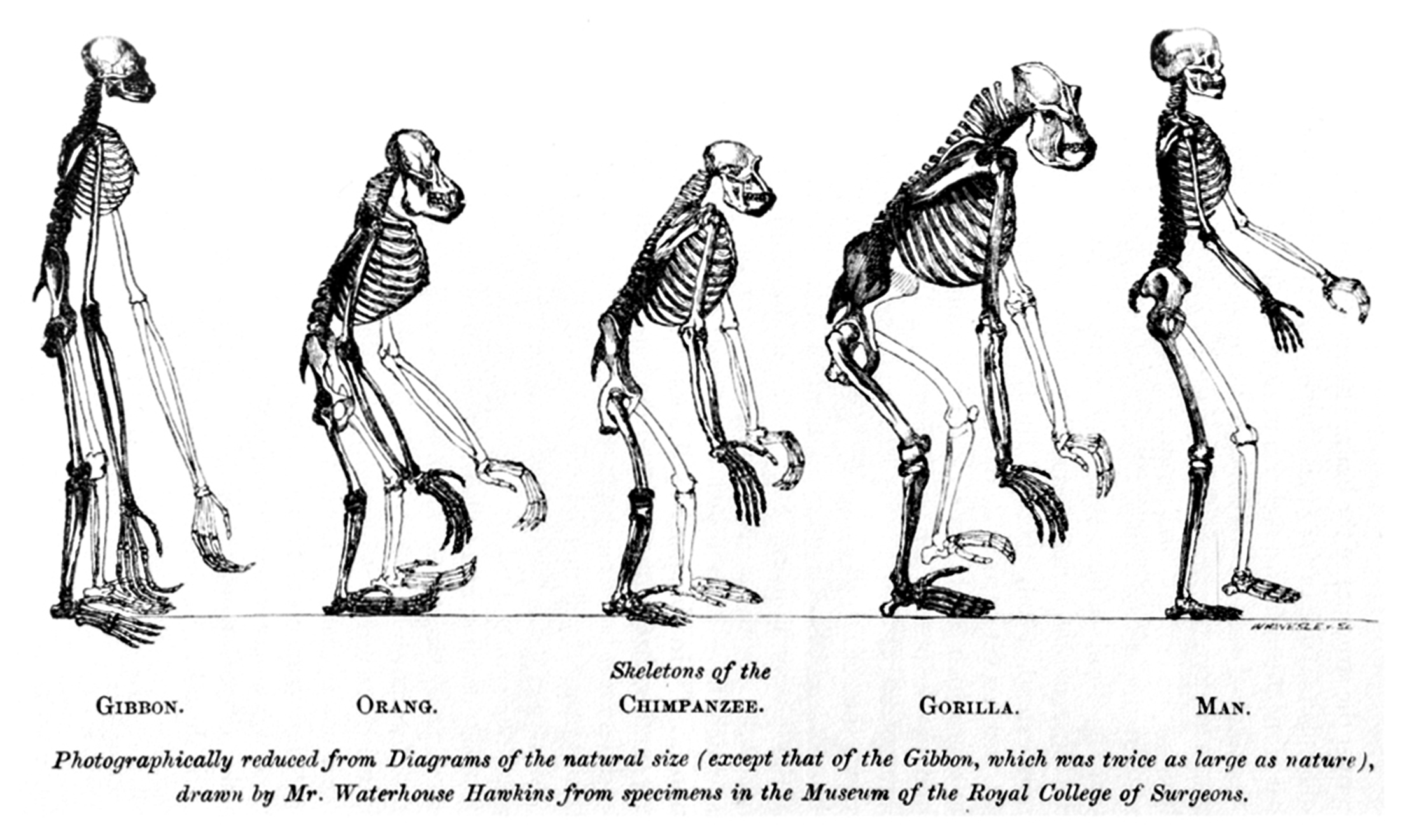
They meant the metaphor as unironic, unmetaphoric praise. To buyers of chromolithographs like this one, if perhaps not to readers of texts like The Education of Henry Adams or Henry James’s “The Jolly Corner,” it was only natural that a ship should be seen to stand upright like the man representing the outcome of history in a Darwinian tableau.
Huxley

For yes: after eighty years of evolution in marine architecture, it was accepted as a matter of course that this ship – Kaiser Wilhelm der Grosse of the North German Lloyd, the first of the great four-funnel liners – would be the biggest, fastest, and safest vessel afloat when it entered service in 1897. So rapid had been the change that when a New York Times writer tried to explain it he found himself trying to speak a language for which there weren’t yet even words. A very short time earlier, he and his readers had been taught a technical vocabulary of jack-tar monosyllables like “sprit” and “main truck,” but for whatever it was that was up on the truck now the only term at hand was a sixteen-syllable improvisation found in the mud at the shoreline. “The Marconi system of wireless telegraphic signaling,” gasped the improvisation through its brand new lungs.

101051934

Obviously, though, that lungfish periphrasis was soon to make way for something more efficient. So on Good Friday, April 13, 1900, the genius of the ship’s home port, Bremen, was comfortable with the idea of settling with her coat of arms into the potted palms and Art Nouveau curves of an up-to-date salon and raising her torch in Germanic salute to the genius of the ship itself, its eponymic Kaiser. The demigoddess had paired herself with the emperor for adoration, and their coupled icon opened like a tabernacle to reveal a dinner menu featuring turtle soup, sautéed pigeon, apricots, and pistachio and lemon ice cream.

nypl.digitalcollections.510d47db-48a3-a3d9-e040-e00a18064a99.001.w300D

Of course it isn’t even worth the effort to skip ahead and read what happened next. On August 27, 1914, only days into the Great War, Kaiser Wilhelm der Grosse, now an armed commerce raider, was sunk in battle off northwest Africa by the British cruiser Highflyer. You saw that coming. Irony was laid down with the keel of the story. But perhaps it was also made part of the story’s structure by your own post-Highflyer visual education – a visual education that has had the effect of making the two lithographs, the lithograph of the upended ship and the lithograph of its traveling pantheon, look oversimplified now. Hoch! cried Fräulein Bremen in 1900, and up rose Kaiser Wilhelm der Grosse to overtower Wall Street’s own temple, Trinity Church. For 1900, the ceremony of abdication and succession was impressive. But at about the time Kaiser Wilhelm der Grosse was being repainted gray and fitted with guns, ceremony was being forced into an evolutionary change of its own. That change worked itself out not on the materials of ape bone or marine iron but on surface and couture, and it when it was ready it strolled into history fetchingly attired as a second girl who was arriving to spell Fräulein Bremen in the bar.

picasso-bottle-of-suze 300

Pablo Picasso had gotten acquainted with her in 1912. Her nickname that year was “La bouteille de Suze,” but to Pablo and her other friends ever since she’s just Suze. It’s always fun to be with her, too, because she’s the girl that dresses all crinkly in newspaper. She’s one of the first collages ever created, and she’s so excited about what she’s wearing that she doesn’t need Thomas Henry Huxley or Norddeutscher Lloyd. She already has all the admirers anyone could need. With them, with us, she always begins the fun by giggling, “I’ve got glue all over myself!”

And then she asks, “How do I look?”

And she looks fine.

And then she asks, “Is that thing way out there, going away, a boat?”


Image sources

Gray Lith. Co., untitled scale lithograph of Kaiser Wilhelm der Grosse, between 1898 and 1900. Library of Congress, http://www.loc.gov/pictures/item/2016649824/.

Thomas Henry Huxley, illustration from Evidence as to Man’s Place in Nature, 1863.

The Buttolph Collection of Menus, New York Public Library, https://digitalcollections.nypl.org/items/510d47db-48a3-a3d9-e040-e00a18064a99.

“Pablo Picasso’s Bottle of Suze, 1912.” Mildred Lane Kemper Art Museum, https://mlkemperartmuseum.wordpress.com/2014/02/05/pablo-picassos-bottle-of-suze-1912/.

The images of the ship, the evolutionary diagram and the menu have been adjusted in Photoshop to restore detail and color.


Explanatory annotation

Aufstieg eines Jagdflugzeuges

Monet’s haystacks are a pastoral technology. Unchanged in form since the mummy god Osiris taught men to plant seeds in the earth, they remain still on the earth while the wheeling light passes over them. It is from such stillness under change that we have become aware of time.

This image is a Monet landscape, but its pastoral imagery is now shrunken almost to unnoticeability. High and large in the foreground and, as the image’s title says, ascending, a new technology is sending unchanging shadow back up to the sky from which changing light once descended unchecked, bringing with it life and death in seasonal alteration. Linear Marinetti history is superseding cyclical Monet history. A hundred years ago, says this historical record, death was on the rise.

Source: Aufstieg eines Jagdflugzeuges (“Ascent of a fighter plane”), Austria-Hungary, about 1917. National Library of Austria, http://www.bildarchivaustria.at/Pages/ImageDetail.aspx?p_iBildID=4814016. Photoshopped.

A naughty song for Google

It’s like a carpet bazaar in a cheerful souk: every day on my Android tablet, Google unfurls a selection of news stories before my eyes and asks how happy they make me. I happily reply.

For instance, I recently told Google, I’m not interested in reading any more of your contributions from the right-wing Washington Times. “Thank you, sir! No problem at all, sir!” replied Google. Then it began sending me stories from the much more right-wing WorldNet Daily and Daily Caller.

Not interested in those, either, I told Google. “Thank you, sir! No problem at all, sir!” Google replied. Then it began sending me stories from the neo-Confederate, neo-Nazi VDARE.

Try again, I told Google. Replied Google, “Thank you, sir! No problem at all, sir!” And then it began sending me aluminum-foil-hat stuff about TWA Flight 800 from a site called American Thinker.

Google, may I suggest that one alternative to right-wing stuff is more right-wing stuff but another alternative is less?

And about that driverless Google car you’ve been thinking of, have a song! Consider it my thank-you note.

http://www.loc.gov/jukebox/recordings/detail/id/3576


On paper

The picture depicts a sheet of paper, matte-textured and a little wrinkled with age. Floated onto its surface has come this Baldwin airship, circa 1910, bearing the pioneer aviator Lincoln Beachey into the air on a girder.

Toward the front of the girder you can see the airship’s little motor, with its gravity-feed fuel tank and its propeller shaft extending forward. The propeller isn’t visible, though. Instant by instant, its blurry trace was taken up into the bright light as it prolonged itself up through the air. Then even the light and the air were taken up by the paper. Of the moment of seen flight no record remains except, on paper, the Baldwin.

But on that surface there have been made to remain the Baldwin’s support wires, cloth-covered empennage, sewn seams around a contained body of that which is lighter than air, and just below the gas valve the body of a man (1887-1915) unmoving now but flying then, and having left a trace of flight still on the wrinkled paper.

Source: http://californiastatelibrary.tumblr.com/post/123125863066/up-up-and-away-lincoln-beachey-san-francisco. Photoshopped.

Toward the end, a new way of reading the word “light”

In New York, one cold morning as the long nineteenth century drew to its close, the front page of the New York Sun bustled with news of the continuing revolution in transportation. Off the coast of Massachusetts, said the Sun, the passenger liner Roma, carrying 500 souls, had been driven by a gale onto the rocks of an island called No Man’s Land, where it was stranded for four hours before being safely refloated. In Florida, Lieutenant J. M. Murray of the Naval Aviation Corps had been killed when his airplane nose-dived into Pensacola Bay. This was the naval station’s first fatal air accident. On the other hand, in California Silas Christofferson had flown from Bakersfield to Los Angeles, reaching an altitude of 7000 feet and effecting history’s first crossing of the Sierras by air. And at the bottom of the page, a one-sentence story datelined London declared: “It is announced that the new Cunard liner Aquitania will sail from this side on her maiden voyage to New York on May 30.”

The page was dated February 17, 1914. Just one more decade afterward, with the long nineteenth century definitively in the past, Le Corbusier would claim the Aquitania as a paradigm for his pedagogy of twentieth-century space.

No people are on view in these images. For Le Corbusier, the people always were secondary to the geometry. But as of 1914 the Sun was still following journalism’s chatty nineteenth-century convention of humanizing events by giving them
names —

(Who, exactly, was Silas Christofferson? No, reader, you don’t know either. But as soon as it crossed your mind that you don’t know, you realized that you live now by means of a sensibility from which the nineteenth century’s ways of perceiving and reacting have departed. Only in the artificial nineteenth century imagined by the twentieth-century ironist P. G. Wodehouse could Jeeves praise Bertie’s new shirts by observing in the spirit of Le Corbusier that the monograms would come in handy if Bertie should forget his name.)

— and this front page had one more chatty story to tell.

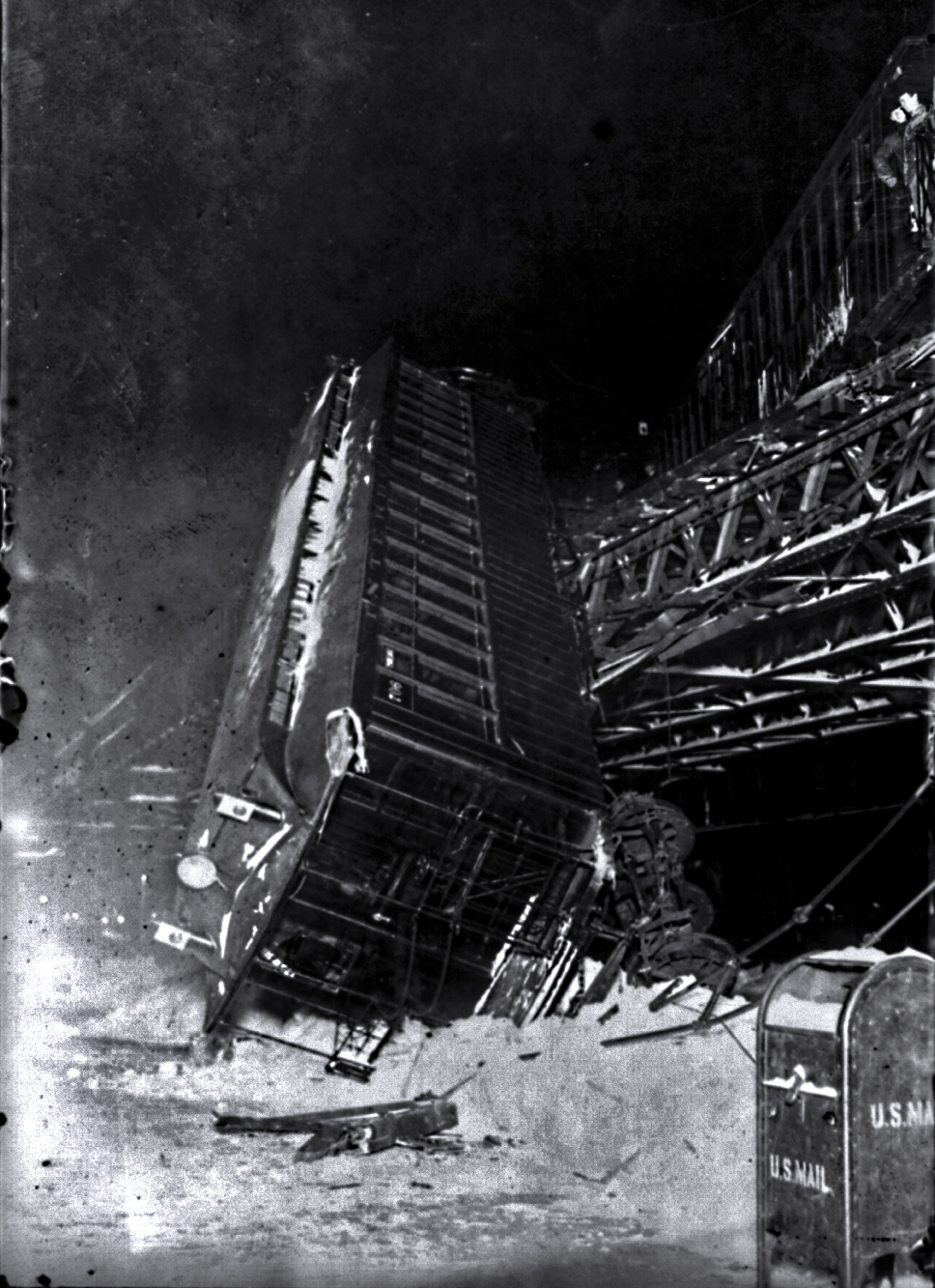
At about 7:15 on the night of February 16, said the story, a train on Manhattan’s Ninth Avenue elevated line derailed at 138th Street and sideswiped a car on the adjacent track, sending it over the side of the trestle with one end hanging from the rails and the other down on the street in a pile of snow. The car was empty except for its motorman, John Becker, and he wasn’t hurt. But the nineteenth-century conventions of journalism insisted on completing the anecdote by furnishing the named and extricated Motorman Becker with a quip to say, and so to the immortal record Motorman Becker was then said to have said:

“Well, here I am. Guess I’ll go get my dinner.”

To enlarge the quip and try to imagine it as an oration, click it. The click won’t get you far, though, because this nineteenth-century front page is all text, no pictures.

But the long nineteenth century also brought perception the gifts of a camera and a tripod and a frying pan filled with powdered magnesium. In the right hands, these turned out to make it possible to understand in the dark. And so, at the end of this particular century of development, readers began seeing their reading matter in a new way: without words.

Here, for instance, is the wordless version of the anecdote of Motorman Becker. Right at the start, its language is distanced from reading by the effect of translation — in this case, translation from text to chiaroscuro, with the surprise effect of a suddenly vertical railroad car finding its balancing irony in the surprise effect of a suddenly illuminated night. Imagining Motorman Becker locked in his dark cabin in the image’s interior, we on the image’s exterior are locked in a frame full of brilliant reflections. If we do any reflecting of our own there, it won’t be in words. We may think of words later, sitting at (for instance) a typewriter in a newspaper’s city room, but here and now we can have nothing in mind except light and dark, in silence. The Sun story is full of excited conversations in the crowd and the noise of the Eighth Avenue streetcar that eventually hauled the El car back down to horizontal, and because we’re now reading the sound-words in sound-words of our own, the sounds continue. But as you begin seeing your way into this oblong of black, the story is light and dark (seen), and silence (not heard), and nothing else.

In scenes like these, filled with nothing else in a way that isn’t available to text, frying pans loaded with new light began helping readers at the end of the long nineteenth century to draw a dark line around a moment of time and say, “Forever after, anything outside this frame will be named The End.”

Sources:

Le Corbusier, Toward an Architecture, second edition, trans. John Goodman (1924; Los Angeles: Getty Research Institute, 2007), [154].

“Elevated car falls to street 2/16/14.” George Grantham Bain Collection, Library of Congress, http://www.loc.gov/pictures/item/2002699891/. Photoshopped.

The New York Sun from 1914 is online at the Library of Congress’s Historic American Newspapers collection, http://chroniclingamerica.loc.gov/.

Strike flat the thick rotundity o’ the world

The fat man appears to be airborne over the deck of his ship, hovering with arms stiffly extended forward and down like landing gear. His cushiony, shock-absorbing hands appear to be huge, but perhaps that’s an illusion produced by foreshortening. In his image, outlined by a rectangular frame of decayed photographic emulsion, he is strongly foreshortened at every point.

“W. N. McMillan.” G. G. Bain collection, Library of Congress. http://www.loc.gov/pictures/resource/ggbain.18560/  Click to enlarge.

At and around the man’s hands, further decay has accentuated the contrast between the image’s light and dark areas. The decay has done an artist’s job: it has shaped an outline.

An outline is usually a line of demarcation which an artist lays down between his creation and the rest of the universe. Here, however, outline is an index of decay. The universe has invaded the physiology of this image like a virus and set it to manufacturing a counterfeit of the artist’s death-defying gesture of separation from time.

And the optics of photographic image-making have bloated the man into an incipient sphere: a fruit rounding as it ripens toward decay.

The rounding has been preserved in its incipience, however. It comes to us educationally, preserved through natural history as if it and we had been destined from the beginning to face each other from opposite sides of a vitrine.

Surrounded by the Library of Congress’s explanatory words, the image is a fat mute struldbrug surrounded by volubly signifying youthfulness. The words singing in the surround are a choir of still unravished brides.