Captions and unreading

What am I reading here? Some history. I can place the document in that genre because it explains and is explained by its date of composition: April 1942. Off the page, history has already taught me that April 1942 has something to do with the United States’ entry into World War II in December 1941, and I accordingly think I understand what the words on the page mean when they say: “Los Angeles, California. The evacuation of the Japanese-Americans from West Coast areas under U.S. Army war emergency order. Japanese-American children waiting for a train to take them and their parents to Owens Valley.”

That timestamped and circumstantial text isn’t only a history, of course. It’s also a literature. Shaped by narrative convention, it belongs to the literary genre of the caption — specifically, the caption to this photograph by Russell Lee in the Library of Congress’s Farm Security Administration / Office of War Information archive at http://www.loc.gov/pictures/item/fsa1998003537/PP/.

Because a caption has an explanatory power over its attached image, its words make the image in some sort verbal. They make it tell a story. From this historical era, for example, there exist similar photographs taken in other theaters of World War II, and our reaction to any of them will be, so to speak, captional. If the caption tells us of a Japanese baby being evacuated from Los Angeles, we’ll react one way; if the caption tells us of a Chinese baby being evacuated from Nanking, we’ll react another. Likewise, as of August 2014 I think most of my academic colleagues would react with sympathy if a caption told them that the image were of a Palestinian baby, but with exasperation if an editor then corrected the caption’s adjective “Palestinian” to read “Israeli.”

It’s been a long time since a news photo could be thought of as intelligible on its own terms, of course.  A century ago, not long after Freud taught us how hard it is in principle to know what we’re seeing, Lev Kuleshov demonstrated that in practice we can’t even see the difference between a dead baby and a bowl of soup. In Kuleshov’s experiment, a movie clip — one clip, only — showed an actor going through the physical correlates of emotion. A montage of that clip with some ostensible stimuli of emotion then made clear that any imputed sense of emotion, of emotion about an ostensible stimulus,  was demonstrably nothing but an artifact of the montage effect. Juxtaposed with the image of the baby, the actor’s mobile features and heaving chest seemed to mean one thing; juxtaposed with the image of the soup, they seemed to mean something else. We might have thought they expressed feeling, but In themselves they were nothing but mobility and heaving. Whatever emotion we derived from them was an illusion.  We were misled by our expectation of a caption to read. But from the belated realization that Kuleshov’s tiny silent movie is captionless there follows a happy ending. To learn that one is free from captions is to learn to be free from other things as well.

Alternate link: http://youtu.be/4gLBXikghE0

Therefore, face to face with an image that has been captioned, I find myself wondering whether I can do something in the captional space above the border where the caption’s words begin. Wondering, I open Photoshop and set about trying to change the non-verbal part of this historical record. Timidly, at the start, I may tell myself and you that I’m only restoring the captioned image, only using modern narrative technique to put an illustrated story — a children’s book, a picture book! — back together.  But of course what Photoshop and I are doing to this ensemble of words and non-verbal forms isn’t merely a historiographic revision. Photoshop and I aren’t doing history now; we have subordinated ourselves to a corpus of aesthetic principles that have nothing to do with Los Angeles or trains or 1942. Our project has been taken over by art. So:

And you see: I have not merely restored the record or corrected it. I have (as editors used to say in the days of Thomas Bowdler, he of the verb bowdlerize) improved it. See how much more tragic than Russell Lee’s original my little girl is, hear how much more clearly we can say “Little does she know” about her! How satisfyingly pretty I have made this children’s story!

Because it’s open to the possibility of an aesthetic judgment like that one, my version of Russell Lee’s photograph is no longer quite a historical document. It can now be read without its caption, as if it were in the process of growing distant from the history of events. It’s no longer merely captional. If it isn’t yet art, it may at least be art history. Because the space around the little girl has now been filled with art, her mother has now been barred forever from entering the image frame to reroll her daughter’s cuff. Because art always has a completion function, the caption below this image has now been translated into a dead language and made emotionally unreadable on any terms but art’s.  The little girl’s picture can now say only the one thing art ever can say about itself: The End. Waiting for a train which can now never arrive to transport her out of the image, holding the doll which she now will never outgrow, the little girl has become an unravished bride of quietness.

“Bloom opon the mountain”: several notes, one not in words

1, the text: Emily Dickinson’s “Bloom opon the mountain stated,” poem 787 in the Franklin edition, is accessible online, in manuscript facsimile and in diplomatic transcript, at the Emily Dickinson Archive, http://www.edickinson.org/.

2, the textual history: thanks to R. W. Franklin’s chronological reordering of the manuscripts, we can now see that during the second half of 1863, when Dickinson wrote “Bloom opon the mountain,” she was thinking about the incommensurability between human language and the impassivity of the phenomenal world. From this period, three other poems that explore the theme are Fr768, “The mountains grow unnoticed”; Fr776, “Drama’s vitallest expression”; and that deep exploration of the void, Fr778, “Four trees opon a solitary acre.”

3, the glosses:

For stanza 1, the 1844 dictionary that Dickinson used (online at the Dickinson Archive) defines “stated” (line 1) as “Established; fixed; non-fluctuating; regularly occurring.” This may mean that the mountain and the sunset obey a natural law that has no concern for such merely human contingencies as emotion or (more generally) life itself. I suppose Dickinson could have been influenced in that idea by Tennyson’s In Memoriam, Clough’s Dipsychusor any number of other anguished midcentury texts.  At least one more of the poems from this 1863 group, Fr780, “The birds reported from the south,” may also allude (as Cristanne Miller says) to the vast silent grief that come flooding northward to Amherst from the battlefields of the Civil War. But Dickinson was already exploring the silent void beyond words two years earlier, in Fr259, “A clock stopped.”

In “Bloom opon the mountain,” then, I read the beginning of stanza 2, “Seed had I,” as a subjunctive: “If I had seed.” If the poet had words, she might think of bringing them to the mountain for the tilling/telling. But on the mountain, words cannot be uttered. As in “A clock stopped,” the phenomenal replies to any human proposition only with a monosyllable from which any possible meaning in human terms (Dickinson’s precise term is “concern”) has been drained. In the emptied interiority that remains, the word “concern” has been so completely freed from the strictures of what used to be meaning that it now plays a game with its own combining form. In the absence of anything else to do, concern bats syntax back and forth with “cool – concernless No,” and the score is never anything but zero.

Advised by “A clock stopped” to read concernlessly, I read stanza 3 of “Bloom opon the mountain” as beginning with an implicit “However.” She who brings her seed to the mountain in a poet’s effort to endow the day with a light of her own will only go to zero herself. For its part, the mountain, having effected the annihilation of the lightbearer’s seed, will continue passing, unhearing and unchangeable, on its route through time toward the stated moment when bloom goes dark everywhere.

Work cited: Cristanne Miller, Reading in Time: Emily Dickinson in the Nineteenth Century. Amherst: University of Massachusetts Press, 2012. 160.

Other:

Portrait minus face


Miss Vixen, mascot of USS Vixen, probably between 1899 and 1901. Detroit Publishing Company Collection, Library of Congress, http://www.loc.gov/pictures/item/det1994001025/PP/. Photoshopped.

Bibliographical note: the text in this link refers to Vixen as a funboat. In the MARC record, however, the word is gunboat. And I’d guess that the record’s stated terminus a quo for the photograph, 1890, should be something like 1899. According to Wikipedia, Vixen was built in 1896 as a private yacht and commissioned in 1898 for service in the Spanish-American War.

Camera; hard object

I’m not going to publicize it by providing access details, but the image on a popular photo-sharing site as of July 21, 2014, displays a dark-skinned woman alone among passers-by on a street. She is holding four soft toy animals: a small baby-blue monkey (?), a medium-sized tiger, a medium-sized teddy bear, and a big teddy bear with long, slender arms and legs for the designed purpose of hugging. However, this bear is neither hugging nor being hugged. His arms and legs are flopping loose, his face is looking away over the woman’s shoulder, and her bent arm isn’t embracing him but clutching. As we watch the animals in their photographed distance, we become aware that a filter in the image-processing software has sharpened and individualized every strand of the woman’s graying, uncombed hair and every muscle at its clenching work just beneath her knitted brows, downturned mouth, and rolling eyes.

Everything else in the picture has been left unfiltered. Blurred by motion and tilted by edge-of-field distortion, the delineated people at its margins appear merely normally imperfect as they flow past the immobilized creature at the image’s center. Unlike hers, their faces are unlined and unweatherbeaten. Nothing like emotion wells from their smooth surfaces toward the camera. You don’t even need to imagine what it would be to touch that clean skin, because whatever it is that lives within doesn’t have any need, during the instant when its surface is exposed, for touch. Just above the image, too, is a title that applies only to the woman alone with her toys at the center. It’s one word long: a psychiatric term.

At the same time we read the word, other readers in a comment stream just below the image are complimenting the photographer on his technique. The compliments are so insistent that they almost seem about to rise, flooding, into the picture itself. If such a flood were of tears, it might hint that the photographer has effected a reassuringly wordless solution to a problem that we can’t bear to articulate in words. Stopping short at the brink of words, a man with a camera has successfully achieved one more wordy iteration of an anecdotal genre, the Arbus-Winogrand street photograph. In all but language, that success says to its anxious spectators:

“Regardless, for me and you, everything is all right. You and I aren’t like this woman. Unlike her, we don’t need to fear, because we have been granted cameras. With camera power we not only see, we diagnose. The diagnosis will be something written down on a label, and when we have read it back to ourselves we will begin believing that we have safely outgrown the wordless fear that the camera once locked into itself. Yes, I experienced fear at the instant my finger touched the shutter release. But fearful as I was, I took the camera up in my hands. I grasped it, I stroked it. And then I spoke of it and it saved me.”

It has probably helped, too, that our readerly feelings of release and relief were occasioned by the visualized textures of a woman. In his classic paper “Transitional Objects and Transitional Phenomena — A Study of the First Not-Me Possession” (International Journal of Psycho-Analysis 34 [1953] 89-97), D. W. Winnicott offers this diagnosis of the special being that a soft thing becomes when it is a woman’s to touch.

“Patterns set in infancy may persist into childhood, so that the original soft object continues to be absolutely necessary at bed-time or at time of loneliness or when a depressed mood threatens. In health, however, there is a gradual extension of range of interest, and eventually the extended range is maintained, even when depressive anxiety is near. A need for a specific object or a behaviour pattern that started at a very early date may reappear at a later age when deprivation threatens.

“This first possession is used in conjunction with special techniques derived from very early infancy, which can include or exist apart from the more direct autoerotic activities. Gradually in the life of an infant Teddies and dolls and hard toys are acquired. Boys to some extent tend to go over to use hard objects, whereas girls tend to proceed right ahead to the acquisition of a family.” (91)

But Winnicott is speaking at this point of the soft thing as it is held, not as it is seen through a viewfinder. At the very beginning of touch, Winnicott notes, “there is no noticeable difference between boy and girl in their use of the original not-me possession, which I am calling the transitional object.” Likewise, whether it was once held by a baby girl or a baby boy, the soft thing ordinarily comes to its end in only one way. “Its fate,” says Winnicott, “is to be gradually allowed to be decathected, so that in the course of years it becomes not so much forgotten as relegated to limbo. By this I mean that in health the transitional object does not ‘go inside’ nor does the feeling about it necessarily undergo repression. It is not forgotten and it is not mourned. It loses meaning.”

But the soft things in this picture have undergone a different fate. Their poignancy is that they still mean. Their babytalk has been forbidden to become a dead language. Winnicott’s linguistics of babytalk presupposes a translator of communication with the transitional object — a mother, ultimately a social system — but the toys in this picture are alone. They have no one now to communicate through, not even the woman to whose face they cannot bring a smile.

That failure, that prefiguration of silent death, is terrifying. Terrified accordingly, a man with a camera once reached a finger toward its button; touched; held; released. His own communication with the hard machine was successful. On a memory card no bigger than a postage stamp, the memory of a soft organism’s fear has now been spread, pinned, labeled, and been made forgettable.

Old Glory

Sequence:

1. In the Library of Congress’s George Grantham Bain Collection at http://www.loc.gov/pictures/item/ggb2004009750/, this.

2. I photoshop it for contrast and tonal balance.

3. I begin abstracting from the content, cropping some parts of the image that represent symbols too obvious to be interesting (iron bars, fallen leaves) and adjusting the color.

4. I crop and zoom.

And applied to an image about a hundred years old, computer technology has recovered an antique irony arising from the juxtaposition of the words “glory” and “old.” The computer has processed the image in historiographic mode. Free for the first time in a century to read the image as a text, we have placed ourselves once again under the interpretive control of Looking Backward or Maggie: A Girl of the Streets or Les Misérables. But in the interim between that moralized reading from the past and the recovered moralized reading of the present, there was a brief interim in step 3 when the picture wasn’t an allegory but only a picture.

And about that interim the immoral question has to be asked: wasn’t it beautiful?

At http://theartpart.jonathanmorse.net/portrait-ca-1910-2014/ I write about another image of this man and this dog.

“Hordes”: an attempt at visualizing the metaphor


Source: George Grantham Bain Collection, Library of Congress, http://www.loc.gov/pictures/item/ggb2005022285/. Photoshopped.

In The Great Gatsby, the title of the book that disturbs Tom during the summer of 1922, The Rise of the Colored Empires, by “Goddard,” is an accurate topical reference to Lothrop Stoddard and the propaganda campaign that resulted in the Immigration Restriction Act of 1924.


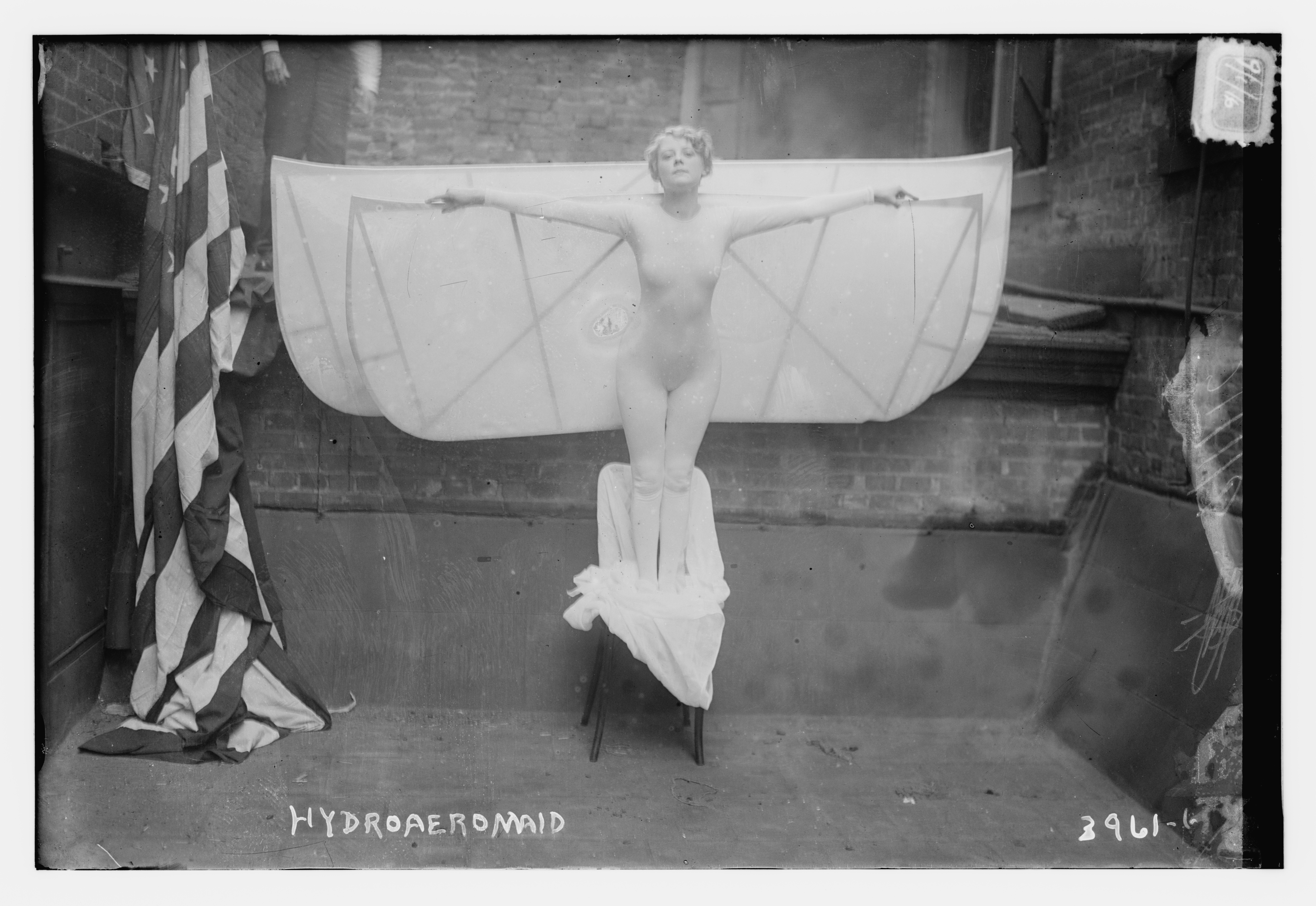
Portrayed reminder: think about rethinking the surly bonds of earth

A century later, the image in the Library of Congress’s George Grantham Bain Collection has gone humorous, the way items remembered after oblivion sometimes do. This item stimulates us neither to nostalgia nor to tragedy nor, thanks to the costume’s baggy knees, to the thought of eheu fugaces labuntur anni. The name “Hydroaeromaid” is comical too, with its philological odor of a tavern by a school during the Georgian era (“Ho, maid! Bring me a tankard of nut-brown ale whilst I construe me lines!”). * And so, looking at the image brought back to light, we laugh.

22635u

And because the light has been merciful and faded out some of the details, we photoshop. We wield the controls in the spirit of the post-Georgian nymph Dorothy Parker, who wouldn’t have been caught dead with baggy knees.

But long after the era of Dorothy Parker has passed, the girl in the image is still standing on her chair. What would she be now? What was she then, out of the uniform that was once fitted onto her by comedy in one of its sergeant-major moods? If we looked at her in a different way through Photoshop, would we be able to think of her now not as a what but as a who?

I look.


And then the image comes to me of an airplane seen at morning in a novel written just after the Georgian era, when the sight of an airplane was still something new:  Mrs. Dalloway.  By the end of Mrs. Dalloway it is nighttime, and in 1923, the year Mrs. Dalloway was published, airplanes generally weren’t flown after dark. But Mrs. Dalloway has returned home and changed her clothes, and the book’s last sentence ascends from the light of its page like an image newly revealed after a long darkness:

“For there she was.”

Source: http://www.loc.gov/pictures/item/ggb2005022645/

* Or, since the flag in the picture is American, of Owen Johnson’s Stover at Yale (serial publication 1911, publication as a novel 1912), whose hero fills his days quantum sufficit playing football, doing Latin, and adjourning to Morey’s for a toby of musty.

Update: from a pair of notes by Art Siegel at https://www.flickr.com/photos/library_of_congress/14440864879/ we learn that the model is named Pearl Palmer and she is posing for a trophy. Mr. Siegel also links to a not very clear contemporary photograph of the trophy, and the New York Tribune published this note about it on August 20, 1916, p. 13.

Trophy article