fashion
Regina in the Tarnhelm
By the summer of 1922, ten years after the event, Meyer Wolfsheim had shaped its memory into a well formed, well rehearsed narrative, organized classically into beginning, middle, and end. “The old Metropole,” ran Mr. Wolfsheim’s beginning. “Filled with faces dead and gone. Filled with friends gone now forever. I can’t forget so long as I live the night they shot Rosy Rosenthal there.”
During the event’s immediate aftermath, of course, the classical hadn’t yet gone into effect. The very long article that the New York Times published on July 26, 1912, for instance, couldn’t settle down to its storytelling until it had jittered and rasped its way through a pre-classical lead-in groove communicating little more than surface noise. That was the pre-narrative sound-effect analogue of a stage direction reading, “Time: the present.”

Likewise, the contemporaneous photograph that accompanied the article was little more than beginner’s literature, with content predetermined by a didactic caption right up top and a moral communicated by a pair of overly obvious symbols: on one side of the image’s woman protagonist a dark portal, on the other a sign proclaiming, with sweatily indignant irony, “Tables for ladies.” The picture story’s supporting roles, too, betray negligence in the casting department. Pigeontoed gumshoe in ill-fitting suit, bald and distressed proprietor wanting to get back inside: the hiring decision that brought these types onto the scene was 9-to-5 hackwork. This photographed setting is just a trailer for a story that (the picture promises us) is fully communicated somewhere else. It satisfies nothing but whatever demand there may be for an illustration of the words “Dodging camera.” In a composition that amateurishly cancels out the overdetermined with the unseen, can Rose be more interesting than the dark behind the door to her right?

But now submit the image to the discipline of the classical. Delete the dark, for instance, and make Rose symmetrical by arranging for her to become a center. Then see:

The delicate mesh purse, the clutched glove, the ungloved fingers daintily curled beside the daintily tenacious thumb and index, the drooping plumes atop what was called, at the time, a picture hat . . .
Seen now merely as she is, freed from the interpretive shackles of her caption, Rose has become fully visible. Now the details of her image have acquired significance and become character attributes. They are honest agents of their protagonist now, working hard to conform themselves to the Aristotelian unities. A photographer has caught them in the act of policing themselves into subordination to the art of the photograph, which is the art of being caught in the act.
On a stage somewhere else, perhaps in the same moment, an artist in a different medium is making cognate gestures in obedience to the discipline of his own art. This artist is a worker in sound, but at the moment he has become quiet —
Vorsichtig löst er den Helm und hebt ihn der Schlafenden vom Haupte ab: langes lockiges Haar bricht hervor. Siegfried erschrickt.
(He carefully unfastens the helmet and lifts it from the sleeper’s head. Long, curling hair pours out. Siegfried is startled.)
— and as we watch, his silence pours from the stage, fills the theater, and becomes another episode, this one silent, of the story noisily illustrated elsewhere by a photograph and a set of stacked headlines. There on the sidewalk in front of Hanover Lunch, the corresponding part of the story turns out to be an American translation of the moment when the warrior woman Brünnhilde was put to sleep somewhere in Germany, there to await the future.
Looking at the photograph, we may still think it differs from the opera. But the classical organization of detail is the same in both works of art, and perhaps the only significant reason for difference is that the art of helmet-making underwent changes between Wagner’s time and, say, Otto Dix’s. In the days of the helmet-shaped picture hat, a single image of the deathly still could be beautiful enough to startle a heroic tenor into silence. Ten years later, it was only the subject of a picturesque anecdote told by Mr. Wolfsheim to his indulgent young friend Major Gatsby, who had already seen the sights from under a helmet of his own.
Source: George Grantham Bain Collection, Library of Congress, http://www.loc.gov/pictures/collection/ggbain/item/ggb2004007790/. Photoshopped.
Prewar incident: from the last moments of visage
In the far distance, seen from the American side of the Atlantic Ocean, the squabble seems almost comical. Little, of course, did the New York Times know what was about to start happening in the neighborhood of the zeppelin hangars, and so the Times’s editors saw no need to drive home their point any further by illustrating it.

But the image of what was to come was already in place and already signifying as hard as it could. See, in the image, the forms hovering impatiently on the ceiling of their barn, already fledged in streamline and about to slip free and feral.

In the image, all but a few of the men who do see have their backs to the camera. They are looking up toward those ridged cylinders as if they’re waiting for them to emerge, cast off, and mount. They understand the cylinders’ purport. They may even have been taught that they’ll love what is about to happen to them.
But the man they have sent away from the bed of ascension is understanding in a different way: actively. His traveling cap is ready to don, he is holding a writing tool in each hand, and his eyes are in the act of piercing.
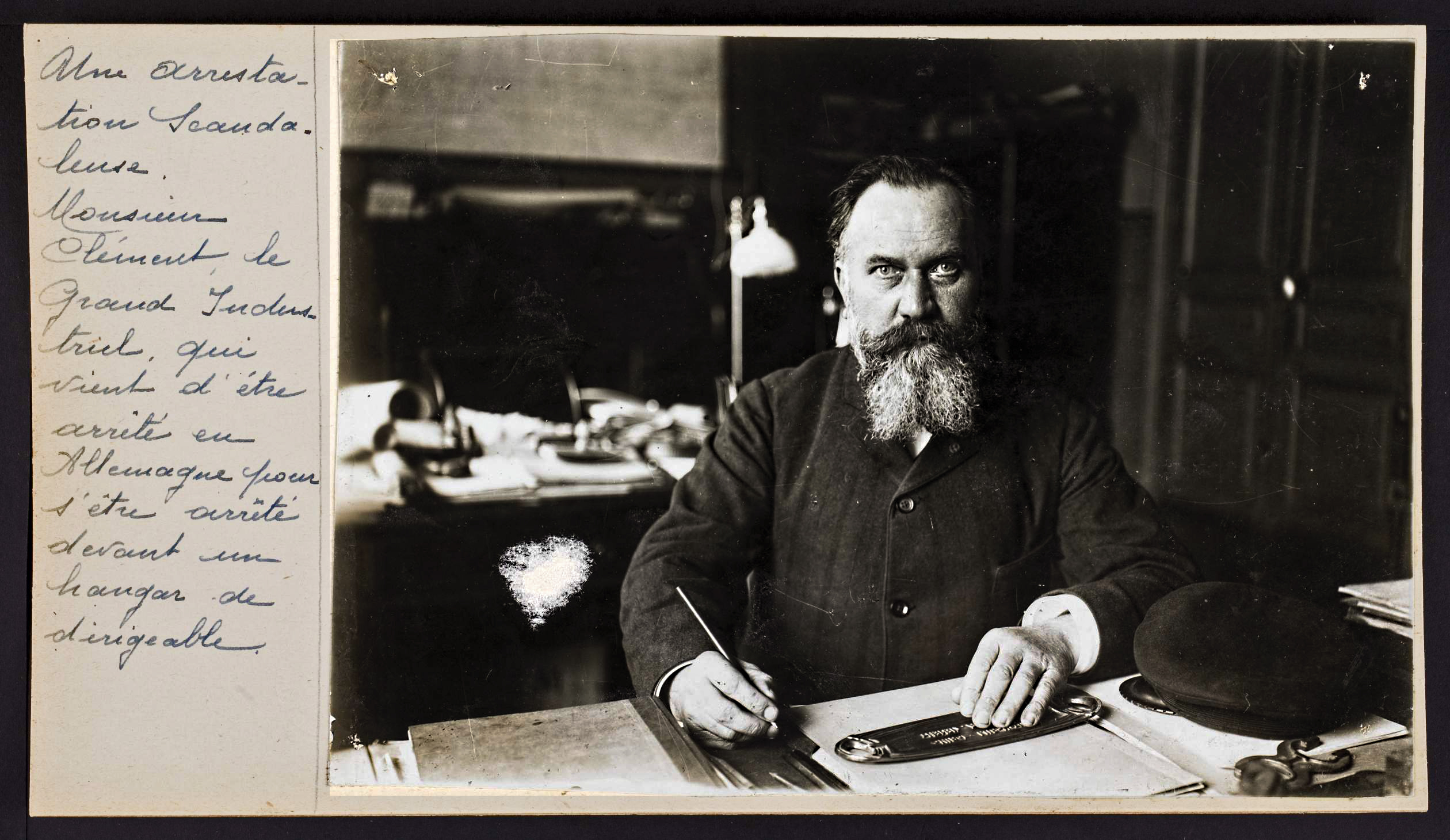
Without the beard that grows beneath, they would be only eyes in a face — say, a face fronting one of the derbied Germans who have so deeply failed to interest the camera in themselves. With the beard, M. Clément’s face becomes an emblem of the time before the dirigible and the Freudian reinterpretation of will. During that long but abruptly vanished prehistory, men didn’t just face the camera when they posed; they faced the camera down. With their sensitive mouths covered deep under layers of masculine muff, some men of the last moments before the Great War seem actually to have believed that the momentarily living self they showed to the finder could be a visage, hard and glittering as a face self-sculpted in stone.
Source: Université de Caen Basse-Normandie, https://www.flickr.com/photos/universite_caen/15232404609 and https://www.flickr.com/photos/universite_caen/15232404839. Photoshopped.
Weeds at embarcation

As he waits to board the car on the right, the young man’s derby seems to be anchored to his head by a cord running to a clip behind his ear. The effect seems disproportionately serious, like the obsessed drawings in one of those books about funny patents. Furthermore, in the years since this photograph from 1905 was taken, the derby itself has acquired comical connotations, and men’s hats in general have gone ironic. But if we treat the image with the common intellectual decency of trying to see it as of 1905, it will go tender on us. The young man and the pretty little woman next to him then might be, oh, Gabriel and Gretta Conroy from “The Dead,” and the little girl in her sailor suit might be one of their children. Backs turned on us who look at them, they are off now to wherever it is that Gabriel and Gretta will voyage through their long snowy night.
Simultaneously, from the door of the car on the left, a young woman is watching two more women say goodbye. One of them, middle-aged, has a foot already on the trainman’s portable step. She is the one who will be leaving on this train, and the car she is about to board has been given a 1905 purpose that, like the derby, is no longer in use: ladies’ dressing room. She seems emotionally undressed herself as she exchanges a kiss with an older woman, but once she boards the dressing room she will become fully clad in the wear of 1905. As to the older woman, she is already dressed because she won’t be boarding the dressing room, and her clothes are another specialization for the seen universe of 1905.
The clothes are called weeds, and weeds were the mourning wear dictated for widows in 1905 America. The word “weed,” singular, had meant “clothing” for about a thousand years before then, from the ninth century through the nineteenth, but it soon acquired specialized meanings which by 1905 had diminished only to one. Some time before 1905, “weed” came to refer only to a widow’s veil, and then (says the Oxford English Dictionary) the rest of the wardrobe followed and became an outfit strictly in the plural.
But the fashions of signifying death didn’t stop changing with that, and as the term “weeds” became incomprehensible in time, the related terms “dressing room” and “lady” also had to be read in new lights. Flash photography, too, is no longer executed with a frying pan full of powdered magnesium, and so we see in new lights as well. On the evidence of this photograph, the fourth wall stood closer to the backdrop in 1905 than it stands now, and the farewell speech in between was more aglare with high contrast.
But we don’t seem able now to read the expression on the face of the third actress, the one standing at the door of her dressing room. In the glare of 1905 it ought to be immediately understandable, but the immediate seems to have vanished from this image. Requiring a mediation that the image can’t supply, the expression on the woman’s face is one more term dated strictly 1905. Time-stamped, it is to be understood as a word extracted from a body language that is no longer comprehensible now.
It has changed, and in the disembodied language you’re now reading we can’t know how. But at least we can say why. Moments after George T. Nicholson took this picture, the ladies’ dressing room rolled away into what’s called forever after, and in the shed whose flashlit form remained in memory over the darkened track, nothing remained.
Source: George T. Nicholson, “CC Ladies’ dressing room on the Limited.” Library of Congress, http://www.loc.gov/pictures/item/2012649442/. Photoshopped. I don’t know what “CC” stands for — “chair car,” maybe? The Chicago & Alton Railroad used the term, and in 1900 its Alton Limited was the subject of a famous panoramic photograph by George T. Nicholson’s employer, George R. Lawrence.

http://www.midcontinent.org/rollingstock/dictionary/hortonseats.htm
What to write while wearing

Source: “Mrs. F. C. Coppicus.” George Grantham Bain Collection, Library of Congress, http://www.loc.gov/pictures/item/ggb2005024823/. Photoshopped.
What to wear. What to say as you inflate.

Source: Lindsay Turley, “Novelty, Simplicity, Buoyancy, and Pliability,” 31 July 2012. http://mcnyblog.org/2012/07/31/novelty-simplicity-buoyancy-and-pliancy/. Image photoshopped. Via Retronaut, http://www.retronaut.com/2014/07/the-victoria-inflated-skirt/