After the World Series of 1913, the New York Giants and the Chicago White Sox boarded the first of many trains and headed west for a series of exhibition games. After they arrived in California, they kept right on rounding bases through Asia, Australia, and then Europe. In England they played a game before King George V, then boarded one last steamer for their return to the United States. It arrived in New York on the morning of March 6, 1914.
It docked two hours late, and the weather over the harbor was rainy and snowy. Nevertheless, a riverboat brought hundreds of people alongside, cheering. A photographer from the Bain News Service recorded their approach, and after that somebody scratched three words of explanation into the silent negative that survived the event. Using a photo-editing program, I’ve erased them from this print. Trying to read them on their own single term is pointless now, because “now” is the period of time extending almost all the way back to the instant of shutter release. To read the word “now” requires a supplementary history archived far from the site of anything instant.
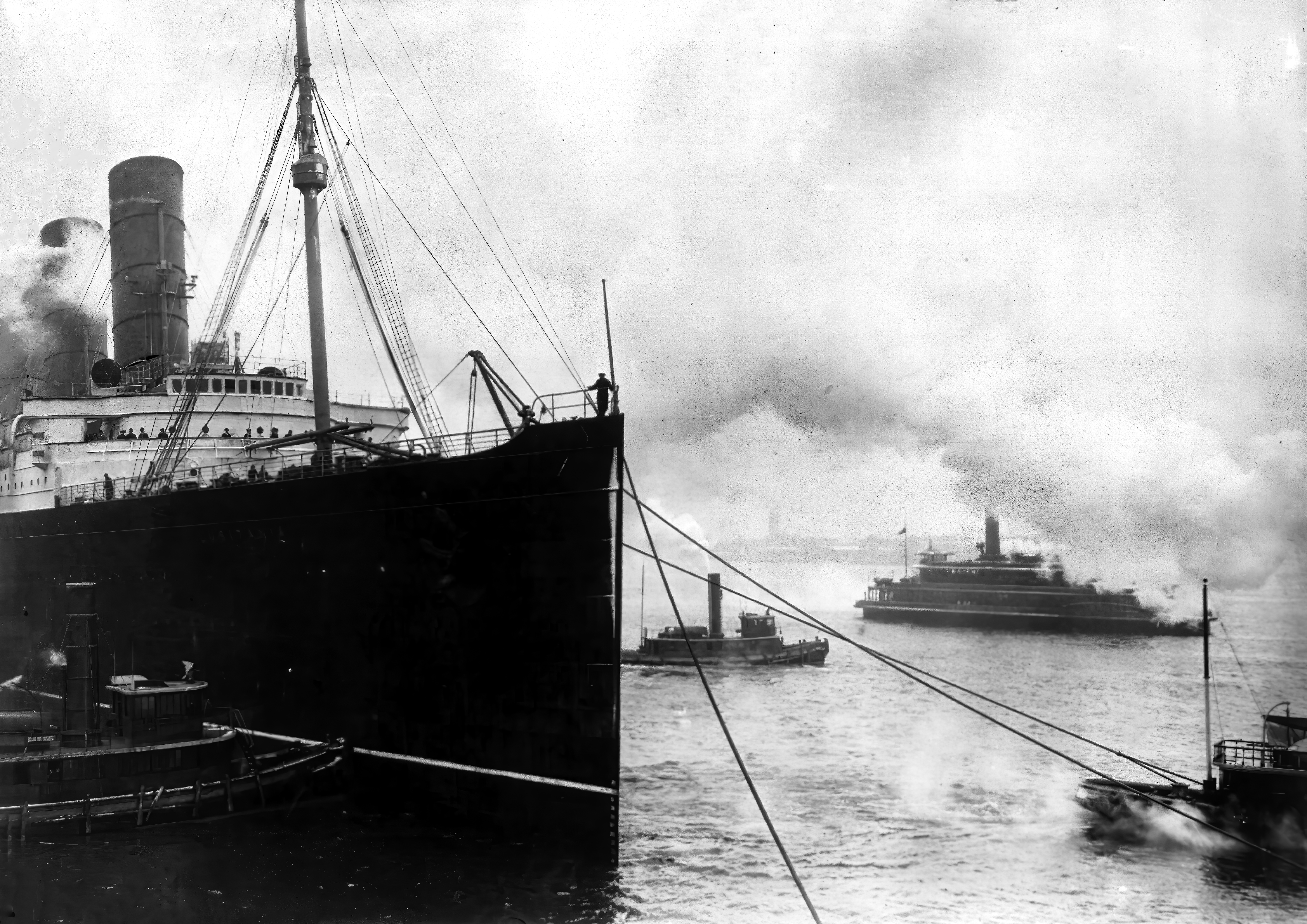
The words that no longer mean are “Ship with fans.” Other attempts at inscribing meaning might have been made, of course: words such as “prow,” “angular,” and perhaps “geometric” or “abstract.” Two more would have to have been “white” and “black.” Think of a Mondrian shape without color. As of March 6, 1914, however, the time for such a thing hadn’t yet arrived.
But one more incision scratched into the negative cut all the way through to the time beyond 1914. Referring across a few more inches of silver halide emulsion to the word “ship,” it gave it a name bearing the colors of a future. In 1914 “ship” in plain black and white was all it needed to be. For the purposes of a news service’s lexicon in 1914, the ship was only a mode of baseball delivery. The second scratching gave “Ship” a proper name, but as of 1914 that amounted only to journalism’s who-what-where practice at its automated busywork. The name itself remained insignificant.
But in 1915 it suddenly began signifying on its own. Suddenly the ship sank below the visible surface of things; suddenly the letters on its bow and stern became unreadable; suddenly, then, they were transformed from a string of morphemes painted on metal to a meaning capable of existing anywhere. Now that they are gone into history, the metal letters are history. Their historiography took only a few minutes to accomplish, and in its final form it is only one synecdochic word long.
Say the synecdoche. In memory, as memory, say Lusitania. Like Guernica, it will be one of the words in which some artists of the twentieth century defined a mortal passage out of time.
Sources:
Tom Clavin, “The Inside Story of Baseball’s Grand World Tour of 1914.” Smithsonian Magazine, March 21, 2014.
“Giants Get Rousing Welcome Home.” New York Times, March 7, 1914, page 12.
[“LUSITANIA, 1907-1914 . . .”] George Grantham Bain Collection, Library of Congress. https://www.loc.gov/pictures/item/2002721377/
 Its talisman in words is, “Make [name of myth] great again.”