The original, in the Louise Crane and Victoria Kent papers, Beinecke Library, Yale University, https://t.co/lYA0JolYFg:

With contrast and detail restored:

The original, in the Louise Crane and Victoria Kent papers, Beinecke Library, Yale University, https://t.co/lYA0JolYFg:
With contrast and detail restored:

What Randall Jarrell said about Robert Frost is also true of Emily Dickinson: her best poems are almost as beloved as her worst. But here’s some scholarship in mitigation.
First the poem: Fr982, as it usually is formatted online.
If I can stop one heart from breaking,
I shall not live in vain;
If I can ease one life the aching,
Or cool one pain,
Or help one fainting robin
Unto his nest again,
I shall not live in vain.
Second, historical evidence for the genteel pronunciation of “again.” In the sequence beginning at about minute 18:30 of
you’ll hear it: “eggayne.”
Third and decisively, artificial intelligence has motored up at last with aid for the fainting robin. Perhaps the stretcher bearer was Ernest Hemingway.


Between a river valley in 1898 and you, there has passed this image of the no longer moving. Clouds, ripples and all, everything now visible within the black border has been dulled and stilled.
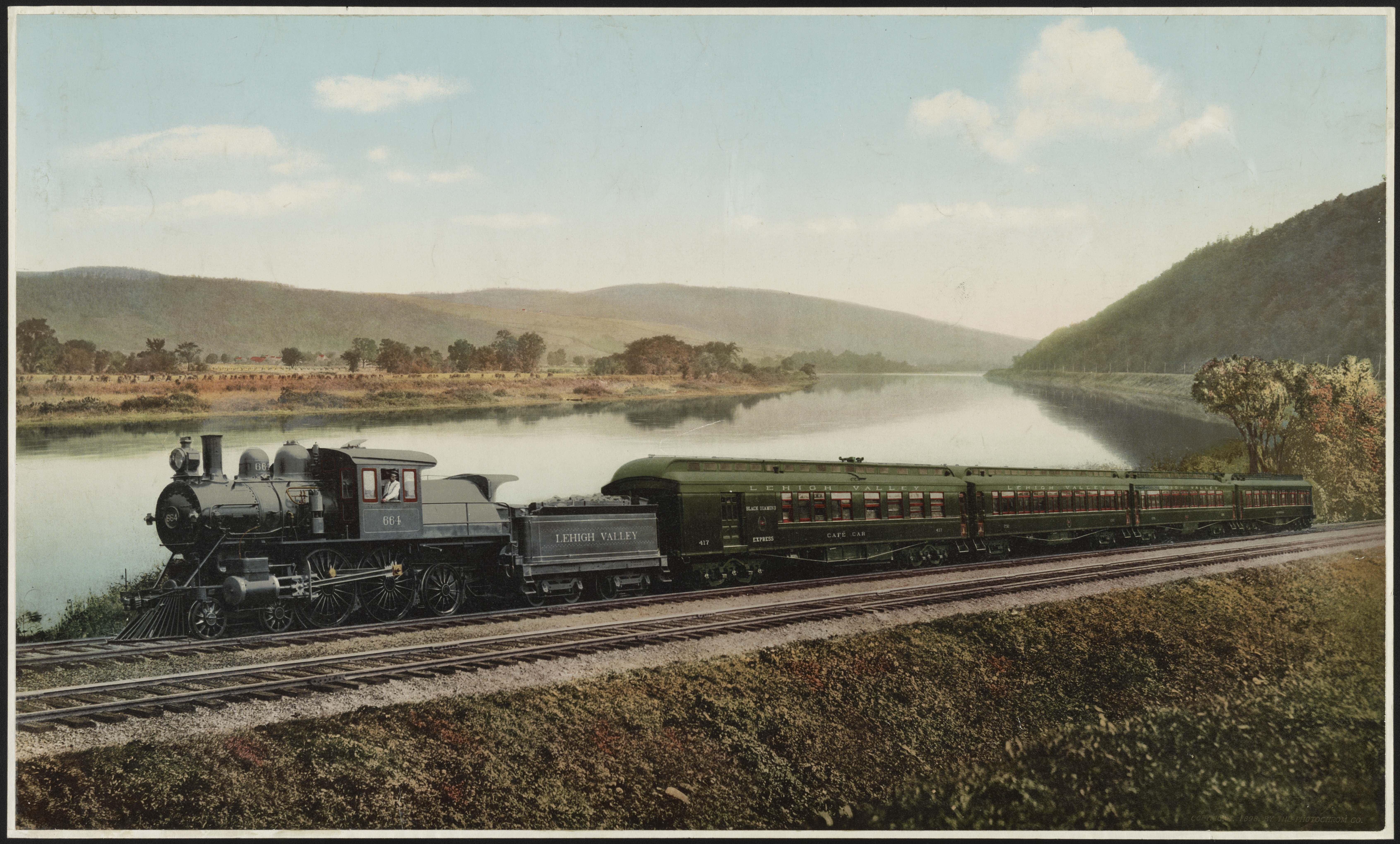
One of the incidentals in there is an episode from the history of steam. What you see acting it out is a powerful little locomotive known as the Mother Hubbard which saved money for some Pennsylvania railroads like the Lehigh Valley by burning low-quality coal in an oversized firebox supported by the engine’s big drive wheels. The type didn’t spread far beyond Pennsylvania’s anthracite fields and didn’t last long; it separated the engineer from his fireman, it sometimes killed him when the engine threw a piston rod up through the cab, and when engines grew bigger its firebox couldn’t. But when Mother Hubbard was mobile, Americans communicated by postcard, and this was one of the the Detroit Publishing Company’s cards. It was the work of William Henry Jackson (1843-1942), who traveled America’s rails on Detroit Publishing’s behalf in his own special car.

The photograph of Yellowstone Falls on the bulkhead is Jackson’s own icon. Dating from 1871 and the first photograph ever made of the Falls, it is a contact print made from a glass negative measuring some 16 by 20 inches, hauled into and out of the canyon by mule train. In a less strenuous era and a less strenuous part of the nation, someone still took painstaking brush and pigment and colored in the Black Diamond.
It’s easier now.
The current technique’s business model is monthly rent, and its business name is Lightroom. As long as your credit lasts within the room, it proposes to enact and perform memory for you. Now, because you have tapped a credit card, you are entitled to believe that you see clouds passing above the damp riverbank where you stand in sunlight.

This month I paid for you. The door opened, the Room let you in, and now you believe you once saw what you see now. Subject to the terms of the agreement, you began believing you were on a river path to a place where earth is soft beneath Mother’s breath-warm steam.


In 1918 a caption written in American expository prose employed the word twixt. The caption’s author assumed that that word twixt would mean something to his readership, just like the two-word combination Hoffman House. If it has turned out that you don’t know what Hoffman House means, he was wrong. In 1918 his words were part of a lexicon dating from 1918, but that number turned out to be impossible for computers to handle in 1918, when the word computer referred to a person. In 1918, on May 19, James Joyce wrote to Harriet Shaw Weaver about Ulysses, “It is impossible to say how much of the book is really written.” But in 1918 Joyce was in the process of writing off 1918.
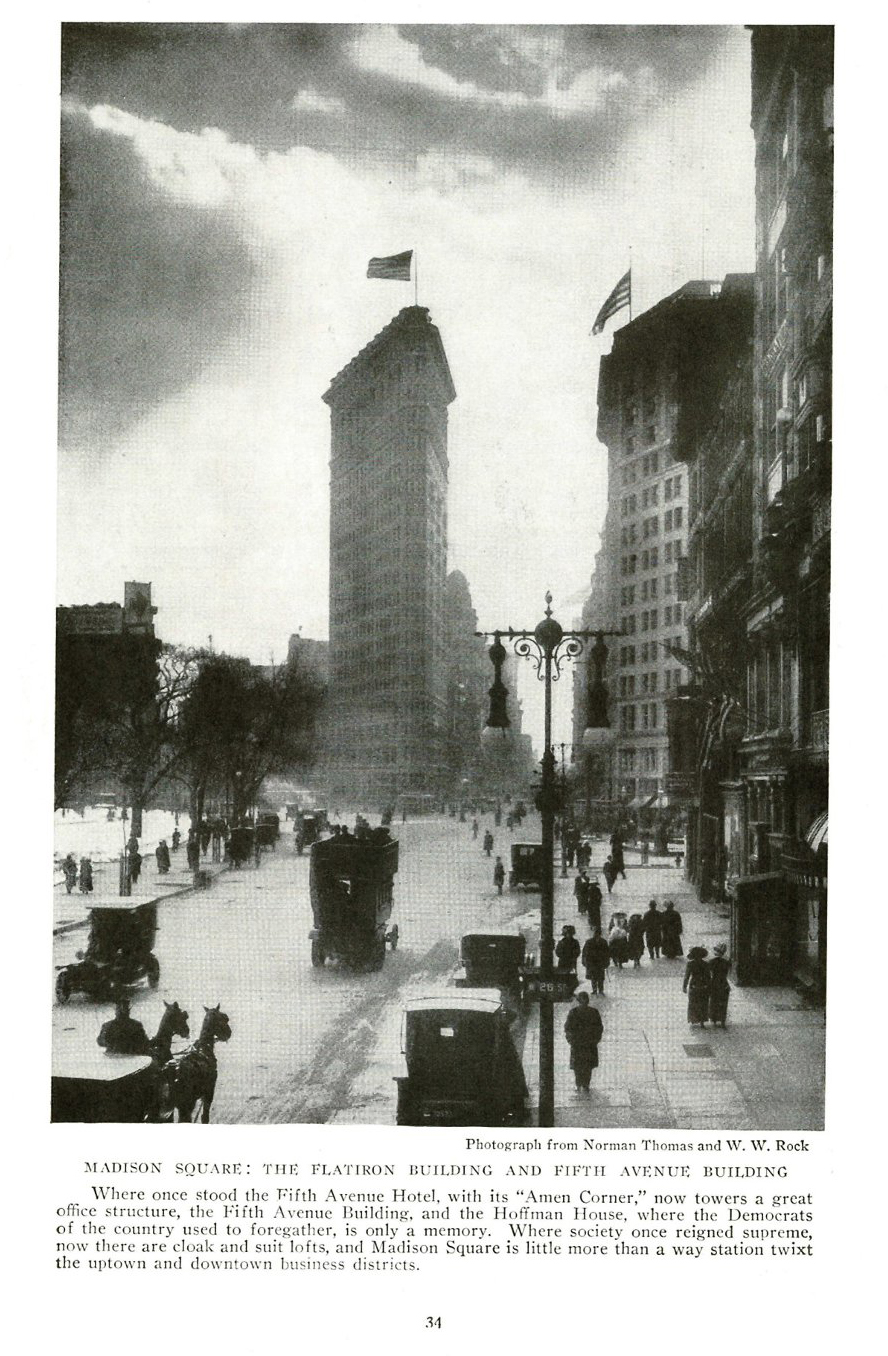
In the same magazine, another block of prose suggested ten years as a range of history during which terms like Hoffman House might remain stably conceivable. The thought must have seemed reasonable while its subject was still sharing a present tense with horse traffic. 
But now we know that it’s harder to say “It identifies” than we used to think. In 1918 a billboard atop the building at the left of the image of Madison Square identified a remedy for indiscretion, but the identification couldn’t be read in 1918’s Geographic text and in texts post-1918 it can’t be understood.

But now that it can’t be understood, it can be read.

As people say, it goes without saying. Artificial intelligence has transported us up Fifth Avenue to a caption. The caption’s lexicon now comprehends the legible words laxative water on a rooftop and legible fashion on women approaching a door. In the fullness of time, the deposit of data saved on a large-format negative in 1918 has matured at last. Its worth is redeemable now. But what, now, can at last mean?

We have been enabled to read 1918, but all we can do now that 1918 is over is to see it: depictionless, without seeing that its label bears a signature. Unsigned, however, is the glare that comes forward behind the Flatiron and reverberates from the wet paving. That you can still experience as people experienced in 1918: communication in a present not bound to a knowable future. The wordless glare in the gutter isn’t a part of the caption because it isn’t captionable. All along, faithfully paralleling the caption from 1918, has been something just above it on the page: something long pre-1918. There in the unchronicled is image uncaptioned, without words to slow the light that comes flowing down the gutters of Fifth Avenue to us.
Somebody at lower right went blurry and moved off in the dark. For a time a shutter had opened and the dark was filled with glitter. It threw light on the change of circumstance. Within the dark, non-glittering somebody would never be seen again.

In 1916, wings could still be translucent. Their delicate black markings were shadows of a metaphor for the term endoskeleton. At each tip, these particular wings also shadowed a purely human term: Germany’s black Iron Cross.

On the record, these wings and this thorax are black and white. One of the black and white men accumulating before the lower wing is wearing the tunic ribbon of the Iron Cross, but in 1916 that too would have been black and white. The other tunics are in various 1916 instars: some accurately following contours of flesh and bone, others shaped by the now dead; all black and white.
But in the white space between two of the human bodies hangs a cross in blue. At the time it was inked onto the Rostock print somebody intended it to refer to one or the other of the bodies, but nobody now can tell which. Separated by a shared white space, the black and white bodies are in the midst of an uninked record. The inked cross suspended in the white looks like what we readers think of as an X, but it is the X in an alphabet that can no longer be read. We receive it now only as a shape combined with a color. The color is the color of a sky no longer perturbable by wing.
