
photography
Bal

Ionic order

Dream resource no. 334: homage to the past


Art’s work: poetry, medicament, prose

∫

“Norma Lawrence is 10 years old and picks from 100 to 150 pounds of cotton a day. Drags the sack which often hold 50 pounds or more before emptied. Lewis W. Hine. See 4569. Location: Comanche County, Oklahoma.” Lewis Wickes Hine, October 10, 1916. National Child Labor Committee Collection, Library of Congress, https://hdl.loc.gov/loc.pnp/nclc.00608. Contrast restored.
Iron, 1922
1.
“I saw the hardware store from across the street. I didn’t know you bought flat-irons by the pound.”
2.
The speaker will decide on two, weighing six pounds each. He is The Sound and the Fury’s Quentin Compson, and he will use his purchase to weigh down the body when he drowns himself. The date of the event, in unpunctuated lapidary uppercase, will be JUNE SECOND 1910.
3.
In 1910, customers would ordinarily have bought their irons in pairs as Quentin did. The appliances were made of cast iron, they resembled the fourth of these tokens from a 1935 Monopoly set,

and while one was in use the other would have been heating on the stove. But the metals were changing.

4.
The iron made of iron gave its metonymic name to a building erected in 1902 on a triangular lot in New York formed by the diagonal intersection of Broadway with Fifth Avenue and East 22nd Steet. In 1904, an era when photography emulated what were then called the beaux arts, Edward Steichen shaped this image.
https://www.metmuseum.org/art/collection/search/267803
5.
But compare

See this one contra-Steichen: from top to bottom, starting with the printed date. For a year in a magazine about changing social fashions, that’s a point of origin. As of 1922, for one instance, 1922 was the year when the American novelist Sinclair Lewis published a social satire named Babbitt which by 1930 would make him the first American writer to win the Nobel Prize for literature. It’s all but forgotten now, but in 1922 its description of an evening cityscape seemed memorable. It was full of styles. But just as a matter of professional practice, Lewis didn’t build anything in 1922 that Dickens in 1852 hadn’t built with more imaginative use of material in chapter 1 of Bleak House. More, and decisively: 1922 happened to be a year when the technology of writing English entered a new stage of development. With T. S. Eliot’s The Waste Land and James Joyce’s Ulysses, a poem and a novel did to literature what the steel skeleton had done to architecture. Babbitt was to remain in the iron age. The Waste Land and Ulysses were wired for steel.
6.
In front of a high steel tower in 1922, a low steel tower moved traffic through gridded Manhattan. Entering stage right, a man in spats and a top hat came dancing through the grid. The zigs of Archie Gunn’s cartoon architecture were now ready to be seen as a jazz.
After Darwin, the fossil record
This lurid face once emitted glares and thunderous sounds. Between 1808 and 1900 it was the body of the theologian Edwards Amasa Park, and it influenced American literature at least once: certainly when Emily Dickinson recorded her awed reaction to one of his sermons in a letter to her brother (JL142, November 21, 1853), and later, perhaps, in the form of a poem:

But its physical record is a history of extinction. See how much of the silver-mercury amalgam has been damaged and how little remains. To construct even this partial objet d’art cost me a debt of indeterminable amount to the artifact-generating computer technique called artificial intelligence. With black and white artificially replacing daguerreotype silver, see:

No, it isn’t visible to you now; not accurately, not in any way that would have been received with assent by anyone sitting in a hardwood New England pew in 1853. The Origin of Species was published in 1859, and in due time Emily Dickinson wrote ruefully about it. You see your images now in an evolved way, through a color filter.
So fall into line. You have no choice but to be received into the epoch of tangerine.

It’s in your constitution now.
For detail about Dickinson and Park, see Alfred Habegger, My Wars Are Laid Away in Books: The Life of Emily Dickinson (Random House, 2001), pp. 310-313.
The 1847 daguerreotype of Emily Dickinson, now times 2
In 2021, I published a little Issuu history of a daguerreotype of 16-year-old Emily Dickinson. As of 2023, that image remains the sole fully authenticated photograph of the poet, and my book included an attempt at using artificial intelligence to restore its contrast and detail. The original and the restoration can be found in the book at
But in 2023 I upgraded my computer and its software, and rerunning the restoration now brings back so much more history that separate pages can be seen once again in the book on the photographer’s table. If I still had the Microsoft Word text of my own 2021 book, I’d replace the old image there with the new one and hit Republish. The Word text is long deleted, though, and to change that one page now I’d have to retype the whole book and then hassle with Issuu.
But see the new restoration by itself: a 2023 electronic state of the poet Emily Dickinson in 1847. At the least, more of the fabric in her dress is visible to you now than it was to me in 2021.

But see too: as she explained in advance to Thomas Wentworth Higginson (1862; JL268), the only true way to see Emily Dickinson is wordwise: not as an illustration but with the mind’s eye.
Monochrome

The horses on the monochrome thoroughfare have been stilled.
On the boat, the passengers’ chairs are scattered where they were left when the passengers left the image.
Inside the piano store, the unimaged and silence.
Upper Lake Michigan, summer 1906
Illustrations in a literary section, comprehensible only after a passage through written words.

Unwritten words uttered during their passage out of a frame. In the last of the light, they said We are not dark yet.
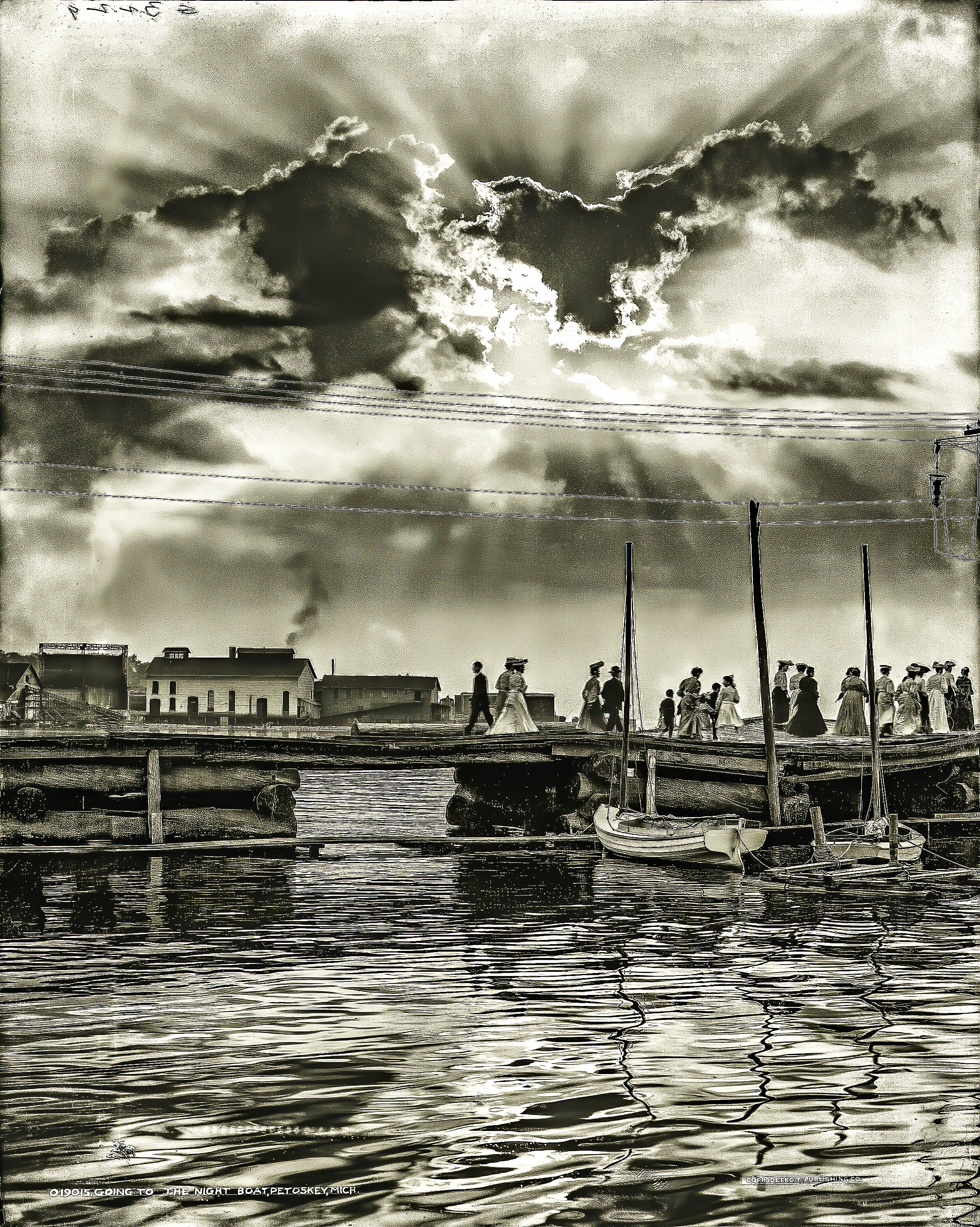
They are still uttering.