
In the midst of all this life, what won’t die is the music

In Honolulu’s Koko Head District Park, among silent cattle egrets, the members of a barbershop quartet rehearse under social-distancing conditions. Notice the yellow barrier tape around the playground equipment, but notice also the gregarious word “Barbershop” on the orange shirt. The mountain isn’t Koko Head but the nearby Koko Crater.


And now he’s dead of coronavirus.
https://www.nytimes.com/2020/03/23/world/africa/aurlus-mabele-dead-coronavirus.html
metal brought among men:
passage of mortal breath shaped by ideal curves into a form with an ending:
pulse for the destined dead:

…
Restored detail of “‘Elmira Cornet Band,’ Thirty-third Regiment, of the New York State Volunteers, July 1861.” Civil War Negatives and Related Prints Collection, Library of Congress, https://www.loc.gov/pictures/item/2013648631/

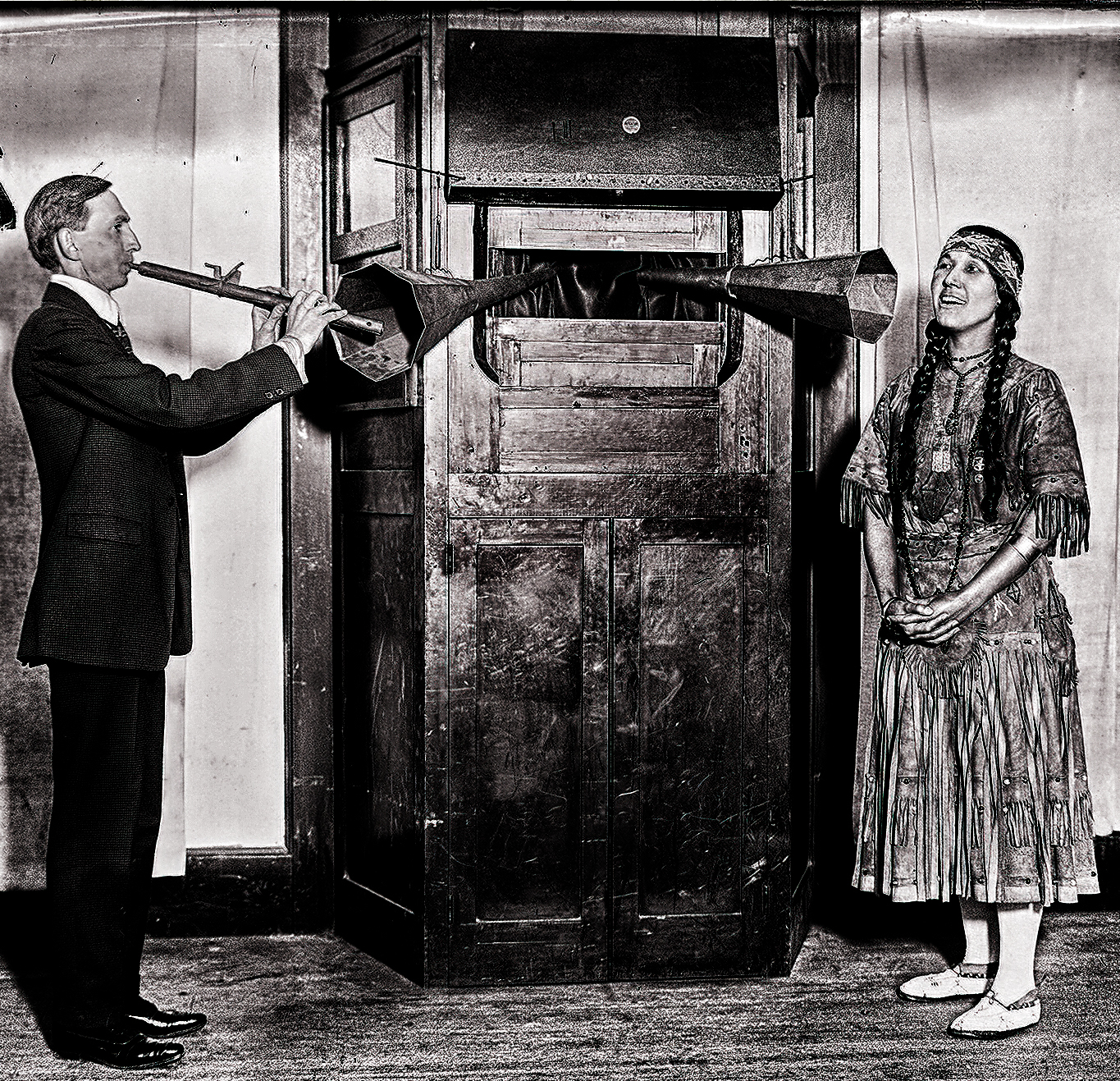
From the summary at https://www.loc.gov/pictures/item/2014713555/: “Photograph shows Tsianina Redfeather Blackstone (1882-1985), a singer and performer of Creek and Cherokee ancestry in recording studio with accompanist Charles Wakefield Cadman (1881-1946). (Source: Flickr Commons project, 2017).” George Grantham Bain Collection, Library of Congress. Post-processed to recover detail.
The musician is dressed in a coat with frayed, patched sleeves. Under the sleeves, at his wrists, there is nothing to be seen but bare flesh and bone: no jacket, perhaps no shirt. His scalp is scarred. His hat doesn’t cover the scars because he has to hold it out in his right hand. His left hand is raised in a dance figure. It has nothing to do with the musician; it is only a part of the music he transmits to his city. He and the music box hanging on him by a strap are equal parts of an art apparatus. Imagine a Piranesi prison seen from outside. The stone would still be there, but it would no longer enclose its universe. Now it would be shutting out.

Through that hard plein air dances Orpheus in his aspect of beggar. Let me dance you into my dance, he begs us. At a subordinate distance from his image you can see the shadow of an ancillary apparatus: the camera that stopped it for a fraction of a second along its route to Hades. Ever after, that fraction of a second has been recorded by the camera’s art in the historical present tense.
And into the image frame there did, once, come dancing another man with his finger up like the musician’s. It too has been stopped in motion. Shadow tarantella following the floral-decorated machine, it will outlive the economy of stone and iron through which it passes.
Source: “A little music in New York,” about 1900. Detroit Publishing Company Collection, Library of Congress, https://www.loc.gov/pictures/item/2016800315/. Image restored in Photoshop.
In New York on April 30, 1921, as the liner Aquitania sailed up the bay from quarantine, the tenor John McCormack, one of the most celebrated singers of the time, showed himself before the recording instruments of the media. The role he was performing approximated what his fellow Irishman William Butler Yeats was to call (in “Among School Children”) “a smiling public man.” A space of foggy air and wooden decking separated him from the battery of cameras.

Then, though, the cameras moved in closer and the singer began to speak.

The reporters took down his words. They turned out to be Irish words.
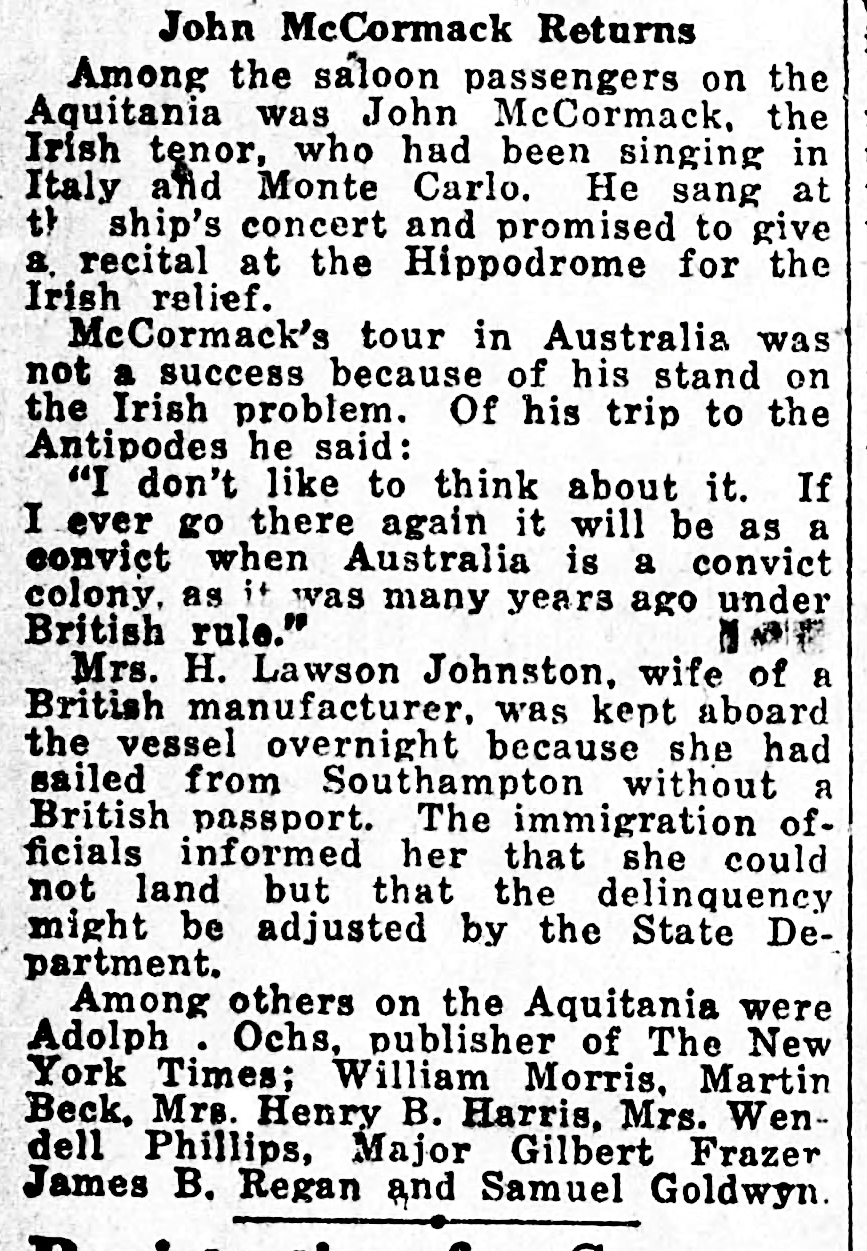
New York Tribune, 1 May 1921, page 12
Along with the celebrated singer, a celebrated newspaper publisher was on board the ship, and so was a celebrated Hollywood producer. We’re willing to believe they were because the story tells us so in indirect discourse. We don’t need the publisher’s or the producer’s actual words to bear witness. And as to the singer, in 1921 all the cameras had to be silent.
But perhaps we can see words forming on his face.

Sources: George Grantham Bain Collection, Library of Congress, http://www.loc.gov/pictures/item/2014712442/ and http://www.loc.gov/pictures/item/2014712445/. Post-processed to restore detail and contrast.