Stance 1, 1889
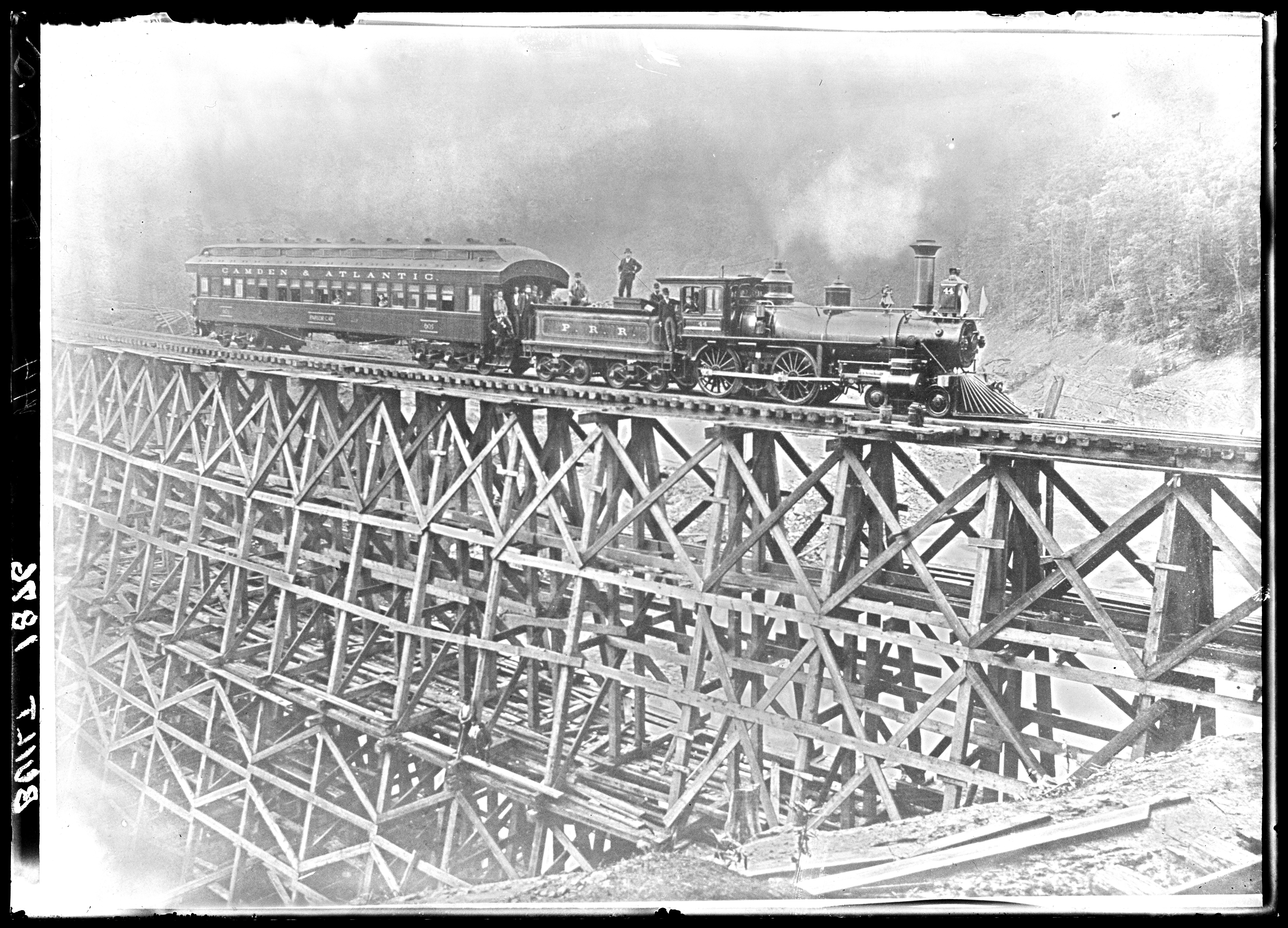
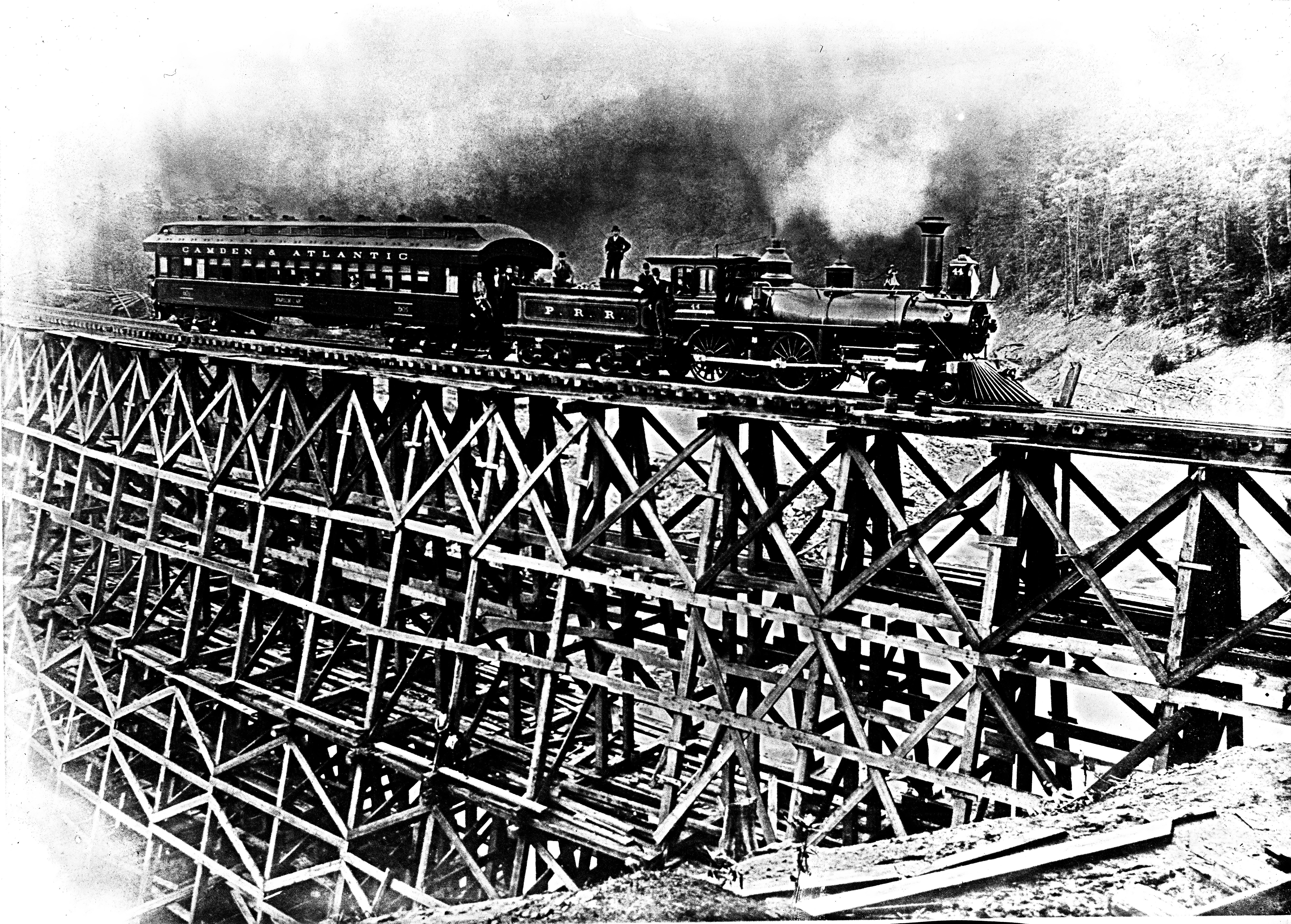
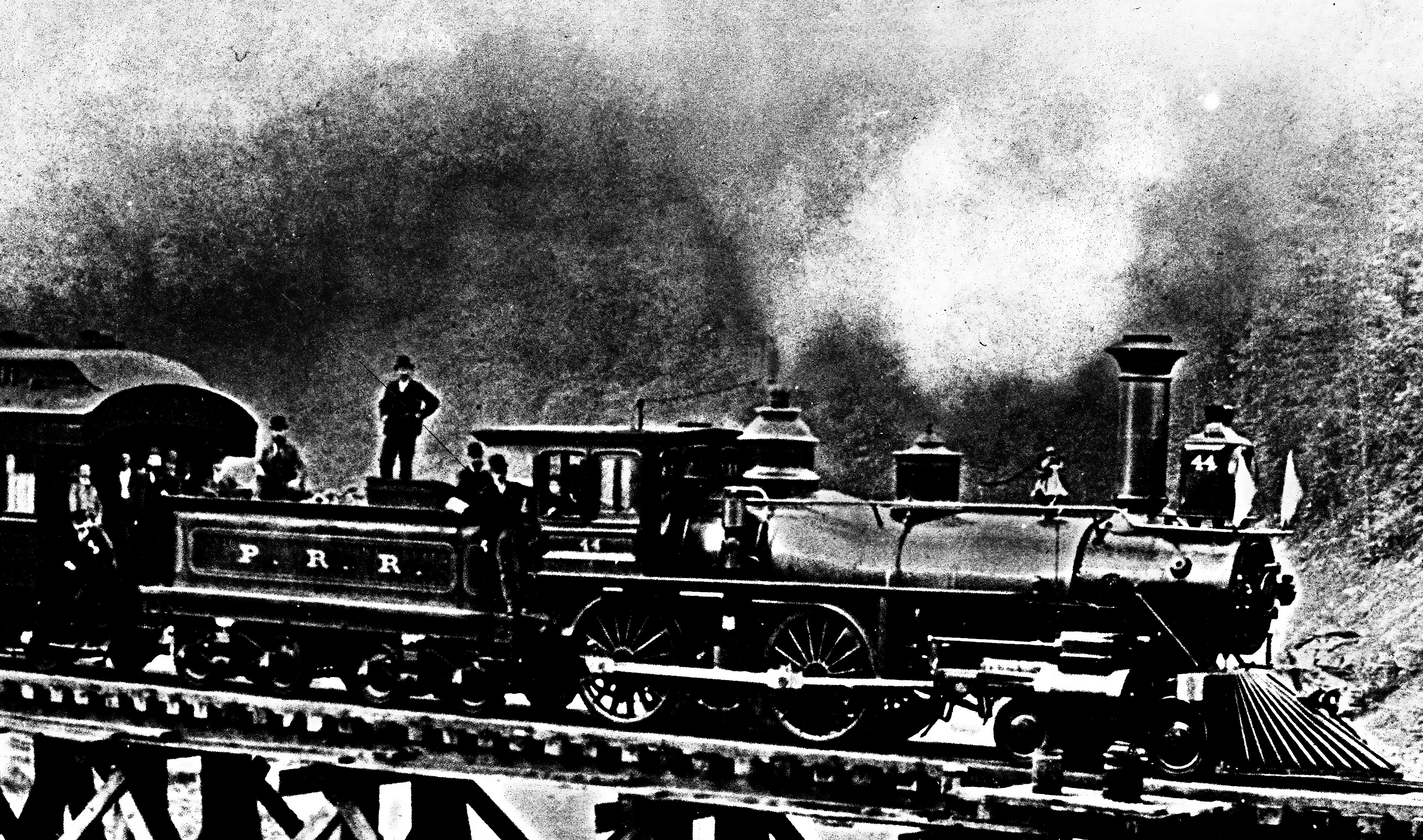
Within a library, we read under library guidance, selectively. Today’s protocol for selectivity, for example, has been a corpus of the locomotive. We are reading locomotive, only: the Louis A. Marre Rail Transportation Photograph Collection. Today’s item entered the collection bearing the name of Number 44, and library protocol has guided us toward learning that in 1876 Number 44 played a part in the centennial of the American Revolution.
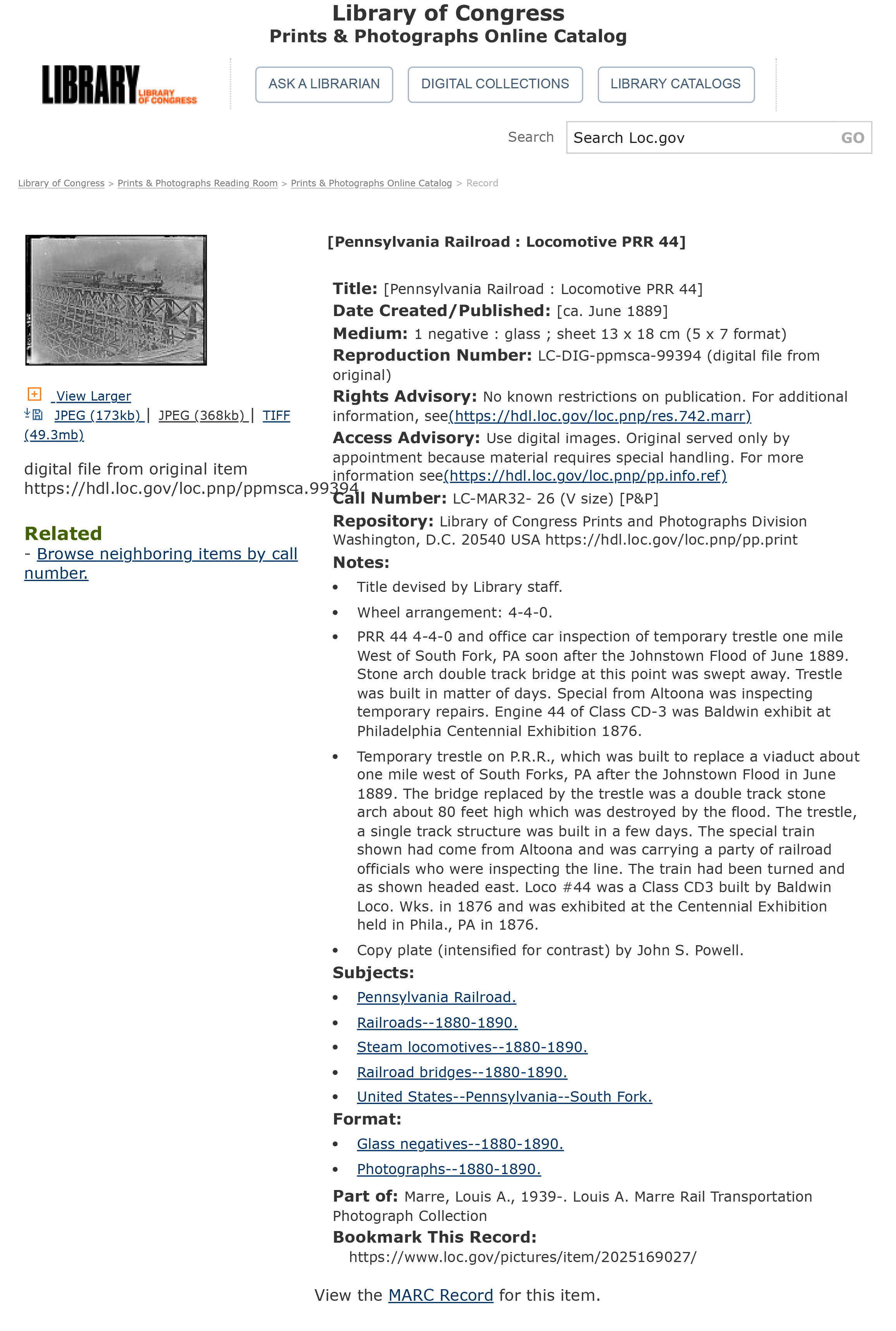
The Library adds that it once went to the trouble of intensifying Number 44’s curated image. Until recently, however, the result wasn’t intense. Emotionally, it was a page from a history book that remained unillustrated. Its only stimulus to vision was a blur. Almost unpopulated, too, was the book’s aura of words. “Loss of life” is a phrase unfigured in its blank white, even though it hints at the death of 2208 people in Johnstown, Pennsylvania, on May 31, 1889, in the churning course of a flood.
But the twenty-first century has delivered a trainload of computers with operating manuals that promise to teach us a smarter way of thinking through our pain. In artificially intelligent sequence, you can see now what the Library might claim to have been unable to reveal until now.
.
.
.
.
And up they come at last, or at least apparently at last: Number 44, part of a forest’s stacked harvest, and a crew of men who labored to deliver the harvest to Number 44 for the sake of life. At next to last, the sake of has become a phrase that almost seems to have delivered itself itself into words en route.
It didn’t, however. We didn’t learn it all the way to its end. Number 44 failed to become fully at one with us. On its page of text there is no hissing or chugging yet to be understood, or noise of floodwater still rushing away under timber. On this page, the only life actually perceptible is an irregular array of shadowy shapes distributed among whatever spaces aren’t filled so far by Number 44. After all, the stilled machine had only been pausing on its progress through history. The men’s heroic pose couldn’t have lasted. It didn’t last, never will last. In nineteenth-century iconography, a pose like the one you now see post-nineteenth century was intended to signify an overcoming of natural force. Bibliographies now shelved in the library will tell you that. The pose was intended to mean Hold back. Hold still.
Stance 2, 1975
But the river didn’t stop moving.
You knew that all along, of course, even though you may not have known of course itself until just now. You knew because of course is a river phrase signifying that which courses. Its function is to perform the grammar of a wordless song.
Of course is never not a song singing a river’s course. It fills its way into you, and with that you have learned to hear and then see and know. So not never, ever:
You don’t want to know why I was waiting outside Castle Hospital’s emergency room at six in the morning, but Uber had told me to expect a red Cadillac driven by a man named Willy. “Oh Detroit,” I thought happily, anticipating a conversation full of memories. And then Cadillac drove up.
It didn’t use the driveway; it, with Willy, waited for me on the other side of the parking lot. I hauled myself up from the hospital’s wheelchair, walked over to the redness, and opened the door. Inside was a sign counseling me to close it carefully, and in the driver’s seat Willy wasn’t what I thought he’d be. He was an elderly local man seated among several thermoses, and from his rear view mirror hung a rosary. Morning sun tinged its red crystal beads, and all of Cadillac’s windows were open, with a cool wind blowing through.
From the T intersection at Castle Junction it’s a short straight drive back to my house in Hawaii Kai, via Waimanalo. But Willy didn’t drive down the T; instead, he turned right and headed toward downtown Honolulu on Pali Highway. I didn’t ask him to correct our course, because it was coming to me that I was embarked on a farewell tour. Sites were showing themselves to me for probably the first time and possibly the last time since I had had to lift my hands from the wheel forever after. Past us once more they came: woods, then the steep climb up Pali Highway to the cliffs; then the tunnel and the peak and the way back down the other side into the city. Again, again, the memory things in their morning light: the Korean consulate; Temple Emanuel; a ramshackle fundamentalist school where Haesun had applied for a librarian’s job right after we moved to Hawaii; the upcurving roofs of the Sanju Pagoda. Then the Buddhist Center and the on-ramp curving down and east into the morning traffic on Interstate H-1.
After H-1 ends, its continuation on Kalanianaole Highway is contraflowed in the early morning, with four of the six lanes coned to direct traffic west. Cadillac and I were bound east, slow in the remaining two lanes. At our speed there was no longer much air blowing through Cadillac’s windows, so for the first time I could hear what Willy had been paying his attention to.
It was Republican talk radio. “Oh I never knew that!” gushed the straight girl, and after that the man with the voice used his basso to stimulate and arouse. Together, the man and the girl began taking turns admiring Bobby Kennedy Jr. Those . . . senators . . . tried to yell at him, sneered the basso, but he showed them. By now the hospital was on the other side of the island.
—
From Africa has come Elon Musk: now the richest and most mobile man in the world but also known for his eleven or so current children conceived by artificial insemination.
Also from Africa there came Aurlus Mabélé (1953-2020). He died during what, post-Bobby Jr., we may wind up calling the First Covid Pandemic. But while he was among us he fathered thirteen children.
Without apparatus, let us think.

is to be Fred.


And now he’s dead of coronavirus.
https://www.nytimes.com/2020/03/23/world/africa/aurlus-mabele-dead-coronavirus.html