On board the Titanic, a lookout scans the horizon for metaphors

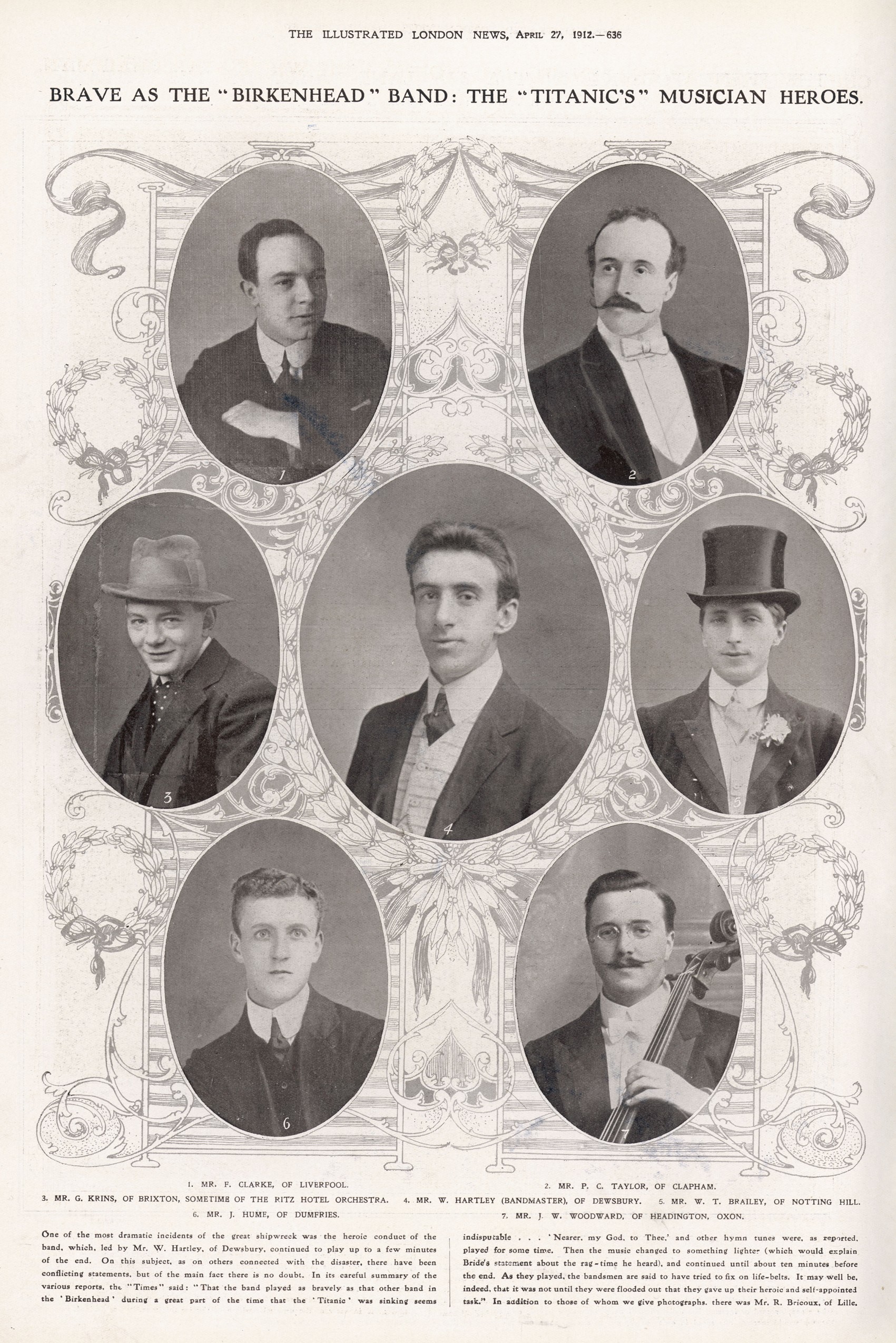
Meanwhile, far below, the musicians tune up for the last dance, which (for the convenience of the men of first class who will shortly be boarding the lifeboats) is to be held en travesti. Letter to the editor, New York Times 4 August 2016:

It is time for responsible Republicans to abandon the sinking ship into which Donald Trump is poking holes and set about fine-tuning their primary system to prevent this travesty from happening again.

https://upload.wikimedia.org/wikipedia/commons/6/6b/Titanic_orchetra.jpg

Airship with airboat

If they’re to continue bearing our consciousness through the restlessly changing universe, the forms of our knowledge will also have to change. The men of this image, for example, are enclosed in a form shaped for the knowledge of earth and water. Soon, but not yet, it will be reshaped for the knowledge of air.

But not yet because the men don’t yet have a new name for their old form. They are still bound to earth and water by the old name, and they haven’t realized yet that the form’s impending ascent into air has left the name’s primary referent behind and reduced what is left to metaphor.

The name is Gondola. On earth, Gondola signifies transit through narrow waterways in a city delimited by history and language. But when this gondola ascends through limit-disdaining air, the men it bears within will learn that it needs a new name. With that revelation, the renamed form will be changed. It will no longer be made of boat-wood and boat-rope and sailcloth, and so it will no longer have to be thought of as boat-shaped. The men in the image can’t yet speak the new form’s new name. They are still under tuition in the Venetian dialect of the old form, a dialect that includes the term gondola. But between the student Venetians and us an educational caption at the image’s front plane promises that the new name will, in time, be taught. If the men there on the other side of the caption won’t have time to learn it, at least we on our side have already been taught that it will be learned.

For now, too, the caption teaches us something we can say in our own language about the language of the men in their gondola. It has to do with the limited time available for them to learn in, it’s in history’s own aesthetic form, and in that form it repeats once more history’s own unchangingly fascinating witticism: Little do they know.


Source: The Miriam and Ira D. Wallach Division of Art, Prints and Photographs: Photography Collection, The New York Public Library. “Ausbildung von Zeppelin-Mannschaften an dem Schulschiff Hansa.” The New York Public Library Digital Collections. http://digitalcollections.nypl.org/items/510d47de-024d-a3d9-e040-e00a18064a99. Photoshopped. The caption translates as, “Training of zeppelin crews on the school ship Hansa.” Hansa’s period of service as a trainer (Wikipedia, “LZ 13 Hansa”) dates this photograph between early 1915 and August 1916.

With many thanks to the New York Public Library for its newly released collection of restriction-free digital images.


A tree for Walter Benjamin, author

At the bargain price of $16.78 from Amazon.com, the shirt comes with an almost superfluous bonus: hanging from a button, a tiny four-page book that attests to the shirt’s pedigree. This shirt, the pedigree book certifies, isn’t just a shirt; it’s a Chestnut Hill. And then it humbly asks us (us! us, the undocumented!) to accept it.

In the United States there are at least two Chestnut Hills: a neighborhood of Philadelphia and a suburb of Boston. Both of those Chestnut Hills are upscale, accessorized with architecture that communicates the patrician values of old houses and old money. The chestnut tree (pictured) also has a sturdy American symbolism, as in Thanksgiving stuffing and the first two stanzas of Longfellow’s once beloved poem “The Village Blacksmith”:

Under a spreading chestnut-tree
The village smithy stands;
The smith, a mighty man is he,
With large and sinewy hands;
And the muscles of his brawny arms
Are strong as iron bands.

His hair is crisp, and black, and long,
His face is like the tan;
His brow is wet with honest sweat,
He earns whate’er he can,
And looks the whole world in the face,
For he owes not any man.

the-village-blacksmith-granger

However, the chestnut tree itself is now almost extinct in the United States, wiped out early in the twentieth century by a parasitic fungus. In the financialized American economy of the twenty-first century, too, the line “He owes not any man” retains little of its primitive truth-value. In the days of Longfellow it connoted virtue, but now it is only a nonsense, with the additional connotation of irresponsible naïveté. And as to combining the best of American style with a sophisticated European sensibility, the shirt itself is made in China.

So the Chestnut Hill where this pedigree has originated can’t meaningfully be thought of as a visitable place in the physical world, with a latitude and a longitude. All it is, as it looks up at us from the page of its little book, is a concept. Here in the pedigree, its name isn’t to be read as the word “Chestnut” followed by the word “Hill,” with each term referable to the atlas. Instead, it’s to be read as a portmanteau form consisting of two inseparable parts, each deriving all of its meaning from the other. On its own, the first part, “Chestnut Hill,” is actually meaningless. It is a term from an atlas without a geography. On its own, the second part, “®,” is meaningless likewise. It is a term signifying the legal status of a word outside any of the laws of meaning. But when the two parts are brought into meaningful juxtaposition by an economic motive, each becomes a lexeme. The combined word-like object that results, “Chestnut Hill®,” has no textual meaning that might be referable to any document except its own pedigree, but there in the pedigree it becomes something that means. It means in an especially luxurious way, too: silently, drawing all of its wordless significance from the body which it has colored by being put on and buttoned up.

But the pedigree also has a verso: this.

The recto, a series of roman constatives demanding to be read as facts, is actually fiction. The verso, an italic simile asking to be read only as a poem, is actually non-fiction. We can’t read the simile as anything but a simile: a closed semantic system with a tenor referring only to its vehicle, which in turn refers back only to its tenor. Into that closed system the lying world cannot enter. Nothing exists there but the system’s own words. Because the words cannot be falsified there, they are either true or meaningless. And Walter Benjamin, Author, comes naming himself onto the page to assure us that he’s still speaking to us, and therefore he’s still alive, and therefore the words on his page are true.

But are the trees in his picture chestnut trees?

I don’t think so, but I’m willing to believe the document that delivers their image to me. In words, they are something warm, to be worn silently on the body.


Track; buttress

Framed by his open rear window, the conductor of the Putnam Avenue trolleycar has his eye on the curved track rising behind him. The car is moving on schedule through space and time. It and its track, all the other cars and all their tracks, have become the seen parts of a steel and stone structure rising buttress by buttress toward two piers in the hazy sky, and a wall of towers rising still higher beyond them. This construction in space and time dates from the summer of 1908. Click to enlarge.

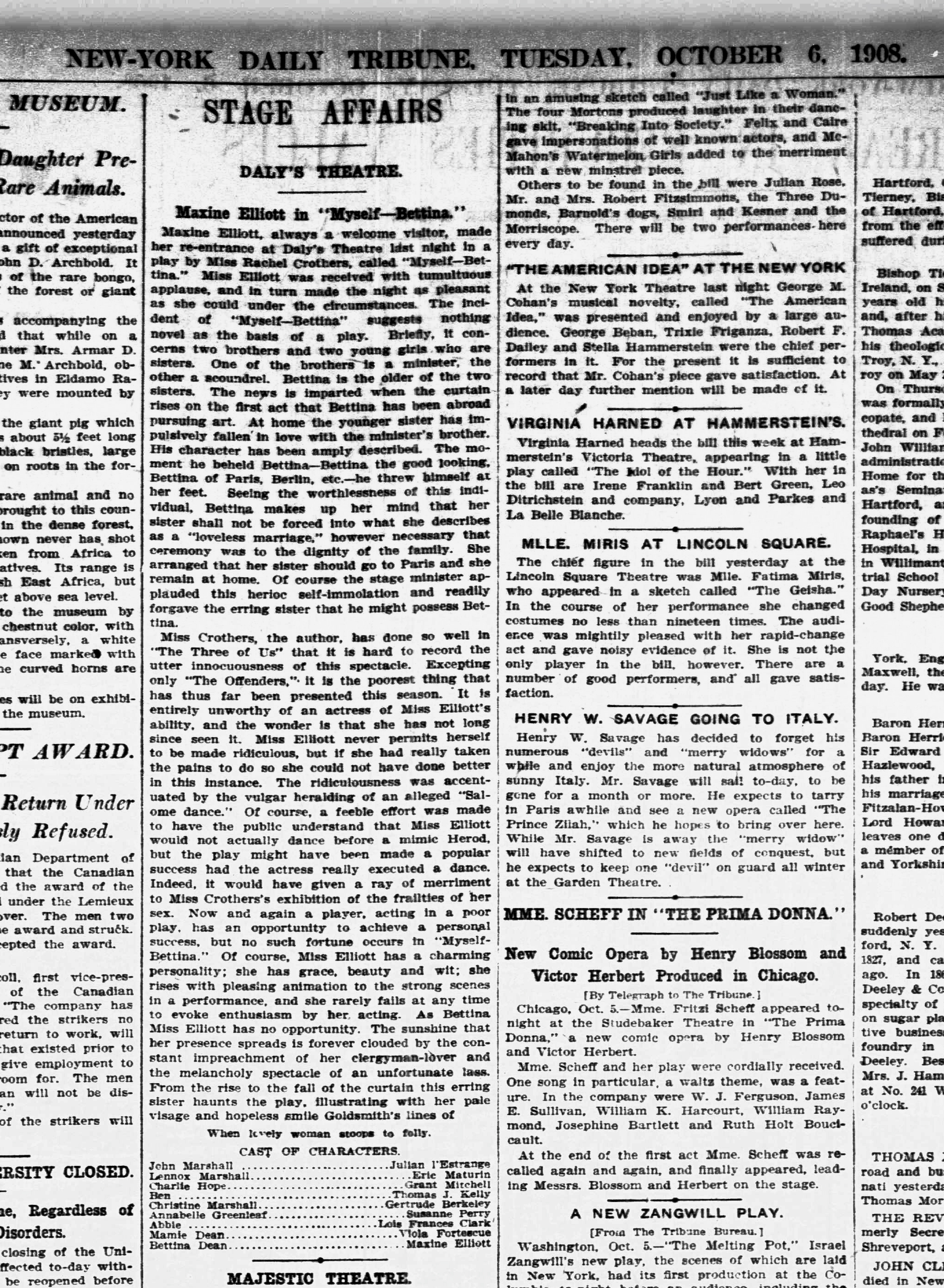
Toward the image’s right edge some words offer us a way of reading New York 1908. Our own New York, it turns out, is different. “Try Horsalene Salve today,” counsels a billboard advertising a skin-care product — but then the words spoken in 1908 canter away from us, laughing as they whinny, “if you want to use your horse.” Oh yes: Horsalene as in ha ha Horse! And to the left of the horsewords another billboard informs us that one of Broadway’s biggest stars, Maxine Elliott, will soon — that is, far in the past — be at the Grand in a new play, Myself — Bettina. Read into the past, the billboard’s nouns and pronouns (“Maxine,” “Myself”) become imperatives. They require us to transfer our desired object of vision from a single image we will not be able to see to an archive of images once actually seen by others.

In the archive, closed off from such distractions as the woman actually seeable on the sidewalk far below the Putnam Avenue car, we’ll find that Myself — Bettina happened to arrive on a different schedule from the one published on the billboard. It didn’t open at the Grand in November; it opened at Daly’s in October. In fact, it barely even made it into November. According to the Internet Broadway Database, it ran only 32 performances, from October 5 to November 1. All four of the reviews I’ve read online (in The Forum, The Smart Set, and the New York Times and Tribune) are negative. Twelve years after Harold Frederic’s novel The Damnation of Theron Ware offered reviewers an opportunity to visualize a small American town populated in its religious district by a sophisticated Catholic priest, his atheist friend, a cigarette-smoking aesthetic girl, and a bumbling Methodist minister, the reviewers lined up along Broadway to complain that the small-town religious architecture of Myself — Bettina was visually obsolete.

Imagine reading this review as you rode the Putnam Avenue car onto the bridge. Imagine, then, deciding not to proceed uptown to Daly’s Theatre and see the show. But just below and to the right of the Tribune’s view of Myself — Bettina, another headline announces the scheduled arrival of a play which in the event will stay and stay and stay onstage, and then transit into literary history. It’s a melodrama just as silly as Myself — Bettina, but unlike Myself — Bettina it came to Broadway from London equipped with a title that was useful on the approaches to the Brooklyn Bridge. Under New York’s smoky skies, it suggested: “With Ellis Island busying itself in the harbor, your world is changing. So stop thinking of yourself with that antique conception, ‘Myself.’ Instead, think of yourself as a thing: a thing continually changing into a newer thing — a thing as wonderful as, say, a bridge capable of spanning the world. You can do it! After all, you are in [pause; then, with emphasis] The Melting Pot.”

But here on the buttresses of the approach, melting has not yet occurred. The innocent words of the billboards facing into traffic still speak to us only of using our horses and eating our superior macaroni. Hart Crane has not yet imagined the Brooklyn Bridge as “harp and altar, of the fury fused.” But see the buttresses and read the reviewer’s complaint about a drama unwilling to register that which, on the immediately available evidence of the senses, was then seen to be making the Putnam Avenue trolleycar rise to the towers along a buttress’s curve. As of 1908, Hart was only a nine-year-old in Cleveland, waiting. But the bridge was already open for business.

Sources: “Approach to Brooklyn Bridge, Brooklyn, N.Y.” Detroit Publishing Company Collection, Library of Congress, http://www.loc.gov/pictures/item/det1994005064/PP/. Photoshopped.

New-York Tribune, 6 October 1908, p. 7. Library of Congress, http://chroniclingamerica.loc.gov/lccn/sn83030214/1908-10-06/ed-1/seq-7/. Photoshopped.

Performance history of Myself — Bettina: Internet Broadway Database, http://ibdb.com/production.php?id=6595

“Hordes”: an attempt at visualizing the metaphor


Source: George Grantham Bain Collection, Library of Congress, http://www.loc.gov/pictures/item/ggb2005022285/. Photoshopped.

In The Great Gatsby, the title of the book that disturbs Tom during the summer of 1922, The Rise of the Colored Empires, by “Goddard,” is an accurate topical reference to Lothrop Stoddard and the propaganda campaign that resulted in the Immigration Restriction Act of 1924.