Teaching undergraduate literature at second-tier universities in the late twentieth century, I used to get lucky with “The Use of Force,” a short story by a modernist poet who earned his living as a pediatrician. He wrote it in 1938, as a kind of casenote.
“You know,” I’d suggest to the class, “this is a story about rape.”
“No!” the class would roar back. “The man is a doctor! He’s trying to help the little girl!” But then we would start actually reading the words that the doctor actually wrote, and faces would light up.
But after the late twentieth century gave way to the early twenty-first, the lights stayed off. “Big deal,” jeered the 19-year-old healthies seventy years after 1938. “Every male-female relationship is a rape.” So I stopped teaching “The Use of Force.”
And after all, by then there remained few physicians who had ever even seen a case of diphtheria.
But oh, Mr. Secretary Jr.: how wonderful the word “again” may be about to become again.
Colorized or in black and white, Arnold Genthe’s 1914 photograph of Edna St. Vincent Millay with a magnolia tree is well known. Less well known, however, is that the original image itself is in color: an Autochrome transparency. An obvious reason is that it’s too dark.
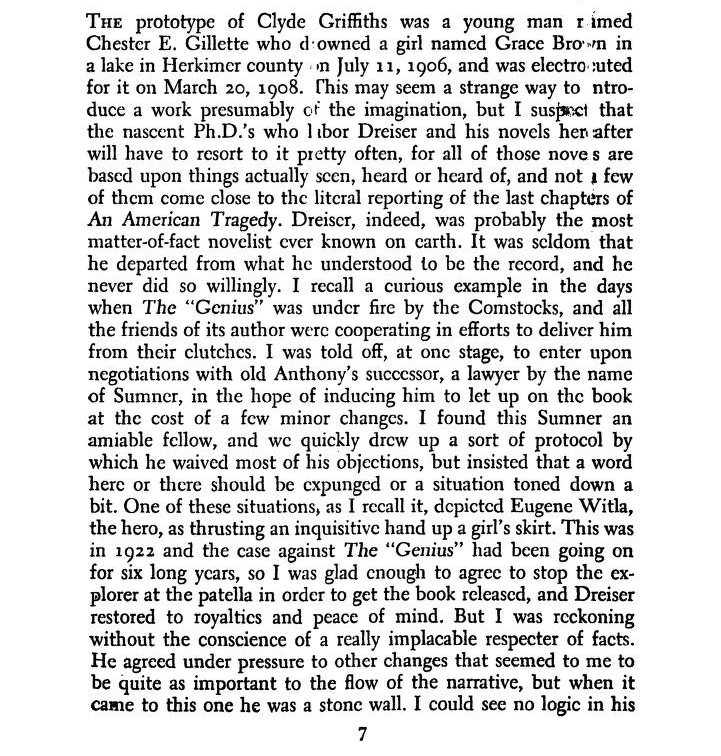
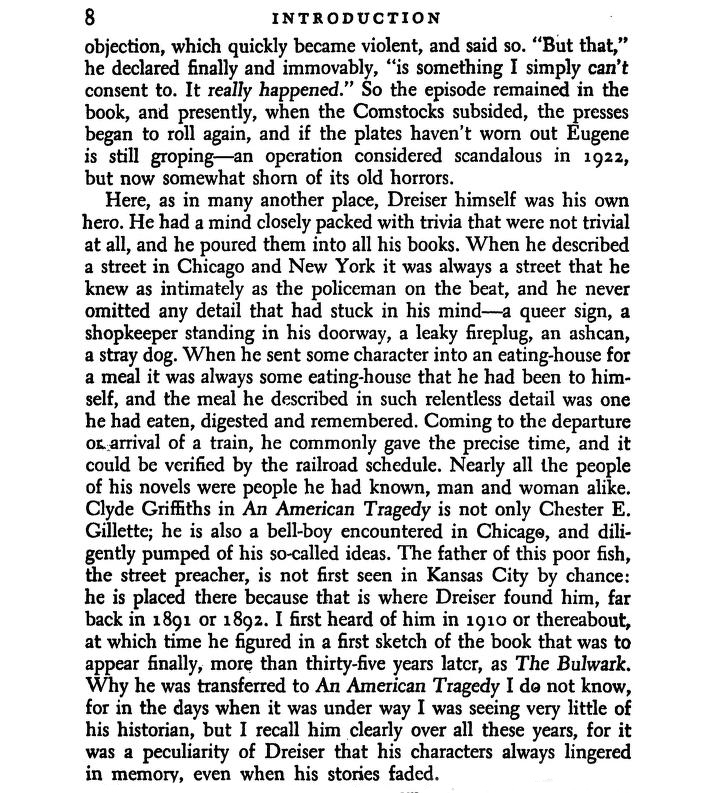
In 1925 the two big volumes of Theodore Dreiser’s novel An American Tragedy were published nineteen years after the occurrence of the one little non-fiction on which they were based: a small-town murder, followed by the murderer’s apprehension, trial, and execution. Bit by bit during the nineteen years, Dreiser laboriously traced the historiographic relationship between himself and those data. For the 1948 World Publishing Company edition of his final transcript, H. L. Mencken explained:
“It really happened”: italicizing Dreiser’s words as if they were foreign, Mencken distanced them from his own. He seemed to assume that he himself wrote under the control of a literary norm, whereas Dreiser’s discipline was something like an autobiographical sociology.
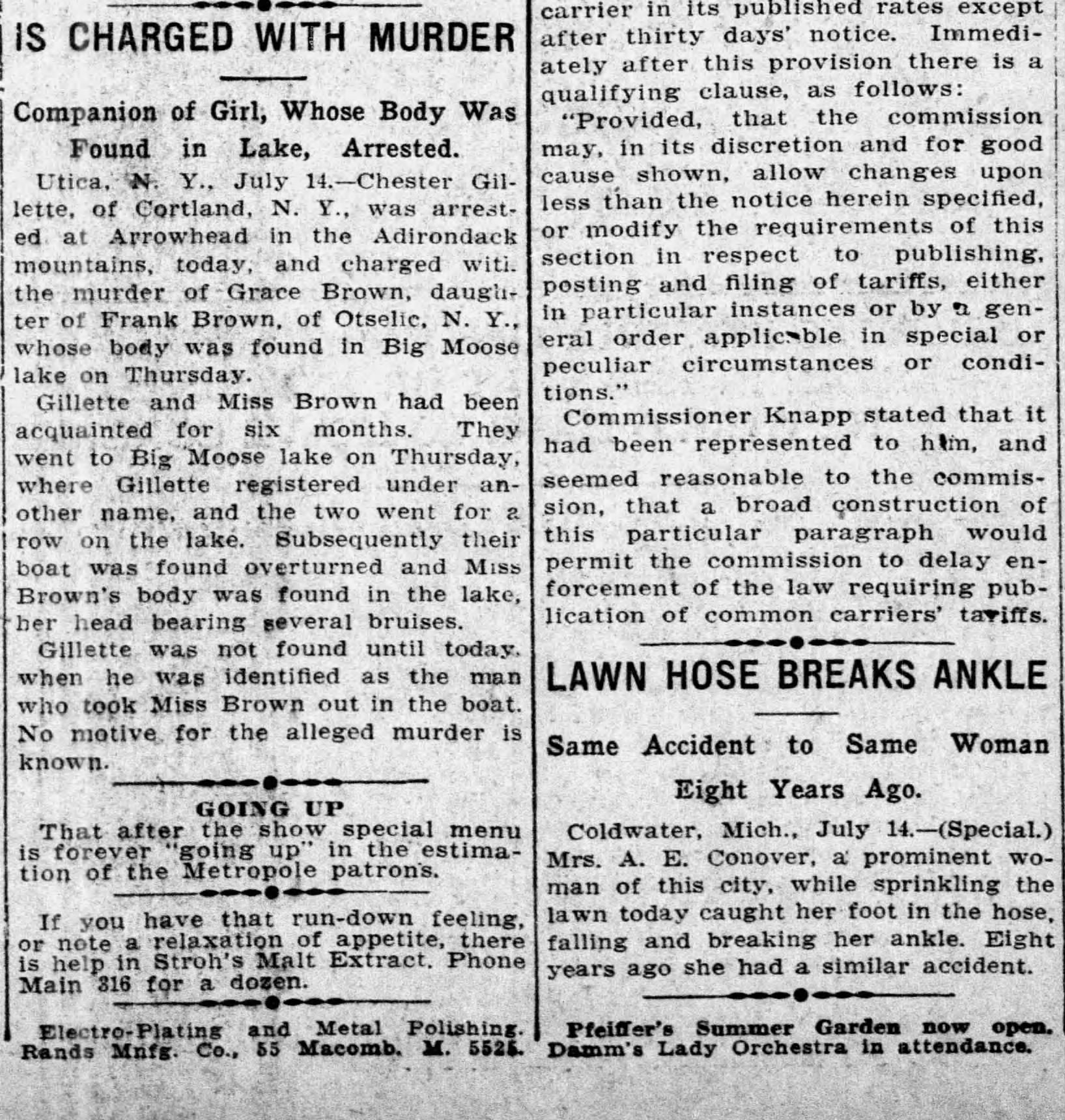
But the source of the language that immersed Dreiser wasn’t entirely under Menckenian genre control. Look below, for instance, at this twinned pair of stories from the Detroit Free Press for Sunday, July 15, 1906. Together they were printed on the front page.
There below the fold they appear side by side: first an early text of the upstate New York drama of Chester Gillette; then, with no space whatever between, the text of a drama closer to Detroit. The Detroit text and only the Detroit text is tagged “(Special).” It also comes to us marked with a time term, “Eight years ago,” which points to the little did she know genre of dramatic irony. A mere six years after Chester’s boat capsized, the Titanic went down.
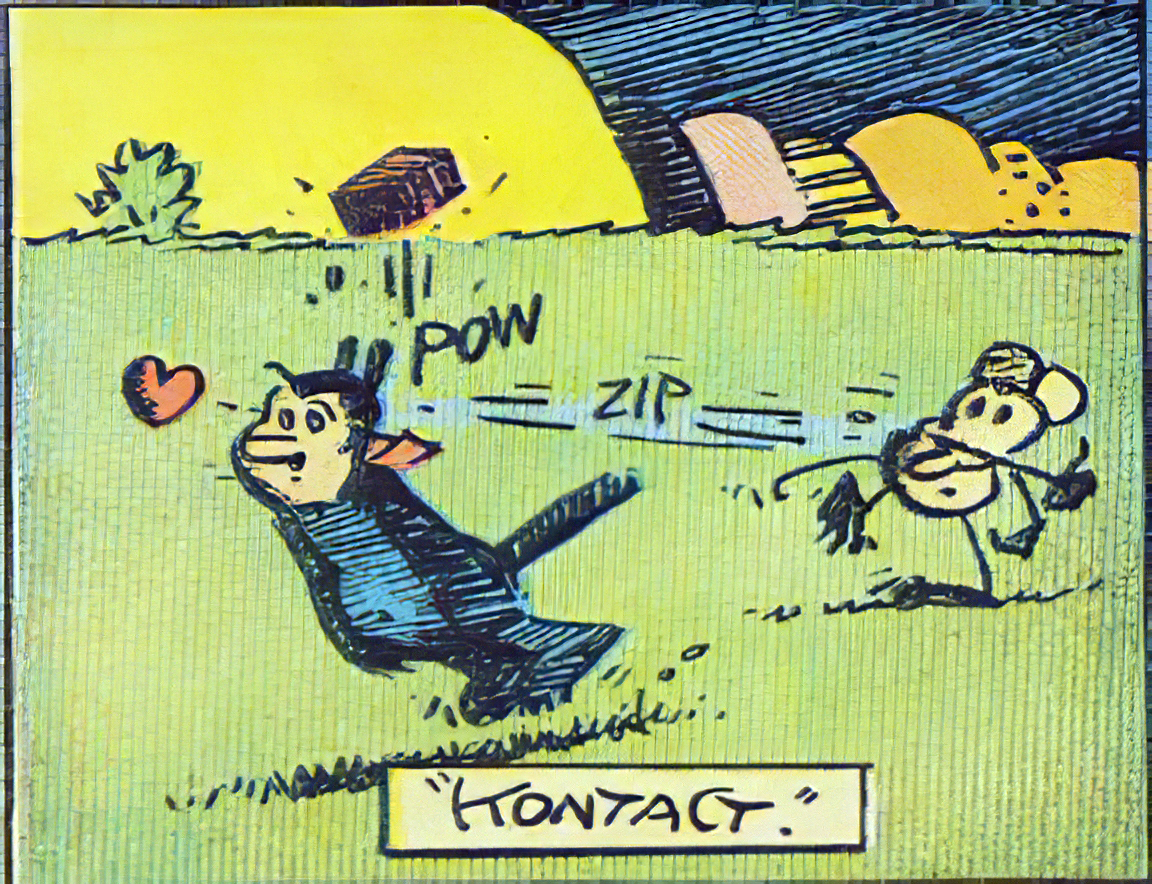
On a page, such a pairing of texts becomes one more text. Think of the infinitesimal between the liftoff of Ignatz’s brick (Zip) and its touchdown on Krazy’s head (Pow). Think of Ignatz and Krazy’s George Herriman as a geometer writing an equation that reveals that curve through time as one more thing: uniting the mouse, the brick, and the cat, their integrating idea.
Think of Herriman’s no longer read older contemporary Theodore Dreiser as almost another such artist, but this one the one who wrote thousands of slow words about a trajectory through time without being able to name it. Little did he know: its name was the infinitesimal Zip.
In 1930, in his early middle age, William Faulkner bought an unoccupied nineteenth-century house in his Mississippi home town. The next year he gave it a name, Rowan Oak, and began the remodeling that would occupy the remainder of his life there. As the transformation into an ancestral estate went forward, the estate’s on-site storyteller devised a tradition for it: every evening at dinnertime, one of the family retainers would parade the main course around the table before setting it down. Perhaps the idea was that this would mark the end of one day and the beginning of the next, for always.
Before dinner, the Modernist storyteller had been teaching language some things about time that would make tradition obsolete. In that telling, Quentin Compson had begun the day of his death by tearing the hands off his father’s watch.
2
Chris Wiley’s essay “What Old Money Looks Like in America, and Who Pays For It,”
introduces the work of Buck Ellison, who photographs carefully staged tableaux of models wearing the very best of understated fashion in the very best of settings, with every blade of grass on the putting green just so and the outdoor or indoor weather always perfect. Before the first image reveals itself, the prose prepares us this way for the responsibility of seeing it.
It’s the cut of the jacket that’s the dead giveaway. The graceful arc it draws above the woman’s waistline looks architecturally engineered, its hourglass effect enhanced by tastefully wide peaked lapels. The fabric, too, looks sumptuous. Cashmere? Probably.
Wiley mentions in passing that Ellison is gay, and the import of this deadpan scrapbook seems to be a travesti like the Trockadero Ballet — a travesti with all the wistfulness of an anatomically male body forcing itself onto pointe but none of the forced hysterical laughter. What’s being acted out through Ellison’s images isn’t at all gentle, but it is acted quietly.
After all, it is acted in The New Yorker, whose language is written in a traditional script. To the native speakers of The New Yorker’s dialect, the discreet but firmly lodged diereses in coöperate and reëlect are to be heard only at the overtones of their natural frequencies, and the ostensibly nonfictional is punctuated at strictly observed canonical intervals with understatedly Homeric descriptions of the characters’ clothes. These details of house style are themes, and they claim a moral purport. Other languages will change, says the house style to itself about itself, but I am as classic as changeless Roman marble. Simultaneously, on the advertising pages, capital is at romp, melting all that is solid into air.
3
In this 1849 print by Nathaniel Currier, one of the men at the foot of George Washington’s deathbed is identified as “Quaker, an intimate friend of Washington.” Perhaps out of Quaker modesty, his name is not named and his face is not shown. But we know the style he would speak in this silent image, because he is wearing the small-clothes of a gentleman at the end of the eighteenth century.
The other man’s face does show. The man is identified, too: with a euphemism, “Domestic.” But that is a mere pleonasm, because after all the man’s color reveals half of the unnamed truth of what he is.
The clothes reveal the other half. Close enough to the body of the father of his country to love but never to have been loved, this is a sans-culotte.
4
Bernard Faÿ, a French Modernist man of letters, saved the lives of Gertrude Stein and Alice B. Toklas during World War II by letting them live, rent-free, in his house in the unoccupied zone. He wasn’t using it himself at the time because he was occupied in administering both the Bibliothètheque Nationale and the Pétain government’s anti-Masonic program. At war’s end, he was one of the bitter-end collaborationists sheltered by the Nazis at Sigmaringen. After the war he escaped from prison with suspicious ease and crossed the French border into Switzerland, where he picked up his career where he had left off and spent the remainder of his professional life at the University of Fribourg.
There he continued his long collaboration with another right-wing Catholic, the Fribourgeois man of letters Gonzague de Reynold. The Fribourg years came and went, and de Reynold marked their passage with a tradition of his own: on special occasions, in the gallery-crypt where the culottes of his ancestors were preserved, he opened the chest and dressed up.
5
How but in custom and in ceremony
Are innocence and beauty born?
Between 1925 and 1958 it went through 36 editions (Veselá 105). Every time the party line changed, the author changed his story, and he kept changing it until death claimed him. Long before then, it had became a canonical paradigm of the Socialist-Realist novel.
Translated by Liv Tadge, 1981. Moscow: Raduga, 1985. Thanks to Imported Publications (floruit ca. 1970-1989), the Socialist Camp also contributed to the aesthetics of my home with some of Ivan Bilibin’s illustrations of Russian fairy tales, an English-language book from East Germany about Soviet photography, and, from North Korea, a North Korean handbook containing useable information about the opera The Fate of a Self-Defence Corps Man and the ballet The Leader’s Noble Idea Flowers Out.
And in after years the revisions underwrote rereadings, like this sample snapshot in time.
Pages 104-123
But passim, when their changeable language tried to change itself from dead to living through metaphors like “stormy blood,” it tended to mean words like “blood” as unchangingly as could be, in words that were themselves always stably dead. Liv Tadge’s translation (the 1981 edition quoted above) omits the word, but in the biology of Cement, cement is always to be mixed with blood. That’s one of the constants of this novel, no matter what the edition. When bodies are imagined as if outside the blood-red band of the spectrum, they are to be tinted a mere livormortis.
The contrast between red and unred happens to be a little hard to see in Raduga’s Cement typography, because the only color in its presses for that run was extratextual: the green of the page numbers. Everything else about the prose was a uniform gray.
In Gladkov’s time, movies too were generally monochrome. But the cement in this 1933 movie poster is not a single shade of Gladkov gray. It is radiantly spectral.
That’s because Mikhail Dlugach, the designer of the poster, did his work of envisioning under the lights of a different spectrum: one meant to illuminate a studio, not a library. Because they were created under that regime, the stairs that lead the eye upward from words to a smiling unspeaking face are Constructivist, and the shadow of the human that has been left behind by the ascent is Expressionist. The unspeaking face’s cosmetics too come from a silent repository: the cabinet of Dr. Caligari. But the dentistry that constructs its smile is the artifact of an aesthetic dating from long after the time of Tatlin’s tower and Wiene’s asylum. In fact, the poster suggests that the smile isn’t even attributable to dentistry. For that humble domestic science its scale is too vast. On the poster’s lavishly laid down slabs of color it erects itself like a heroic architecture, and as an architecture its relation in scale to the human it is not 1920s Expressionist but 1960s Brutalist.
So think now, in the aftermath of the Brutalist era, of how the sound of your stormy pulse might have reechoed from the walls of a Brutalist bedroom where you and Comrade Dasha had shared the concrete mattress. One of the purposes of modern architecture since at least the days of Le Corbusier has been social control, explicitly stated as theory (in, for instance, Le Corbusier’s Vers une architecture), and Socialist Realist fiction provided a way to translate the theory’s language of instruction from body to text. Raise your eyelids and grin, the translated schema instructs the body waiting on its postcoital cinderblock. Then look out the window, sight down the barrel of your rifle at that string quartet in the distance, and aim.