On paper

The picture depicts a sheet of paper, matte-textured and a little wrinkled with age. Floated onto its surface has come this Baldwin airship, circa 1910, bearing the pioneer aviator Lincoln Beachey into the air on a girder.

Toward the front of the girder you can see the airship’s little motor, with its gravity-feed fuel tank and its propeller shaft extending forward. The propeller isn’t visible, though. Instant by instant, its blurry trace was taken up into the bright light as it prolonged itself up through the air. Then even the light and the air were taken up by the paper. Of the moment of seen flight no record remains except, on paper, the Baldwin.

But on that surface there have been made to remain the Baldwin’s support wires, cloth-covered empennage, sewn seams around a contained body of that which is lighter than air, and just below the gas valve the body of a man (1887-1915) unmoving now but flying then, and having left a trace of flight still on the wrinkled paper.

Source: http://californiastatelibrary.tumblr.com/post/123125863066/up-up-and-away-lincoln-beachey-san-francisco. Photoshopped.

Deal: Eternal City and complete funeral

The history, with Mr. Deal’s statement of principles on the second page:

The corpus, partially masked and undergoing decay:

“Embalmed and treasured up to a life beyond life”:

Sources: “[People standing under dirigible].” National Photo Company Collection, Library of Congress, http://www.loc.gov/pictures/item/npc2007006056/. Photoshopped.

Milton, “Areopagitica.”

Flightverb

The image in the Library of Congress’s George Grantham Bain Collection at http://www.loc.gov/pictures/item/ggb2004008125/ (click to enlarge) is gray.

Explaining to us what we’re supposed to be seeing, an appended afterthought of a noun phrase is crabbed and black.


But to add a verb is to add color.

And then light shines through a cloth-clad wing, a wave takes the light in and mates it with black, and a clause comes into being and teaches us to soar with M. Van den Born. Soaring, we enter a seabird’s bodily understanding of the word “above.”


Portrayed reminder: think about rethinking the surly bonds of earth

A century later, the image in the Library of Congress’s George Grantham Bain Collection has gone humorous, the way items remembered after oblivion sometimes do. This item stimulates us neither to nostalgia nor to tragedy nor, thanks to the costume’s baggy knees, to the thought of eheu fugaces labuntur anni. The name “Hydroaeromaid” is comical too, with its philological odor of a tavern by a school during the Georgian era (“Ho, maid! Bring me a tankard of nut-brown ale whilst I construe me lines!”). * And so, looking at the image brought back to light, we laugh.
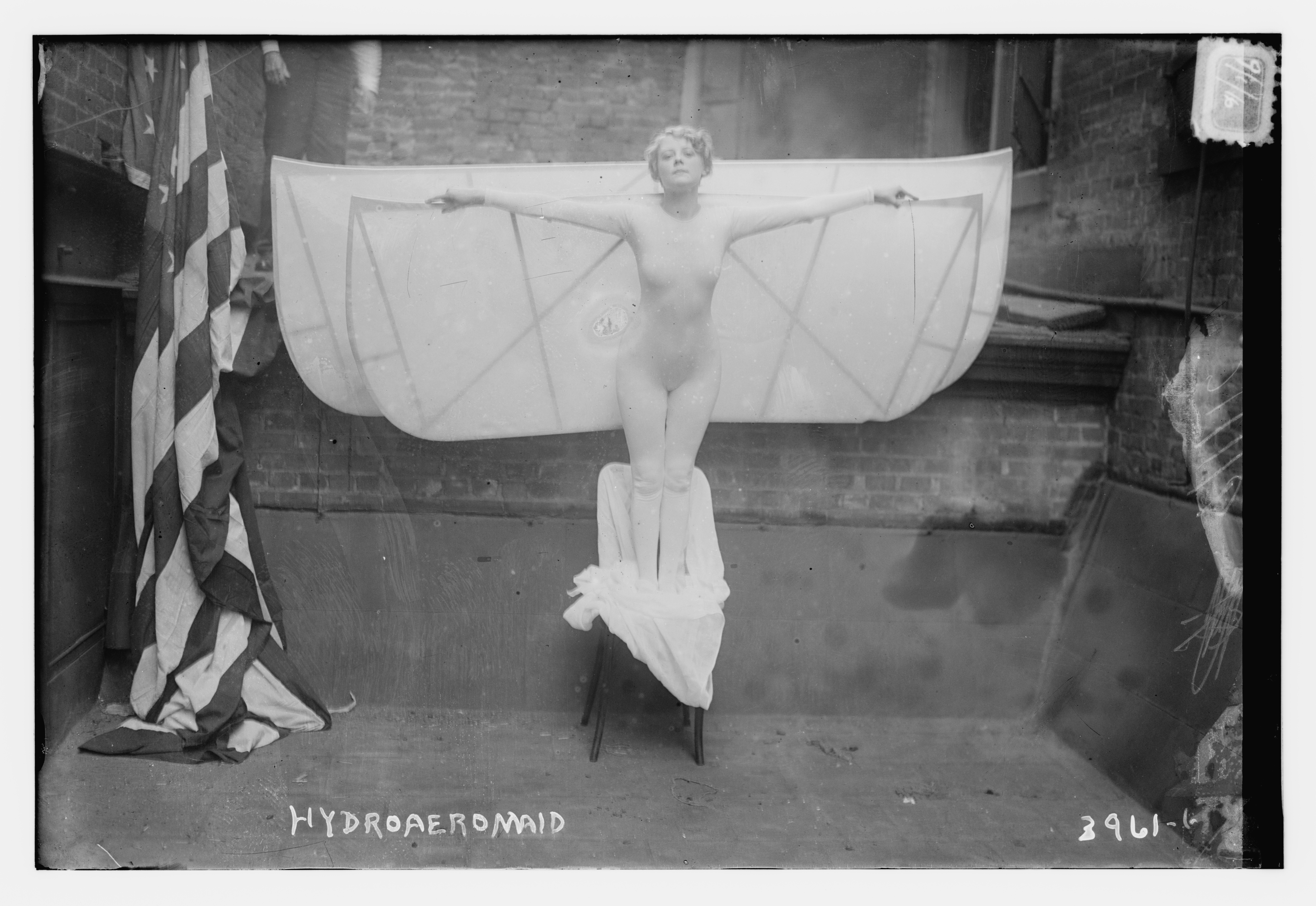
22635u

And because the light has been merciful and faded out some of the details, we photoshop. We wield the controls in the spirit of the post-Georgian nymph Dorothy Parker, who wouldn’t have been caught dead with baggy knees.

But long after the era of Dorothy Parker has passed, the girl in the image is still standing on her chair. What would she be now? What was she then, out of the uniform that was once fitted onto her by comedy in one of its sergeant-major moods? If we looked at her in a different way through Photoshop, would we be able to think of her now not as a what but as a who?

I look.


And then the image comes to me of an airplane seen at morning in a novel written just after the Georgian era, when the sight of an airplane was still something new:  Mrs. Dalloway.  By the end of Mrs. Dalloway it is nighttime, and in 1923, the year Mrs. Dalloway was published, airplanes generally weren’t flown after dark. But Mrs. Dalloway has returned home and changed her clothes, and the book’s last sentence ascends from the light of its page like an image newly revealed after a long darkness:

“For there she was.”

Source: http://www.loc.gov/pictures/item/ggb2005022645/

* Or, since the flag in the picture is American, of Owen Johnson’s Stover at Yale (serial publication 1911, publication as a novel 1912), whose hero fills his days quantum sufficit playing football, doing Latin, and adjourning to Morey’s for a toby of musty.

Update: from a pair of notes by Art Siegel at https://www.flickr.com/photos/library_of_congress/14440864879/ we learn that the model is named Pearl Palmer and she is posing for a trophy. Mr. Siegel also links to a not very clear contemporary photograph of the trophy, and the New York Tribune published this note about it on August 20, 1916, p. 13.

Trophy article


Shadow: for the solstices

The prose says: over the bay in San Diego in late December 1910 or early January 1911, a race was flown between the pioneer aviators Eugene Ely (who made the first flights in history from shipboard) and Hugh Robinson (who invented the tailhook that Ely used and then went on to formulate the concept of dive bombing).

Look up.

The prose says: on June 26, 1911, over what was then the German kingdom of Württemburg, in the service of DELAG, the world’s first airline, the zeppelin Schwaben flew past the railroad track down which was steaming the Offenburg-Freiburg Express.

Look down.

The prose says, “It was sure great.”

The solstitial light says something that can’t be said in words.

Note in prose: DELAG (Deutsche Luftschiffahrts AG, “German Airship Transport Corporation”) began operating on a regular schedule between cities in Germany in 1909.

Sources:

San Diego Air and Space Museum Archive, R. H. Macdonald album AL-75, image 00011. https://www.flickr.com/photos/sdasmarchives/14197432491/in/photostream/

“Wettrennen zwischen Schnellzug und Luftschiff,” http://timelineimages.sueddeutsche.de/wettrennen-zwischen-schnellzug-und-luftschiff-1911_192800

Both images photoshopped for contrast and sharpness.