
American literature
Topical reflux
Even with our eyes upcast from the ground, we’ll probably have to acknowledge, sooner or later, that we are periodically overwhelmed from low within by something brute. The evidence is in the record. Twentieth-century Anglo-American literary history, for instance, yields up a whole alluvium of anecdotes about F. R. Leavis and Delmore Schwartz. Leavis, of Cambridge, was a critic who happened not to be able to write, read, or think; Schwartz, of Harvard, was a poet whose works are vanished now except for a single short story. But no one ever recovered from a seminar with Leavis or a conversation with Schwartz, and during their lifetimes those wordy men exerted a mute musclepower.
The nature of that relationship between us subordinates and those dominants has proved to be historically reversible. The century-old short story you’re about to read was forgotten long ago, and of course (you’re about to say) deservedly. Dating from the epoch of modernist literature, it never became literature itself. On the page before you it’s only old journalism: a few paragraphs on browned old paper, written in words whose developing language system moved out from under them and left them behind. But this year, see if this story doesn’t affect you in a way that seems new: new again for the first time in a century and therefore actually new. The developing language system has given you new powers and simultaneously deprived you of old ones.

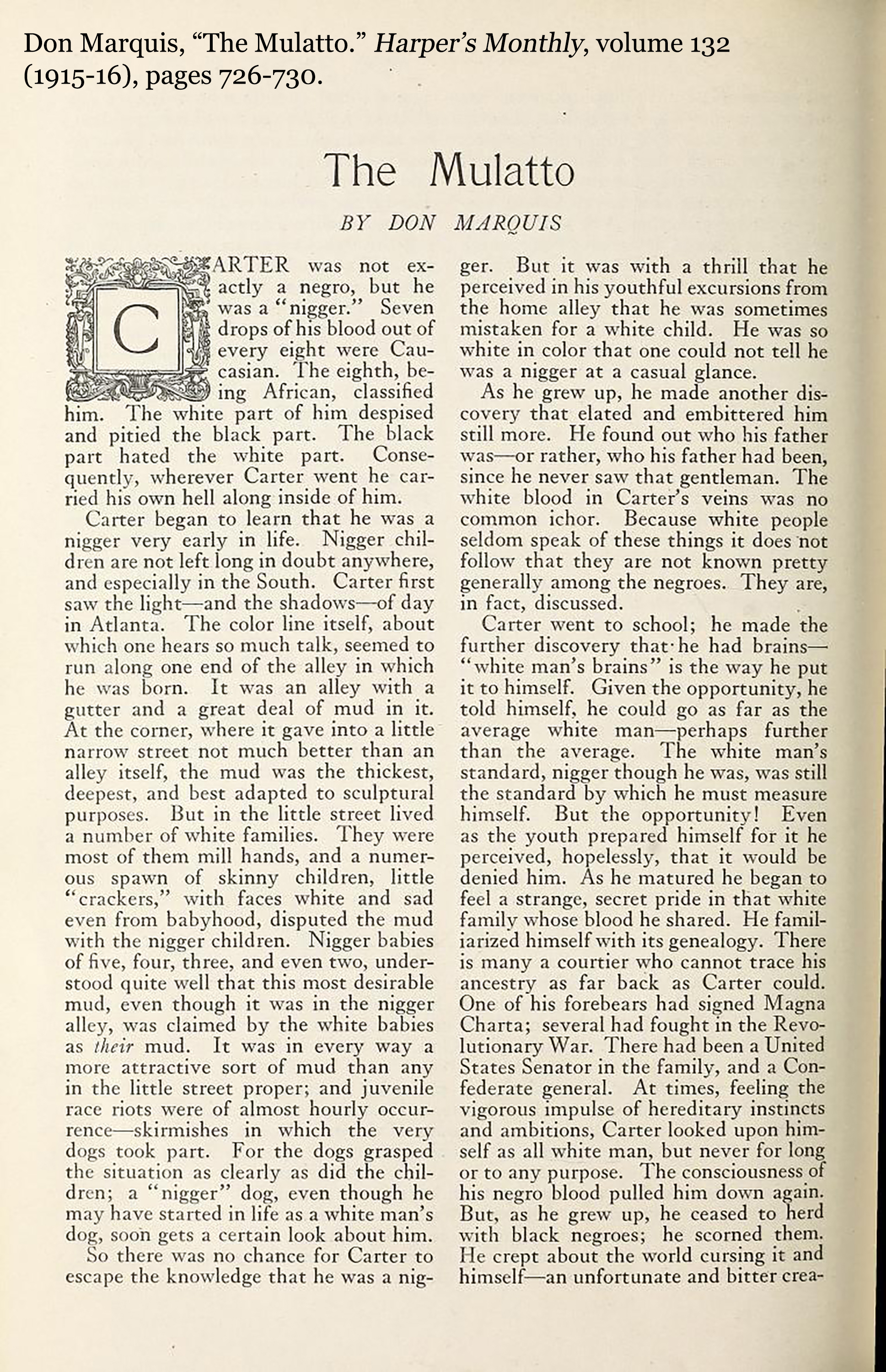
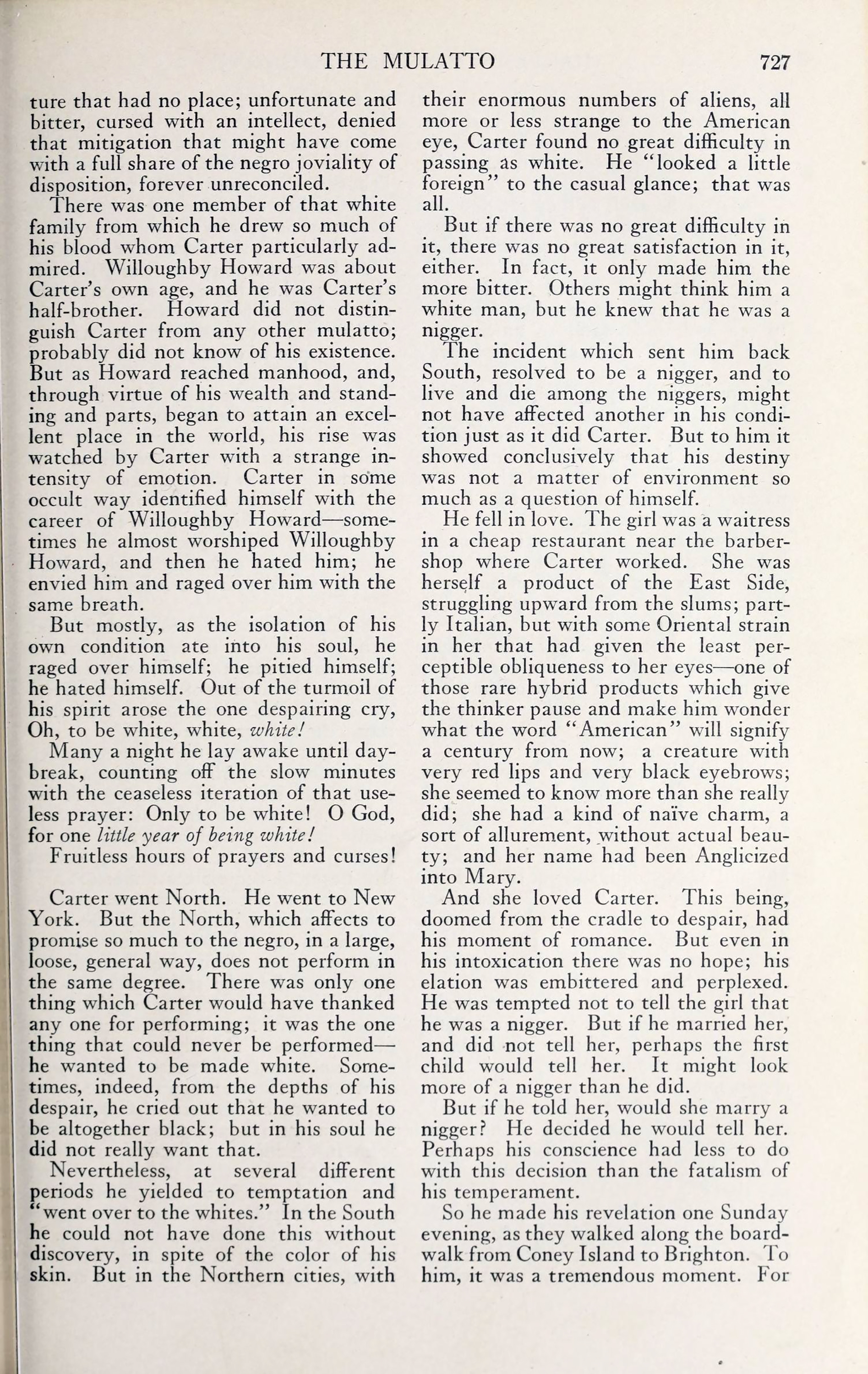
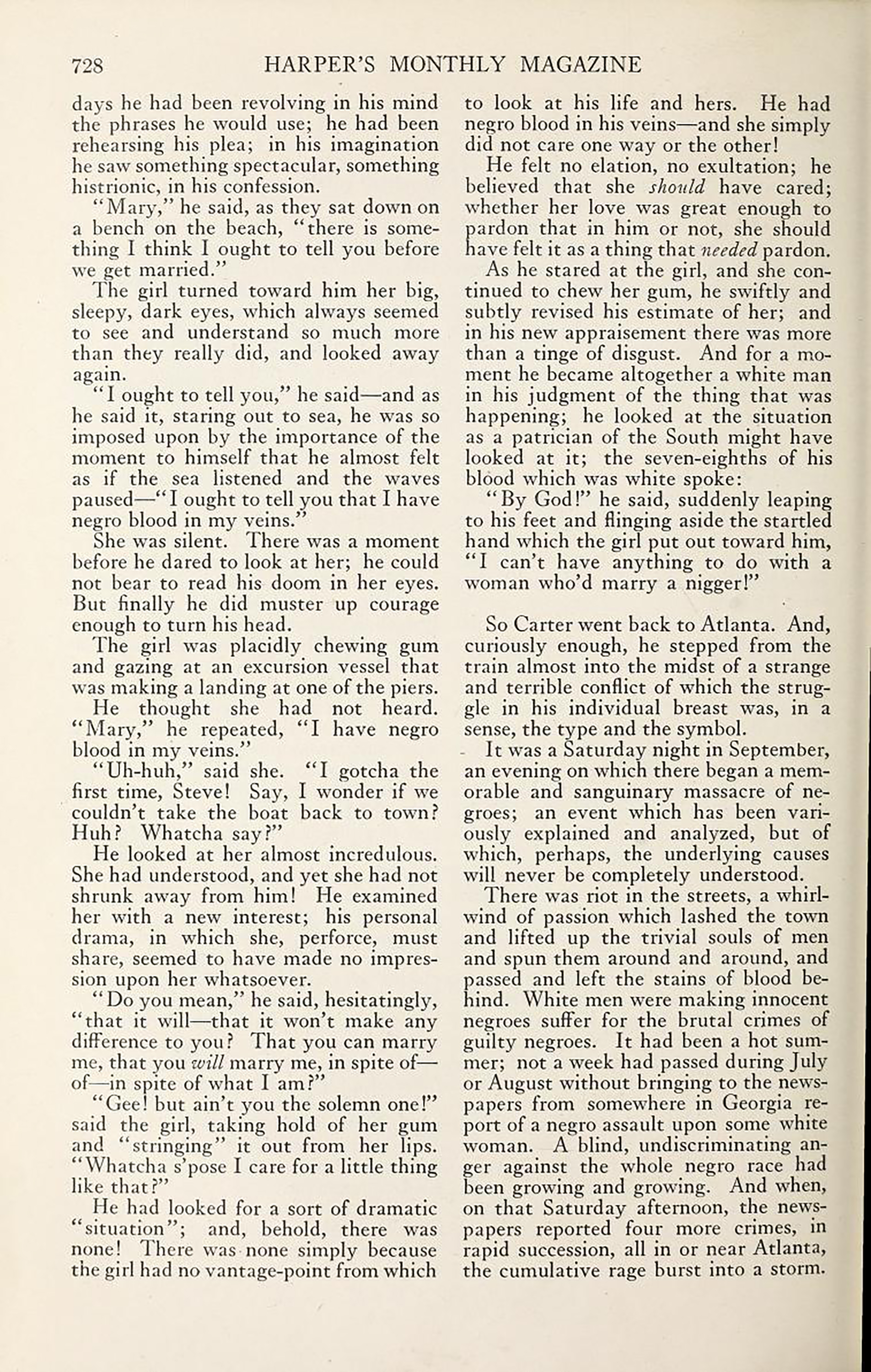
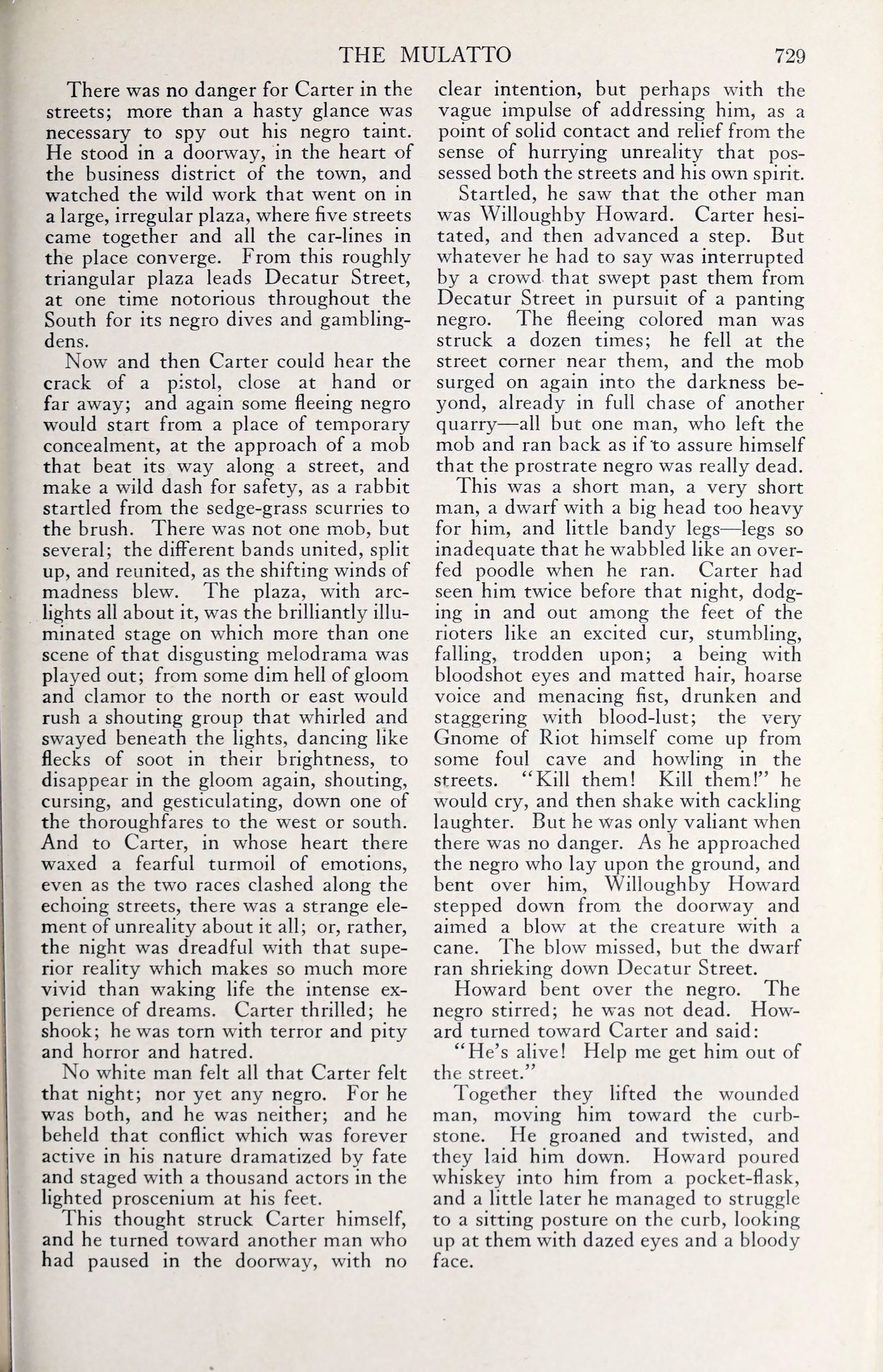
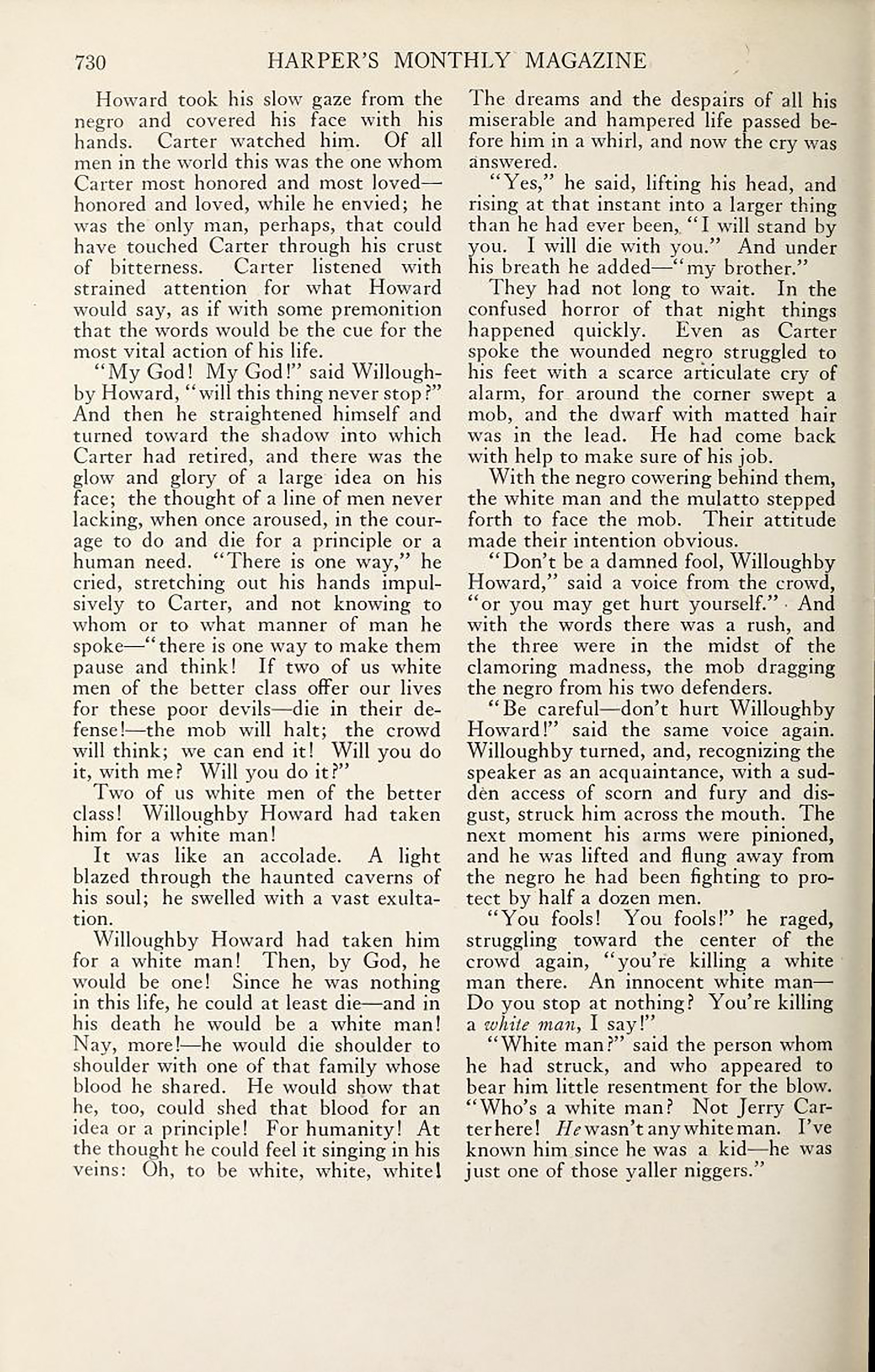
During his shortened life (1878-1937), this story’s author, Don Marquis, expressed himself in genre after genre through persona after persona, but what lives on now in words is only the persona you see in fine print here: Archy the cockroach poet.

And Archy himself was later to undergo the defining final stage of his metamorphosis at the hands of a graphic artist who (unlike Marquis) had a line in modernist textuality. That was George Herriman, the creator of Krazy Kat.
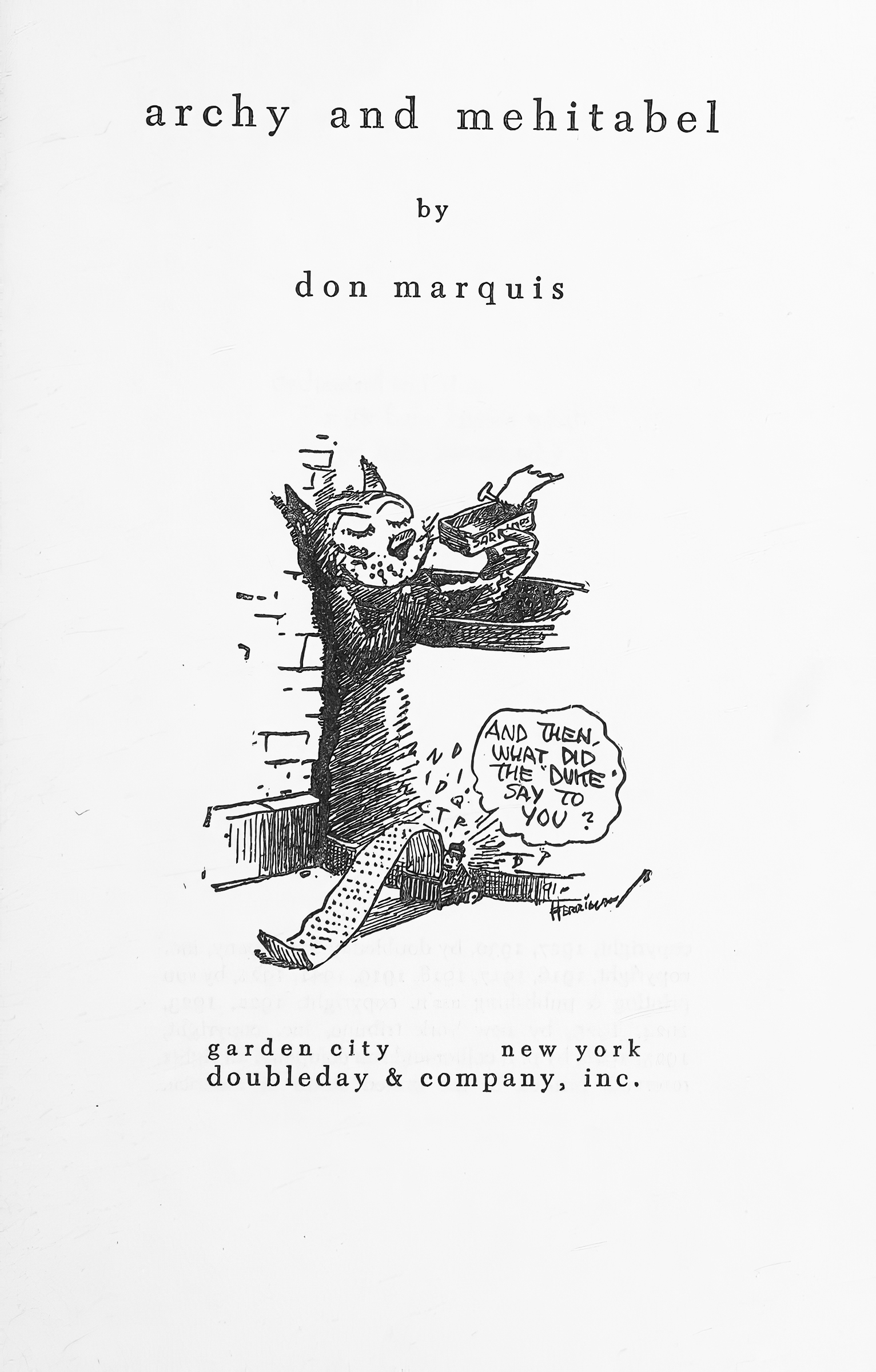
Nevertheless: because the image that you’ve just seen probably moves you, the short story that you probably haven’t really read moved you too, whether or not you knew at the moment that the transport was under way. You can test that assertion by keying it to a single probative fact:
Like the protagonist of “The Mulatto,” George Herriman was a black man who passed as white.
I wrote and bolded that sentence on May 26, 2025. If it had been written on May 26, 2024, it wouldn’t be readable now in the circa-2025 way you have just read it. Its relation to the verisimilar would be deeper-rooted. The change occurred during the interval between 2024 and 2025, when history’s personal force came rushing in an inaugural January flood between you and 2024’s older, loamier way of reading. Upwelling from undetected whiteness, it washed away some of the words you used to read with. As it came, it didn’t just dumb language down; it rooted it up and dumbed it away.
You can see for yourself how blank the page beyond Marquis and Herriman looks now. Until the white subsides, it may be all there is going to be.
Archy: cockroach and statuary
In his New York Evening Sun column for January 27, 1917, Don Marquis reported that an artist named Helena Smith Dayton had executed a statue of Marquis’s correspondent Archy, the poet whose soul had transmigrated into the body of a cockroach. On January 30, Archy himself responded,
i
stared at the statue and the statue stared at
me and i resolved in the future to be
a better cockroach of course it doesnt flatter me
any my middle set of legs arent really
that bowed but the intellectual look
on my face is all there
I haven’t yet found an image of the statue, but in the restored image below you’ll find some other works from Dayton’s oeuvre. She called them clay cartoons.
Don Marquis, The Annotated Archy and Mehitabel, ed. Michael Sims. Penguin, 2006.
Richmond (Virginia) Times-Dispatch, August 30, 1914, section 6, page 1. https://chroniclingamerica.loc.gov/lccn/sn85038615/1914-08-30/ed-1/seq-39/
Her first book

Historical resource: Whitman’s Broadway and Brooklyn Ferry
“South Ferry.–The Omnibus,” about 1865.

The stereo pair with contrast and detail restored

An anaglyph of the stereo pair (requires red-and-blue stereo viewer)

Silver Practise: The 1847 Daguerreotype of Emily Dickinson
That’s the title of my new (and free) Issuu photobook about (1) photoshopping the only known photograph of Dickinson to bring out detail, and then (2) thinking about what then makes itself seen. Click here:
Scientifically cool, with new cartoon
Observation on the basis of iconography: American cultural history and American literary history seem to be arguing for new study of the once famous, now forgotten Georgia novelist Erskine Caldwell (1903-1987). See below. The second icon depicts the office of House Majority Leader Nancy Pelosi during the Republican insurrection of January 6, 2021, when the United States Capitol was occupied by a paramilitary force of Caldwell grotesques.
Grotesques were a Caldwell specialty; grotesques and lurid sex scenes. A cruel laughter pervades. But Caldwell was also a serious liberal who collaborated in 1937 with the photographer Margaret Bourke-White on a documentary book, You Have Seen Their Faces, which showed its readers some of the things that the South’s chain gangs and sharecropper economics had done to faces and bodies. Soon to become Caldwell’s wife, Bourke-White was one of the foremost photojournalists of the twentieth century, but when You Have Seen Their Faces is read in the twenty-first it’s read only for educational comparison with James Agee and Walker Evans’s Let Us Now Praise Famous Men, which was published in 1941 and went virtually unread at the time. In her history of that exchange of reputations, Janet Holtman suggests a reason why: Caldwell’s attitude toward humanity, which was naturalist tending toward eugenicist. In retrospect, where the literary judgments are made, Caldwell’s characters have turned out not to be fully human. We remember Agee’s three families for their souls, but we recognize Caldwell’s type species only for their pathognomonic signs. And the faces photographed by Bourke-White in the service of Caldwell’s vision were reduced by his captions to the function of medical illustration.
But oh, go ahead and notice the Bible in the pocket in Caldwell’s image 3. The Caldwell way of seeing is still available to you after all — if not photographically, at least verbally. After all, too, the initials N.A.L. stand for New American Library. So go ahead: read. Then, if you can, laugh. Laughing, close thy Agee. While thou art at it, close thy sentimental Steinbeck too. Instead, if only as an experiment, open Caldwell and see if he can be thine. Consider it possible that the maimed humor characters who swarm through his language actually are happy with what it has done with them: summoning up their bodies from the pathology text, making them live and move and hit and tweet and kill. Then, please, try to understand what your disbelieving laughter is teaching thee about our country.



Janet Holtman, “‘White Trash’ in Literary History: The Social Interventions of Erskine Caldwell and James Agee.” American Studies, vol. 53, no. 2, 2014, pp. 31-48.
And it was Diogenes Teufelsdröckh in Carlyle’s Sartor Resartus who said, “Close thy Byron; open thy Goethe.“
Frederick Goddard Tuckerman considers a flight from BOS, where the azure is barren, to HNL, where it isn’t
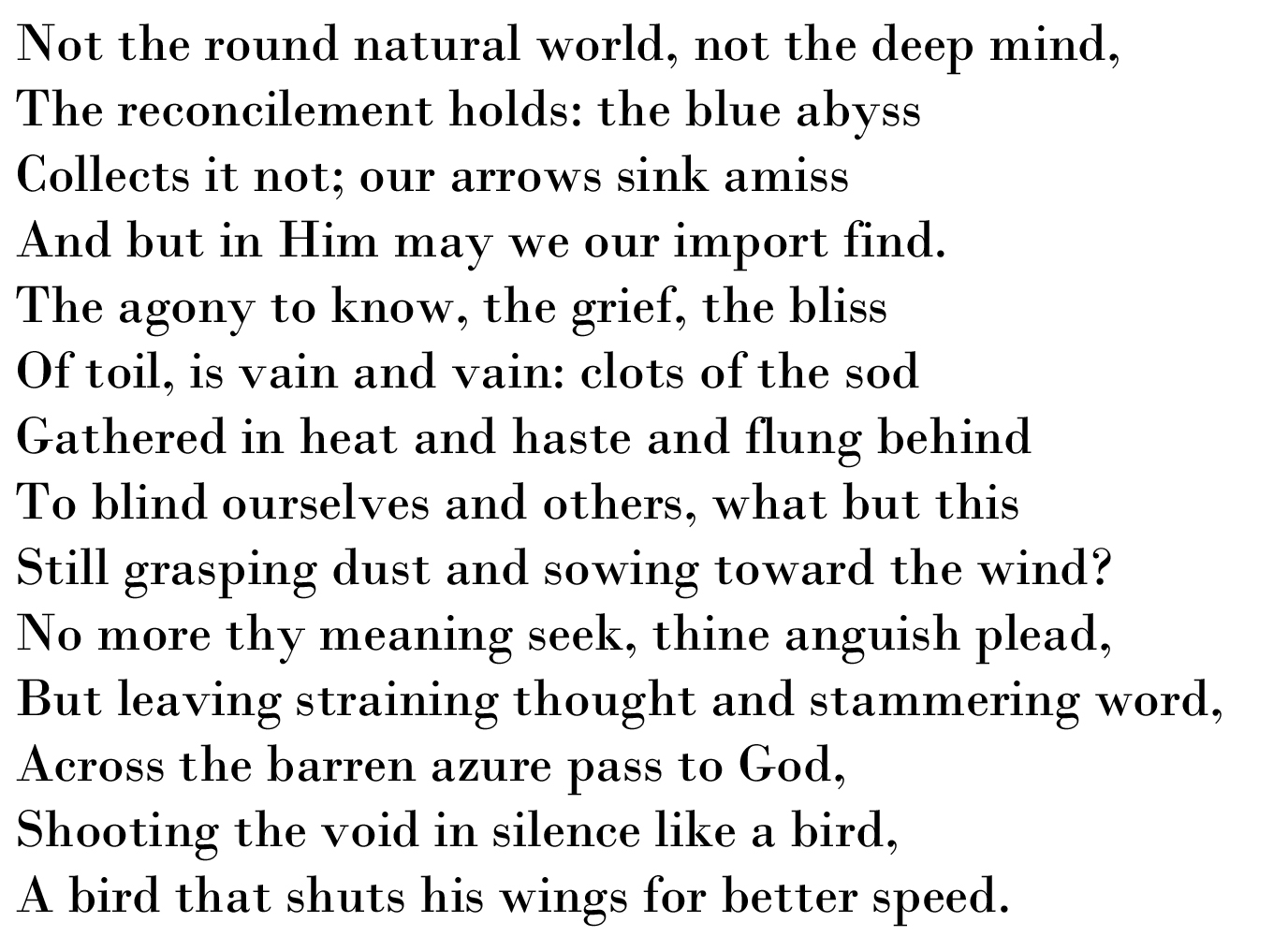
While on the other hand . . .

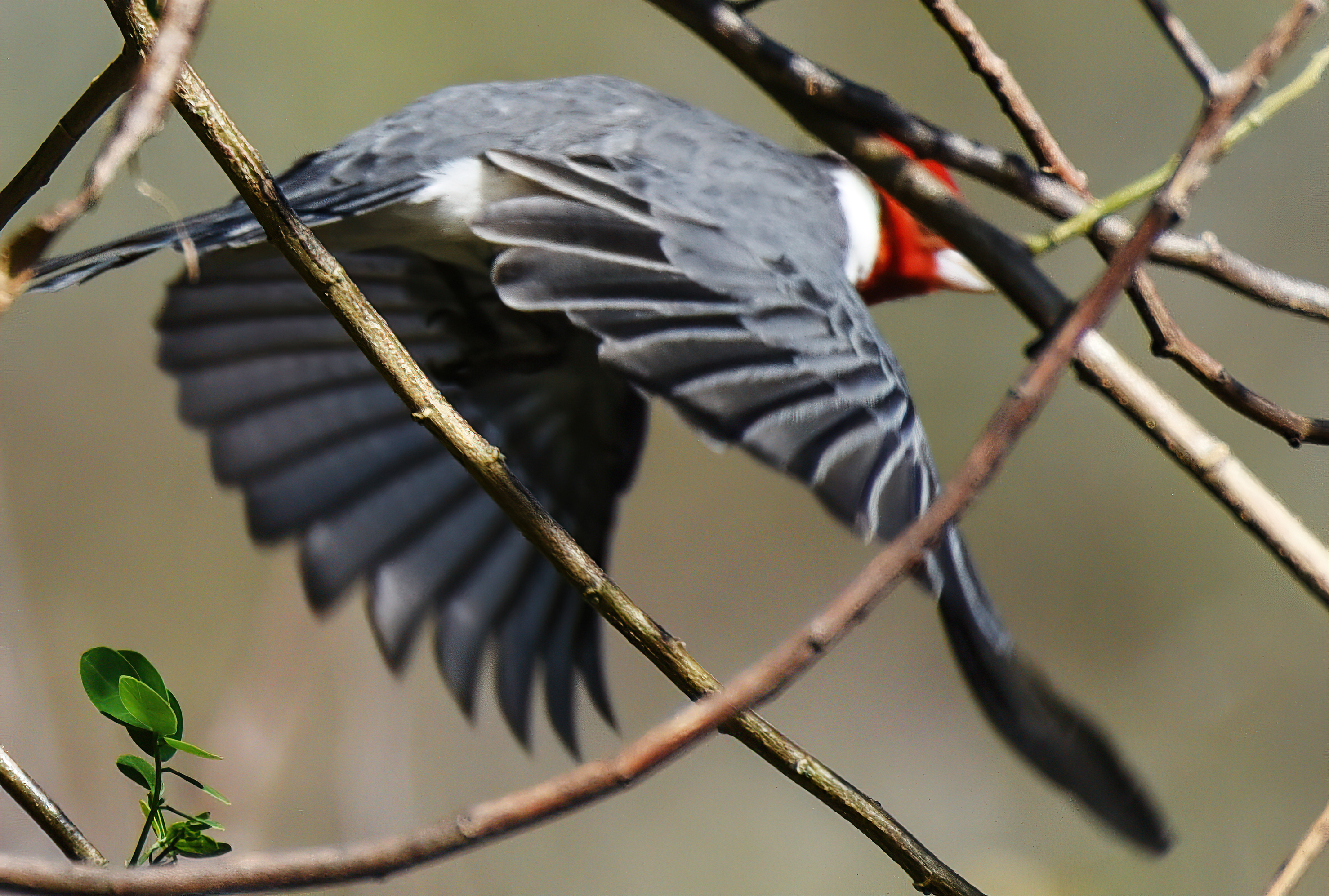

He realizes
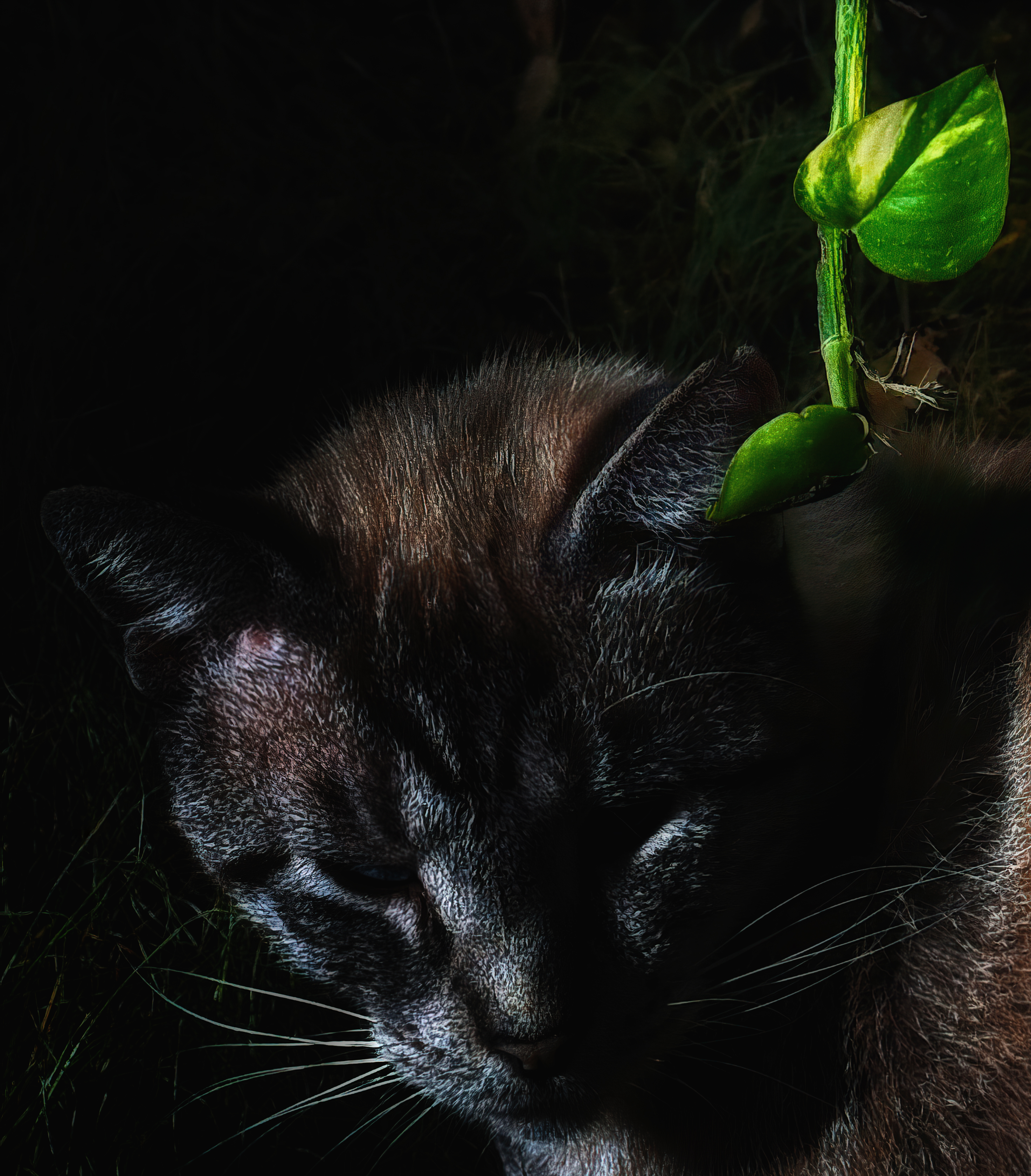
To him who in the love of Nature holds
Communion with her visible forms, she speaks
A various language.
Special occasions
Cavafy’s “Days of 1901” is missing some last words. On the page, this elegy sings the recession into time of something that can return only at longer and longer intervals. On its returns it still looks like love, but what there is to see of that love is now coarsening and blurring under time’s accreting memories. The memories are of youth and purity: qualities that are now less accessible to the touch of sensitivity than they were, hidden farther and farther beneath the darkening eaves of upper limits. Youth goes louche, and the days of 1901 go historical.

Formally, too, the poem’s wit is about the past tense. “I am a reminder that there is nothing new about what you feel,” says Cavafy’s Greek sonnet, and it says that on the authority of being in Greek, and a sonnet. But the little hint of budding life within the past culminates in a line so unhistorical that it hasn’t yet taken recorded form. Classical norms would grant “Days of 1901” one more line to bring to a merciful reconciliation the contradiction between immediate beauty and the poignancy of having lived prior, but here at this poem’s end there is only erasure. There ought to be six lines extending all the way to the end, and the prosodic category-name for that imperative, sestet, implies that at the end there ought to be six because a sonnet has earned the right to say and mean that there always have been six. But this sestet begins (in Daniel Mendelsohn’s translation), “The beauty of his nine-and-twenty years.” In Cavafy’s Alexandria, there can be no always. The days of 1901 are partially in ruins, like all the other days.
—
Look toward the margins and you’ll notice that off the American coast the days of 1901 arrived with an escort of battleships. Among the squadron, the days’ beauty wasn’t the poignant beauty of an individual, like the beauty of Cavafy’s slowing, thickening 29-year-old; they were as bright and delicate and grateful to the touch as new clean well-printed banknotes. Theirs was a Daisy Buchanan beauty: the beauty whose defining quality is the being prized. Competing for the beauty, rich men raced yachts through those days, and the love of the collective that defines love for us was there to protect them in steel boats with flags that snapped in the wind, and the apparatus of history was at hand to inscribe the rushing waves with records of love’s eager speed in a perennial Roman typeface.

The octave of Cavafy’s sonnet read,

The key word was “Almost,” probably to be read as an ironic indirect aside. But in 1901 America a different flesh found its voice in the straightforward positivity of Whitman’s “As Adam Early in the Morning,”
Touch me, touch the palm of your hand to my body as I pass.
In its Walt warble it added: “Because I am passing through this watery element as fast as can be, and time is money.”
Sources:
C. P. Cavafy: Complete Poems, trans. Daniel Mendelsohn. Alfred A. Knopf, 2012. The facsimile of the manuscript is online at several sites.
“U.S.R.C. Onondaga“: Detroit Publishing Company Collection, Library of Congress, https://www.loc.gov/pictures/item/2016804970/. Post-processed.