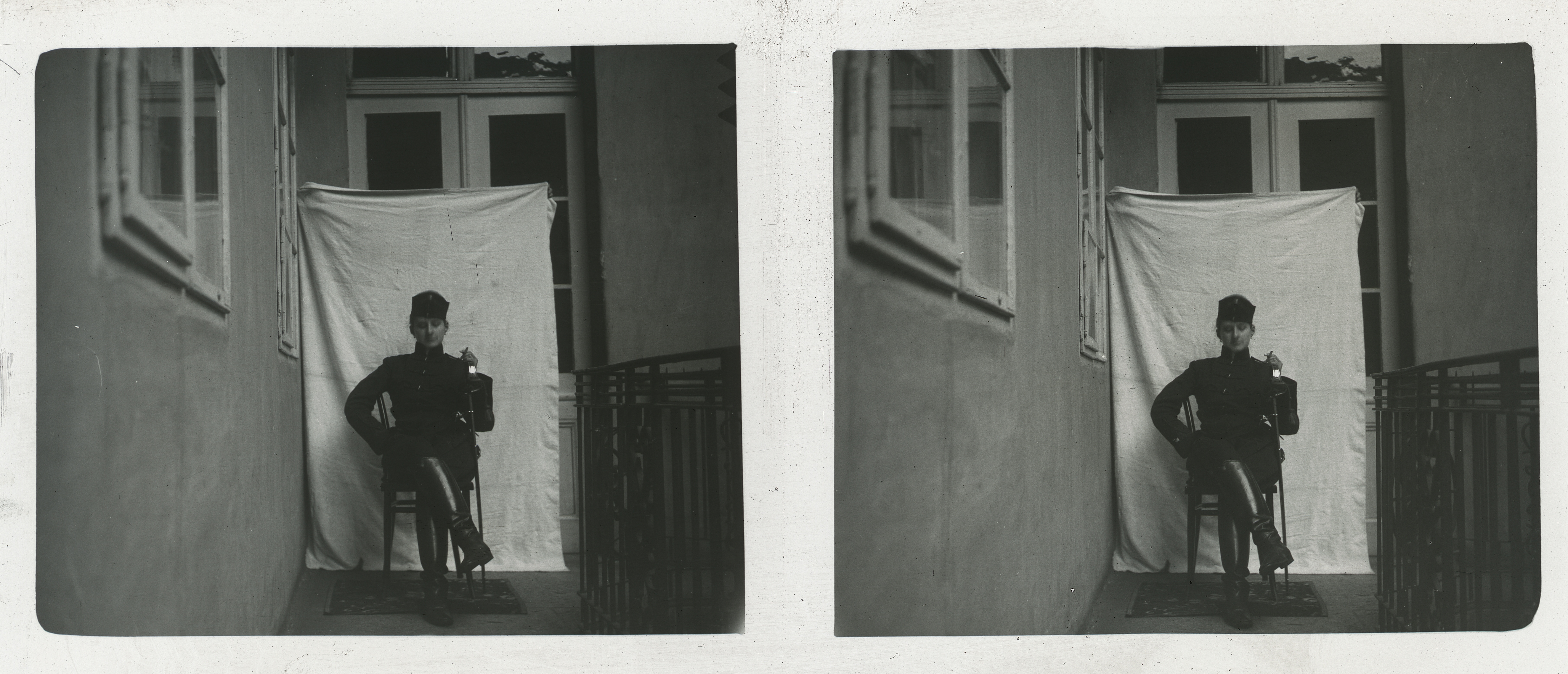
A Nerd’s World, a Toronto graphic design shop, currently holds a Verascope stereo camera used by a French army photographer during World War I, and the shop’s website has made available a collection of slides found in the camera’s case.
Here’s a different approximation: an anaglyph. It’s still, unlike the Nerd’s World image, but its size is smaller, its resolution is lower, and the superimposition of the images has further reduced their sharpness.
Trying to improve my illusion while still holding to an idea that the past must be still, I photoshopped the slide. The image pair reverted before me to an approximation of clarity. But then something terrible happened.
My tiny original anaglyph had been fuzzy. Its low-resolution cloudiness worked against the barely distinguishable verticals of the trees like the diagonal brushstrokes in a Cézanne. The distress I felt before the picture of the suffering men, tiny figures struggling up a tilted Cézanne image plane, was therefore also an educated frisson. Yes, I thought as I looked at the blur; the Impressionists were there before us immer schon, teaching us how to see. I felt happy in my distress, as though I were sitting at the feet of Gertrude Stein and Papa Hemingway at a tutorial in the rue de Fleurus.
But Photoshop scrubbed the fuzz away. Deblurred, the trees’ broken branches stood up into their image, tiny still but now sharp and clear.
And then the didactic force that swiped the blur away slapped me back to first grade and taught me Seeing 1 over again. “Study sharpness,” the photoshopped anaglyph instructed me. “You didn’t get it right before. Learn to see outlines as if they’re clear and simple and educational. Speaking of education, study Meissonier’s trick of mixing his pigment with powdered glass to make his snow sparkle. Learn it. It isn’t just pretty; it’s glorious. Here in my tiny space there’s an army to teach you so.”
Meissonier, “Campagne de France, 1814.” Wikimedia Commons.
Meissonier’s didactic microcosm is, in fact, micro: only 51.5 by 76.5 centimeters. Tinily sparkling, it loomed over me with a lesson plan, and I had to learn it. Afterward, I knew for the first time what I had failed to understand before: that the way of seeing called Prewar is not dead. Alongside Apollinaire and Gaudier-Brzeska there still live Rupert Brooke and and a forever standing army of marble quarrymen : murderously undying as the idea of glory.
As of September 28, 2013, the prose of Wikipedia’s article “Rudolf Berthold” pants with a breath smelling of nineteenth-century hygiene.
Throughout the summer of 1918 Berthold continued flying, increasingly relying on morphine for pain relief. Such was his strength of will he also taught himself to write with his left hand.
The image that comes to mind is less a picture than an idea, less an idea than a corpus of prose. Since the day of publication of A Farewell to Arms, at the latest, it hasn’t been possible to understand the phrase “Such was his strength of will” as anything but a phrase from a textbook. “Such was his strength of will” is language attempting to stand alone, without the aid of image.
But look at the image on its own terms, with its explanatory language (“Unser erfolgreicher Kampf-Flieger”) reduced to a remainder left flatfooted at the bottom.
San Diego Air and Space Museum Archive, catalog number 10_0017272
Then follow the image’s hinted command, open Photoshop, and use the Dodge control on the eyes.
You must. Such was the image’s strength of will. And now you cannot stop seeing.
Because they come to us surrounded by words, these images are a document. The document is now held in the Library of Congress, where resident historians have established its origin as a fall day rich with light spilling into river water. That origin is now the title of a story, http://www.loc.gov/pictures/item/2010646582/ , which waits in the Library of Congress to be retold. The hopeful motto of all the stories in every library is Happily ever after.
But now put on your red-and-blue anaglyphic glasses and read past the happy ending into the image. As its separated halves reassemble themselves in the eye, see how the story’s wordy boundaries fall away. The document, its read presence, vanishes into the dark beneath a cloud of smoke which rises into air above moving water. Soon, as the boat and its freight of cylinder-hatted bodies pass out of sight, all that will be visible will be the cloud. Because you can imagine that, it may be that you have always had the ability to read forward along time. The power came to you in a cloud of words.
And as it disappears instant by instant, this other cloud in the image is an unworded text formed by sight and thought into a moving darkness unchangingly changeable as the ordinances of nature.
 LZ127, Graf Zeppelin. Richard Denbo Special Collection, San Diego Air and Space Museum Archive. Catalog number Denbo_00254. The original image is linked at http://www.flickr.com/photos/sdasmarchives/10176186066/in/photostream/