
* The man in the white shirt is Wilhelm Furtwängler.
* The man in the white shirt is Wilhelm Furtwängler.
Disc 1: the United States ends its neutrality and enters the Great War. Track by track, one side of one historical record sings:
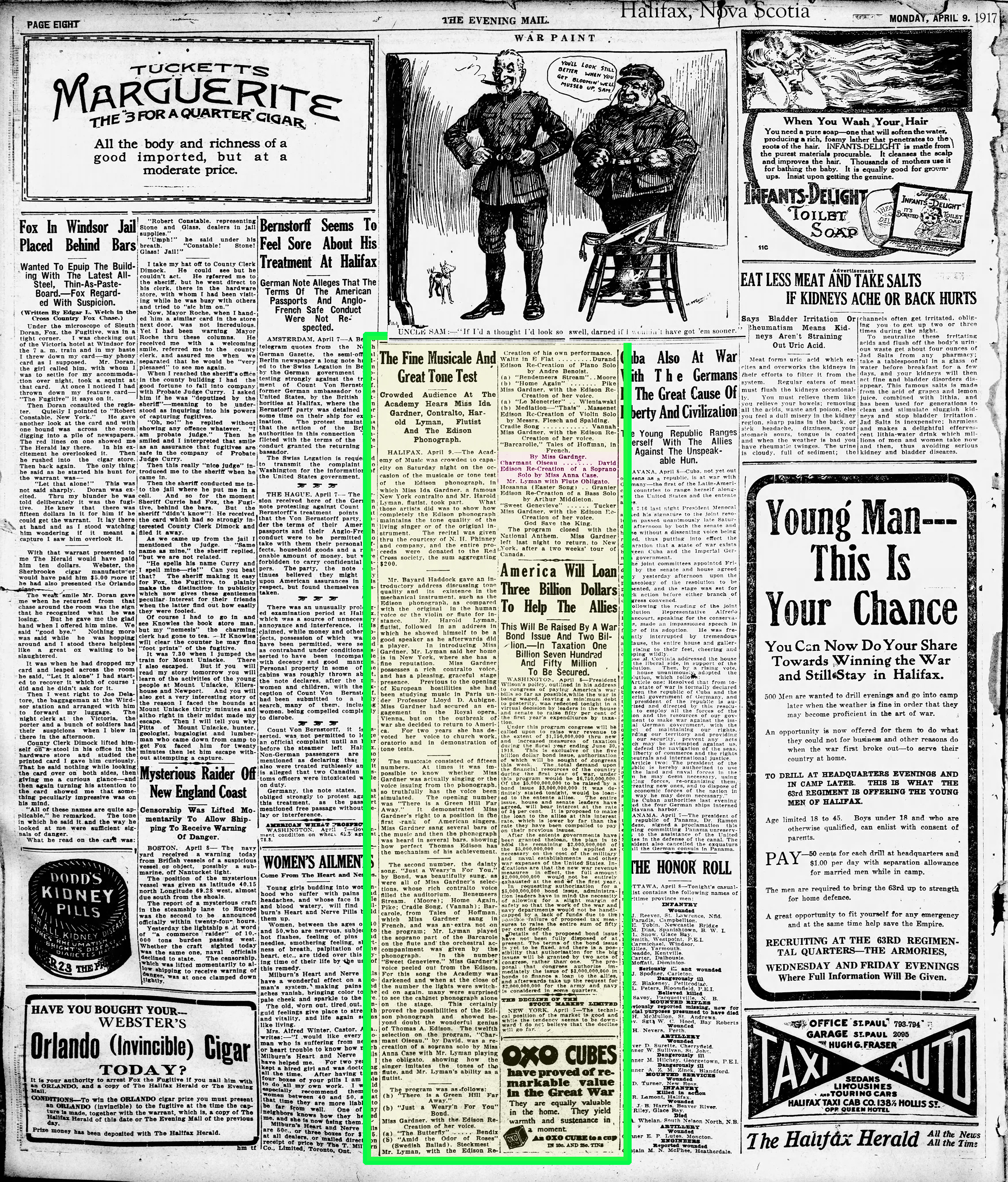
Disc 2: in the same date range, the title of a song has promised its hearers a charm, and those who made the song audible have pledged their fidelity to its magic. But what ever remains of the music of time? Little did they seem to know, Madame Case and Mr. Edison and the performer of the obbligato, how breakable records are.
https://archive.org/details/edison-82078_01_2460
Shostakovich:
You don’t want to know why I was waiting outside Castle Hospital’s emergency room at six in the morning, but Uber had told me to expect a red Cadillac driven by a man named Willy. “Oh Detroit,” I thought happily, anticipating a conversation full of memories. And then Cadillac drove up.
It didn’t use the driveway; it, with Willy, waited for me on the other side of the parking lot. I hauled myself up from the hospital’s wheelchair, walked over to the redness, and opened the door. Inside was a sign counseling me to close it carefully, and in the driver’s seat Willy wasn’t what I thought he’d be. He was an elderly local man seated among several thermoses, and from his rear view mirror hung a rosary. Morning sun tinged its red crystal beads, and all of Cadillac’s windows were open, with a cool wind blowing through.
From the T intersection at Castle Junction it’s a short straight drive back to my house in Hawaii Kai, via Waimanalo. But Willy didn’t drive down the T; instead, he turned left and headed toward downtown Honolulu on Pali Highway. I didn’t ask him to correct our course, because it was coming to me that I was embarked on a farewell tour. Sites were showing themselves to me for probably the first time and possibly the last time since I had had to lift my hands from the wheel forever after. Past us once more they came: woods, then the steep climb up Pali Highway to the cliffs; then the tunnel and the peak and the way back down the other side into the city. Again, again, the memory things in their morning light: the Korean consulate; Temple Emanuel; a ramshackle fundamentalist school where Haesun had applied for a librarian’s job right after we moved to Hawaii; the upcurving roofs of the replica of the Byodo-In Temple. Then the Buddhist Center and the on-ramp curving down and east into the morning traffic on Interstate H-1.
After H-1 ends, its continuation on Kalanianaole Highway is contraflowed in the early morning, with four of the six lanes coned to direct traffic west. Cadillac and I were bound east, slow in the remaining two lanes. At our speed there was no longer much air blowing through Cadillac’s windows, so for the first time I could hear what Willy had been paying his attention to.
It was Republican talk radio. “Oh I never knew that!” gushed the straight girl, and after that the man with the voice used his basso to stimulate and arouse. Together, the man and the girl began taking turns admiring Bobby Kennedy Jr. Those . . . senators . . . tried to yell at him, sneered the basso, but he showed them. By now the hospital was on the other side of the island.
—
From Africa has come Elon Musk: now the richest and most mobile man in the world but also known for his eleven or so current children conceived by artificial insemination.
Also from Africa there came Aurlus Mabélé (1953-2020). He died during what, post-Bobby Jr., we may wind up calling the First Covid Pandemic. But while he was among us he fathered thirteen children.
Without apparatus, let us think.
.


The cartoon is about something that was on a lot of front pages in September 1903: “the problem of aerial navigation.” Just below the picture, a little story about the impending voyage of Samuel Pierpont Langley’s flying machine Aerodrome is to be read as a footnote in advance.
Pedagogically, it teaches us that on October 7 and again on December 8, the Aerodrome and its pilot catapulted themselves into the air from a boat moored in the Potomac River but then nosed down and sank. Langley’s attempt at powered flight had been supported by the resources and publicity apparatus of the Smithsonian Institution, but when the ripples closed above them, the problem of aerial navigation remained unsolved.
It was to be solved on December 17 by Orville Wright, but even during the moment of the immediately post-Langley nobody at the Indianapolis Star was in position to see that coming. Elsewhere in its front-page layout for September 28 the Star had offered its subscribers opportunities to read about several murders, a gallows confession, an accidental electrocution, and a horse-show scandal. All those readings, however, were rooted in the still earth of September 1903. The problem of aerial navigation remained as unsolved as ever. Column 1’s long article about a train falling from a trestle could treat only the idea of descent from ground to ground.
But the Wright Brothers solved the falling-body problem, and over the following years the solution became known. By 1924 the body at the foot of the trestle could be imagined on the rise. According to Wikipedia, this record of the change was the first country song to sell a million copies.
https://archive.org/details/wreck-of-the-old-97_202102
Listen to its cheerful whistlings. Fast mail train no. 97 had taken on feathered flesh. Now it could fly on to heaven, leaving its wood and metal mortalities in death-filled earth.

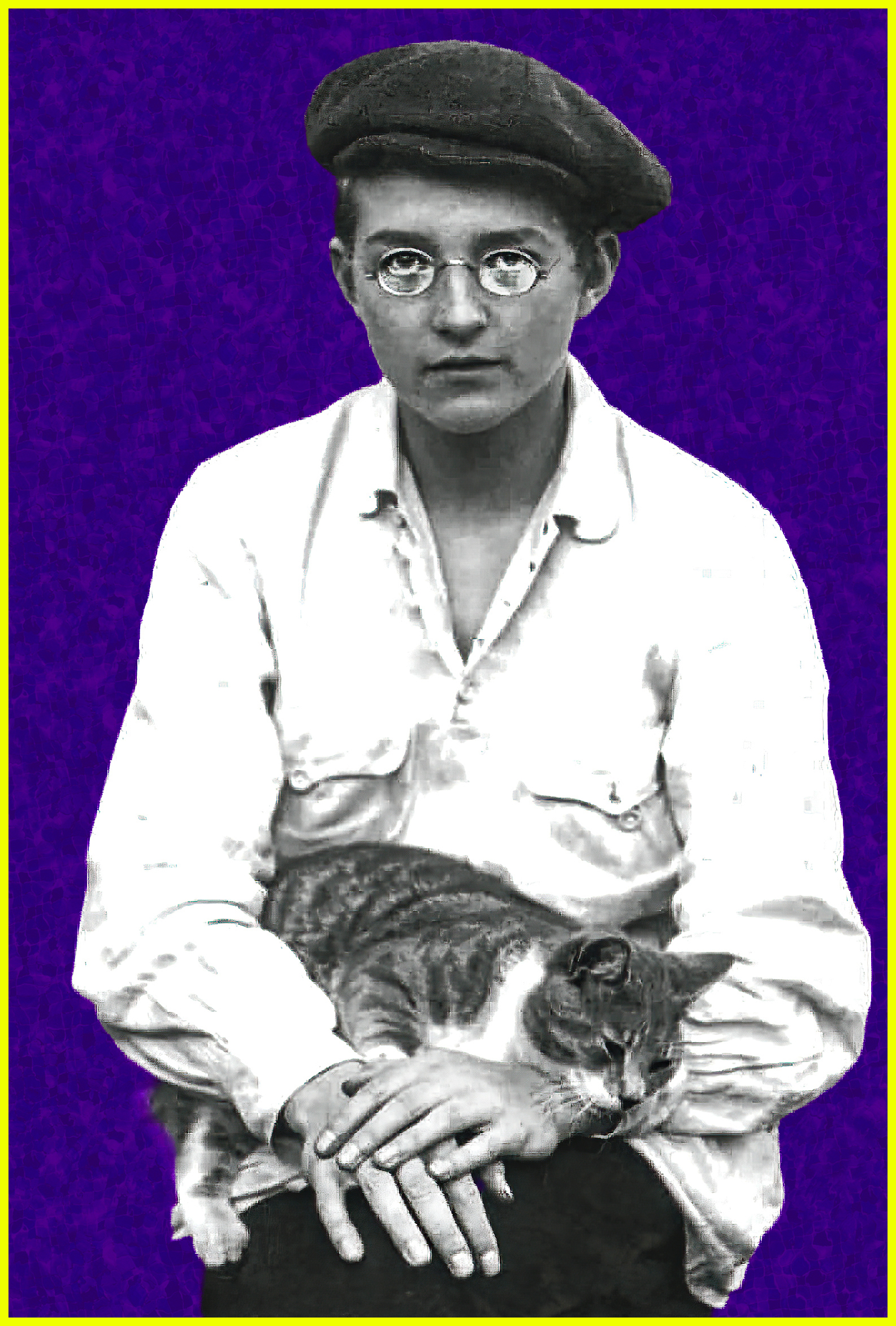
The singer James Joyce, author of a short story about a man who heard distant music, shelved this concert review in Leopold Bloom’s library.

Observing a bewhiskered black body in morning sun, Mr. Bloom remembered nights before and thought, “They shine in the dark, perhaps, the tips.” The hungry black body moved toward him, was captured by his field, and became a satellite. Two desiring bodies making a little island group, his cat and he were seen by a storyteller to be orbiting each other in harmony.


The article about the Rorschach inkblot test and its surprise late-sequence transition from black to color is online at http://captainmnemo.se/ro/hhrotex/rotexcolour.pdf. The undated, unattributed photograph of Wilhelm Furtwängler is in the Landesbibliothek Mecklenburg-Vorpommern, https://vzg-easydb.gbv.de/object/30eaad07-8e97-4875-a003-f3a5dbddd5b1. I’ve reversed some of its color decay.
For coloring in your own emotions, you might try this tool. It was made in a factory under the auspices of Strength through Joy (Kraft durch Freude), the Third Reich’s recreational and community-building arm. Under what auspices, do you think, could one of these black-and-white faces be retooled into yours?
https://www.youtube.com/watch?v=FoU-iCT21fc