Cloud and rippling water nineteen six

That summer evening, women in white gowns went to a boat under a sky that didn’t seem to concern them. For the five years of my life since I first saw their image in that act, I haven’t understood. I’ve been trying to make the sky around them concern me, but I haven’t succeeded.

The women are present to us now only as a blemished, poorly processed image in an archive:
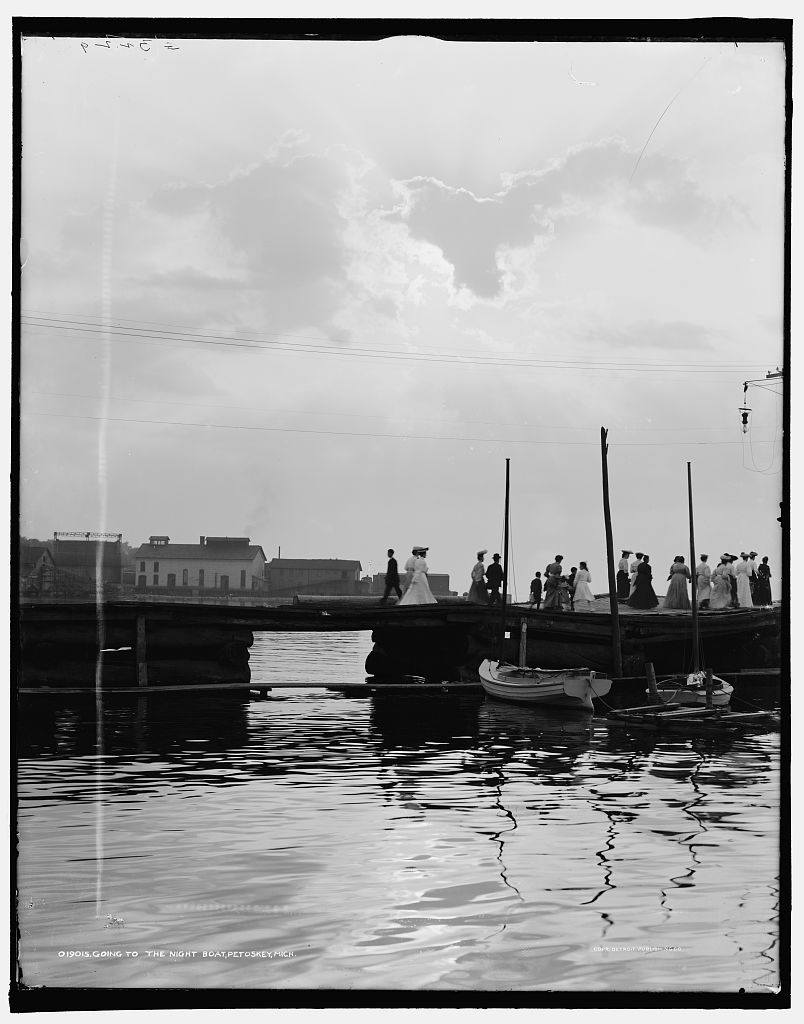
“Going to the night boat, Petoskey, Mich.,” 1906. Detroit Publishing Company Collection, Library of Congress, https://www.loc.gov/pictures/item/2016800038/.
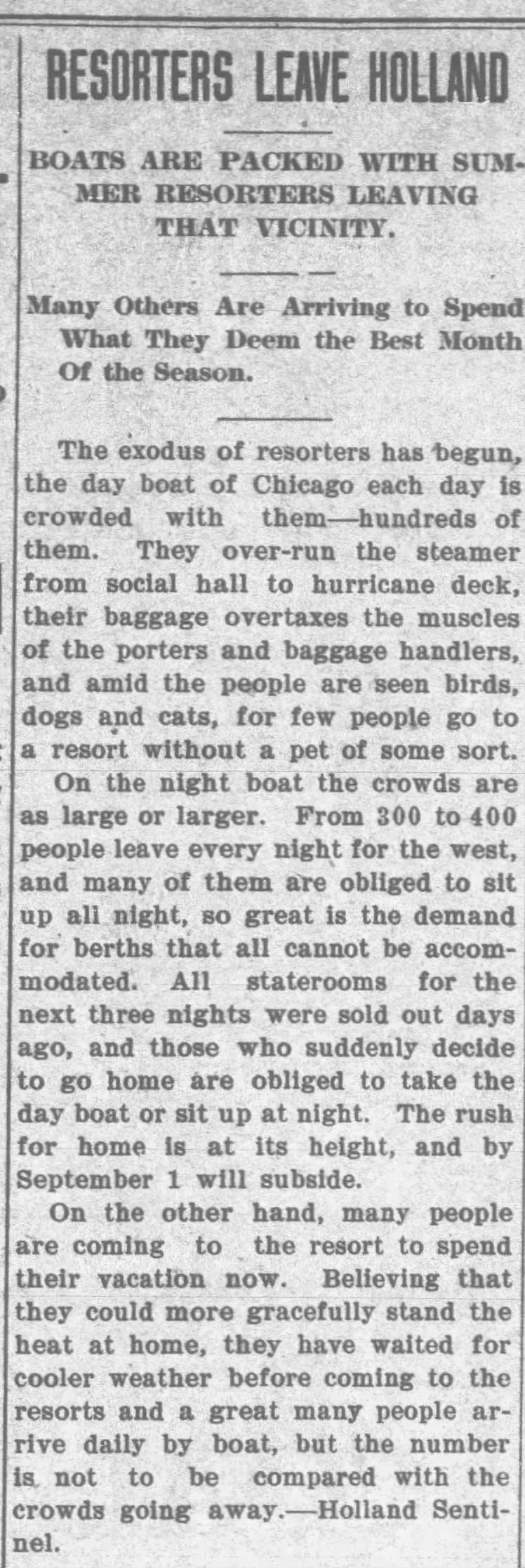
Petoskey, their place of being in the image, is a tourist town near the northern end of Lake Michigan, and there exist plenty of other archives that can easily define the women’s tour term “night boat” by placing it in historical context — for example, in detail that can be increased almost as much as you’d like,
(1)
St. Joseph (Michigan) Daily Press, Monday, August 27, 1906, page 1

(2)
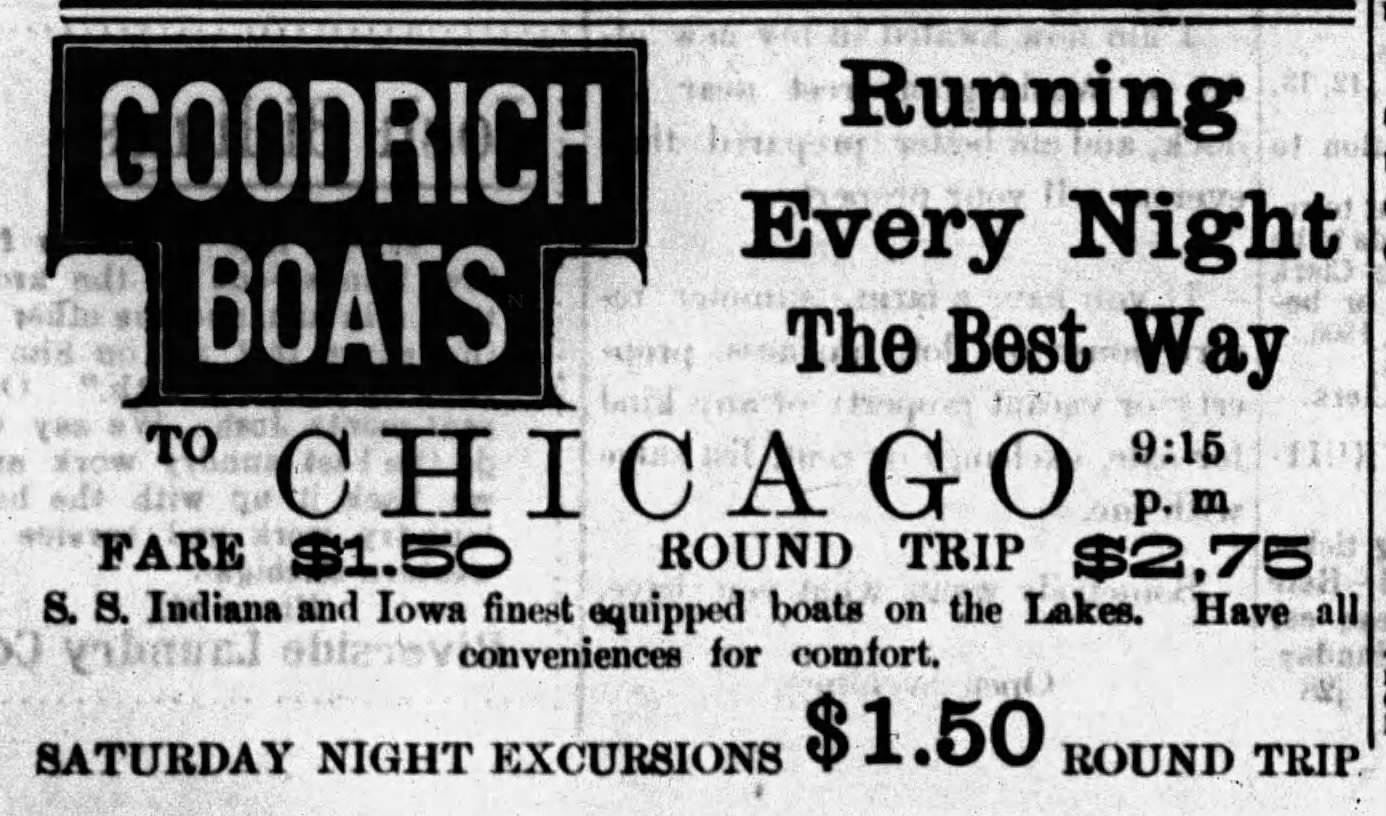
Grand Haven (Michigan) Tribune, Wednesday, June 27, 1906, page 4

(3)
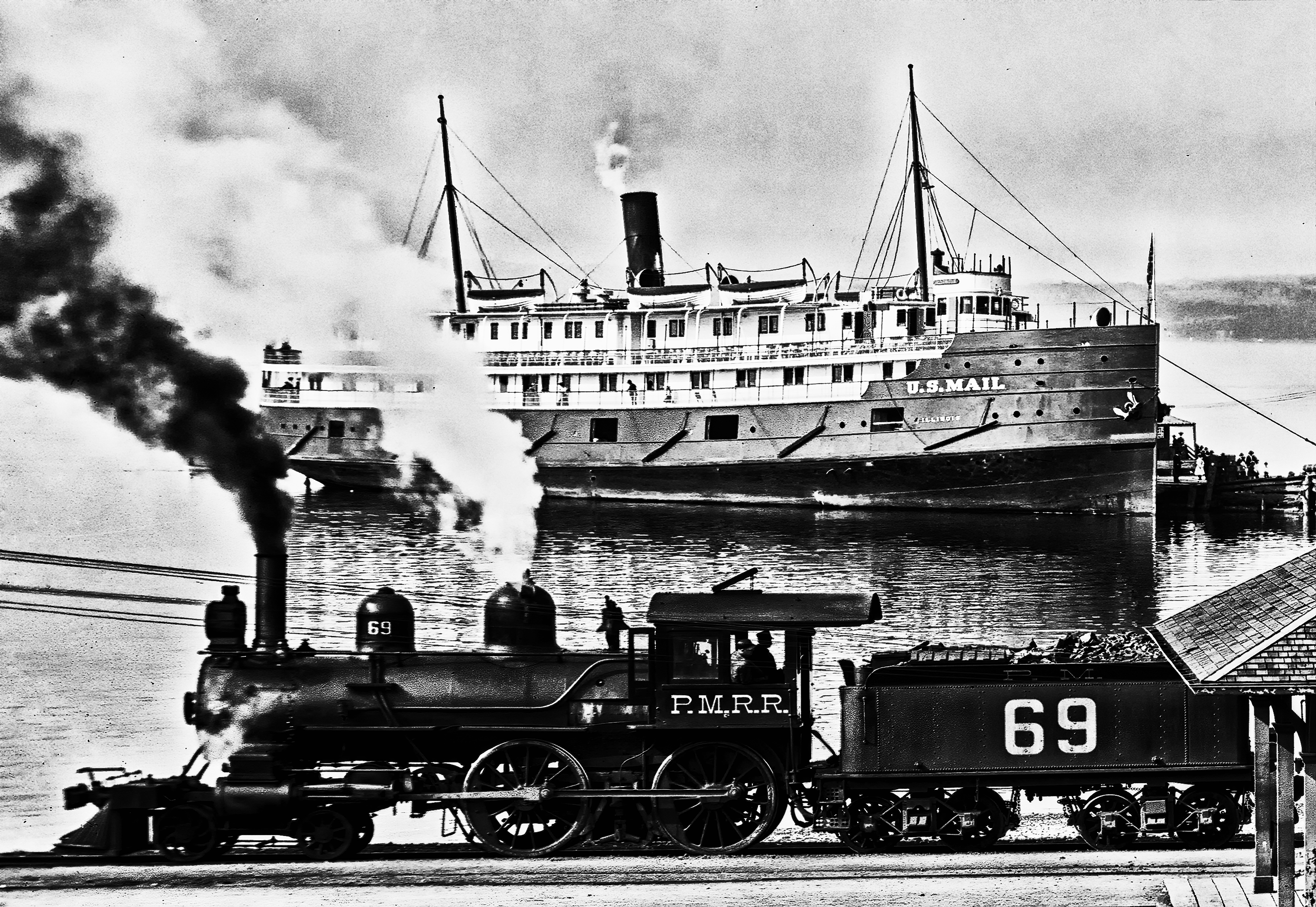
Detail from “R. R. Station and Park, Petoskey, Mich.,” 1908. Library of Congress, https://www.loc.gov/pictures/item/2016814610/
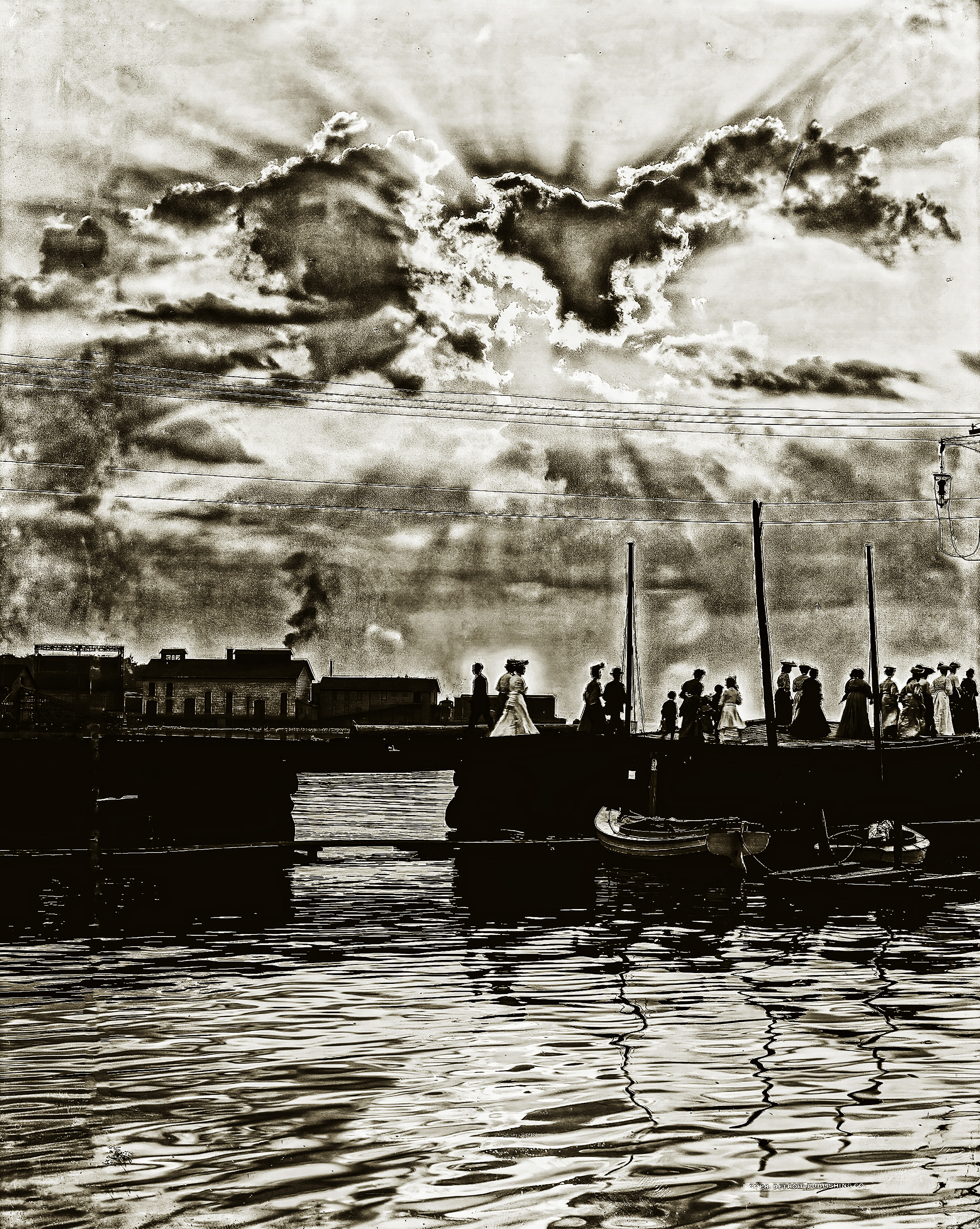
But somehow the gowned women were also all of a piece with a cloud and a sun and some rippling water, and that plenum isn’t present except as an image.
Left behind with me in the visible, the first traces of the image seem no longer to be apparent. They are no longer detectable in the present tense that once was written “going.” Perhaps they never were detectable, and perhaps that’s why the gowned women seem not to have noticed, there under the setting sun, what they were undergoing. At any rate, it seems apparent to you now that some time ago the women in white and their particular sun were erased to dark.

Monochrome

“Huron St. and ferry landing, Port Huron, Mich.,” between about 1905 and 1910. Detroit Publishing Company Collection, Library of Congress, https://www.loc.gov/pictures/item/2016815112/. Contrast and detail restored. The ferry between Port Huron, Michigan, USA and Sarnia, Ontario, Canada was replaced by a bridge in 1938.

The horses on the monochrome thoroughfare have been stilled.

On the boat, the passengers’ chairs are scattered where they were left when the passengers left the image.

Inside the piano store, the unimaged and silence.

Against the bridal day, which was not long

With a conductor’s gesture, a man poised at a brink once brought together two curves.

4a16298uaiF7

Angular flesh and rounded iron approached each other, light and shadow moved over them, and a moment was consummated and became past.

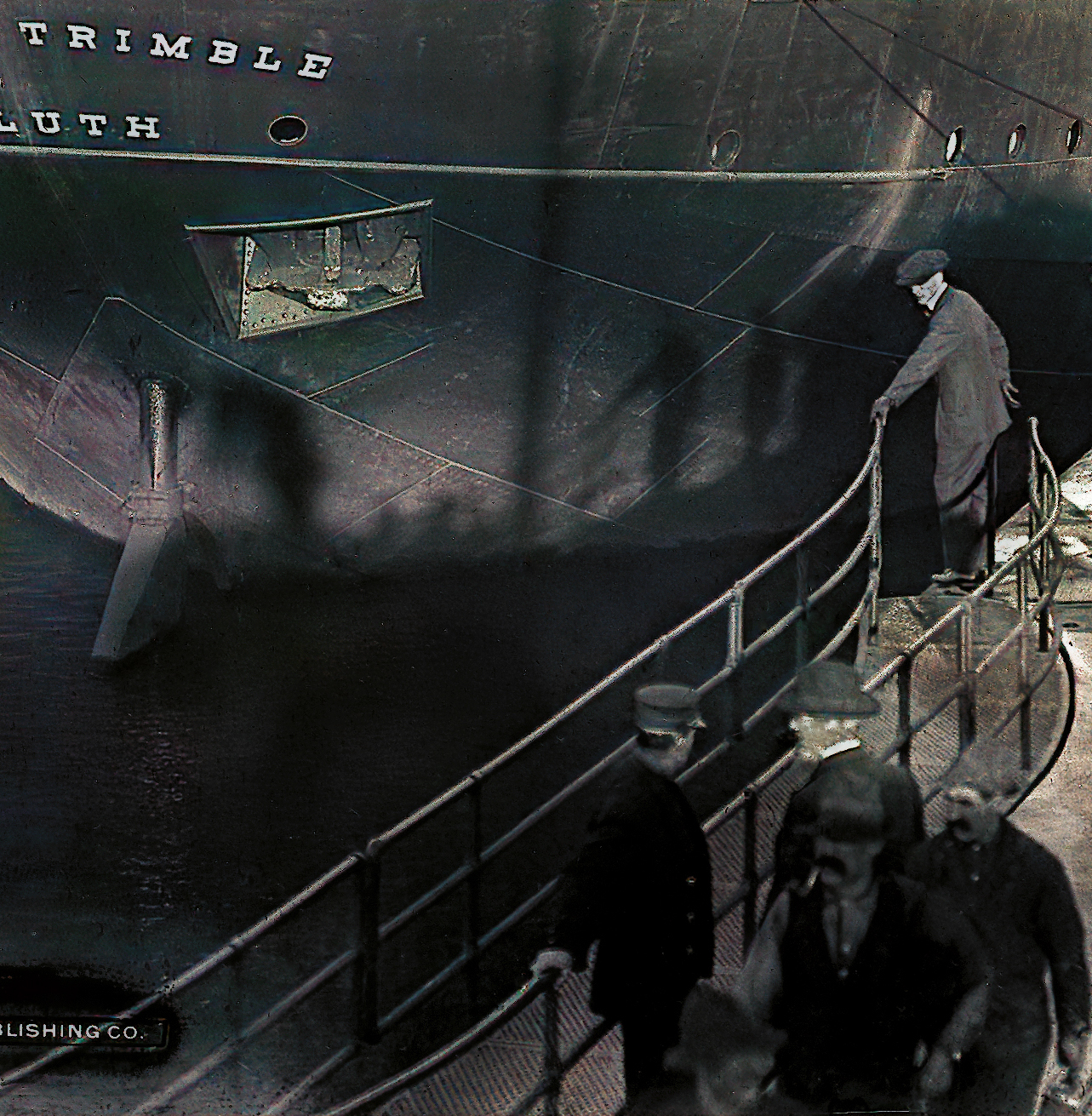
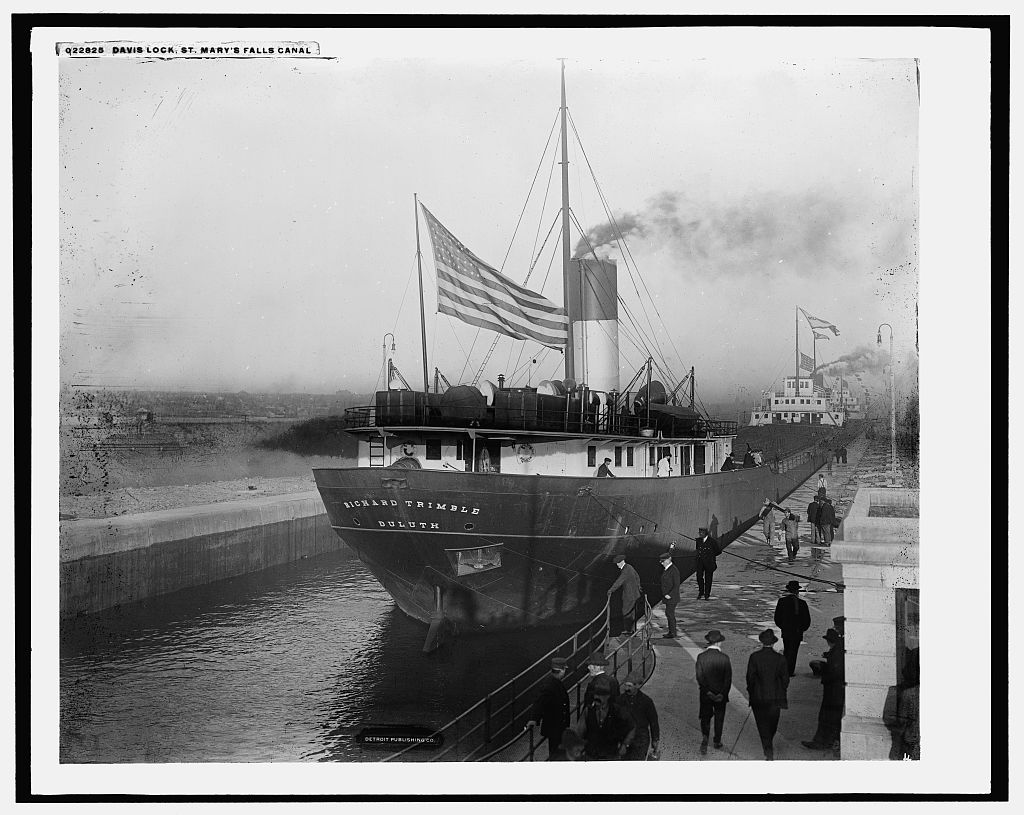
Borne above the shapes like a banner, the word Trimble meant nothing. It only said, as if say were an intransitive verb. It was an order of service: a separately published hymnal to be sung from while the two bodies approached, touched, and then fell away. During that limit instant, the word and the two bodies were united in a single imaged meaning, fully understood but not articulable. Thereafter, in separation, all that could be said in words took the form of a caption (“Davis lock, St, Mary’s Falls canal”) that sang of the watery bed but not of the coming together in light and shadow that had once filled it.


Source: Detroit Publishing Company Collection, Library of Congress, https://www.loc.gov/pictures/item/2016800144/. The complete, pre-Photoshopped image is

4a16298v

The Library dates the image between 1913 and 1920. However, the mustached man with the pipe appears to be wearing a wristwatch — an accessory which didn’t come into wide use until after World War I.

Hoist and convey

Sources:

Wagner, Das Rheingold.

“Cleveland & Pittsburgh Ore Docks, Cleveland,” about 1900. Detroit Publishing Company Collection, Library of Congress, http://www.loc.gov/pictures/item/det1994000556/PP/. Photoshopped.

Detect the plaque that reads, “Built 1896 by The Brown Hoisting & Conveying Machine Co., Cleveland, O.” It is a spell’s libretto. Singing the verbs hoist and convey over a cargo of ores, it sends them into the smoky sky.