Heritage

Toward the end of its era, Fascism embarked on a campaign of cultural self-pity. Italy has been attacked by darkness, Fascism told Italy. Everything that Italy has inherited from its past is being violated. In the chiaroscuro, it may seem that nothing remains for us but to grieve. Our candles are out; our heads are bare and bowed before the advent of the black helmets. However, our light will return. Something that will not die bows down to us in our grief and whispers light’s vindicating truth.
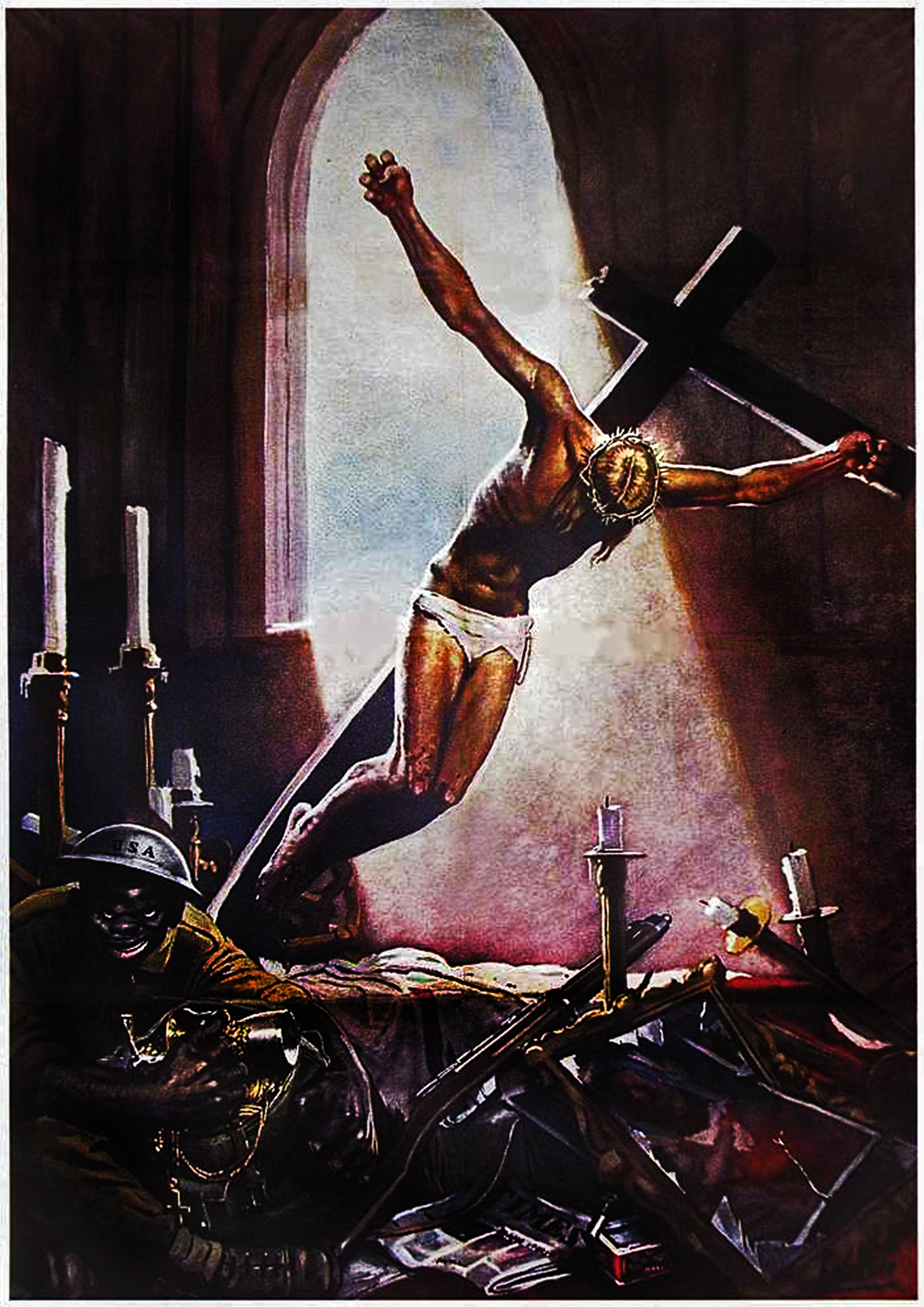
But even as the black helmets were making their slow way from temple to darkened temple, the land under Italy’s temples was being cleared day by bright day from the air. Most of the bombers that came flying through the light to accomplish that task of war were Consolidated B-24s, and these bore a propaganda name of their own: Liberators.

In the sheets of light beneath liberation’s radiant onslaught, Fascist art could do nothing except to repeat its now meaningless trope of darkness. Desperate to continue depicting the trope, it once went textual and tried to supplement its now meaningless self with an explanation outside the picture:

“Liberators take liberties!”

Outside the picture, the pun is too witless even to be visualizable. But the image’s trope of darkness retains some meaning nevertheless. Seventy years after the fall of Fascism in Italy, it still speaks to the politics of the United States. It does so because it articulates a myth, and myths are hard to make die.

After all, there can be no light without darkness. That is one sense of the myth of Pluto and Persephone.

Bernini

That myth says: Light goes down into the underworld and is reborn there from death to life. This will be the happy ending of the art-stories of the looted church and the rape which has been redeemed for art by a successfully understood allusion to Italy’s cultural heritage. When he wrote the history of anecdotes such as those, Ezra Pound was fond of using the word splendor, which means brilliance or radiance. But a splendor returned from the underworld has been in that which is dark, and when it reascends it can never again be immaculate. Bearing shadows within the folds of its mantle, splendor must bring darkness back with it. At nightfall, splendor’s darkness will rejoin the primal dark. Then, after morning comes, we may pick up our brushes once again, seventy years later, and charge them once again with black.

At the present linguistic moment, the Pound-word “heritage” is one shade of that black. Spoken today by reenactors remaking themselves as ghosts on battlefields, it is a word that darkness has taken to itself and refashioned as a mode of immortal yet unliving form.


Look at heritage’s eyes. Look at its pointed fingers delicately touching its slender musket. Understand, as you look, the lesson that heritage is wordlessly teaching you: the lesson that darkness, having once been comprehended by art and shaped by it into myth, can never wholly return, forgotten, to the past and to death.

Sources: the Italian propaganda posters come from a collection at http://ic.pics.livejournal.com. The image of the B-24 comes from a site for airplane modelers, Wings Palette, at http://wp.scn.ru. Its Russian caption translates as, “98th Battle Group, Libya, 1943. Shot down August 1, 1943, by [Bulgarian] Lieutenant Stoyan Stoyanov.”

The image “Unidentified soldier in Confederate uniform with bayoneted musket and knife” is in the Liljenquist Family Collection of Civil War Photographs, Library of Congress, http://www.loc.gov/pictures/item/2014646219/.

All images photoshopped.

“Gorgeous Nothings”: the colors of crumbling

Dilapidation’s processes
Are organized Decays –

— Fr1010, “Crumbling is not an instant’s act”

For the visual study of poetry in English,  the most important manuscript publication of the last half-century must certainly be Valerie Eliot’s 1971 facsimile of the manuscripts of The Waste Land, with their annotations by Vivien Eliot and Ezra Pound. By clearing and opening the trace of Eliot’s inspiration, Mrs. Eliot institutionalized a permanent corpus of theses about the modernist canon. In that canon, the proper interpretive questions now come to us as mere obvious corollaries, not followed but preceded by their crushingly definitive textual answers. Question: what did Eliot mean when he called Ezra Pound il miglior fabbro? Answer: you’ve already passed through the life-originating darkness of Pound’s thick pencil strokes. Question: what did Eliot mean when he wrote, “Only those who have personality and emotions know what it means to want to escape from these things”? Answer: you’ve already overheard, as from behind a hastily closed door,  the muffled quaverings of Vivien Eliot’s marginalia to “A Game of Chess.”

Because those answers come to us fully saturated with immer schon, they don’t need the confirmation of beautiful detail. The facsimile publication comes to us as a set of low-resolution black-and-white photographs facing pages of diplomatic transcript in conventional letterpress, and for reading The Waste Land in a room furnished with a black- or whiteboard, the letterpress is to be preferred. Running in parallel but a  few steps off the trail to institutional certainty, the facsimile pages represent a distraction, even a threat. We would rather consult them only as it may be necessary to verify Mrs. Eliot’s editorial accuracy. Canonical fences, the confinements of diplomatic transcript render the poem of the twentieth century safe for readers to look at.

But the wing-shaped, brilliantly colored creatures of Emily Dickinson: The Gorgeous Nothings slip through the bars. These tiny manuscripts, each written on a scrap of an envelope, pre-fragmented yet complete, represent a lexicon arising out of antonyms to The Waste Land. They are not fragments shored against ruins; they are assemblages and rebuildings. In her introductory essay to the volume, “Studies in Scale,” Jen Bervin quotes the principle from a book that Dickinson’s mother owned, Lydia Maria Child’s The Frugal Housewife: “The true economy of housekeeping is simply the art of gathering up all the fragments, so that nothing is lost” (9). As Mrs. Dickinson and her daughter would have understood, Mrs. Child was alluding to the nourishing miracle of the loaves and the fishes: John 6.12, “When they were filled, he said unto his disciples, Gather up the fragments that remain, that nothing be lost.” She added, “Preserve the backs of old letters to write upon.”

But The Gorgeous Nothings comes to us pleading the inadequacy of preservation. Of the two envelope manuscripts on the cover, one may be a display of prosodic purpose across the centuries: a found name in bold black ink, Mi∫s Emily Dickinson, past which flutter two tiny orthogonal lines in delicate pencil

to light, and
then              return

with the last two letters of “Dickinson” thrusting upward to force a pause after “then.” The other communication is visually bolder still: the entire inner front of an envelope covered with the pencil trace, and a brown chevron at the left margin. But of course this second boldness shows no trace of human agency. It’s only the mark left by the passage of entropy through the system marked down by the poet on her bit of paper — specifically, the oxidation of the glue on the envelope flap. Having failed of the touch of a tongue,  the glue now darkens its way through a poet’s web of words.

The Gorgeous Nothings, then, arrives in read life to mark a brief pause in the poetics of browning and crumbling. Its date of publication was a memento mori of impending escape from the uniqueness of a manuscript touched by a poet’s hand to the impersonal memorandum of letterpress. As long as I can remember a poem and say it back without a piece of paper in my hand, I won’t regret the loss of the part of it that I once might have seen. But during this moment I am grateful, while I can be, for the visual testament of The Gorgeous Nothings.

Sources

T. S. Eliot, The Waste Land: A Facsimile and Transcript of the Original Drafts, Including the Annotations of Ezra PoundEd. Valerie Eliot. New York: Harcourt Brace Jovanovich, 1971.

Marta Werner and Jen Bervin, Emily Dickinson: The Gorgeous Nothings. New York: New Directions, 2013.

The Eliot quotation is from “Tradition and the Individual Talent.”

Photographs by Jonathan Morse, October 26, 2013.


Mistah Tennyson — he dead

Ten years ago, Wikipedia’s article about Emily Dickinson read like a high school project full of beginner’s mistakes. That’s the Wikipedia problem in general, I would tell my students during the last days of the floppy disc. Sure, Wikipedia is handy. Sure, I use it myself. But you can’t trust it.

But Wikipedia’s crowdsourcing algorithm has kept on doing its relentless eugenic good. Now, in the tablet era, Wikipedia’s article about Dickinson has become as useful an introduction as you’d find in a reputable print encyclopedia. The entire process of reference is evolving through a sequence of change as earnestly, unidrectionally Victorian as the project of “Locksley Hall”:

Men, my brothers, men the workers, ever reaping something new;
That which they have done but earnest of the things that they shall do.

But about those men . . .

Early in 2013, the writer Amanda Filipacchi discovered that her Wikipedia entry had been moved from the category “American novelists” to a brand new category, “American women novelists.” The change seemed to have been the unexamined idea of a single Wikipedia editor (male), and after Filipacchi complained in print she was joined in protest by a number of other writers, female and male. Immediately after that, her Wikipedia article was re-edited in an apparent attempt to trash her into oblivion.

http://www.nybooks.com/blogs/nyrblog/2013/apr/29/wikipedia-women-problem

The news brought me back to this memory.

A few years ago I was surprised and gratified to find an article of mine cited in Wikipedia’s article about Ezra Pound. The next time I looked, however, my article was gone. Some time later it was put back, and then it disappeared again. Puzzled, I went searching through the pages reserved for Wikipedia’s editorial use, and that’s when I discovered what men they were who had taken charge of my online reputation.

Well, not exactly men, or at least not men yet. One of the Pound boys had given himself the modest nom de guerre of “Truthtalker” and another, no doubt in the spirit of the Master himself, wrote for the Wikisource as Malleus Fatuorum, “the hammer of fools.” A third boy wanted to call the others’ attention to something interesting from his own experience. He had met several people named Ezra, this boy said, and every one of them without exception was Jewish. So could it be, asked the boy, that Ezra Pound was a Jew?

Well, you know along what river of knowledge these young belated Victorians steam. No, it isn’t the Congo. This is still one of the dark places on the earth, and Mistah Kurtz — he dead. The River Wikipedia is a comment stream, and on its banks its bands of savages still shriek and gesticulate. The only difference is that the old savages lived in grass huts and the new savages live in their mothers’ basements.

“Literature is news that STAYS news.”

At

http://www.pbs.org/newshour/businessdesk/2013/03/cyprus-the-nightmare-scenario-1.html

you’ll find an analytic piece by Larry Kotlikoff about a banking crisis in the little nation of Cyprus which as of March 23, 2013, threatens the financial security of the euro zone. But don’t bother to read the article — not if you’re interested in evidence that there’s a different kind of communication which has a chance of outliving the current events of March 23, 2013. That evidence isn’t in the article; it’s in the comment stream.

“Gold,” you’ll read there.

“Federal Reserve.”

“Jackson.”

And of course “Jews.”

No, certain themes don’t die. Transmuting the words of which they’re composed into myth, they live on through the vocabularies of their continuators. There, words and their writers mutually immortalize, forever.

As Mr. Pound says, in the eternal present tense of certain poems that can’t die,

What thou lov’st well remains.


The pitilessness of alphabetical order: two poets named M. Moore

Appendix to the July 16 post about Merrill Moore:

Click to enlarge.

Professor Dryasdust to his class: Marianne Moore’s “Poetry” is a famously revised text, and what you see here is an early version, with three stanzas instead of the four in the penultimate version. That penultimate version, also famously, now exists as a footnote to the final version, which reads, in its entirety:

I, too, dislike it.
. . . . .Reading it, however, with a perfect contempt for it, one discovers in
. . . . .it, after all, a place for the genuine.

As Ezra Pound used to say, “Dichten = condensare.” The German verb means both “to write poetry” and (sort of) “to thicken or (as in the Italian verb) condense.” The reduction from “One discovers that there is in it” to “One discovers in it” is an example of the process.

Whereas Merrill Moore didn’t revise.