Quantitative demo: Dickinson > Poe

The other day I posted this portrait to my Tumblr over a caption by Emily Dickinson: “I see thee better in the dark.”

DSC_4704aiE

Instantly the likes and reblogs began pouring in, and by the time the flood let up there were 255 of them.

Last night I posted this portrait over a caption by Edgar Allan Poe: “How statue-like I see thee stand, / The agate lamp within thy hand!”

DSC_4748aiF

Total number of likes and reblogs as of late this morning: 2.

Joke*

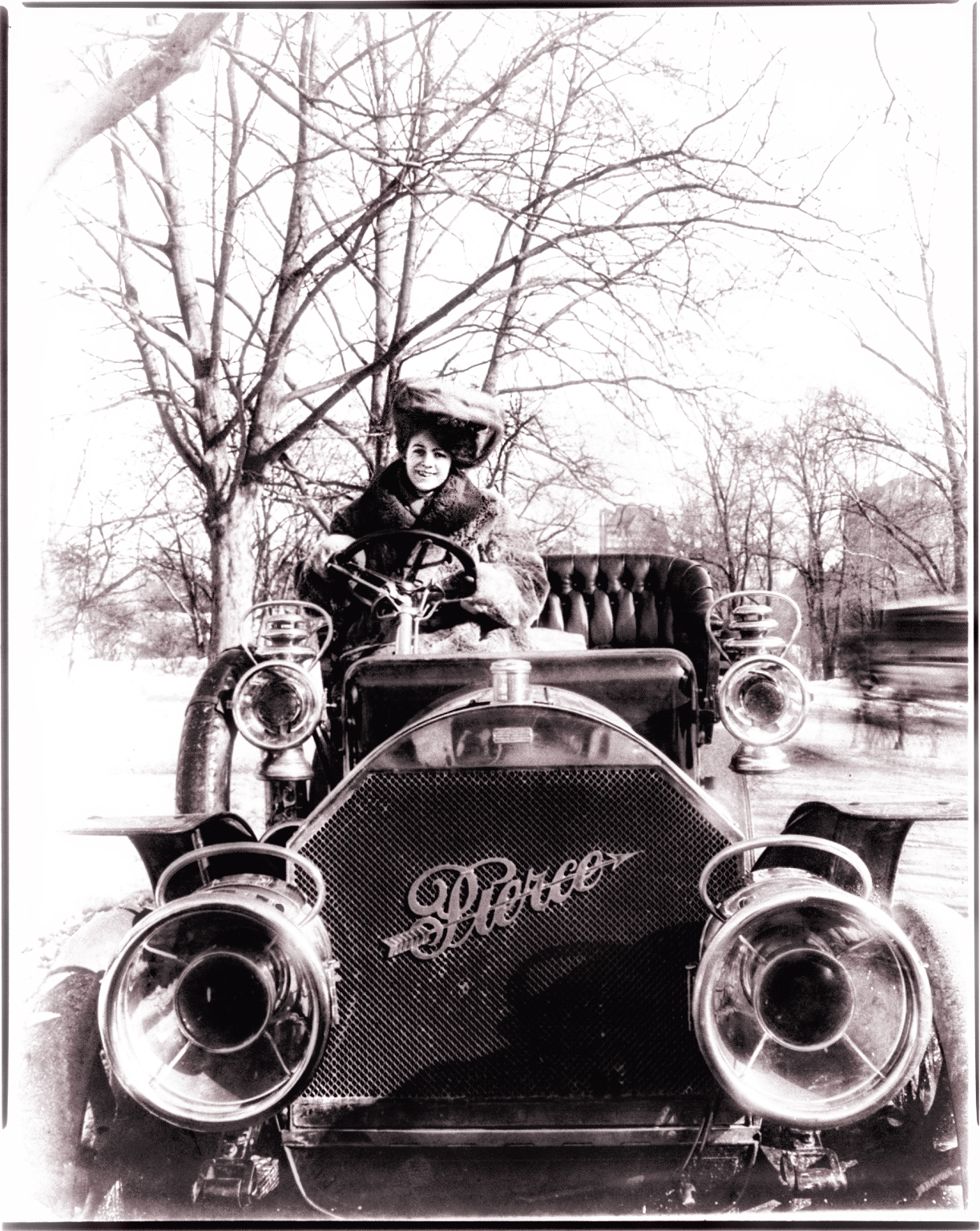
* With all her brass agleam, Miss Howe passes Mr. Death on the right.

3a20639uM

** Susan Howe is the author of a book called Pierce-Arrow. The Pierce-Arrow made of metal, photographed here, was an American luxury car of the early twentieth century. Susan Howe’s vehicle, the Pierce-Arrow made of words, is a rhapsody on themes of and by and about Charles Sanders Peirce, an American philosopher who wrote an essay called “How to Make Our Ideas Clear” and died in poverty.

*** Susan Howe is also the author of a book called My Emily Dickinson.

**** Mr. Casaubon’s punch line: In this image, Miss Dickinson may be the passenger in the ghostly vehicle on the right. Her driver slowly drove, according to the trip log, but even a heartbeat moves enough to make us and the record in images of our lives unclear.

Source of the image: http://www.loc.gov/pictures/item/98508090/. Photoshopped.


My noon had come to dine

Visible only in the tropics – that is, in the latitudes between the Tropic of Cancer and the Tropic of Capricorn – this is the zenith passage or Lahaina noon: the moment when the sun is directly overhead and an object standing vertically will cast no shadow. In the tropics it comes twice a year: when the sun is on its way north to the Tropic of Cancer (which it will reach at the summer solstice) and when it is on its way back south to the Tropic of Capricorn (which it will reach at the winter solstice). In Hawaii, where I took this picture today, the dates are in May and July.

And the picture’s title comes from a poem by Emily Dickinson, “I had been hungry all the years.”

Technical note: in memory of the online library

In 2012 the Emily Dickinson International Society inaugurated a series of online publications called New Directions in Dickinson Studies. Unfortunately, members of the society showed little interest and the series came to an end in 2013.

I posted an article there myself in 2012, and it’s still up on the site’s page at http://newdirectionsindickinsonstudies.org/?m=201211. However, all of its image links are now broken. To spell out what that means: it got published with peer review (good!), and fast, unlike paper publication (good!) — but now it can’t be read (as if every library that held it had burned down!). So, academic types:

do your students refuse to buy textbooks because they think everything is online?

Do your administrators say they don’t need libraries because they think everything is online?

If your answer to either of those questions is Yes, then please join me as we all say as loudly as we can, to students and administrators and Silicon Valley / Wall Street “reformers”:

There’s a moral there.

And here, a tiny dandelion timidly sprouting in the ashes of the library, is my article with its links intact.


Our Gnome revised with bio-1 Our Gnome revised with bio-2 Our Gnome revised with bio-3 Our Gnome revised with bio-4 Our Gnome revised with bio-5 Our Gnome revised with bio-6 Our Gnome revised with bio-7 Our Gnome revised with bio-8 Our Gnome revised with bio-9

Asks air silence; seeks sign

In his Amherst years, David Todd (1855-1939) had been the astronomer who almost but not quite discovered the moons of Mars. He was also the husband of Mabel Loomis Todd, who became first the mistress of Emily Dickinson’s brother and then the first editor of Dickinson’s poems and letters. It was David, an obsessive record-keeper, who induced Mabel to start keeping the sex diary which in later years made her one of the heroines of Peter Gay’s The Bourgeois Experience: Victoria to Freud — specifically volume 1, the volume subtitled Education of the Senses.

By 1924, David was in retirement, living out his years in a discontinuous series of mental hospitals. In August of that year, however, he was at liberty, and perhaps he was able then to catch the ear of President Coolidge, an Amherst alumnus. At any rate, here he is in Washington on August 21, 1924, with a démarche to Mars, an apparatus for recording the response, and (in the rear) the inventor of the apparatus, the radio pioneer C. Francis Jenkins.

And here is the report he filed from Mars.

And with those words “freak which we can’t explain,” this chapter in the history of air silence came to an end. Ever since, the static noises of freak have been equally a part of air silence’s language with explanation and poem.
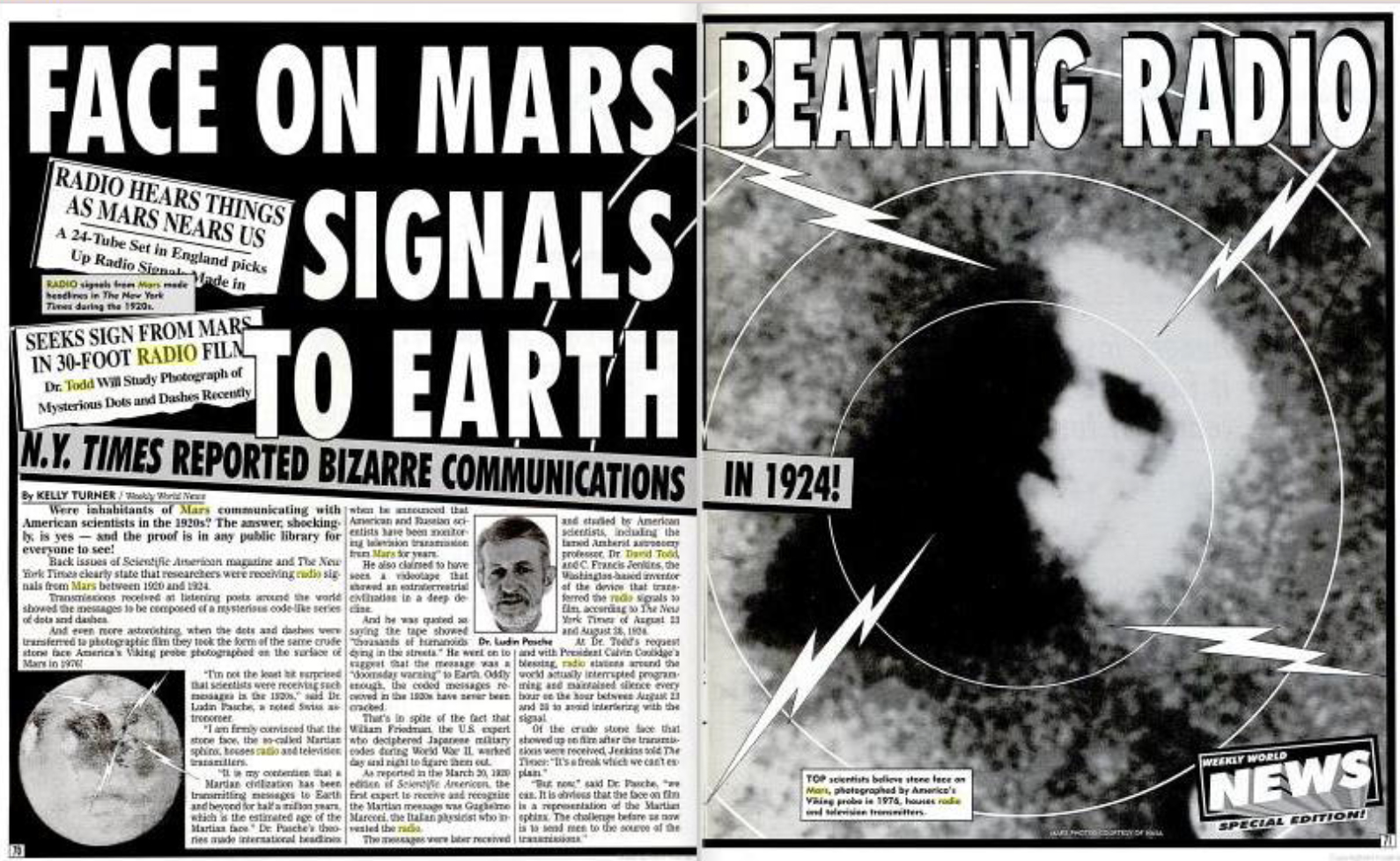
Weekly World News, July 6, 1999

But back in Amherst Miss Dickinson’s three apparatuses were tuned to receive silence, only. Mrs. Todd used to visit her house and play Bach for her on her piano, but she saw Miss Dickinson’s face only once: in her coffin. In memory of piano, house, and long prepared deathbed, then,

this antenna array.

Sources:

Peter Gay, The Bourgeois Experience: Victoria to Freud. Volume 1: Education of the Senses. New York: Oxford University Press, 1984.

Polly Longsworth, Austin and Mabel: The Amherst Affair and Love Letters of Austin Dickinson and Mabel Loomis Todd. New York: Farrar Straus Giroux, 1984.

“Dr. David Todd & C. F. Jenkins, 8/21/24.” National Photo Company Collection, Library of Congress, http://www.loc.gov/pictures/item/npc2007011972/. Photoshopped. The image is also discussed at http://www.shorpy.com/node/12482.