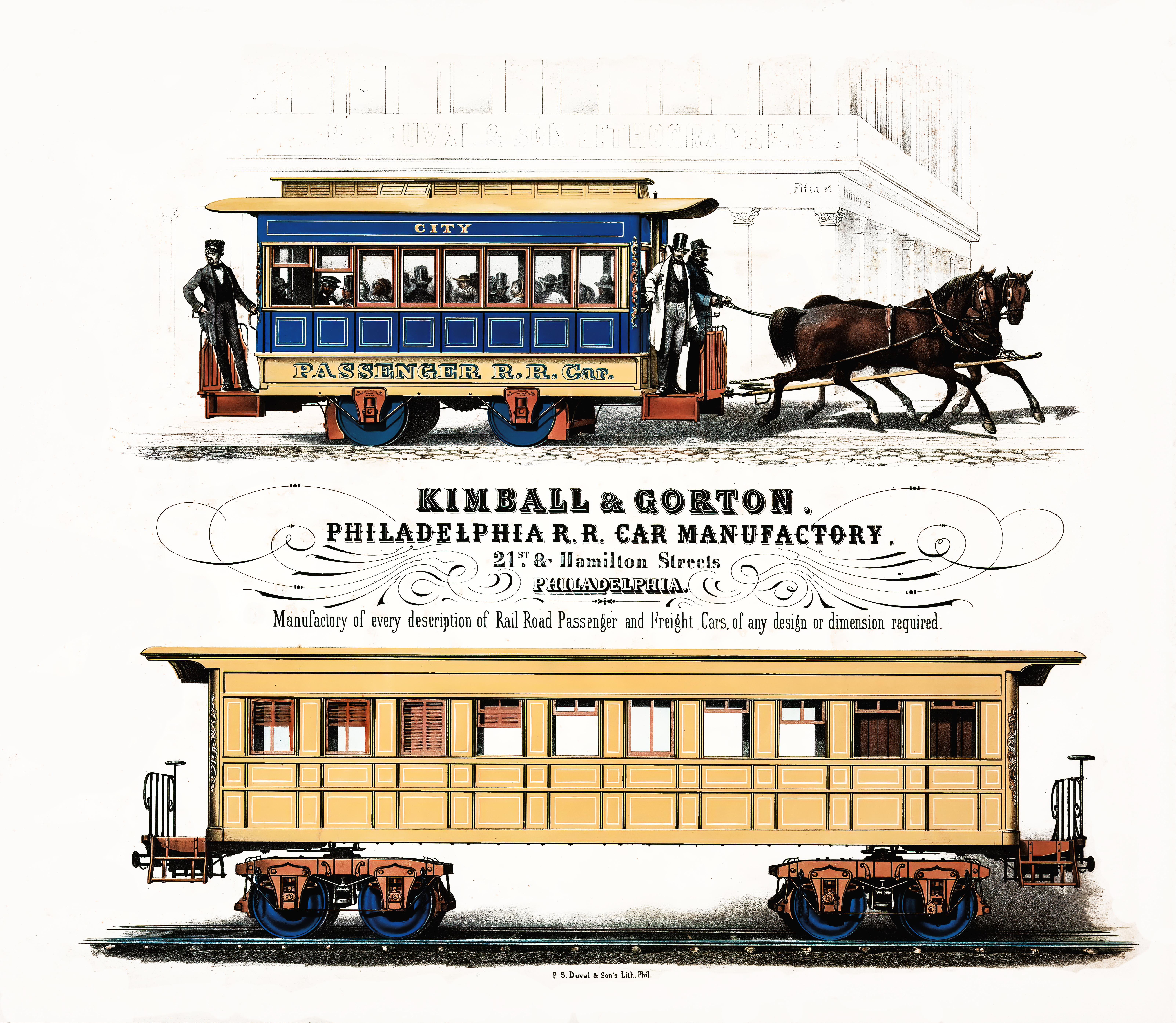
Appear’d the cloud, appear’d the long black trail
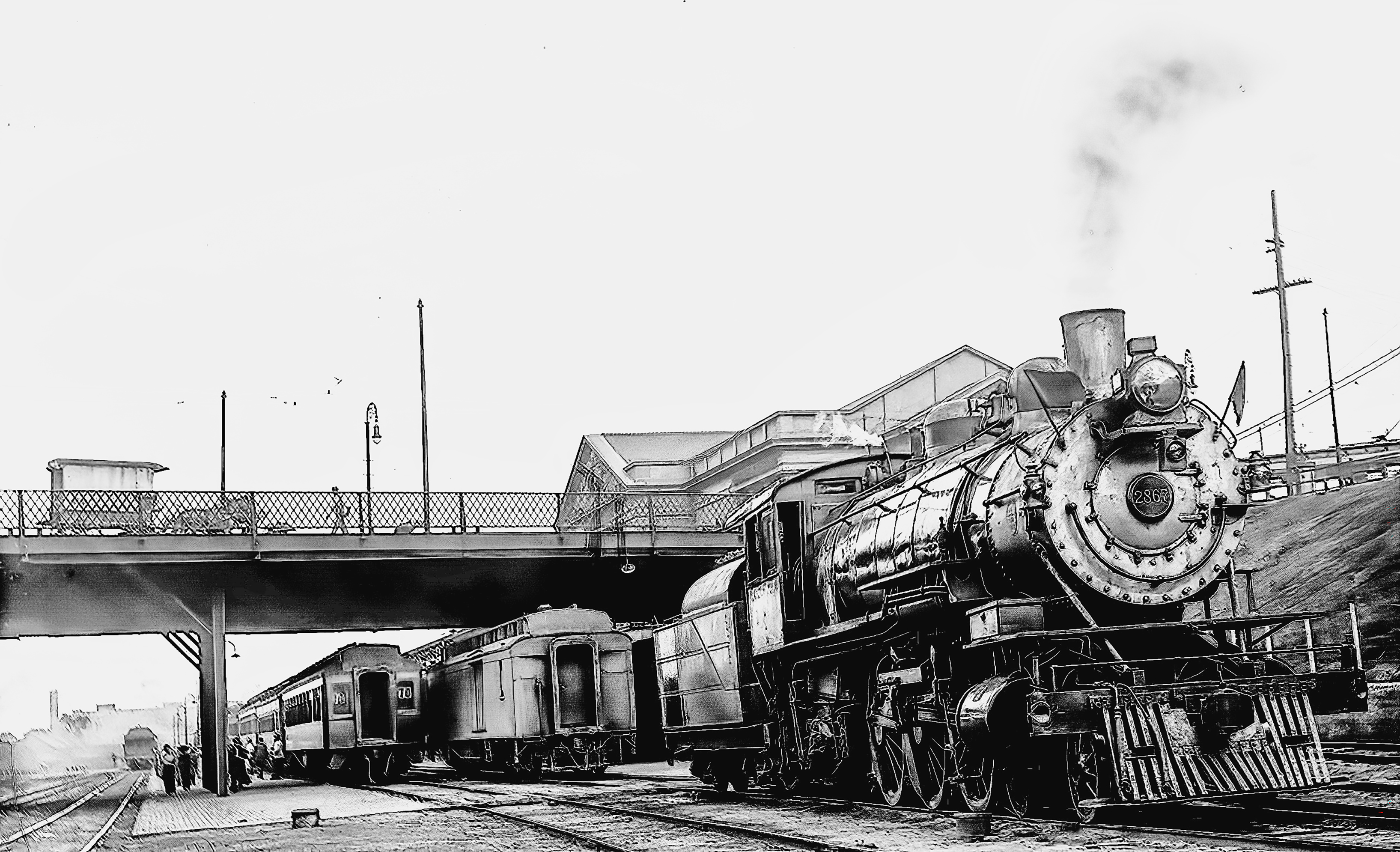
A horse on a bridge. Men and women under the bridge. Telegraph wires weighed down by birds. A locomotive, steaming.
Their date is 1910. They all are warm to the touch — still and forever.
A moral is this aria from Handel’s Judas Maccabaeus:
How vain is man, who boasts in fight
The valor of gigantic might,
And dreams not that a hand unseen
Directs and guides this huge machine!
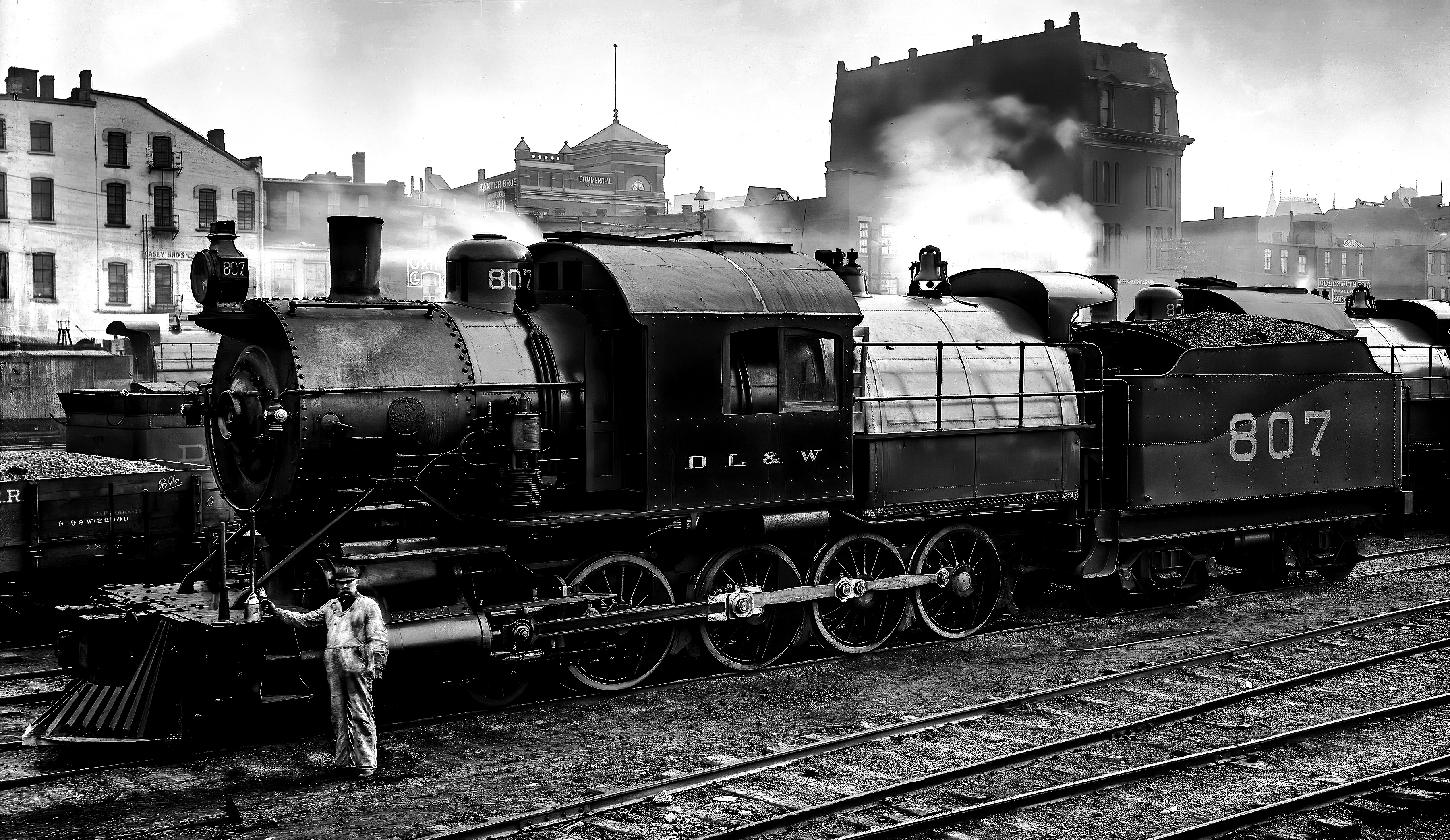
But the libretto directs that the aria’s performer be a coloratura tenor, not a man in coveralls with a dented oilcan and lungs full of coal smoke. The unseen hand and its score are a musical machinery, but the mustached body once was warm and tangible.
—
From “Group of Lackawanna freight engines,” between 1890 and 1901, Detroit Publishing Company Collection, Library of Congress, https://www.loc.gov/pictures/item/2016801376/. In 2020 I posted to this blog an earlier edit of the image (no longer shown) under the title “Man in City.” The city is Scranton, Pennsylvania, which between 1851 and 1960 was the headquarters of the Delaware, Lackawanna & Western Railroad.
Between a river valley in 1898 and you, there has passed this image of the no longer moving. Clouds, ripples and all, everything now visible within the black border has been dulled and stilled.
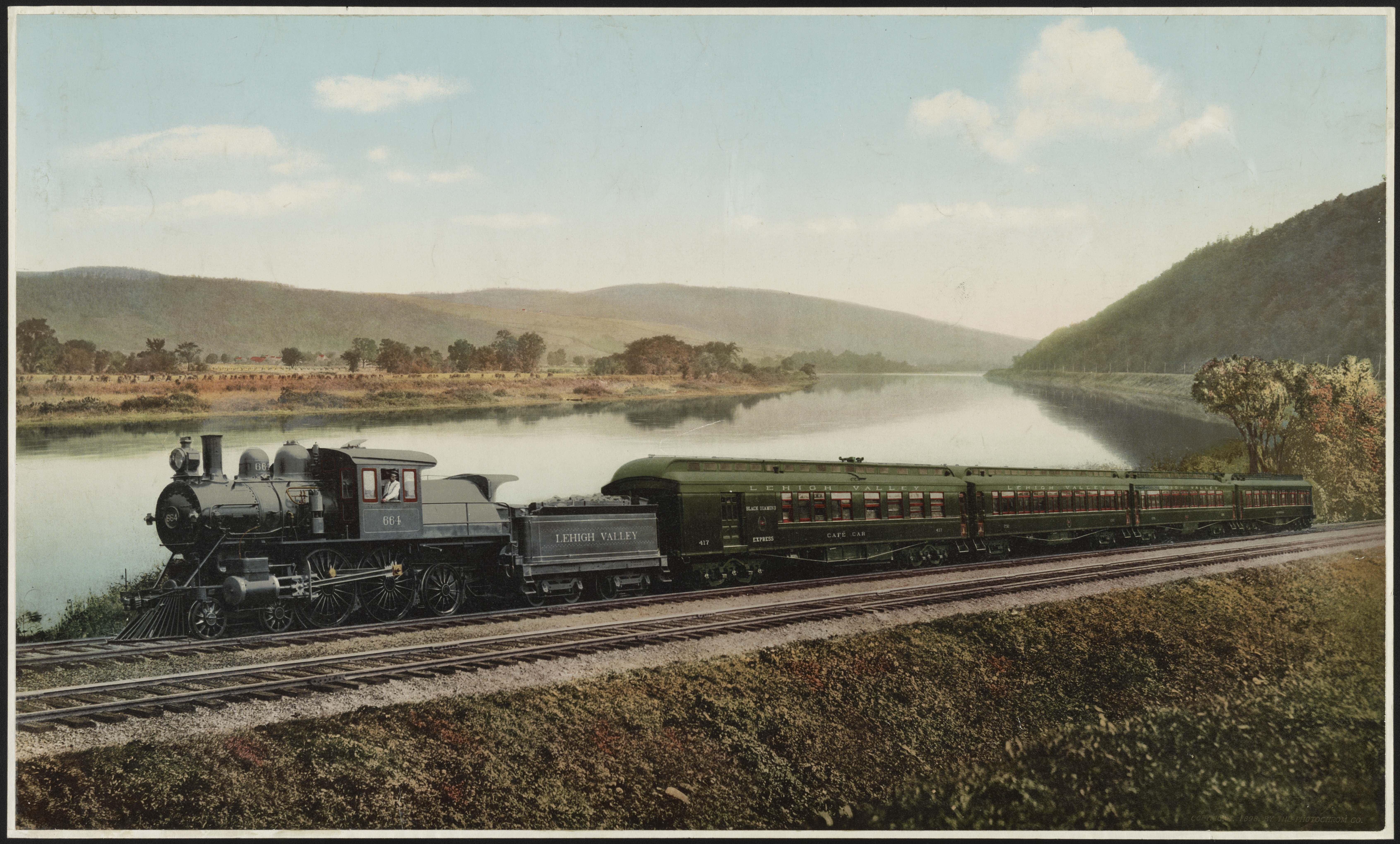
One of the incidentals in there is an episode from the history of steam. What you see acting it out is a powerful little locomotive known as the Mother Hubbard which saved money for some Pennsylvania railroads like the Lehigh Valley by burning low-quality coal in an oversized firebox supported by the engine’s big drive wheels. The type didn’t spread far beyond Pennsylvania’s anthracite fields and didn’t last long; it separated the engineer from his fireman, it sometimes killed him when the engine threw a piston rod up through the cab, and when engines grew bigger its firebox couldn’t. But when Mother Hubbard was mobile, Americans communicated by postcard, and this was one of the the Detroit Publishing Company’s cards. It was the work of William Henry Jackson (1843-1942), who traveled America’s rails on Detroit Publishing’s behalf in his own special car.

The photograph of Yellowstone Falls on the bulkhead is Jackson’s own icon. Dating from 1871 and the first photograph ever made of the Falls, it is a contact print made from a glass negative measuring some 16 by 20 inches, hauled into and out of the canyon by mule train. In a less strenuous era and a less strenuous part of the nation, someone still took painstaking brush and pigment and colored in the Black Diamond.
It’s easier now.
The current technique’s business model is monthly rent, and its business name is Lightroom. As long as your credit lasts within the room, it proposes to enact and perform memory for you. Now, because you have tapped a credit card, you are entitled to believe that you see clouds passing above the damp riverbank where you stand in sunlight.

This month I paid for you. The door opened, the Room let you in, and now you believe you once saw what you see now. Subject to the terms of the agreement, you began believing you were on a river path to a place where earth is soft beneath Mother’s breath-warm steam.
Somebody at lower right went blurry and moved off in the dark. For a time a shutter had opened and the dark was filled with glitter. It threw light on the change of circumstance. Within the dark, non-glittering somebody would never be seen again.

Güterzuglokomotive für die Königliche Eisenbahn-Direktionen Berlin und Köln und für die Dortmund-Gronauer Eisenbahn. Architekturmuseum, Technische Universität Berlin, https://architekturmuseum.ub.tu-berlin.de/index.php?p=79&Daten=223297
During the nineteenth century, coal and its no longer latent powers began mattering to art and literature. Having been perceived and depicted, they now demanded equal but different rank with the divine. To realize Anna Karenina’s feelings during her night passage on the Moscow-St. Petersburg express was the same problem for Tolstoy that it would have been for Homer, but it was only Homer’s routes that traversed a universe conceivable as a surface hiding no secrets and revealing all there was to reveal. Against that, the moment at the end of Anna’s emptied book when a disconnected fuel tender came rolling by itself down its track (VIII.5) was a revelation of movement without a discoverable origin in intent or terminus in meaning. It may have been that that extorted the last tears from Vronsky. His voyage of discovery had ended without conclusion, in smoky midair.
See how you yourself now perceive this silhouette of eleven womanless men and a danger sign. Inside their collective image, smoke from a waiting parovoz ascends to darken the cloudscape, and that seems to be all the meaning there is. Certainly no one within the artwork’s dark margins is reading the sign’s words.
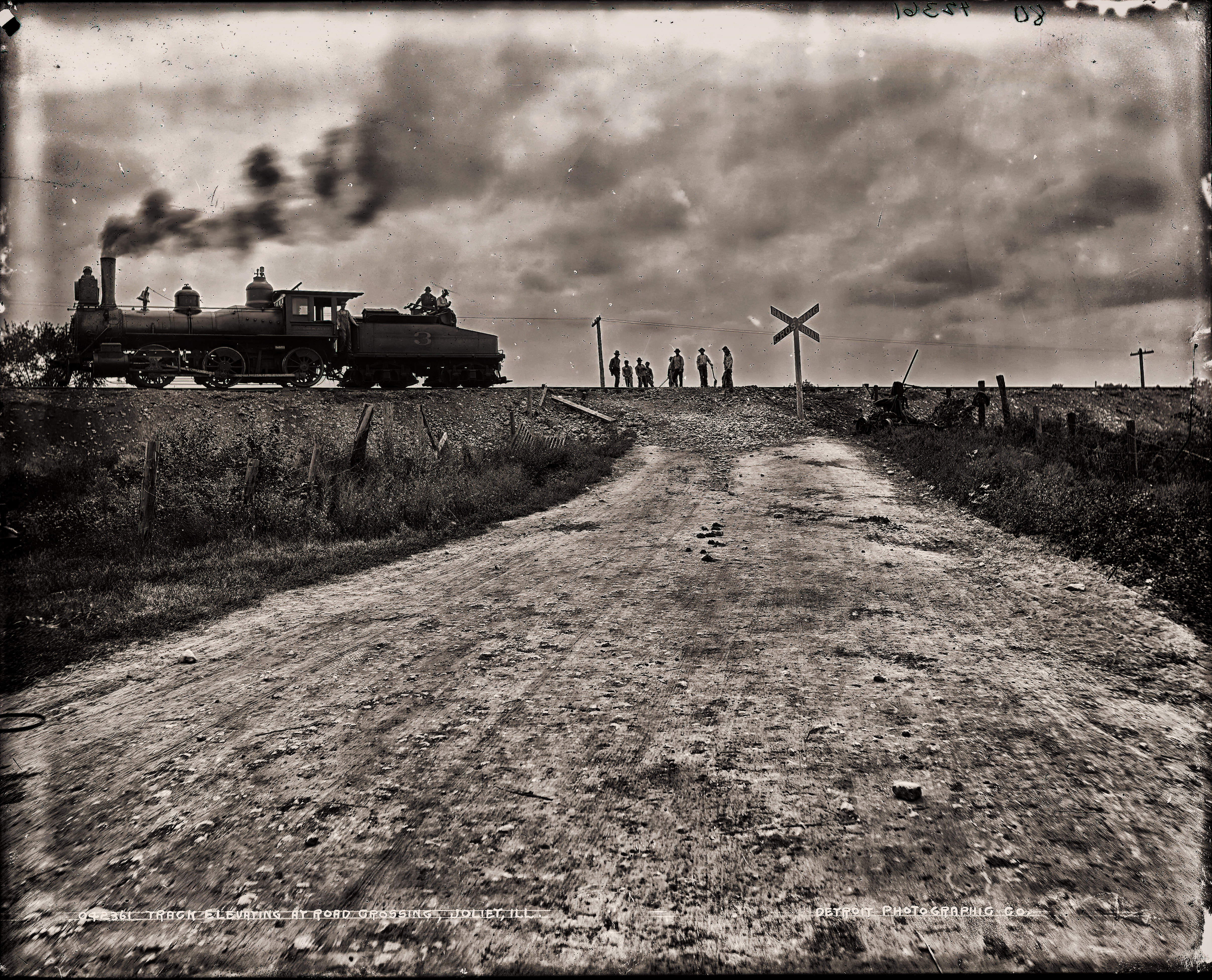
Signed at under such circumstances, lesser realists such as William Dean Howells and Jacob Riis reacted by filling their non-fictions and their fictions alike with brand names and street addresses, recorded with due accuracy. The intent seemed to have been to force signifiers like the railroadmen’s unread X to give up a meaning. In time, James Joyce came to understand that a record’s significance lies in its words, only. The data of its ostensible content are a pre-text, and that is enough. But the image you have just seen in parallel with Tolstoy’s words is a wordlessness. Its primary signifier is not a history like Tolstoy’s or Joyce’s but a chemistry and a meteorology, and its record is only one of the smudges that coal in the nineteenth century left in the air.
She was Phoebe Snow, the white-gowned heroine of one of the most successful advertising campaigns in American business history: Earnest Elmo Calkins’s series of streetcar advertising cards (1903-1917) for the Delaware, Lackawanna and Western Railroad. This was the onset of Phoebe’s dream.

Its poems and its history can be read at http://cs.trains.com/ctr/f/3/p/264453/2986868.aspx. For the dream itself, however, no language was required beyond a few alphabetic cells of the meaning into which Phoebe was to awaken .

And because the alphabet was a dream, the awakening from dream to meaning was happy.

I also discuss Phoebe at https://jonathanmorse.blog/2012/05/26/as-things-fade-to-white/. The photograph above comes from the story of Earnest Elmo Calkins. I’ve post-processed it for color and detail.