Observation: as the political atmosphere changes, the sounds of meaning also change

On December 27, 1933, as the Third Reich approached its first anniversary, The Nation published a letter of political protest. The policies being protested weren’t Hitler’s; they were The Nation’s. Wrote the author about the magazine that was publishing him: “Its insinuations that the new leaders [of Germany] are men without conscience — in short, cruel, inhumane, selfish, and even immoral, lacking even one redeeming characteristic — I resent.”

Six and a half years ago, when I discussed that letter on this blog, it seemed obvious that its author’s expression of resentment was meaningless not just factually but ontologically, as if it were a contradiction of its own language. The word “resent” was so totally wrong in its ghastly historical context that it was almost funny. Obviously (it seemed to me in 2013, during the Obama administration), whatever The Nation had opined in 1933 about Hitler must have been provably right — and the proof was in the protest. If a Nazi sympathizer resented someone calling Hitler cruel, the a priori case was that Hitler must have been cruel. But how strange it is to say “cruel” in 2019, when the c-word has changed from a term of disapproval to a term of approval, like “fuck” in the mouth of Lady Chatterley’s lover!

So here, if only for its antique-store curiosity, is my post from 2013.

https://jonathanmorse.blog/2013/07/24/tune-by-victor-to-be-played/

I reread it yesterday because I’ve learned some new details about its contents, and these are now incorporated in the text. But the text as a whole now seems beyond revision, doesn’t it? I wrote it in the American English that was current in 2013, and as of 2019 that language is becoming incomprehensible. It is a dying language: victim of its writers’ will to cruelty.
Sociopolitical sounds, 2019

Sound 1: “Sosh-shkyerty”

An American regional pronunciation, normative in areas that are characteristically conservative. Here a Midwestern politician says it in the 1970s.

https://www.youtube.com/watch?v=AY5OD6aR3eA

Sound 2: “Washton duh-ee suh-ee”

Another regional pronunciation, but with connotations of class contempt. Across the United States there are many towns named Washington, but only one large city — the city that happens to be the nation’s capital. By spelling out that city’s name in full, the speaker implies that the extra detail is necessary for people like his interlocutors and him: members of a linguistic community in possession of a comprehensive Heideggerian knowledge of the meaning of all the other Washingtons: where and what they are, how they are.

Compare:

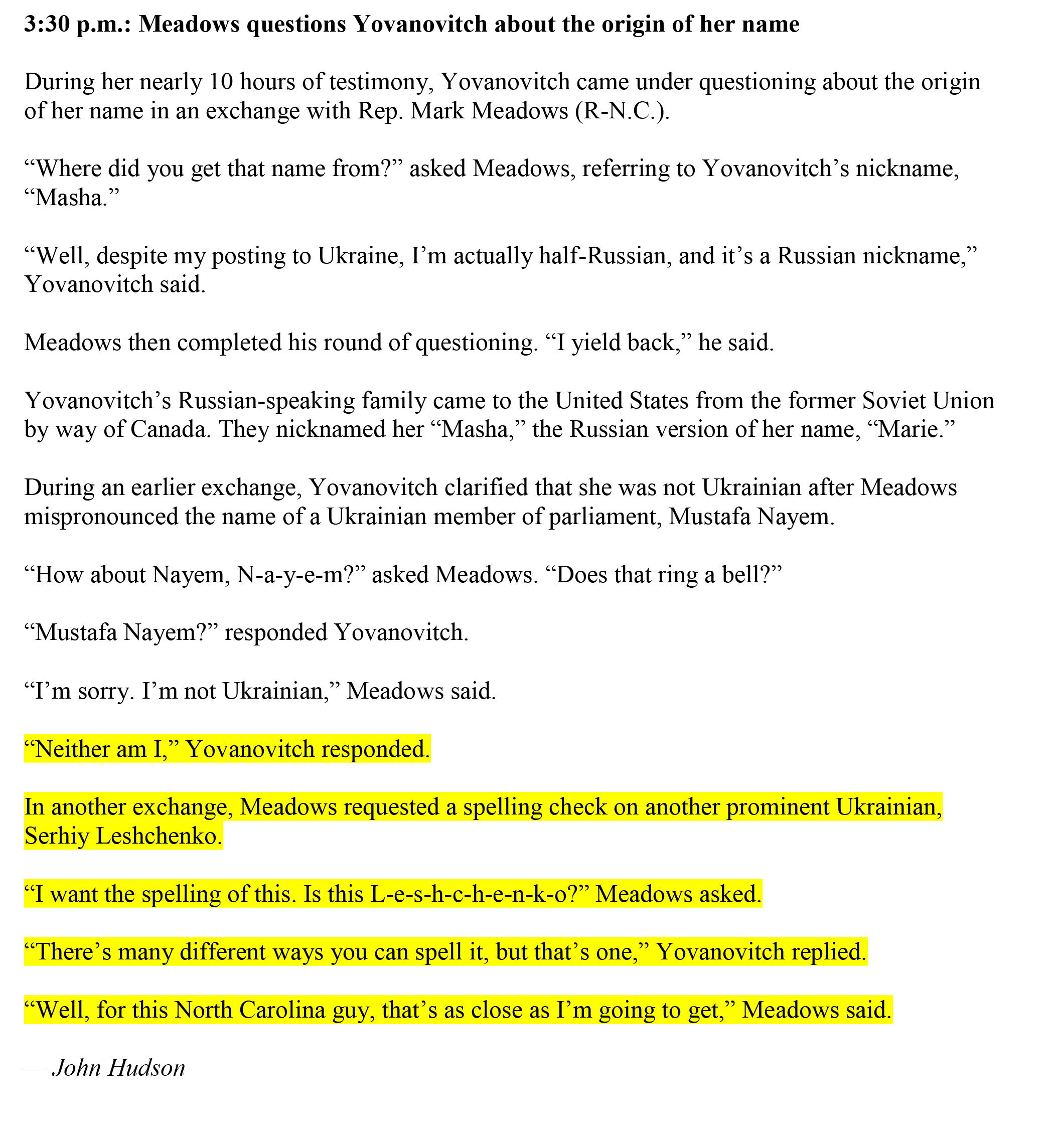
Meadows, marked
https://www.washingtonpost.com/politics/trump-impeachment-inquiry-live-updates/2019/11/04/f850b79a-fef2-11e9-9518-1e76abc088b6_story.html

As in, “In North Carolina, where we marry our sisters . . .”

Sound 3: The three-letter word that is pronounced with either three syllables (“Zionist”) or six (“uh Jewish uh person”)

For the gloss on that, consult

9-1
“Simon Wagstaff”: pseudonym of Irish writer, 1667-1745


News from the twentieth century: topless is fine as long as you aren’t Allen Ginsberg

It also helps not to be unwhite.

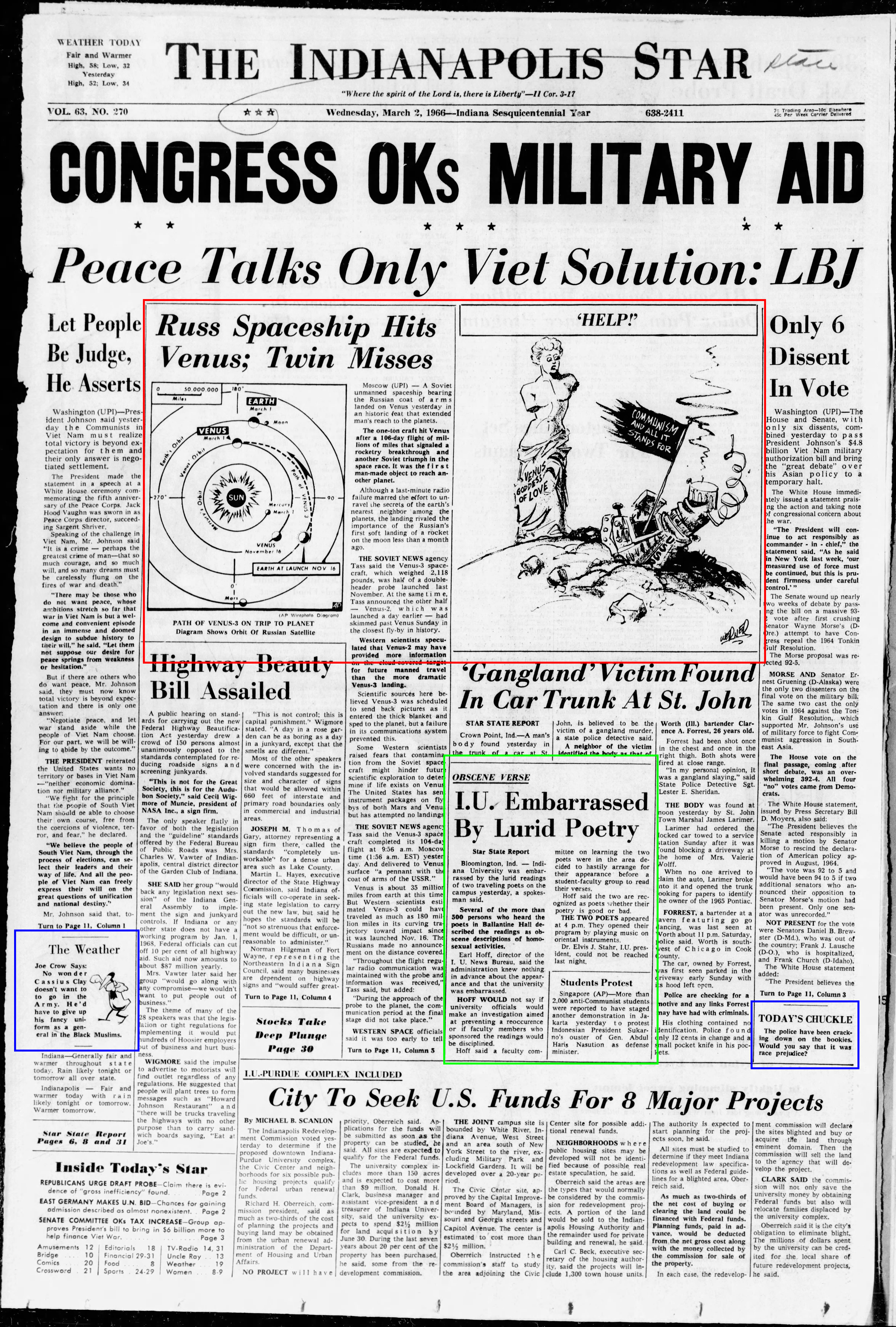
The_Indianapolis_Star_Wed__Mar_2__1966_1A

For several days after this story broke, the reading was front-page news in the Star. The Star’s analysis two days later (March 4, pages 1 and 4) explained:

The_Indianapolis_Star_Fri__Mar_4__1966_4 clip

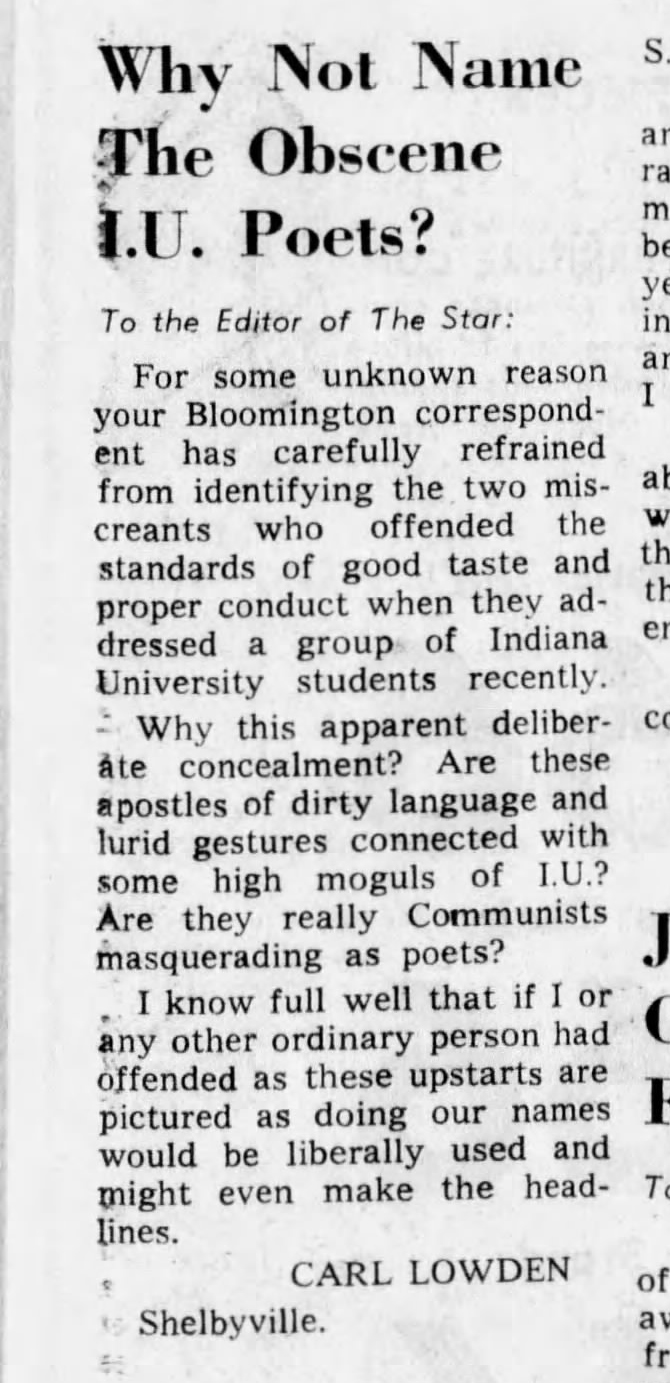
In all that time, the poet’s name never sullied the whiteness of the Star’s newsprint. On March 11, page 21, a reader complained:

The_Indianapolis_Star_Fri__Mar_11__1966_ clip

Ginsberg’s own record of the event is the poem “Auto Poesy: On the Lam from Bloomington,” collected in his 1972 City Lights volume The Fall of America: Poems of These States 1965-1971. It mentions the “tower walls” of the Eli Lilly & Co. plant in Greenfield where I read the Star’s coverage in a break room,

and figured out the poet’s name,

and came with a sinking feeling to the realization that I was the only person in the complex who would know or care. About that, a line from Hart Crane’s The Bridge may have the grammatical distinction of being the only factually incorrect imperative ever written:

Come back to Indiana — not too late!

It is not possible to set foot too late in Indiana.


Some history on behalf of the Thirty Meter Telescope

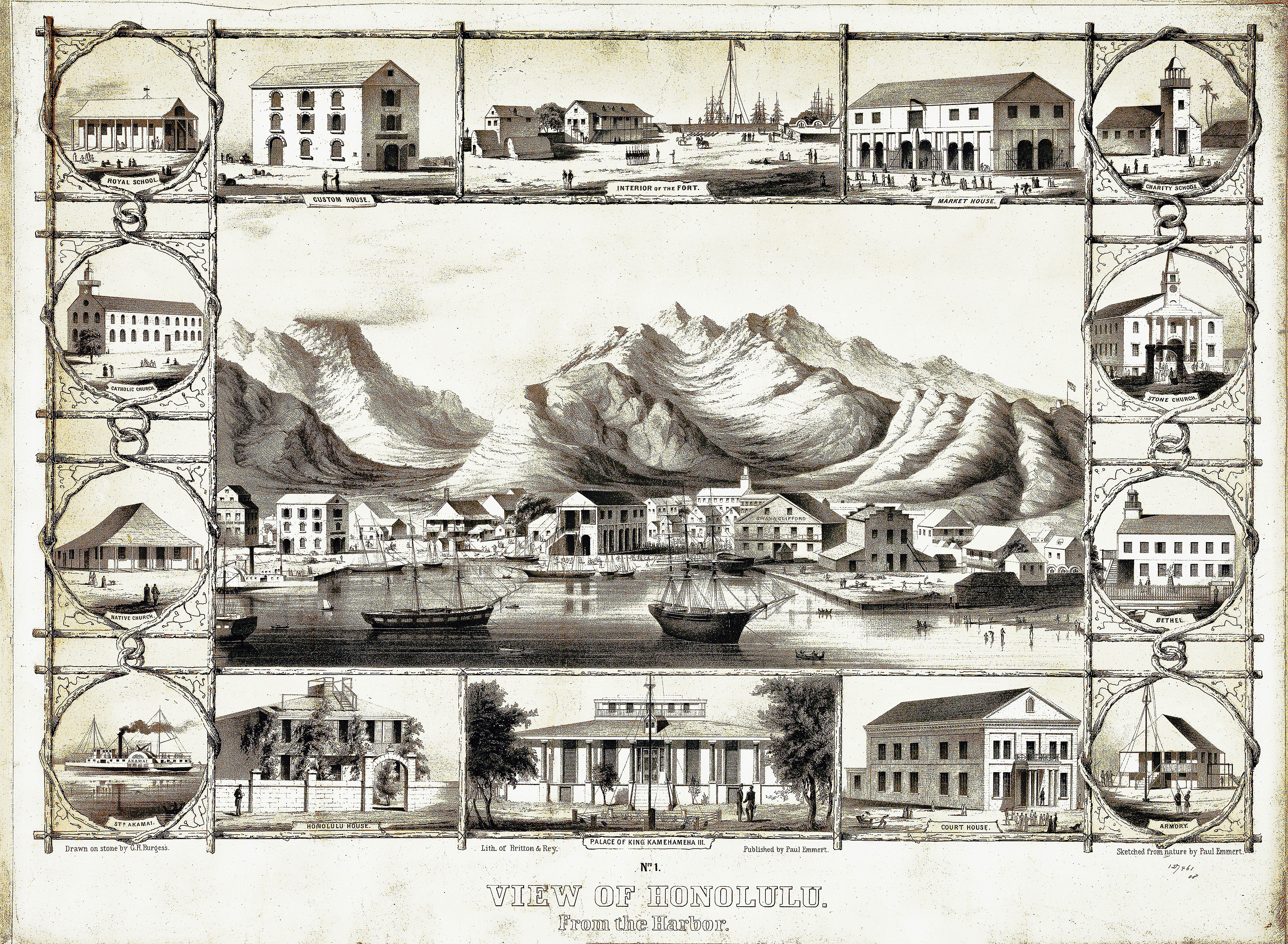
Here, dating from 1854, is a view of downtown Honolulu.

00315u6E

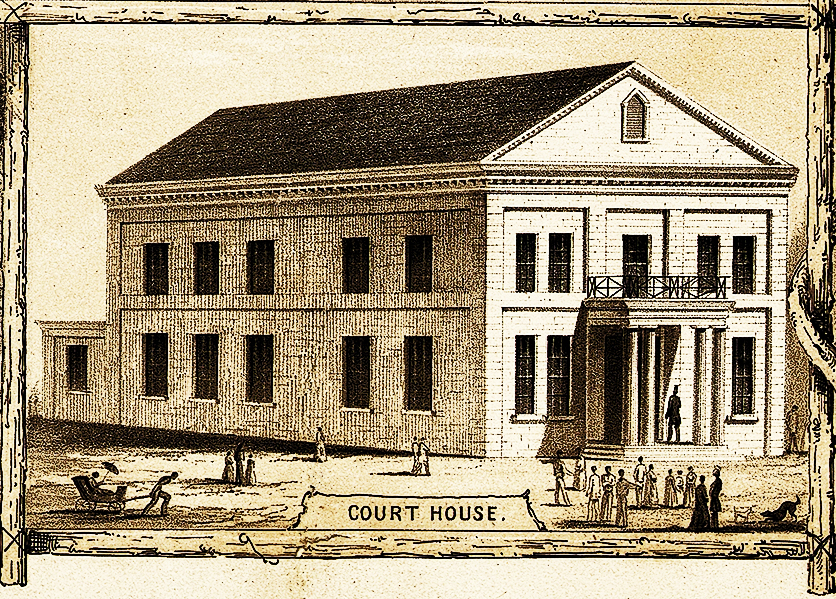
Here’s a detail from the lower right of the image.

00315u6 cut

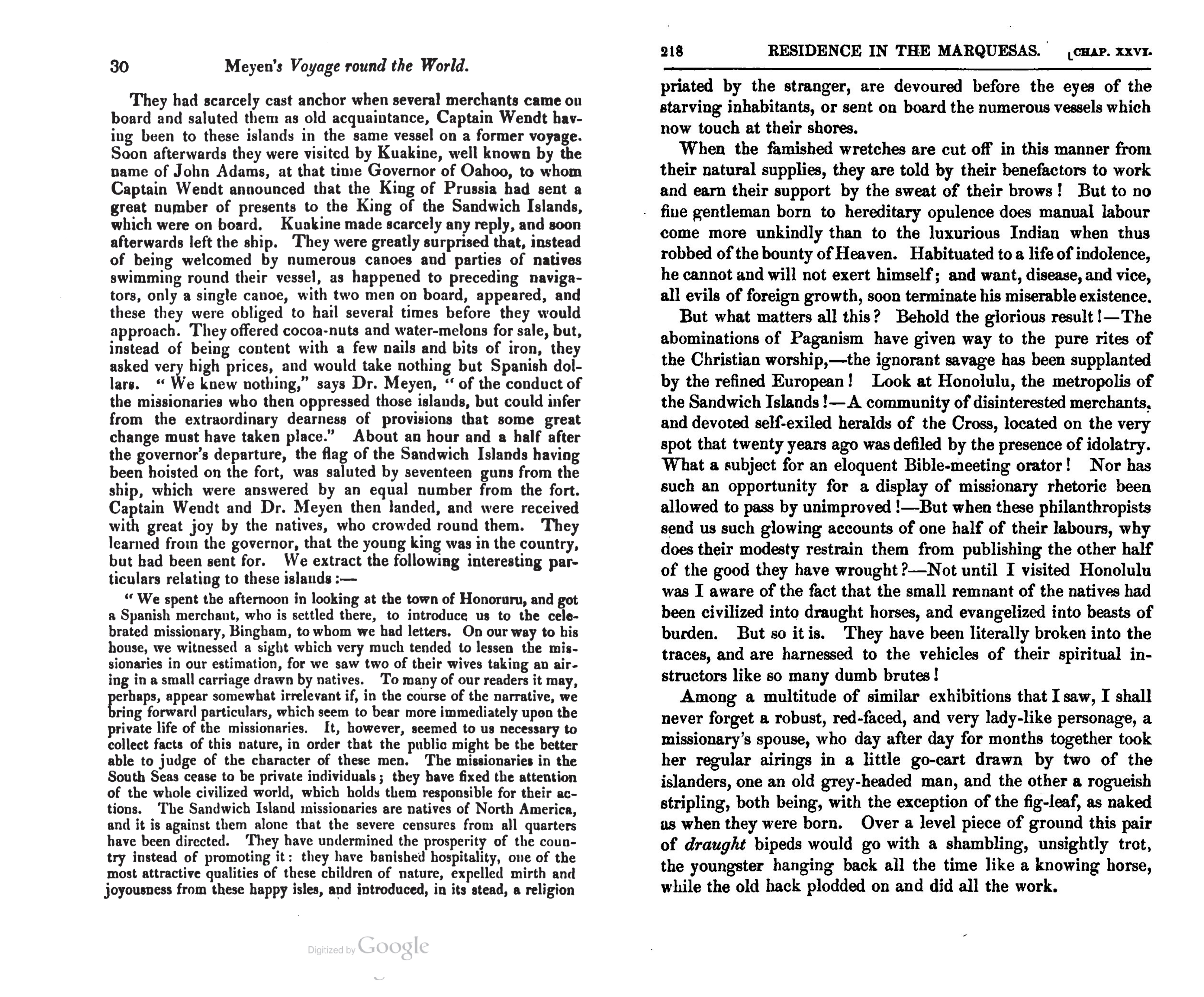
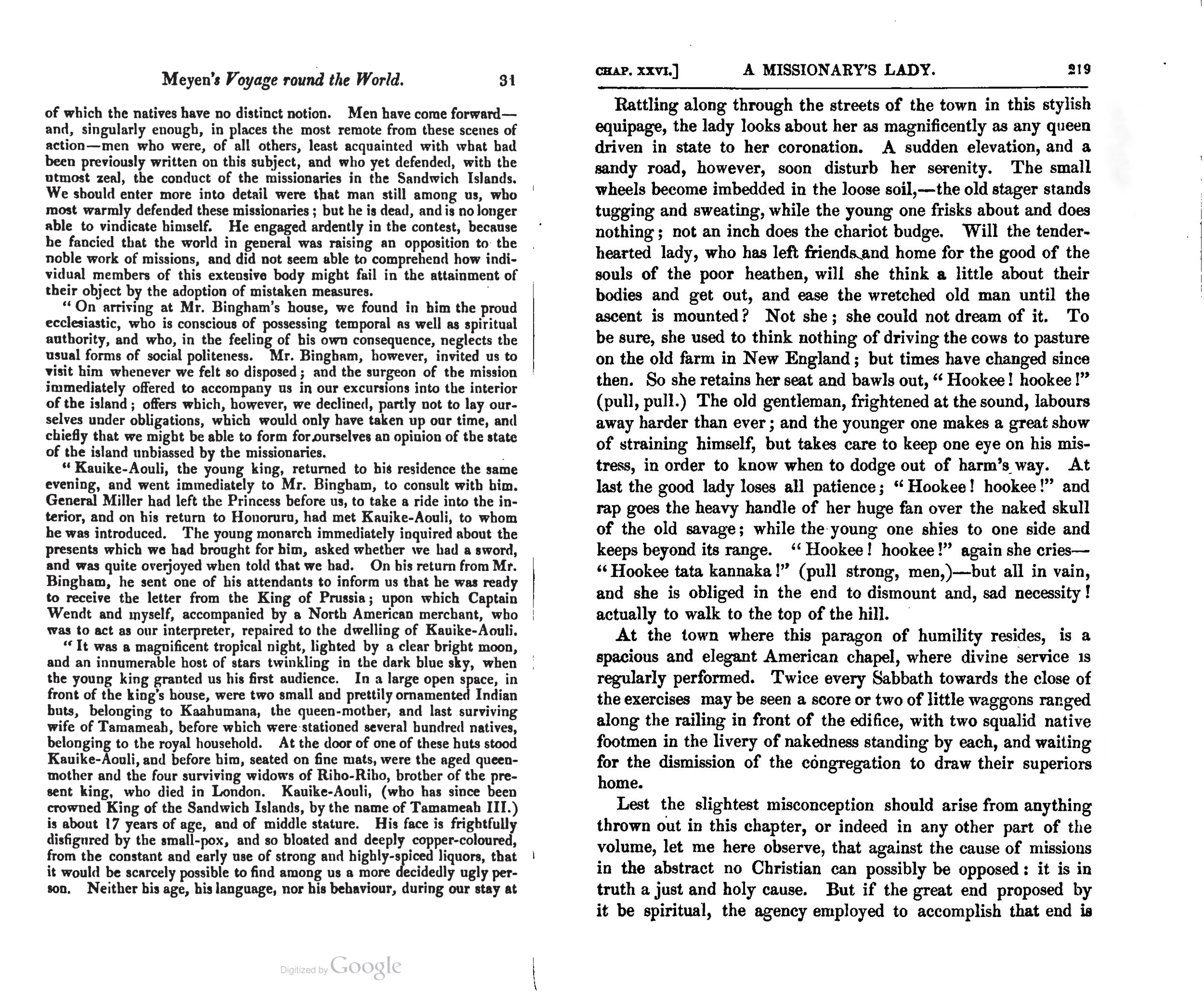
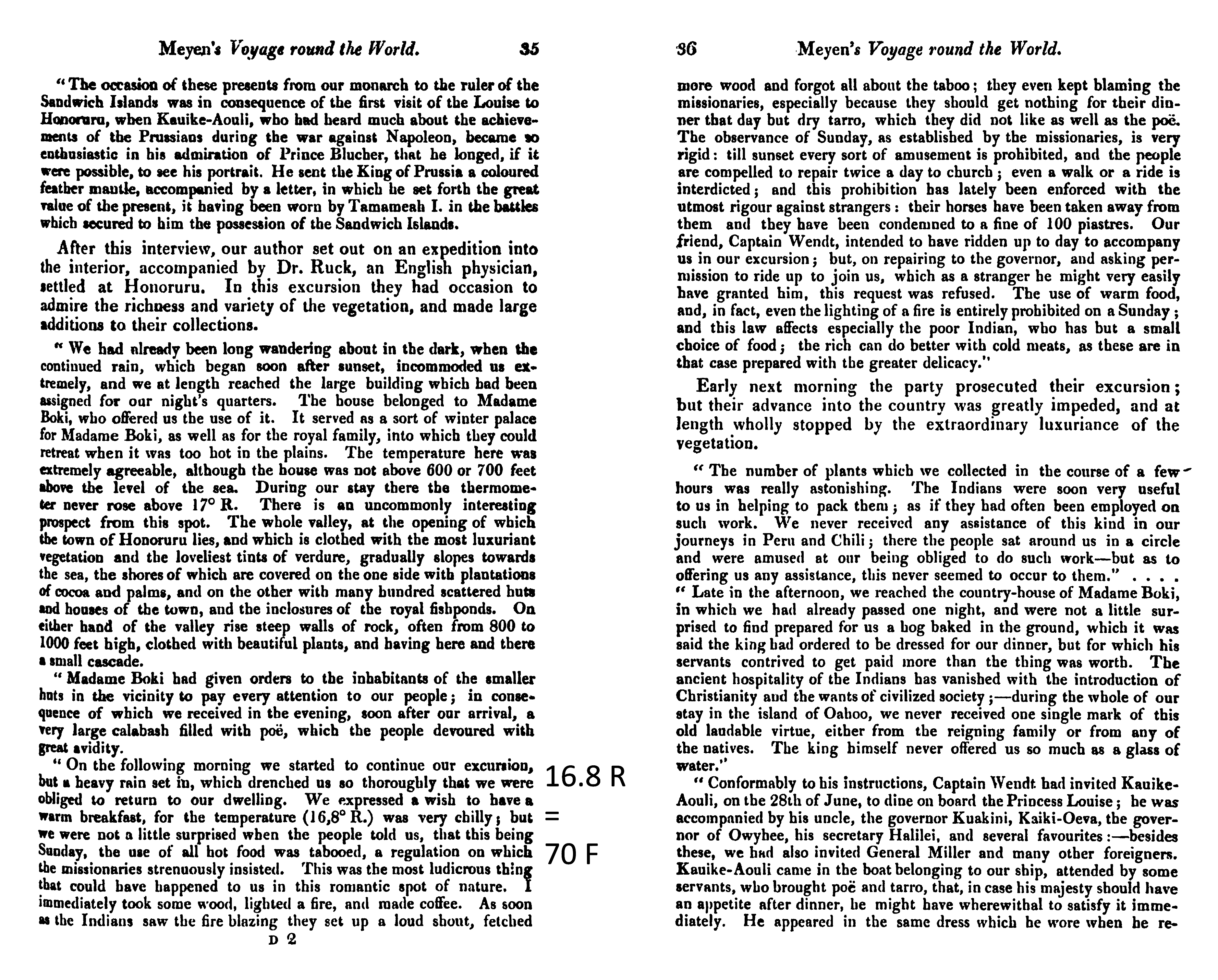
And here’s a double description of what your eyes have just beheld. One half of the description comes from the 1847 second edition of Herman Melville’s first book, Typee; the other half comes from an 1835 translation of what appears to have been Melville’s source, an 1834 account of an expedition around the world by the German botanist F. J. F. Meyen.

The_Foreign_Quarterly_Review

The_Foreign_Quarterly_Review

The_Foreign_Quarterly_ReviewThe_Foreign_Quarterly_ReviewThe_Foreign_Quarterly_Review

And here are two more pages of Meyen which Melville didn’t use.

The_Foreign_Quarterly_Review.pdf

As I write, a group of Hawaiian monarchist protesters are holding up construction of the great Thirty Meter Telescope atop the Big Island’s Mauna Kea. They call themselves cultural practitioners, and what they claim to be practicing is the animist religion of pre-contact Hawaii. In this they are supported with money and public relations by Kamehameha Schools / Bishop Estate, the combined successor power of Hawaii’s nineteenth-century puppet kings and their Christian missionary puppeteers.

Typee is partially non-fiction, partially fiction. For a start, Melville’s “four months’ residence” in the Marquesas was only three weeks. As Hawaii’s history is generally taught, it too is partially fiction. But look at that illustration again. Look at that woman with her parasol and her Hawaiian slave.

It tells you that the things called history and culture are complicated, but sometimes they show us things that are true. So please: before you click away, look one more time at the man towing his missionary burden. He wasn’t a king or a priest. None of the people blocking progress on Mauna Kea today would claim descent from him. Still, he did exist, and perhaps he’s worth trying to remember.

Battery

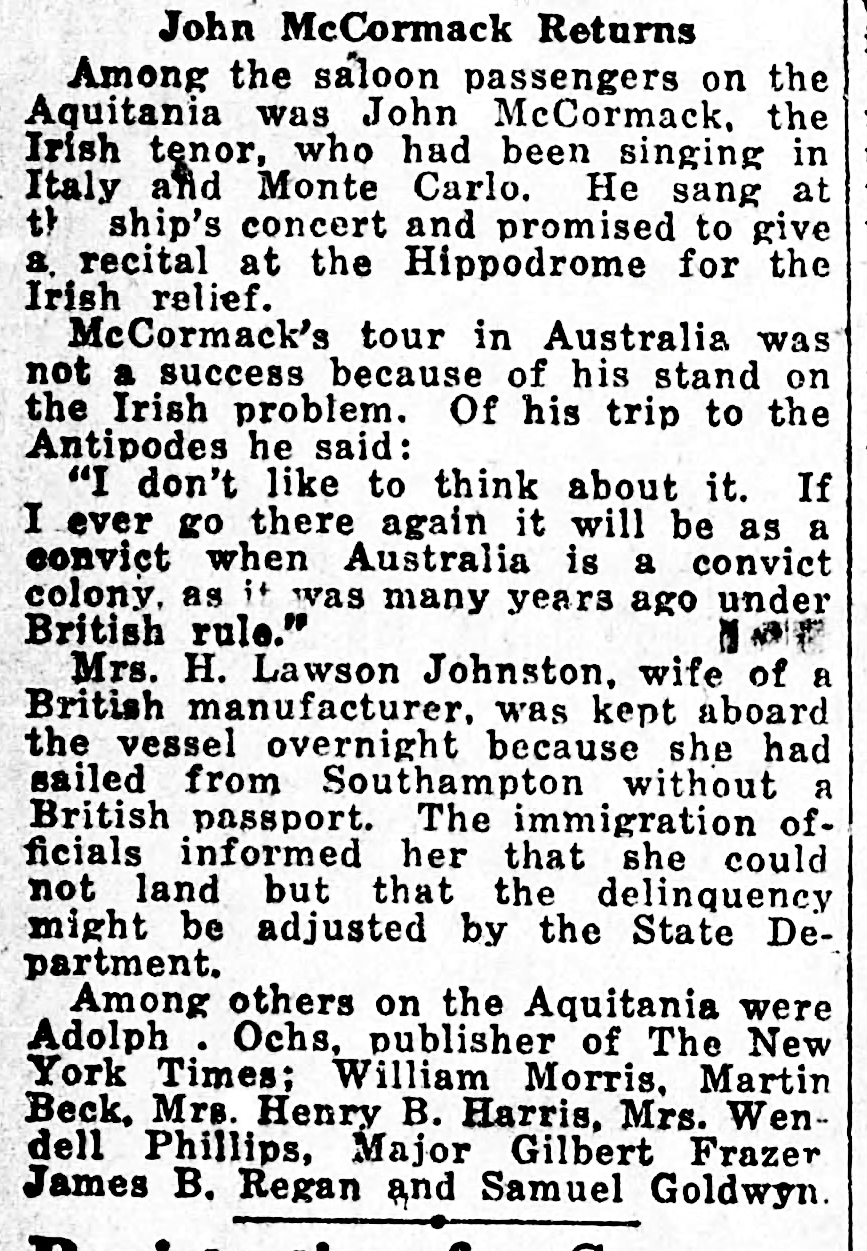
In New York on April 30, 1921, as the liner Aquitania sailed up the bay from quarantine, the tenor John McCormack, one of the most celebrated singers of the time, showed himself before the recording instruments of the media. The role he was performing approximated what his fellow Irishman William Butler Yeats was to call (in “Among School Children”) “a smiling public man.” A space of foggy air and wooden decking separated him from the battery of cameras.

32289uaiD

Then, though, the cameras moved in closer and the singer began to speak.

32292uaiF

The reporters took down his words. They turned out to be Irish words.

New_York_Tribune_Sun__May_1__1921B_
New York Tribune, 1 May 1921, page 12

Along with the celebrated singer, a celebrated newspaper publisher was on board the ship, and so was a celebrated Hollywood producer. We’re willing to believe they were because the story tells us so in indirect discourse. We don’t need the publisher’s or the producer’s actual words to bear witness. And as to the singer, in 1921 all the cameras had to be silent.

But perhaps we can see words forming on his face.

32292uaiG

Sources: George Grantham Bain Collection, Library of Congress, http://www.loc.gov/pictures/item/2014712442/ and http://www.loc.gov/pictures/item/2014712445/. Post-processed to restore detail and contrast.

It will be interesting to teach Emerson again after two years away

In 2016, all I had to say to get the discussion started about “Self-Reliance” —

What I must do is all that concerns me, not what the people think–

was “Ayn Rand.” This coming spring, in the Trumpera, the discussion seems all too likely to self-start out of an indignant and rejecting silence.

Still, yes:

Nature is the opposite of the soul, answering to it part for part. One is seal, and one is print. Its beauty is the beauty of his own mind. Its laws are the laws of his own mind. Nature then becomes to him the measure of his attainments. So much of nature as he is ignorant of, so much of his own mind does he not yet possess. And, in fine, the ancient precept, “Know thyself,” and the modern precept, “Study nature,” become at last one maxim.

It’s true, as you see. Nature doesn’t contemplate the possibility of an Ayn or a Donald. In her domain there is only law, reproducing its works by contemplating itself.

DSC_6078aiG

Sources: Emerson, “Self-Reliance” and “The American Scholar”

Pathos as a resource

Many Flickr accounts, mine included, are currently accumulating Likes from girls with lower-case composite names (“faithgoodman,” “kaylaromero”) and identically formatted Flickr pages: every one brand new and displaying nothing but four or five unrevealing pictures of the girl (or “girl”) herself (or “herself”). Moused over to become revealing, each picture obligingly displays a text invitation on the short affective gamut from coy (“I like to wear tight underwear”) to wistful (“Will you be my sex friend?”). And the pages link to sites in, no surprise, Russia.

It’s an extractive industry — an industry whose raw material is pathos.

Several pictures of flowers on my Tumblr page have recently been Liked by somebody with a pseudonym, an egg avatar, and a small collection of pictures of adults wearing diapers.

His raw pathetic nature is open to extraction. The industry will process him, then equip him in his processed state with a hat, a gun, and an identity: Trump voter.