Song unseen

I’d guess that this exposure

Contrast and detail restored.

was followed by a cloud of magnesium smoke filling the studio’s air. The flash was a single-source illumination, and it reflected back at maximum shine from the pretty singer on the right. In the Library of Congress’s George Grantham Bain Collection, https://www.loc.gov/pictures/item/2014719169/, it has eventuated in an array of blacks and whites captioned only “D’Alvanez — Martinelli — Tully.” It isn’t dated. What it is is not two women and a man as such, in general, but an image of two woman and a man under specific but unrevealed circumstances. There it is to be seen, not known. In the unrevealed it is solely glare and shadow, striped broadcloth and glittery silk; solely a patterning.

Furthermore, two of the three names in the caption turn out to be historically corrupt. But they and the image of the microphone have still left an uncorrupted remainder attached to an archive of recordings on pressed shellac, and from that entry it’s possible to backtrack a historiography and reconstruct what we have seen into a readable, datable history.
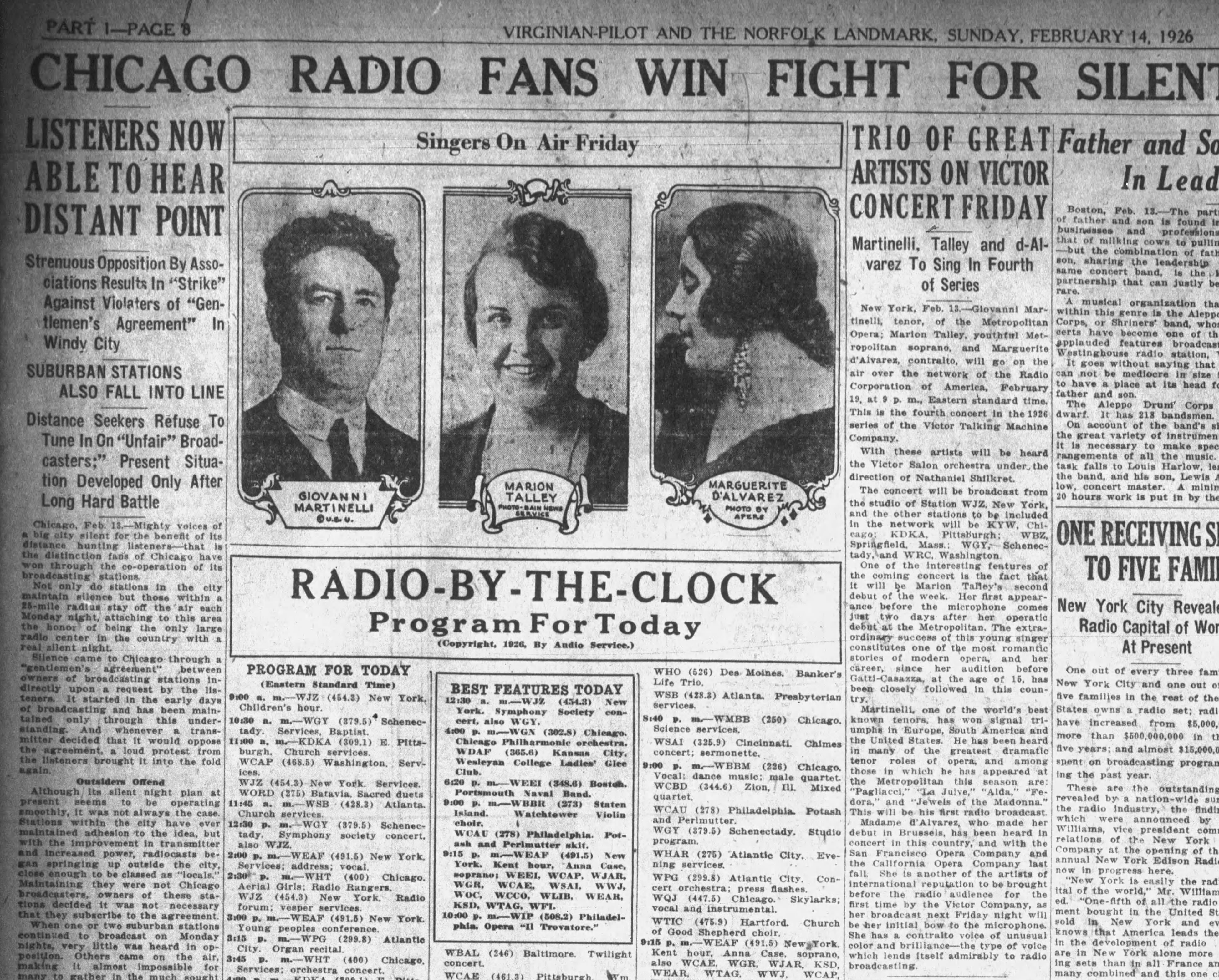
Read once more, then, the name identified as “Tully” turns out to have belonged in the year 1926 to Marion Talley, a teenage soprano who as of her moment on a red Victor label was briefly a star. On its red record, her voice can still be experienced in archival black and white.

But now it can be experienced only as a noise track captured by a single-source microphone and confined to a carceral segment of the audio spectrum. Even in there, too, the shellac grooves of its habitus have undergone metamorphosis. Rossini embodied the idea of his Rosina in a mezzo-soprano voice with embellishments going low, not high, and recording practice in the twenty-first century tends to bypass Marion Talley’s twentieth in a nostalgic joke played on the way back down to a fantasy of the nineteenth. See the current event’s knowing grins.

See the fish silently performing themselves.

Smile in silence for anything that nevertheless may remain of the memory voices of Marguerite, Giovanni, and Marion,

Not heard coming

The cartoon is about something that was on a lot of front pages in September 1903: “the problem of aerial navigation.” Just below the picture, a little story about the impending voyage of Samuel Pierpont Langley’s flying machine Aerodrome is to be read as a footnote in advance.

Pedagogically, it teaches us that on October 7 and again on December 8, the Aerodrome and its pilot catapulted themselves into the air from a boat moored in the Potomac River but then nosed down and sank. Langley’s attempt at powered flight had been supported by the resources and publicity apparatus of the Smithsonian Institution, but when the ripples closed above them, the problem of aerial navigation remained unsolved.

It was to be solved on December 17 by Orville Wright, but even during the moment of the immediately post-Langley nobody at the Indianapolis Star was in position to see that coming. Elsewhere in its front-page layout for September 28 the Star had offered its subscribers opportunities to read about several murders, a gallows confession, an accidental electrocution, and a horse-show scandal. All those readings, however, were rooted in the still earth of September 1903.  The problem of aerial navigation remained as unsolved as ever. Column 1’s long article about a train falling from a trestle could treat only the idea of descent from ground to ground.

But the Wright Brothers solved the falling-body problem, and over the following years the solution became known. By 1924 the body at the foot of the trestle could be imagined on the rise. According to Wikipedia, this record of the change was the first country song to sell a million copies.

https://archive.org/details/wreck-of-the-old-97_202102

Listen to its cheerful whistlings. Fast mail train no. 97 had taken on feathered flesh. Now it could fly on to heaven, leaving its wood and metal mortalities in death-filled earth.

After Darwin, the fossil record

This lurid face once emitted glares and thunderous sounds. Between 1808 and 1900 it was the body of the theologian Edwards Amasa Park, and it influenced American literature at least once: certainly when Emily Dickinson recorded her awed reaction to one of his sermons in a letter to her brother (JL142, November 21, 1853), and later, perhaps, in the form of a poem:

Fr477 (1862), “He fumbles at your soul.” Houghton Library, Harvard University.

But its physical record is a history of extinction. See how much of the silver-mercury amalgam has been damaged and how little remains. To construct even this partial objet d’art cost me a debt of indeterminable amount to the artifact-generating computer technique called artificial intelligence. With black and white artificially replacing daguerreotype silver, see:

Daguerreotype, studio of Mathew B. Brady, date unknown. Library of Congress, https://www.loc.gov/pictures/item/2004664036/. Contrast and detail restored.

No, it isn’t visible to you now; not accurately, not in any way that would have been received with assent by anyone sitting in a hardwood New England pew in 1853. The Origin of Species was published in 1859, and in due time Emily Dickinson wrote ruefully about it. You see your images now in an evolved way, through a color filter.

So fall into line. You have no choice but to be received into the epoch of tangerine.

https://www.cnn.com/2020/06/03/politics/trump-church-visit-religion-burke/index.html

It’s in your constitution now.

For detail about Dickinson and Park, see Alfred Habegger, My Wars Are Laid Away in Books: The Life of Emily Dickinson (Random House, 2001), pp. 310-313.

Monochrome

“Huron St. and ferry landing, Port Huron, Mich.,” between about 1905 and 1910. Detroit Publishing Company Collection, Library of Congress, https://www.loc.gov/pictures/item/2016815112/. Contrast and detail restored. The ferry between Port Huron, Michigan, USA and Sarnia, Ontario, Canada was replaced by a bridge in 1938.

The horses on the monochrome thoroughfare have been stilled.

On the boat, the passengers’ chairs are scattered where they were left when the passengers left the image.

Inside the piano store, the unimaged and silence.

At the length of time, warm

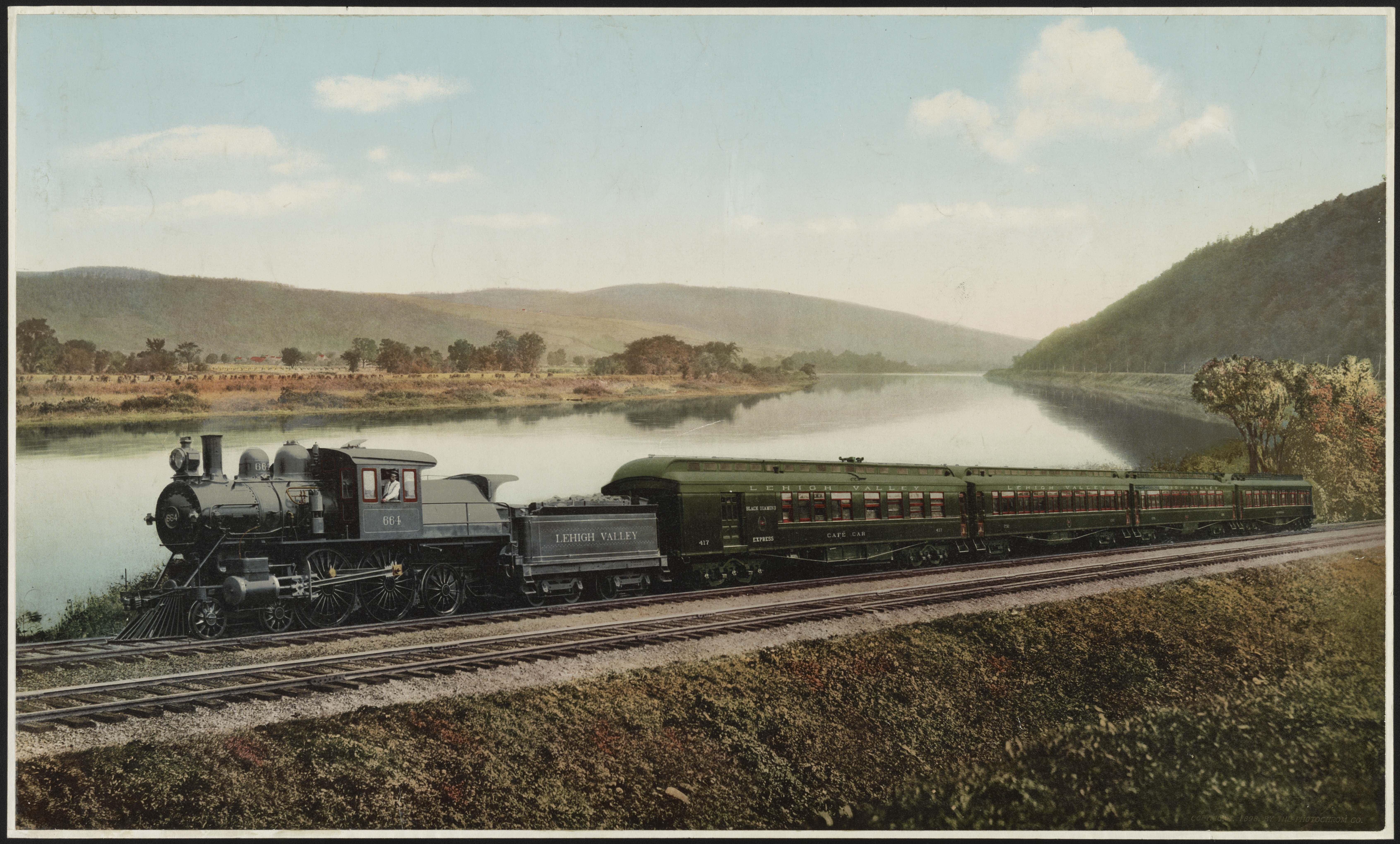
Between a river valley in 1898 and you, there has passed this image of the no longer moving. Clouds, ripples and all, everything now visible within the black border has been dulled and stilled.

“Black Diamond Express, Pennsylvania,” 1898. Detroit Publishing Company Collection, Library of Congress, https://www.loc.gov/pictures/item/2016802635/

One of the incidentals in there is an episode from the history of steam. What you see acting it out is a powerful little locomotive known as the Mother Hubbard which saved money for some Pennsylvania railroads like the Lehigh Valley by burning low-quality coal in an oversized firebox supported by the engine’s big drive wheels. The type didn’t spread far beyond Pennsylvania’s anthracite fields and didn’t last long; it separated the engineer from his fireman, it sometimes killed him when the engine threw a piston rod up through the cab, and when engines grew bigger its firebox couldn’t. But when Mother Hubbard was mobile, Americans communicated by postcard, and this was one of the the Detroit Publishing Company’s cards. It was the work of William Henry Jackson (1843-1942), who traveled America’s rails on Detroit Publishing’s behalf in his own special car.

Library of Congress, https://www.loc.gov/pictures/item/2016795680/(1902)

The photograph of Yellowstone Falls on the bulkhead is Jackson’s own icon. Dating from 1871 and the first photograph ever made of the Falls, it is a contact print made from a glass negative measuring some 16 by 20 inches, hauled into and out of the canyon by mule train. In a less strenuous era and a less strenuous part of the nation, someone still took painstaking brush and pigment and colored in the Black Diamond.

It’s easier now.

The current technique’s business model is monthly rent, and its business name is Lightroom. As long as your credit lasts within the room, it proposes to enact and perform memory for you. Now, because you have tapped a credit card, you are entitled to believe that you see clouds passing above the damp riverbank where you stand in sunlight.

This month I paid for you. The door opened, the Room let you in, and now you believe you once saw what you see now. Subject to the terms of the agreement, you began believing you were on a river path to a place where earth is soft beneath Mother’s breath-warm steam.

Studio with Zouave

Marcus Sparling, “A Zouave” (Roger Fenton in Zouave uniform), Crimea, 1855. Library of Congress, https://www.loc.gov/pictures/item/2001697657/

The Crimean War of 1853-56 contributed to the history of form the Raglan sleeve, the balaclava, the cardigan, and Tennyson’s “The Charge of the Light Brigade.” Then, swelling the record, Roger Fenton made it the first photographed war in history.

Having learned that, you realize that form is unchanged under any of its aspects, and undying.

Waxwork with sound

Once upon a time a U.S. Navy radioman named C. W. Allen served on seaplanes based at the Panama Canal Zone and flew with a camera. His photo album is now in the archives of the San Diego Air and Space Museum and viewable online at

https://www.flickr.com/photos/sdasmarchives/albums/72157635813041746/with/9903098543/

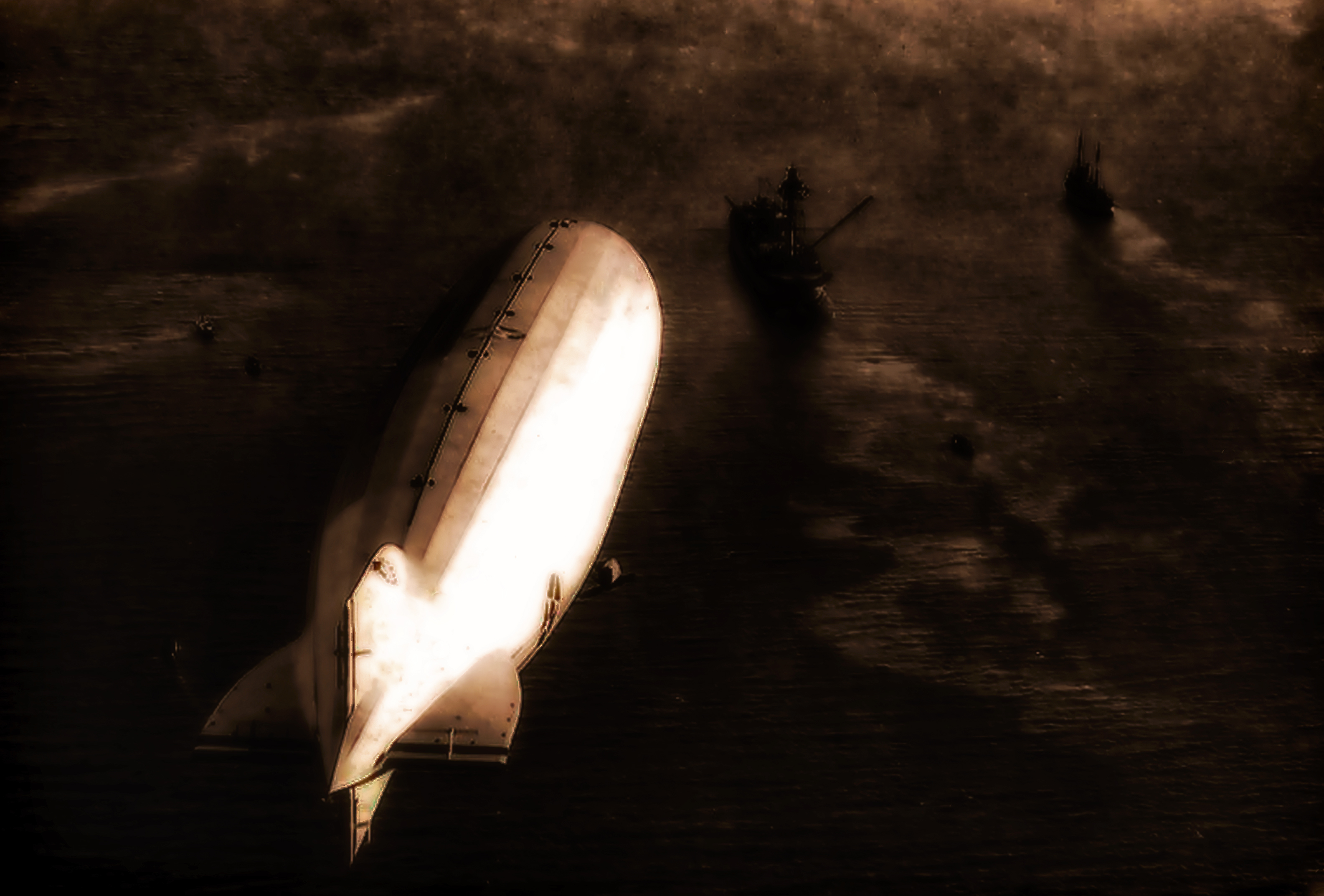
It includes this image of the Navy zeppelin Shenandoah traversing the canal in 1924 or 1925 with its mooring ship Patoka. I’ve previously posted some attempts at reconstructing it, but because editing software keeps improving, the merely historical interest of the original,

grows only more attenuated by the year. It’s small, its resolution is low, some of it has been whited out by the corner stickers that Radioman Allen used to glue it into his album, and every time it’s reseen its aesthetic sense becomes harder to experience in the emotional form of memory. Think of the surface noise of its epoch. It was bad then, even before vinyl and then digital. Now . . .

https://archive.org/details/78_the-wreck-of-the-shenandoah_vernon-dalhart-and-company-maggie-andrews_gbia0334572a

Now, in the workroom of a mortuary, you wouldn’t be able to hear this waltz if it were played over the speakers — not as you would have heard it in its own epoch. Now, instead, you’ll be under obligation to look down at the table where a silent waxwork has been made to appear.

And if something then starts sounding through you, you won’t be able to silence it. The sound coming from your mouth will be an affront to the silence of the past, but it won’t be motivated by any intent, bad or good. It will be a sound that can’t help itself. Think back. Beside the waters of the Zone, a mechanism was wound up with a crank, a needle descended on a spinning shellac surface — right? — and a song welled up automatically.

This business day in the mortuary, you think, “I sound like I’m alive!”