To the dark past


The cartoon is about something that was on a lot of front pages in September 1903: “the problem of aerial navigation.” Just below the picture, a little story about the impending voyage of Samuel Pierpont Langley’s flying machine Aerodrome is to be read as a footnote in advance.
Pedagogically, it teaches us that on October 7 and again on December 8, the Aerodrome and its pilot catapulted themselves into the air from a boat moored in the Potomac River but then nosed down and sank. Langley’s attempt at powered flight had been supported by the resources and publicity apparatus of the Smithsonian Institution, but when the ripples closed above them, the problem of aerial navigation remained unsolved.
It was to be solved on December 17 by Orville Wright, but even during the moment of the immediately post-Langley nobody at the Indianapolis Star was in position to see that coming. Elsewhere in its front-page layout for September 28 the Star had offered its subscribers opportunities to read about several murders, a gallows confession, an accidental electrocution, and a horse-show scandal. All those readings, however, were rooted in the still earth of September 1903. The problem of aerial navigation remained as unsolved as ever. Column 1’s long article about a train falling from a trestle could treat only the idea of descent from ground to ground.
But the Wright Brothers solved the falling-body problem, and over the following years the solution became known. By 1924 the body at the foot of the trestle could be imagined on the rise. According to Wikipedia, this record of the change was the first country song to sell a million copies.
https://archive.org/details/wreck-of-the-old-97_202102
Listen to its cheerful whistlings. Fast mail train no. 97 had taken on feathered flesh. Now it could fly on to heaven, leaving its wood and metal mortalities in death-filled earth.


1. From a second-story roof, an egret watches a new-mown lawn below him. His yellow eyes communicate an idea of intently. The term rests as still in your mind as a dictionary unopened on a shelf. But when the wings open, the stasis breaks. All is in motion then. The egret flaps himself a few inches up, tips himself over the edge, drops to the grass, pecks, flaps again, reascends with legs trailing, and settles with wings and legs folded back on his roof ridge. He has brought back up what he saw down there: a muscular brown centipede. Beat by beat, the egret shifts himself on the roof, elevates his beak, flips the venomous dangle into the air; catches it headfirst, fangfirst; swallows. Between the bird’s unmoving head and unmoving breast the long neck undulates once. A moment ago a dark living something was writhing in the air, yet at that elevation all that survives now is a light, feathery bulk.
A moment ago, the dark something was matter for a life story with a beginning and an end. Now, as it dissolves in the egret, it is an afterthought. What comes back to mind is white, only. About a writhing brown centipede a brown writher of a story is writeable, but it can’t be traced back to ground that any centipede ever crawled. The memory of writhing in the air has dimmed, and the last bird you see will be the one flying to you in white.
.
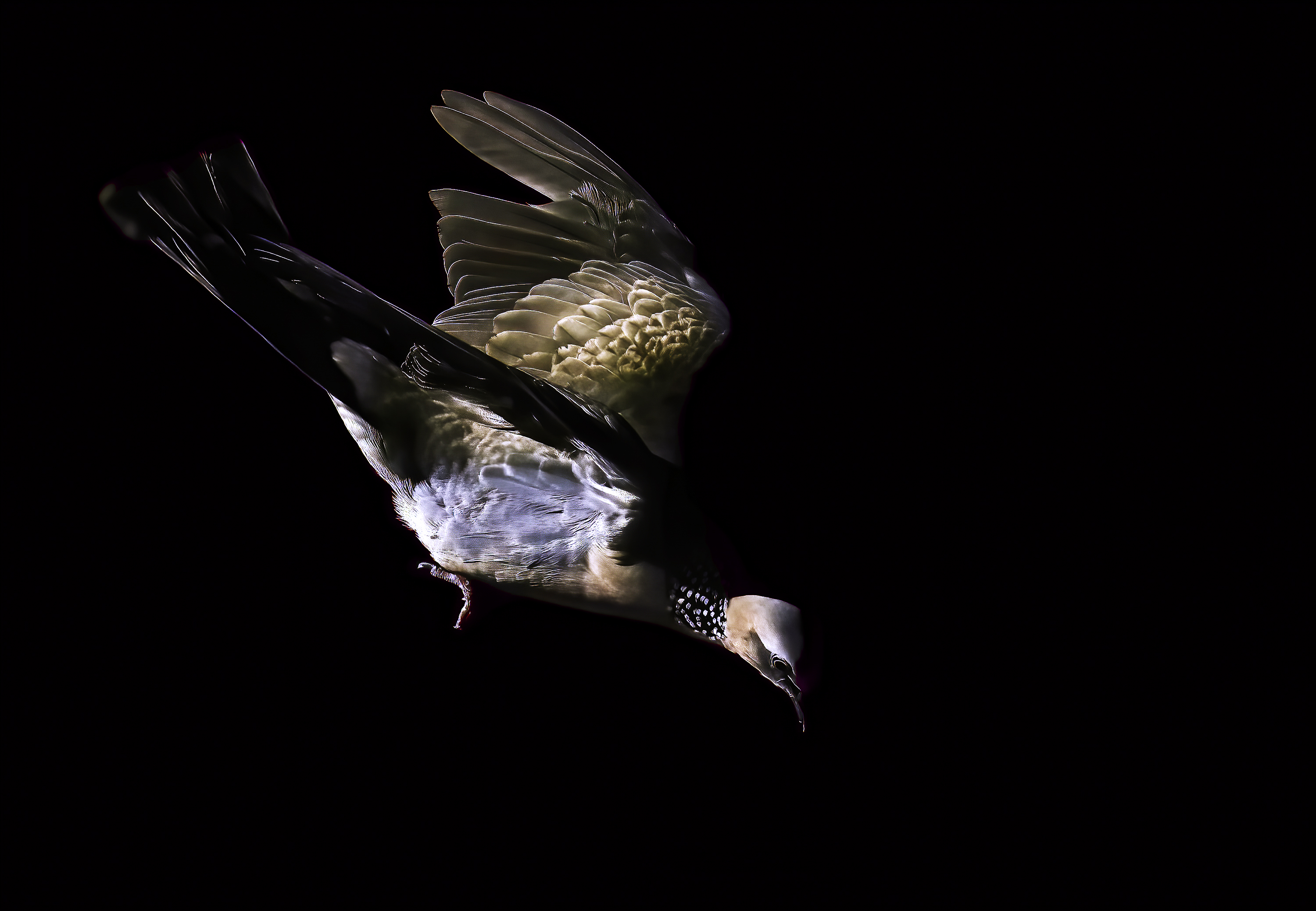
2. From a dove’s wings, frothy light splashes into the firmament. Through fanning feathers, it ripples along from shadow at each wing’s root to light-blurred translucency at its tip.
Aft, between the wings, originates a stout empennage. Holding the rapid beating steady, it aims the dove’s gray little head in the direction of a route. Gray tipped with white, guiding from behind, stiff tailfeathers blaze a way to light.