Old Glory

Sequence:

1. In the Library of Congress’s George Grantham Bain Collection at http://www.loc.gov/pictures/item/ggb2004009750/, this.

2. I photoshop it for contrast and tonal balance.

3. I begin abstracting from the content, cropping some parts of the image that represent symbols too obvious to be interesting (iron bars, fallen leaves) and adjusting the color.

4. I crop and zoom.

And applied to an image about a hundred years old, computer technology has recovered an antique irony arising from the juxtaposition of the words “glory” and “old.” The computer has processed the image in historiographic mode. Free for the first time in a century to read the image as a text, we have placed ourselves once again under the interpretive control of Looking Backward or Maggie: A Girl of the Streets or Les Misérables. But in the interim between that moralized reading from the past and the recovered moralized reading of the present, there was a brief interim in step 3 when the picture wasn’t an allegory but only a picture.

And about that interim the immoral question has to be asked: wasn’t it beautiful?

At http://theartpart.jonathanmorse.net/portrait-ca-1910-2014/ I write about another image of this man and this dog.

“Hordes”: an attempt at visualizing the metaphor


Source: George Grantham Bain Collection, Library of Congress, http://www.loc.gov/pictures/item/ggb2005022285/. Photoshopped.

In The Great Gatsby, the title of the book that disturbs Tom during the summer of 1922, The Rise of the Colored Empires, by “Goddard,” is an accurate topical reference to Lothrop Stoddard and the propaganda campaign that resulted in the Immigration Restriction Act of 1924.


Dear comment spammer, you’re absolutely right about the existential problem posed by reality

I quote your formulation of the problem below. But won’t you tell your readers your name?

I, to name just one reader, would like to thank you personally. Most of my students arrive in college having learned that any paper can be made longer by inserting the three-word phrase “the use of” before every noun, but in their clumsy hands that’s a mere automatism. They do it without thinking. But your substitution of “by using” for “with” in “filled by using punctuation difficulties” is a move that’s genuinely profound. It not only complicates the simple; it ascribes purposiveness and moral agency to error.

And then when you commit errors yourself, irony is created and your slice of rotten spam becomes a work of art to rival Baudelaire’s “Une Charogne.”

Thanks! Readers, admire!

needless to say just like your internet site but you have to take apple iphone 4 punctuation upon numerous within your threads. Many of them are filled by using punctuation difficulties so i believe it is very irritating to tell the reality on the other hand I am going to undoubtedly keep coming back all over again.

Portrayed reminder: think about rethinking the surly bonds of earth

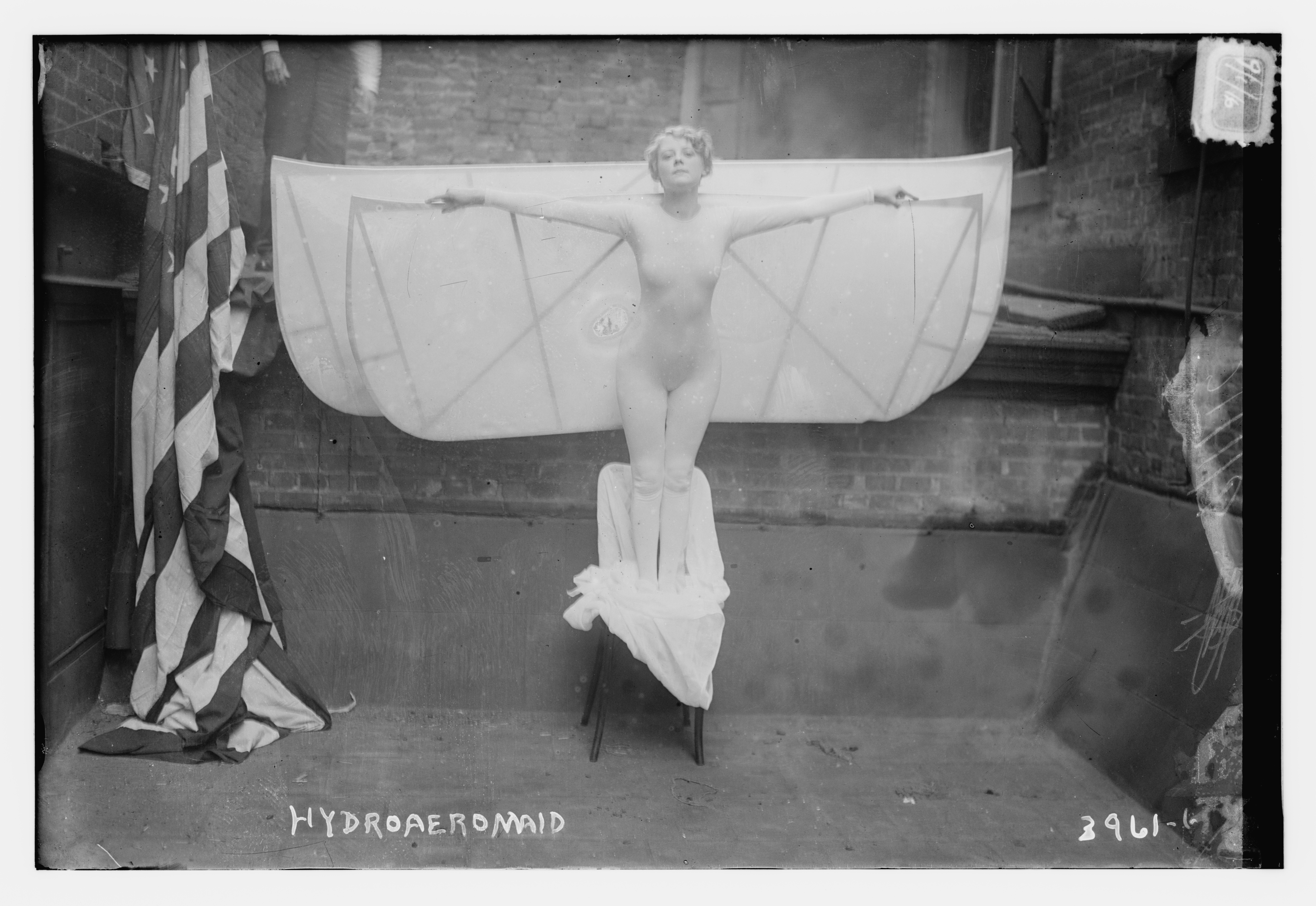
A century later, the image in the Library of Congress’s George Grantham Bain Collection has gone humorous, the way items remembered after oblivion sometimes do. This item stimulates us neither to nostalgia nor to tragedy nor, thanks to the costume’s baggy knees, to the thought of eheu fugaces labuntur anni. The name “Hydroaeromaid” is comical too, with its philological odor of a tavern by a school during the Georgian era (“Ho, maid! Bring me a tankard of nut-brown ale whilst I construe me lines!”). * And so, looking at the image brought back to light, we laugh.

22635u

And because the light has been merciful and faded out some of the details, we photoshop. We wield the controls in the spirit of the post-Georgian nymph Dorothy Parker, who wouldn’t have been caught dead with baggy knees.

But long after the era of Dorothy Parker has passed, the girl in the image is still standing on her chair. What would she be now? What was she then, out of the uniform that was once fitted onto her by comedy in one of its sergeant-major moods? If we looked at her in a different way through Photoshop, would we be able to think of her now not as a what but as a who?

I look.


And then the image comes to me of an airplane seen at morning in a novel written just after the Georgian era, when the sight of an airplane was still something new:  Mrs. Dalloway.  By the end of Mrs. Dalloway it is nighttime, and in 1923, the year Mrs. Dalloway was published, airplanes generally weren’t flown after dark. But Mrs. Dalloway has returned home and changed her clothes, and the book’s last sentence ascends from the light of its page like an image newly revealed after a long darkness:

“For there she was.”

Source: http://www.loc.gov/pictures/item/ggb2005022645/

* Or, since the flag in the picture is American, of Owen Johnson’s Stover at Yale (serial publication 1911, publication as a novel 1912), whose hero fills his days quantum sufficit playing football, doing Latin, and adjourning to Morey’s for a toby of musty.

Update: from a pair of notes by Art Siegel at https://www.flickr.com/photos/library_of_congress/14440864879/ we learn that the model is named Pearl Palmer and she is posing for a trophy. Mr. Siegel also links to a not very clear contemporary photograph of the trophy, and the New York Tribune published this note about it on August 20, 1916, p. 13.

Trophy article


Story

We think the flower looks feminine. Expressed in a medium by an artist, the thought becomes an anecdote. In the museum, a gallery full of Georgia O’Keeffes or Imogen Cunninghams become an anecdote exchange. Soon everybody gets the joke.

Linking the sight with memories of stories we read when we were children, we decide that the insect looks armored in bronze. The men pictured in the books had broad shoulders, too. Shortly after that thought has been acted on with a camera, an anecdotal image of the insect begins communicating itself from Tumblr to Tumblr specialized in militaria and inspirational National Socialist anecdotes.

The communications become entrained by the economic mechanisms of desire. Getting the joke comes to mean acquiring it on an exchange. The interval during which value is transferred, that epoch between the just-seen subject of a future image and the completed and collected painting en route to a warehouse in the Caymans, is what in a story is called the middle. Into the image below, between records of the moment after one seeing and the moment after another, I insert a pictured page from a story. Click it to enlarge.

Gardenia, Perseus, mantis small

Unenlarged between two other images, the image in the middle may resemble the middle term of a single three-part idea, but it isn’t. The panels to its left and the right are wordless souvenirs of the seen, but the middle panel comes to us with an anecdotal pretext arguing that it represents not a seen moment but a known history — in this specific case, the history of the hero Perseus. Guardian and curator of the image, the history won’t allow you to see it as an image. It will impose a context. If the context isn’t visible to the unaided eye, the histoire will slip into its other English translation, “story,” and improvise a substitute out of invisibility. To the left of the middle, there will promptly emerge from the void a panel 1 in which Andromeda’s clothes are being taken off. To the right will emerge the necessary completion of the story, a panel 3 in which Perseus is hauling the dragon’s corpse away to the landfill.

And if you close the handbook of mythology long enough to effect a small change of wardrobe, panel 2 will show itself capable of migration to another story, provided only that the new story belongs to the same genre. The story in the image above and the story in the image below, for instance, are each about a hero. Visually, each is a two-part composition: dark and light, male and female, draped and undraped. The family solidarity of genre even allows the second image to retain its visual integrity after it has been reduced to the status of illustration and humbled by a didactic caption. After all, both the sophisticatedly allusive image above and the demoted image below are histoires. Because they narrate a passage through narrative time with a beginning, a middle, and an end, they transcend depiction in or as themselves. They have a literary history. Just as much as Perseus and Andromeda, the Klansman and his belle refer their meanings at this point in the story to earlier meanings.

(Thomas Dixon, The Clansman)

But the flower on the left and the insect on the right, the images seen only in the moment when they seemed to halt perception with held breath for a moment?

During that moment, they had ceased to become and only were. They had fallen out of the sequence of story. Outside sequence, they had lost their susceptibility to narrative’s power of explanation. We can’t tell a story about the image of the flower; all we can say about it is that during the moment before the words “Once upon a time” could be spoken of it, it may have been in a state of depiction. Supporting a story on either side but capable of referring vision only back to a not yet told story about themselves, such images are not yet readable. And about the moments like those when the told makes contact with the depicted, literary history tells us that after story has been brought face to facing page with a wordless image, it sometimes draws back into itself and goes silent.

At those moments, the story’s words are released from narrative into depiction, there to be seen only as what they are: words, alone or in new associations with other words. I think Pope’s string of naked words, “This long disease, my life,” must have had some genetic homology with the famous glitter of Pope’s eyes. An instant before the words could come to be, the eyes took into themselves the deformed little shape that they had seen in the mirror.

Sources:

Edward Burne-Jones, The Doom Fulfilled120 Great Victorian Fantasy Paintings CD-ROM and Book, ed. Jeff A Menges (Mineola, NY: Dover, 2009), image 022.

The illustration from Thomas Dixon’s The Clansman (New York: Doubleday, Page, 1905) is by Arthur I. Keller, online at http://docsouth.unc.edu/southlit/dixonclan/frontis.html.

“This long disease, my life” is from Pope’s Epistle to Dr. Arbuthnot, line 132.

The moment of the gardenia, according to metadata, was June 30, 2014, at 5:48 PM Hawaii Standard Time. The moment of the praying mantis was July 7, 2014, at 12:43 AM.