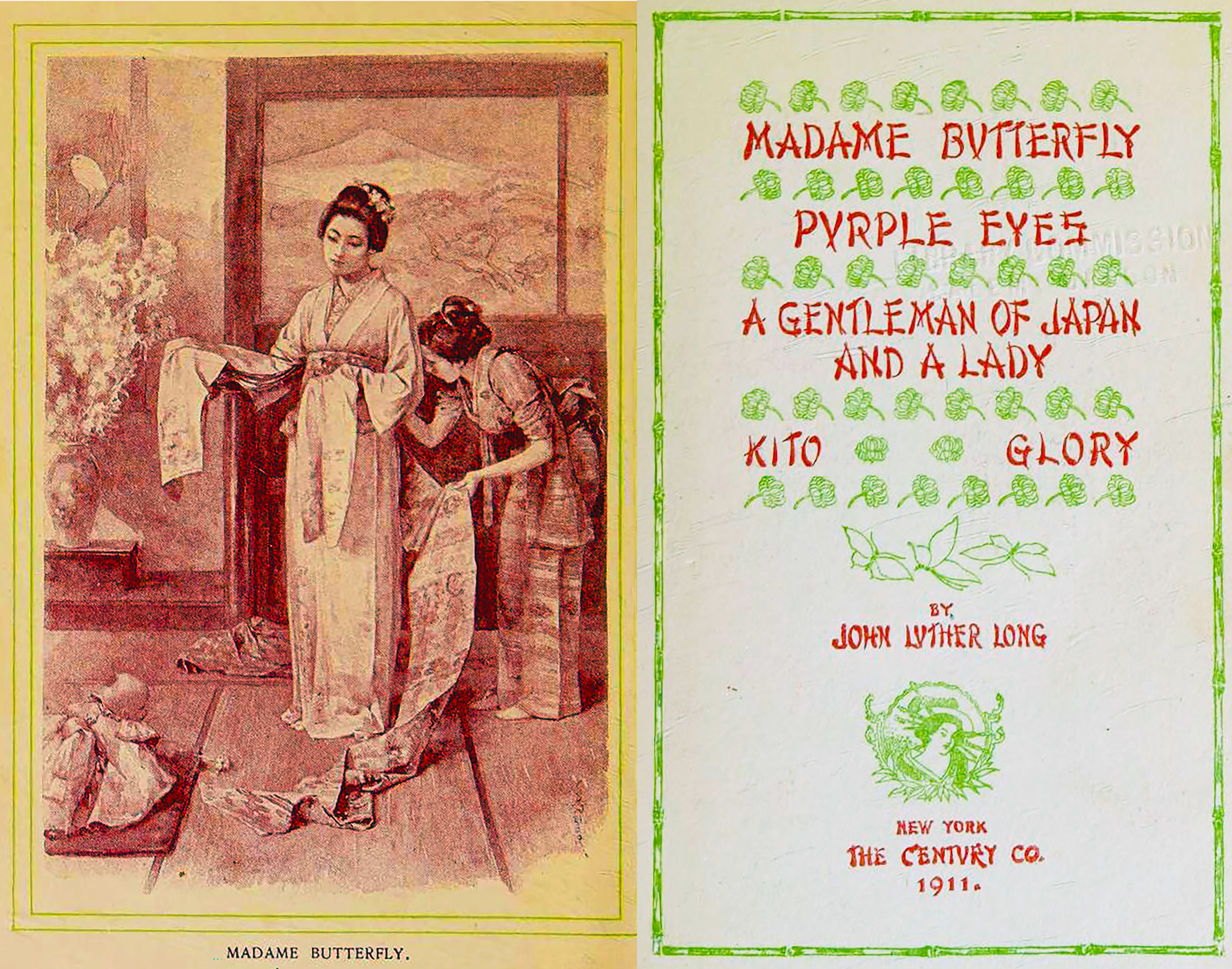
On November 25 I posted a photograph taken in the lobby of the Washington National Opera. There, on an easel at the door leading to the auditorium, stood a sign reading
Content Advisory Warning
Mature Themes
This opera contains the marriage of a minor to an adult and depiction of suicide.
Additionally, there are outdated and offensive attitudes and descriptions of Japanese people in the source material.
Norman Lebrecht, on whose Slipped Disc music site I’d found the image, was sarcastic about its motivation, and of course an easy subject had presented itself. Sure, “this opera” was Madama Butterfly, and Madama Butterfly does end in a depiction of suicide. But sure too, in Tosca there’s torture with loud tenor screams, assassination by stabbing, execution by firing squad, and then and only then, at the last cliffhanger of an instant, suicide. In Andrea Chénier the firing squad is replaced, right there on stage! by a guillotine. And in Lulu . . .
The iron-filings-under-fingernails effect of “This opera contains” may also make you wonder who writes this philistine crap. But as soon as you’ve said philistine you’ll know the answer to that question. Always in the plural number, it will be a team of administrators. Of course opera is an art form entangled in moral complexity. If you’d care to think in synecdoche about the tangle, I can offer you a choice between two words, Richard Wagner, or one, Plato. But an administrator’s executive organ isn’t a thinking mind; it’s Sitzfleisch on an office chair.
But there we’re all semblables of one another, so let’s sit down ourselves. The early performance history of Madama Butterfly was complicated, extricating itself from failure to triumph over a period of years, and two of its worst problems eventually solved themselves as a pair. As a matter of theater convention, the first audiences for an opera by Puccini would have expected a tenor aria; as a matter of Aristotelian theory, the same audiences would have expected an onstage protagonist to change their minds by undergoing change himself. In its first staged version, Madama Butterfly fulfilled neither of those expectations. Because its Lieutenant Pinkerton was a carefree Yankee vagabondo from start to finish, he could sing neither Addio, fiorito asil nor, sobbingly as the curtain fell, Bot terr flai! Bot terr flai!
But those closing sobs have now been going on forever, and the source of Puccini’s libretto is read now only as documentation. Its ur-text is an American short story, “Madame Butterfly,” by a Philadelphia lawyer named John Luther Long who never visited Japan himself but wrote up some of the experiences of his sister, a Christian missionary in Nagasaki. In this writeup, Pinkerton remains unsurprisingly Pinkerton, but a different surprise awaits your own first reading. Its Butterfly neither speaks English nor sings an anachronistic but anticipated Italian; instead, her voice on its page is a barely decipherable static that reads like the dialect humor of the time.
For an audio example of that, go to the Library of Congress’s National Jukebox, https://loc.jov/jukebox, and search for the duo of Ada Jones and Len Spencer, dialect comedians who performed their skits on dozens of discs during the first decade of the twentieth century. (On some, they are identified only as “Miss Jones and Mr. Spencer.”) If you wonder how Stephen Crane’s Irish-American toughs might have sounded when they talked, for instance, try “Coming Home from Coney Isle.” There’s also “Becky and Izzy: A Yiddish Courtship,” with jokes about big noses and burning down the store for the insurance. And the ragtime song “Travel On” actually is a lovely melody.
But with that one, please don’t listen. Leave the tone arm up. The racism is still that bad. For the same reason, please don’t read “Madame Butterfly” in its pidgin original.
But perhaps do think about what you may have been thinking at the moment you saw its title page in this orientalist font.