At first, all we know of these five people is 24 words set off by brackets from the rest of the universe of language:
[Two unidentified women seated on a sofa, two unidentified men standing behind the sofa, with a woman peering over the back of the sofa.]
The words represent the finest detail visible at the end of a zoom in on the five people’s location in archived history:
Library of Congress, USA;
Prints and Photographs Division;
Daguerreotype Collection;
https://www.loc.gov/pictures/item/2004664588/
That is all the zoom is intended to do, and all that words such as “two unidentified women” can do. At the end of the zoom rests a detailed collective body, clothed in modes and tinted, but unable to communicate itself as a body. The tinted body can’t name itself. Between its modes and yours and mine lies no word’s land, the emptied space between the lines where comprehension bleeds away and dies. The five people all had expressive faces, but we’ll never know now what they were expressing.
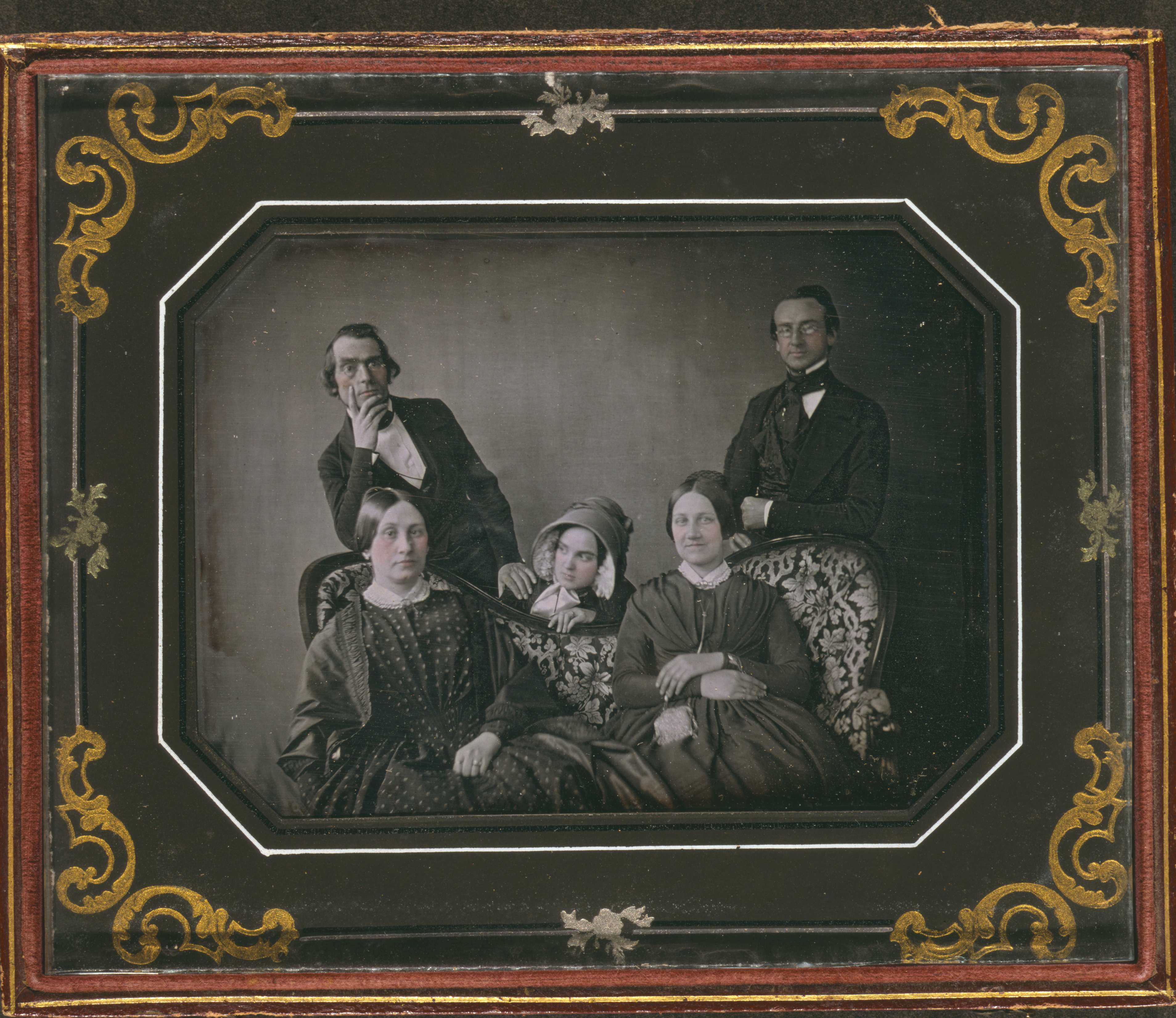
But if we venture to think that they may still communicate by means of their silence, we might try the experiment of examining the silence as if it were a body. We might, for instance, lay it down on a table, turn up the lights,
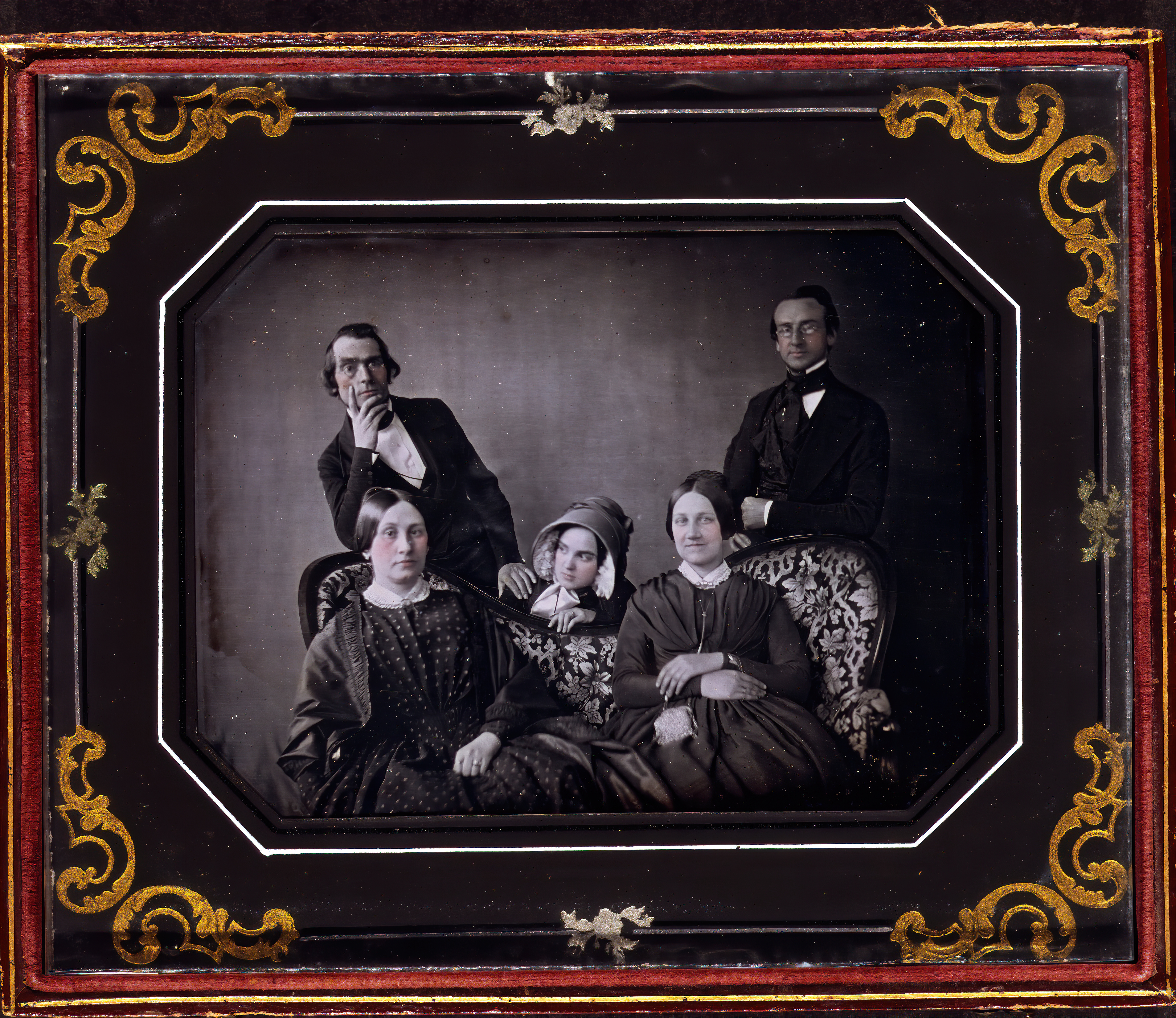
and then lean over it.
Leaning, we see a man’s hand and a woman’s hand. Isolated for inspection, they are seen to be speaking complementary dialects of body language. The woman’s hand clings; the man’s hand holds down.
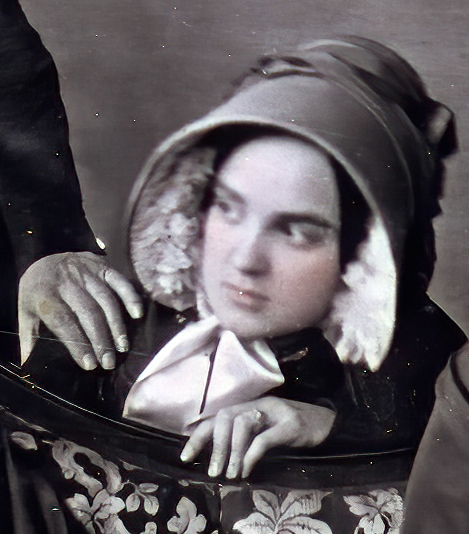
Above and between the hands is a woman’s face. Like the other women’s faces and unlike the men’s, it isn’t set apart from eye contact by a pair of glasses. But even without glasses, of course, we can never see how the woman saw from within her bonnet. Whether she wore the spectacles or we do, there lies between her and us an ever-thickening deposit of optical glass. Lens after lens has been interposed: first by a daguerreotypist during the woman’s floruit (“1840-1860,” says loc.gov), then by us. Seriatim, the lenses deflect the rays that once were direct.
But for the length of a blink, at a location in space and time, this woman became the source of her own light. She was its beginning and end – that is, its history. The history had been latent before its time and it is occulted now, but within its time it was extant. From its blinking open to its close, it endured only long enough to resolve itself to completion like a cadence. But during the resolution – that is, during the only instant when a cadence can be a cadence – it was.
And now we all – once upon their time, for those three women and two men; forever after, for the rest of us – can see that it was. Light had lensed a woman into an image.